
Clinical picture. T., a man in his late thirties presenting with moderate depression and chronic work-related stress, had spent several weeks describing an escalating conflict with a supervisor without moving toward any resolution. He reported feeling overwhelmed every time he tried to think the situation through, quickly shifting to rumination or avoidance. The clinician introduced the Problem-Solving Packet and asked T. to write a single-sentence definition of the problem on paper during the session, using the "impartial friend" prompt from the worksheet. T. noticed immediately that writing it down made the problem feel more bounded; he had been conflating three separate issues, which the clinician helped him split onto distinct pages. By end of session T. had a defined problem and a brainstorm list of five options, two of which he had not previously considered.
Problem-Solving: PDF Worksheet, Tools and Exercises for Clinical Practice
A structured visual PDF worksheet with tools and exercises to teach the five-step problem-solving loop, and get patients from stuck to concrete action.
Clinical vignettes
Avoidance Loop Broken at Step One
Skipped Implementation Step, Revisited
Clinical picture. M., a woman in her mid-forties with a history of generalised anxiety, reported that she frequently generated good solutions to practical problems but rarely followed through, which she attributed to laziness. Review of her worksheet across two sessions revealed a consistent pattern: she consistently skipped Step 4 (Implement), moving from choosing an option directly to reviewing why it had not happened. The clinician used the packet to highlight that her chosen actions were never scheduled, remaining intentions rather than plans. Together they reworked one item by assigning a specific day, time, and location to the first sub-step. At the following session M. reported completing that sub-step, and both she and the clinician used Step 5 to identify one obstacle that would inform the next cycle.
Most patients already know they should "think through the problem." What they cannot do, under stress, is execute the steps in order. Explaining this orally takes more time than it saves. This problem-solving PDF worksheet gives you a shared visual structure to make the method explicit, fast, and memorable, in session, together.
Use this resource with your patients
Handout, exercises and materials ready to use, right inside SessionFuel.
Why Problem-Solving Resists Oral Explanation
The D'Zurilla & Nezu model is deceptively simple to name and genuinely hard to transfer. When you describe the five steps verbally, patients tend to collapse them: they hear define → act, skip everything in between, and reproduce exactly the rushed, stress-narrowed behaviour you're trying to interrupt. The concept of signature step skipping, the idea that each patient has one step they reliably omit, almost never lands without a visual reference. You can say it; they nod. The fiche shows it, and the conversation becomes precise.
The same applies to the Generate step. Patients with high intolerance of uncertainty or strong anxiety-driven avoidance patterns typically arrive at Step 3 with a single option and treat it as the only reality. Without a diagram that makes the brainstorming space visible, the correction feels like an accusation. Pointing to the sheet sidesteps that.
What the Fiche Contains, and Why the Visual Layout Matters
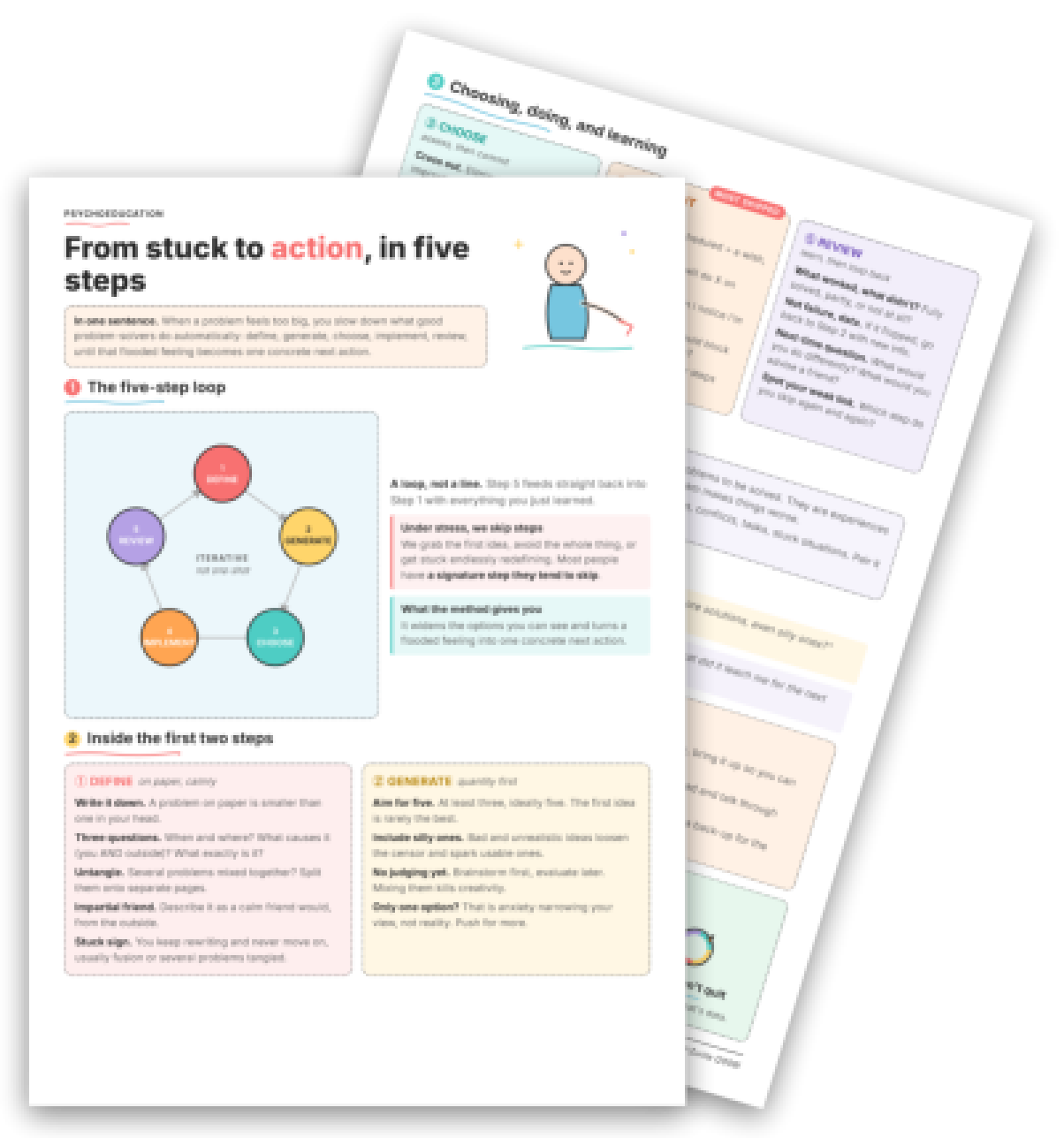
The fiche PDF is built around five numbered panels, each covering one step of the loop: Define, Generate, Choose, Implement, Review. The loop is drawn explicitly as circular, not linear, with a direct arrow from Step 5 back to Step 1. This single diagram does something an oral explanation cannot: it removes the implicit expectation of a one-shot fix.
Each panel carries targeted clinical prompts. The Define panel flags a stuck sign ("You keep rewriting and never move on") that helps patients recognise cognitive fusion or problem entanglement rather than persistence. The Generate panel explicitly instructs "include silly ones" and names the mechanism: "Only one option? That is anxiety narrowing your view, not reality." This framing is useful with patients whose narrowed option-generation links to rumination or perfectionism.
The Implement step is marked "MOST SKIPPED" directly on the sheet, a naming choice that normalises the gap between deciding and doing, and opens a direct conversation about goal-setting and behavioral follow-through. The panel distinguishes time-anchored plans ("I will do X on Saturday at 2pm") from cue-anchored plans, and prompts obstacle planning, which maps cleanly onto the CBT problem exploration model.
The Review panel reframes non-success explicitly as "data, not failure", clinically relevant for patients with perfectionism or self-criticism who abort the cycle at the first setback.
The final section draws a clear boundary: grief, irreversible losses, and trauma memories are "experiences to be felt and processed", not problems to be solved. This contraindication is printed on the sheet, which saves you from having to interrupt the method to make the clinical distinction yourself.
> Key point: The Problem-Solving Packet is a visual psychoeducation support, not a homework form. Its purpose is to facilitate your in-session explanation of the model, the patient leaves with a concrete reference, not a completed questionnaire.
750+ clinical tools
A library built with and for clinicians, ready to use in session and extend between appointments.
Access all the toolsWhen and How to Propose the Fiche
This sheet fits naturally in the early-to-mid phase of a CBT protocol, once the functional analysis is established and the patient is ready to build active coping repertoire. It works particularly well with patients presenting procrastination, interpersonal conflict, occupational stress, or any presentation where adaptive coping is underdeveloped.
You can introduce it with: "I want to show you a map of what good problem-solvers do automatically, we're going to slow it down so you can see exactly where things tend to get stuck for you." This framing positions the method as a skill to learn, not a deficit to correct.
Work through the five panels together in session. Ask the patient to identify their signature skipped step before they leave. The "Phrases to borrow" section at the bottom ("What are three more solutions, even silly ones?", "When exactly will I do this, and what is the cue?") gives them portable prompts for the week ahead.
For patients whose difficulty centres on weighing options rather than generating them, you can extend the Choose panel in session with a structured pros/cons grid. For patients whose stuck-loop is driven by uncertainty rather than skill deficit, pair the sheet with work on intolerance of uncertainty. Avoid the fiche when the presenting difficulty is grief or acute trauma, as the sheet itself makes clear, and redirect toward appropriate processing resources instead.
The fiche does not replace the therapeutic frame. It makes one part of it, the transition from flooded to functional, faster to teach and easier to return to.
Use it with your patients
Share this tool in the mobile app and follow the work between sessions.
Sources
- D'Zurilla, T. J., & Nezu, A. M. (2007). Problem-Solving Therapy: A Positive Approach to Clinical Intervention (3rd ed.). Springer Publishing Company.
- Nezu, A. M., Nezu, C. M., & D'Zurilla, T. J. (2013). Problem-Solving Therapy: A Treatment Manual. Springer Publishing Company.
- D'Zurilla, T. J., Nezu, A. M., & Maydeu-Olivares, A. (2002). Social Problem-Solving Inventory-Revised (SPSI-R): Technical Manual. Multi-Health Systems.
- Cuijpers, P., van Straten, A., & Warmerdam, L. (2007). Problem solving therapies for depression: A meta-analysis. European Psychiatry, 22(1), 9-15.
Your session continues in your patients' pocket
Use with a patientYour resources, available everywhere
The handouts, exercises, programs and audios above: you choose which ones to make available to your patients, in the mobile app dedicated to them.
And far more than a library
The app goes well beyond resources, to support your patients every day:
Related categories
Explore other clinical resources by category.

Emotions
Clinical resources on emotion regulation: worksheets, coping tools, CBT, REBT, and ACT exercises for therapists working across diagnoses and age groups.

Transitions
Clinical hub for life transitions: tools, worksheets and exercises to support psychosocial adjustment, role change and identity work in practice.

Cognition
Printable cognitive therapy worksheets and clinical tools for therapists: CBT, ACT, schema work, defusion, distortions, and belief restructuring.

Build skills
Skill-building resources for clinicians: printable worksheets and exercises for coping, assertiveness, and communication skills training in therapy.

Engage & motivate
Clinical hub: printable worksheets and exercises to build therapeutic engagement and motivation across ACT, CBT, and integrative practice. For clinicians.

CBT
CBT worksheets, cognitive restructuring exercises & behavioral tools for clinicians. Evidence-based resources for every phase of cognitive behavioral therapy.