
Clinical picture. A, a woman in her early forties, presented with generalised anxiety and described spending several hours most evenings seeking reassurance from her partner after receiving brief or delayed text replies from colleagues. In session, the clinician introduced the Intolerance of Uncertainty Model using the informational sheet, walking through each step of the loop with A's own recent example: a one-line email from her supervisor had triggered an extended chain of worst-case rehearsal and three reassurance requests before morning. A recognised, with some surprise, that the relief she obtained from checking was short-lived and that the next ambiguous message consistently felt more threatening. She agreed to map two further triggers between sessions using the sheet, without seeking reassurance, as a first behavioural experiment.
Intolerance of Uncertainty: PDF Worksheet, Tools and Exercises for GAD
A visual psychoeducation sheet to explain the intolerance of uncertainty maintenance loop, map safety behaviours, and introduce uncertainty tolerance work in GAD treatment.
Clinical vignettes
Reassurance Seeking After Ambiguous Message
Over-Preparation Maintaining Worry in GAD
Clinical picture. M, a man in his late thirties referred for longstanding GAD, reported that planning tasks at work had become paralysing: he routinely produced four or five drafts of routine emails and arrived at straightforward meetings having rehearsed multiple defensive scenarios. The clinician used the informational sheet to name the over-preparation explicitly as a safety behaviour rather than a coping strength, tracing how each drafting cycle provided brief relief while reinforcing the implicit belief that uncertainty signalled danger. M noted that the sheet's worked example mapped closely onto his experience with undefined deadlines, a trigger he had not previously labelled as such. A modest goal was set: send one internal email at the second draft, and notice what actually followed.
Patients with GAD rarely struggle to name their worry topics. What they consistently misread is the mechanism keeping the cycle alive: the automatic equation between "I don't know" and "something bad is coming." Explaining intolerance of uncertainty (IU) verbally tends to produce polite agreement and little else. This fiche PDF gives that explanation a visual backbone, making the maintenance loop concrete and discussable in session.
Use this resource with your patients
Handout, exercises and materials ready to use, right inside SessionFuel.
Why the IU Model Is Hard to Convey Without a Visual Support
The core clinical difficulty is that intolerance of uncertainty looks, from the inside, like reasonable caution. Patients endorse worry as productive. They experience safety behaviours as rational. When the therapist describes the loop orally, the patient hears a plausible theory; they rarely see themselves in it.
The second obstacle is the self-reinforcing nature of safety behaviours: checking, reassuring, over-preparing, and rehearsing produce just enough momentary relief to confirm that the uncertainty was dangerous, which primes the next trigger. This paradox, central to the Dugas and Robichaud model, is almost impossible to convey through description alone. Showing it as a closed loop on a page changes that. Paired with exploring what patients actually cannot control and examining reassurance-seeking patterns, the model clicks faster.
What the Sheet Contains: A Visual Map of the Loop
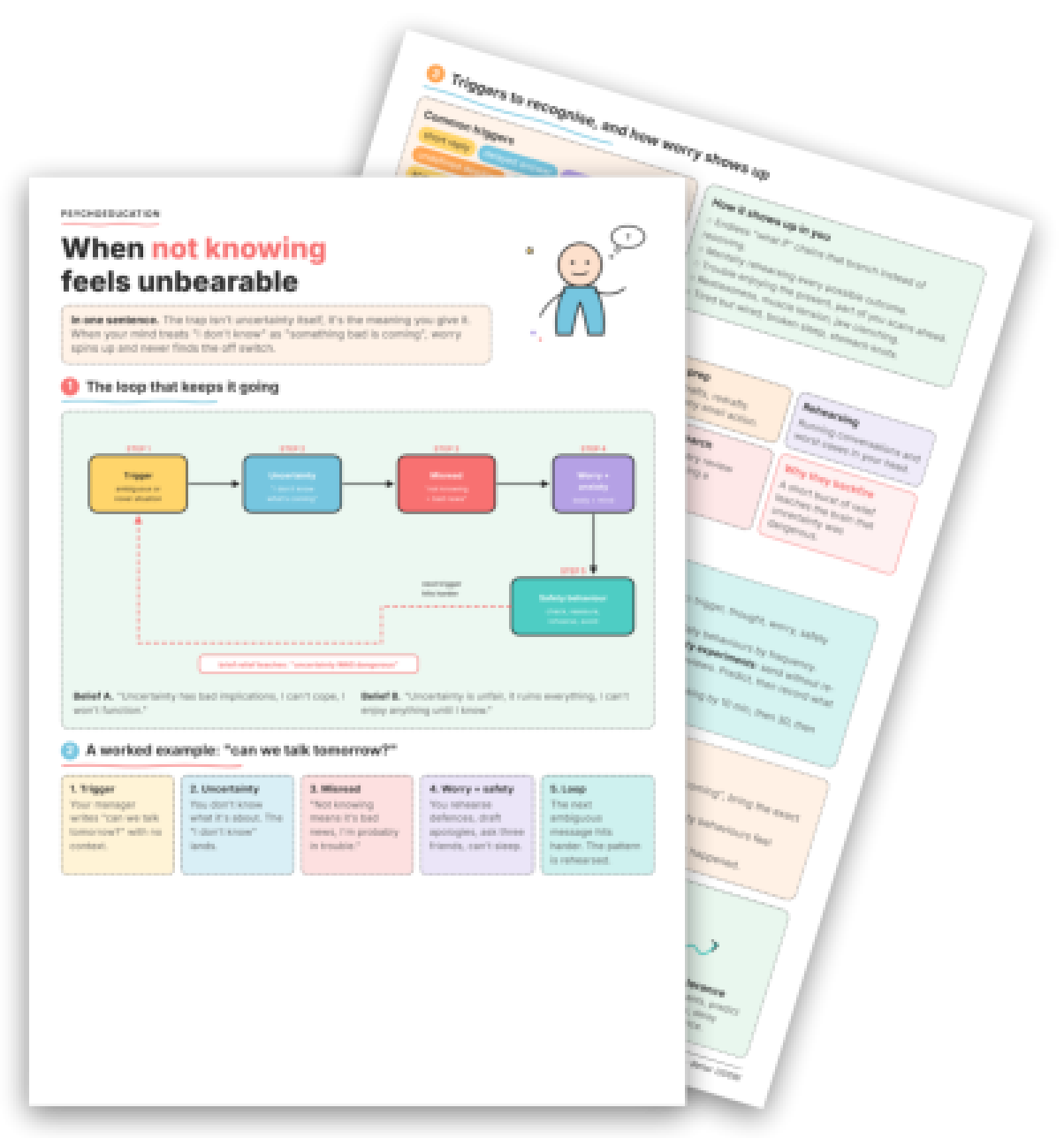
The fiche PDF is built around five sequenced panels that function as a shared reference point during psychoeducation.
Panel 1 presents the five-step maintenance loop: ambiguous trigger, uncertainty ("I don't know what's coming"), misread ("not knowing = bad news"), worry and somatic activation, safety behaviour, and brief relief that teaches the brain "uncertainty WAS dangerous." The loop arrow closing back to the next trigger makes the self-feeding character of the cycle immediately visible.
Panel 2 grounds the model in a worked example ("can we talk tomorrow?"), walking through each step with the kind of specificity patients recognise. Two explicit negative beliefs about uncertainty are named verbatim: "Uncertainty has bad implications, I can't cope, I won't function" (Belief A) and "Uncertainty is unfair, it ruins everything" (Belief B). Naming these beliefs on paper accelerates the move from general psychoeducation to case formulation.
Panels 3 and 4 catalogue common triggers (vague comment, delayed reply, undefined deadline, awaiting results) and seven safety behaviour categories: reassurance, checking, over-prep, rehearsing, postponing, not committing, and over-research. Each is labelled and briefly described, giving you a shared taxonomy to use across sessions. The sheet connects directly to the GAD cognitive behavioural model and complements uncertainty exposure work.
Panel 5 introduces the reframe and concrete steps: mapping a recent loop, ranking the top three safety behaviours by frequency, and running "small uncertainty experiments" (send without re-reading, choose without reviews, delay reassurance by ten minutes then thirty). A "To discuss in session" section closes the sheet with three guided prompts, making debriefing straightforward.
> Key point: This sheet is a visual support that facilitates explanation in session, not a questionnaire the patient completes alone. Use it as the backbone of your psychoeducation session; the patient leaves with a concrete reference, not a homework task.
750+ clinical tools
A library built with and for clinicians, ready to use in session and extend between appointments.
Access all the toolsWhen and How to Introduce the Sheet in Session
The fiche fits naturally after the initial assessment, once GAD or a worry-dominant presentation is clear and the alliance is established, typically sessions two to four. It works particularly well with patients who intellectualise their anxiety, those who present seeking confirmation that their worrying is "just being responsible," and those already identified as relying heavily on reassurance-seeking.
Introduce it without over-announcing: "I'd like to walk you through a diagram that shows how worry tends to feed itself, and see how much of it fits your experience." The worked example ("can we talk tomorrow?") is a reliable entry point for almost any occupational context. Ask the patient to identify their own recent trigger before moving to the safety behaviour panel.
Debrief by naming which loop step felt most recognisable, then jointly ranking the safety behaviours the patient uses most. The Intolerance of Uncertainty: A 4-Lesson Psychoeducation Program can extend this work between sessions, and the Uncertainty Intolerance guided exercise provides a structured five-question format for first uncertainty experiments. For patients who also present worry capturing attention persistently, the two tools complement each other directly.
The one limit to flag: with patients in acute crisis or with significant co-morbid depression, full psychoeducation on the maintenance model may be premature. Prioritise stabilisation first; the sheet will be more useful once there is enough cognitive availability to engage with the loop meaningfully.
The fiche does not replace the formulation or the exposure work. It makes the explanation land, and leaves the patient with something to return to between sessions.
Use it with your patients
Share this tool in the mobile app and follow the work between sessions.
Sources
- Dugas, M. J., Freeston, M. H., & Ladouceur, R. (1997). Intolerance of Uncertainty and Problem Orientation in Worry. Cognitive Therapy and Research.
- Dugas, M. J., & Robichaud, M. (2007). Cognitive-Behavioral Treatment for Generalized Anxiety Disorder: From Science to Practice. Routledge.
- Robichaud, M., Koerner, N., & Dugas, M. J. (2019). Cognitive Behavioral Treatment for Generalized Anxiety Disorder. Routledge.
Your session continues in your patients' pocket
Use with a patientYour resources, available everywhere
The handouts, exercises, programs and audios above: you choose which ones to make available to your patients, in the mobile app dedicated to them.
And far more than a library
The app goes well beyond resources, to support your patients every day:
Related categories
Explore other clinical resources by category.

Anxiety
Clinical hub for anxiety disorders: CBT and ACT worksheets, psychoeducation sheets, and exercises for assessment and treatment across the anxiety spectrum.

Cognition
Printable cognitive therapy worksheets and clinical tools for therapists: CBT, ACT, schema work, defusion, distortions, and belief restructuring.

Understand
Clinical hub for the therapeutic aim 'Understand': worksheets and tools to build patient insight across CBT, ACT, schema therapy and more.

Build awareness
Clinical worksheets and tools to build awareness in therapy: cognitive distortions, schemas, emotions, ACT and CBT resources for practitioners.

CBT
CBT worksheets, cognitive restructuring exercises & behavioral tools for clinicians. Evidence-based resources for every phase of cognitive behavioral therapy.

Trauma
Clinical hub on trauma and PTSD: assessment, differential diagnosis, treatment phases, and printable resources for practitioners. 155 chars.