
Clinical picture. M., a 34-year-old primary school teacher, presented after six weeks of persistent low mood, early-morning waking, and what she described as "just being weak." She had delayed seeking help partly because she believed her difficulties did not count as a real illness. In the second session, the clinician introduced the Depression Information Sheet, walking through the sadness-versus-depression comparison table; M. recognised her own pattern in the clinical column almost immediately. She noted, quietly, that seeing the symptom list in print made her feel less responsible for not "snapping out of it." By the following session she had re-read the sheet twice and arrived with specific questions about the role of sleep disruption, which opened a more focused conversation about behavioural activation.
Depression: PDF Worksheet, Tools and Exercises for Clinical Practice
A printable PDF fiche clinicians can use in session to explain depression clearly, establish a shared vocabulary, and give patients a concrete reference to take home.
Clinical vignettes
Naming the Difference, Reducing Self-Blame
Engaging a Reluctant Partner in Psychoeducation
Clinical picture. D., a 58-year-old retired engineer, was referred by his GP after his partner raised concerns; D. himself attributed his withdrawal and irritability to "getting older" and was sceptical of a depressive diagnosis. The clinician offered the sheet as a neutral reference rather than a verdict, inviting D. to read the signs section and indicate which, if any, felt familiar. D. identified foggy thinking, appetite loss, and fatigue but initially skipped the guilt-loops item; this omission became a useful opening for further exploration in the same session. He left with the sheet, and at the next appointment reported that he had shown it to his partner, which had reduced conflict at home and increased his willingness to trial a structured therapy programme.
Patients with depression often arrive having already told themselves, and been told, that they are "just sad" or "not trying hard enough." Getting the psychoeducation right in the first sessions matters clinically, and doing it verbally alone rarely sticks. This fiche PDF gives you a structured visual support to deliver that explanation efficiently, establish a shared clinical vocabulary, and leave the patient with something to hold onto between appointments.
Use this resource with your patients
Handout, exercises and materials ready to use, right inside SessionFuel.
Why Depression Resists Oral Explanation in Session
The core difficulty is the shame-laden self-narrative. Many depressed patients arrive with an interpretive framework that fuses the disorder with personal failure. Explaining the distinction verbally tends to produce polite nodding without genuine schema shift. The concept is not complex, but it sits against a wall of cognitive distortions, most notably the guilt loops and the personalisation bias that Beck's model identified decades ago.
A second obstacle is the sadness/depression conflation. Patients (and sometimes families) use the words interchangeably, which complicates alliance building and makes it harder to justify treatment intensity. Until the patient sees the contrast laid out clearly, they will keep minimising or catastrophising their presentation, neither of which supports behavioural activation or engagement with structured between-session work.
The fiche solves both problems by externalising the explanation onto a page rather than leaving it as spoken content that evaporates before the next session.
What the Fiche Contains: A Visual Support for Every Key Concept
The fiche PDF is organised into five panels, each targeting a specific psychoeducation objective.
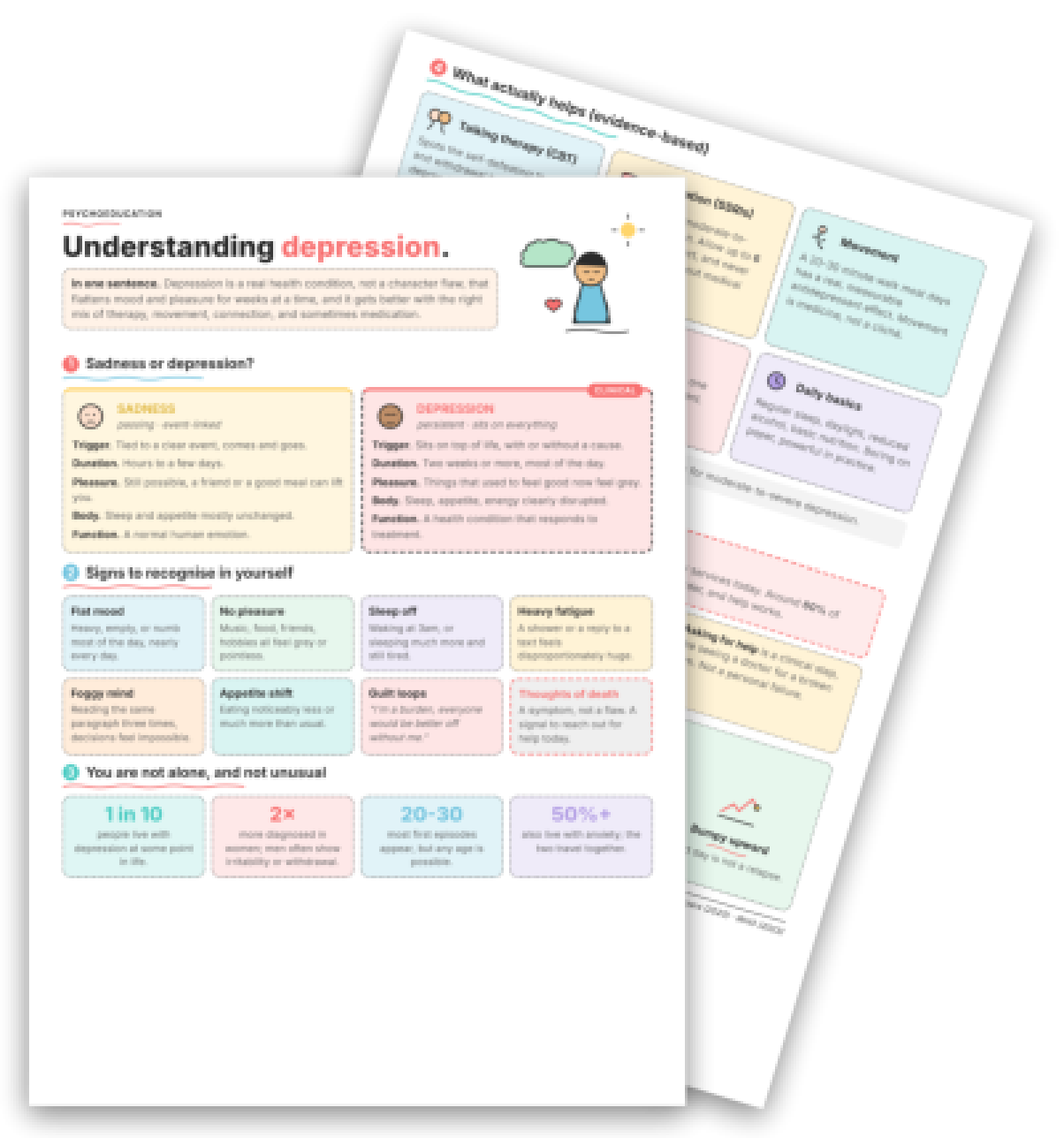
Panel 1 opens with a single-sentence definition: "Depression is a real health condition, not a character flaw, that flattens mood and pleasure for weeks at a time." Having that sentence on paper, rather than offered verbally, lets the patient re-read it between sessions rather than reconstruct it from memory.
Panel 2 presents a side-by-side comparison of sadness and clinical depression across five dimensions: trigger, duration, capacity for pleasure, somatic impact, and clinical status. The visual contrast does in ten seconds what several minutes of oral explanation rarely accomplishes. It is the most clinically useful panel for patients who arrive minimising their symptoms or feeling guilty about "not snapping out of it."
Panel 3 lists eight depressive signs concisely, from flat affect and anhedonia to sleep disruption, cognitive fog, appetite changes, and thoughts of death framed explicitly as "a symptom, not a flaw." This framing alone can reduce the shame barrier that blocks patients from reporting suicidal ideation.
Panel 4 covers epidemiology (1 in 10 lifetime prevalence, the 2:1 female-to-male ratio with a note on male presentation as irritability or withdrawal, comorbidity with anxiety in over 50% of cases). For patients who feel abnormal or uniquely broken, this panel functions as an implicit normalisation that verbal reassurance rarely achieves as efficiently.
Panel 5 maps evidence-based interventions: CBT, SSRIs, movement (framed as "movement is medicine, not a cliché"), behavioural activation, reconnection, and daily basics. A closing safety note addresses suicidal ideation as a medical emergency, and includes a brief flag toward the differential with bipolar disorder, a clinically important prompt before you link to a bipolar psychoeducation resource if relevant.
> Key takeaway: This fiche is a visual support that facilitates explanation in session, not a self-administered questionnaire. You use it alongside the patient to anchor the psychoeducation, then send it home as a reference they can return to when the session content fades.
750+ clinical tools
A library built with and for clinicians, ready to use in session and extend between appointments.
Access all the toolsWhen and How to Propose the Fiche
The optimal moment is sessions two or three, once the anamnèse is complete and the therapeutic alliance is beginning to form. Introducing it at assessment risks overloading a patient who is still mobilising to come at all.
A natural framing: "I'd like to share a one-page overview of what we know about depression. It won't tell you anything you haven't felt, but seeing it laid out sometimes helps make sense of what's been happening." This language avoids the diagnostic labelling tone that some patients find alienating.
Profiles where the fiche is especially useful:
- Minimisers who still frame their symptoms as laziness or weakness: the sadness/depression contrast panel directly addresses the misattribution
- Patients with prominent somatic complaints who have not yet connected physical symptoms to the depressive syndrome
- Family members present in session, who benefit from the same normalisation the patient needs
- Patients starting their first episode, before a fuller psychoeducation program or ACT-based curriculum
For debriefing, ask which panel surprised them most. The answer reliably reveals the specific cognitive distortion or avoidance pattern to prioritise next. If they point to the treatment panel, it opens the door to coping skills work, rumination-focused sessions, or motivational work.
One contraindication worth naming: patients in an acute suicidal crisis need a crisis protocol first. The fiche is appropriate once safety is established and the patient can engage with psychoeducation. The thoughts-of-death item on Panel 3 can be a useful opener in a stabilised context, but should not be the first clinical contact with the topic.
The fiche does not replace the formulation of the case or the therapeutic frame. It makes the explanation clearer, saves time in session, and leaves the patient with a concrete reference rather than a memory that depression itself will distort.
Use it with your patients
Share this tool in the mobile app and follow the work between sessions.
Sources
- Beck, A. T., Rush, A. J., Shaw, B. F., Emery, G. (1979). Cognitive Therapy of Depression. The Guilford Press.
- National Institute for Health and Care Excellence (NICE) (2022). Depression in Adults: Treatment and Management (NG222).
- Martell, C. R., Dimidjian, S., Herman-Dunn, R. (2010). Behavioral Activation for Depression: A Clinician's Guide. The Guilford Press.
Your session continues in your patients' pocket
Use with a patientYour resources, available everywhere
The handouts, exercises, programs and audios above: you choose which ones to make available to your patients, in the mobile app dedicated to them.
And far more than a library
The app goes well beyond resources, to support your patients every day:
Related categories
Explore other clinical resources by category.

Mood
Evidence-based worksheets and clinical tools for mood disorders: CBT, ACT, and positive psychology resources for psychologists and therapists.

Understand
Clinical hub for the therapeutic aim 'Understand': worksheets and tools to build patient insight across CBT, ACT, schema therapy and more.

CBT
CBT worksheets, cognitive restructuring exercises & behavioral tools for clinicians. Evidence-based resources for every phase of cognitive behavioral therapy.

Anxiety
Clinical hub for anxiety disorders: CBT and ACT worksheets, psychoeducation sheets, and exercises for assessment and treatment across the anxiety spectrum.

Trauma
Clinical hub on trauma and PTSD: assessment, differential diagnosis, treatment phases, and printable resources for practitioners. 155 chars.

Identity
Clinical resources for self-identity work in therapy: CBT, ACT, schema tools for clinicians addressing self-concept, core beliefs, and identity disruption.