
Clinical picture. M., a woman in her late sixties, presented eight months after the death of her husband of forty years, reporting shame about moments of laughter and pleasure with her grandchildren. She described these as proof she had not loved him enough, and was beginning to withdraw from family contact to avoid the guilt. The clinician introduced the oscillation model from the psychoeducational sheet, naming both poles explicitly and framing re-engaging moments not as betrayal but as the mind resting so it can return to the loss. M. recognised her pattern at once, noting she always felt a fresh wave of grief the morning after a pleasant evening, which the model accounted for directly. Over the following two sessions she reported less avoidance of family, though sadness remained present and was not minimised.
Understanding the Grief Process: PDF Worksheet, Tools and Exercises
A structured visual PDF worksheet to help clinicians explain the dual-process model of grief in session, normalise oscillation, and screen for prolonged grief disorder.
Clinical vignettes
Normalising the Oscillation After Spousal Loss
Reframing Grief Loops in a Younger Adult
Clinical picture. T., a man in his mid-thirties, sought consultation fourteen months after his mother's death, frustrated that grief had returned sharply around a work promotion she would never witness. He had assumed he was regressing and questioned whether something was wrong with him. The clinician used the sheet's framing that grief loops and returns rather than moving through fixed stages, and spent time on the catalogue of cognitive intrusions described in section three, several of which T. recognised as his own experience. This reframe shifted his self-assessment from pathology to a plausible, if painful, adaptation process. He left with reduced self-criticism and a clearer language for what he had been experiencing, which he said had felt unspeakable until named.
The Kübler-Ross stage model is so culturally embedded that most bereaved patients arrive expecting a linear progression from denial to acceptance, and conclude something is wrong with them when grief loops back, intensifies at month six, or comes mixed with relief. This PDF worksheet gives you a concrete visual anchor for the session conversation that corrects that myth and replaces it with a clinically grounded framework.
Use this resource with your patients
Handout, exercises and materials ready to use, right inside SessionFuel.
Why the grief process resists verbal explanation alone
The core difficulty is not conceptual, it is temporal. When you describe oscillation between loss-orientation and restoration-orientation (the Stroebe & Schut Dual Process Model, 1999), patients intellectually follow. Twenty minutes later, guilt surfaces at home because they laughed at dinner, and the explanation has dissolved. The felt experience of grief is non-linear; an oral account of it is inevitably linear. That mismatch is where psychoeducation fails without a visual support.
A second problem: relief. Especially after prolonged illness, relief is common and clinically unremarkable. Patients rarely believe that unless they see it named explicitly, in print, alongside sadness and longing, as a normal feature of the process. The same applies to somatic grief, the tight chest, the 4 a.m. waking, the almost physical hunger for the person. Patients frequently present these common reactions to trauma and loss as physical illness before connecting them to bereavement at all.
There is also the five-stages myth to dismantle actively. Simply asserting "grief isn't linear" rarely shifts the patient's internal model. Seeing a fiche that says "Real grief loops, jumps, returns. Two people grieving the same loss won't look the same" does.
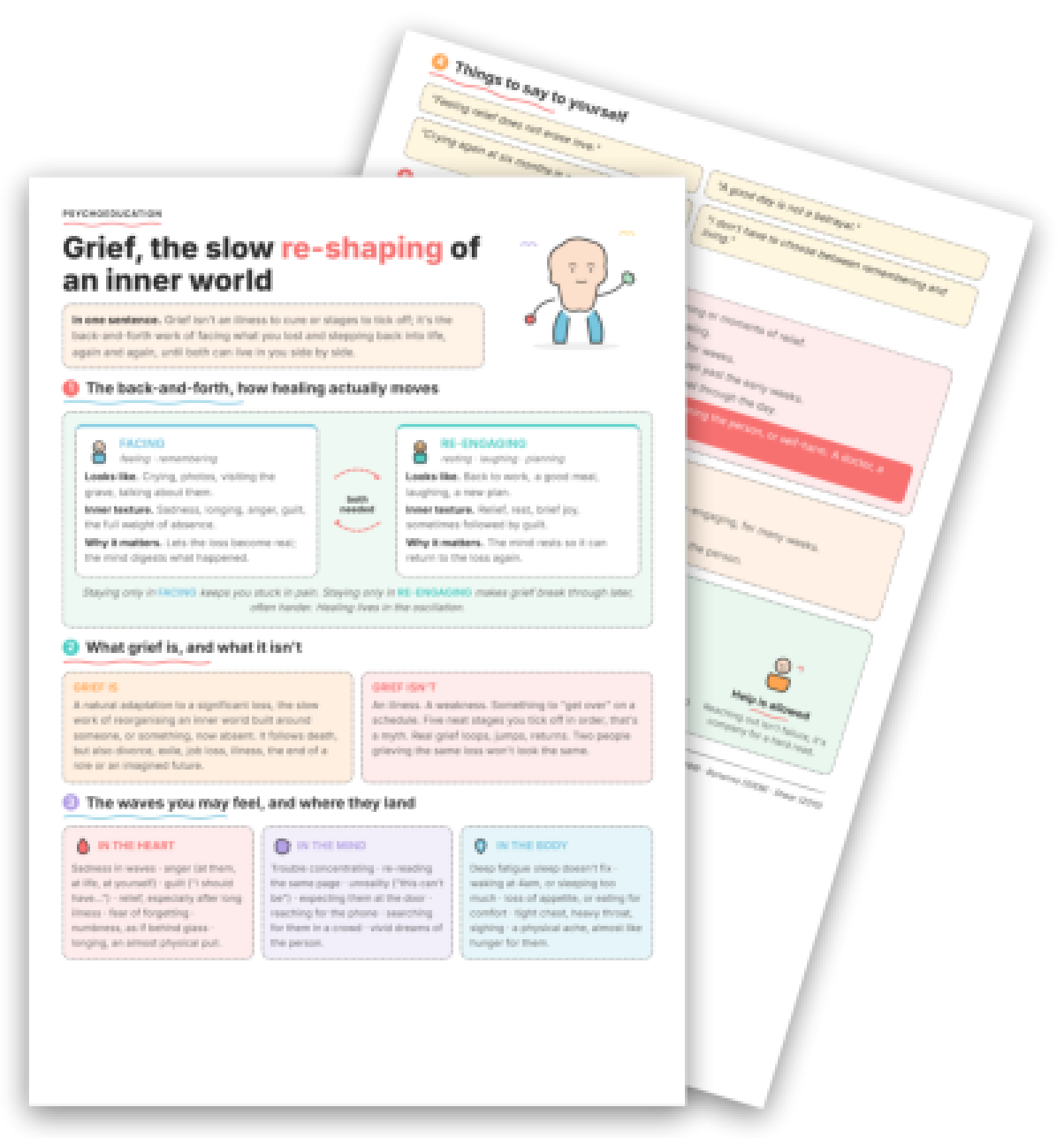
What the fiche contains: a visual support for the dual-process model
The printable is structured in five numbered panels, each serving a distinct clinical function.
- Panel 1 maps the oscillation between Facing (crying, photos, talking about them) and Re-engaging (back to work, brief joy, planning), with the affective texture of each pole labelled explicitly and a clear statement that "Healing lives in the oscillation." This is the visual centrepiece of the fiche, and it shows at a glance what no verbal description communicates as quickly: both poles are necessary, and being stuck on either side is a clinical signal.
- Panel 2 distinguishes what grief is from what it isn't, naming the myth of neat sequential stages directly.
- Panel 3 maps the phenomenology across three registers: cardiac (sadness in waves, anger, guilt, relief, numbness), cognitive (unreality, expecting them at the door, searching in a crowd), and somatic (deep fatigue, tight chest, the physical ache). Patients often recognise themselves across all three and say so during the session, which accelerates formulation.
- Panel 4 offers four brief self-statements, including "A good day is not a betrayal" and "Crying again at six months is a wave, not a relapse." These serve as portable reframes the patient can rehearse between sessions, grounded in compassion-focused language rather than cognitive disputation.
- Panel 5 lists red flags for prolonged grief disorder: pain staying at maximum for many months without softening, distress worsening rather than fluctuating, growing isolation, essential self-care slipping, heavy substance use. A direct crisis prompt follows for thoughts of joining the person.
A "To discuss in session" panel closes the fiche, flagging three specific triggers worth exploring together: prolonged stuckness on one pole, guilt interrupting good moments, and any of the warning signs above.
> Key takeaway: This fiche is a visual support for in-session explanation, not a self-administered questionnaire. You use it to ground the dual-process model visually, create a shared vocabulary for oscillation, and leave the patient with a concrete reference they can return to between appointments.
750+ clinical tools
A library built with and for clinicians, ready to use in session and extend between appointments.
Access all the toolsWhen and how to introduce the fiche
This fiche fits naturally in the second or third session, once the initial anamnèse is complete and the patient has begun describing their grief pattern. It is particularly well-suited when a patient expresses guilt about a good moment, interprets oscillation as deterioration, or presents somatic grief symptoms without having connected them to bereavement.
You can frame the introduction simply: "I want to show you something that might map what you've been describing. Let's look at it together." Walk through Panels 1 and 3 first, inviting the patient to locate their own experience. Panel 5 does double duty as a screening tool for prolonged grief disorder, which you can revisit explicitly if the red flags are present.
For patients already familiar with the stages of grief model, Panel 2 is where to spend extra time, since the myth often creates pressure and shame that complicates the tasks of mourning framework you may be working with alongside it. Complement the fiche later in the treatment with resources on maintaining the bond differently or grief myths depending on the patient's specific sticking points.
One genuine contraindication: in acute traumatic bereavement (violent death, sudden loss with dissociative features), the oscillation framing can feel premature in the first session. In those cases, grounding and stabilisation come first; the grief process fiche is better placed in the second or third appointment, once the patient can metabolise psychoeducation without becoming destabilised.
The fiche does not replace the therapeutic framework. What it does is make the explanation clearer, faster, and more portable, so the patient leaves session carrying a model of their own grief, not just a memory of a conversation.
Use it with your patients
Share this tool in the mobile app and follow the work between sessions.
Sources
- Worden, J. W. (2018). Grief Counseling and Grief Therapy: A Handbook for the Mental Health Practitioner (5th ed.). Springer Publishing Company.
- Klass, D., Silverman, P. R., & Nickman, S. (Eds.) (1996). Continuing Bonds: New Understandings of Grief. Taylor & Francis.
- Neimeyer, R. A. (Ed.) (2001). Meaning Reconstruction and the Experience of Loss. American Psychological Association.
- Prigerson, H. G., Horowitz, M. J., Jacobs, S. C., Parkes, C. M., Aslan, M., Goodkin, K., et al. (2009). Prolonged Grief Disorder: Psychometric Validation of Criteria Proposed for DSM-V and ICD-11. PLOS Medicine, 6(8), e1000121.
Your session continues in your patients' pocket
Use with a patientYour resources, available everywhere
The handouts, exercises, programs and audios above: you choose which ones to make available to your patients, in the mobile app dedicated to them.
And far more than a library
The app goes well beyond resources, to support your patients every day:
Related categories
Explore other clinical resources by category.

Mood
Evidence-based worksheets and clinical tools for mood disorders: CBT, ACT, and positive psychology resources for psychologists and therapists.

Transitions
Clinical hub for life transitions: tools, worksheets and exercises to support psychosocial adjustment, role change and identity work in practice.

Understand
Clinical hub for the therapeutic aim 'Understand': worksheets and tools to build patient insight across CBT, ACT, schema therapy and more.

Prevent relapse
Prevention as a therapeutic aim: clinical framing, risk stratification, and printable resources for relapse prevention and early intervention in mental health.

Integrative
Integrative therapy clinical resources: worksheets, psychoeducation programs, and exercises for eclectic, multimodal practice across orientations.
Anxiety
Clinical hub for anxiety disorders: CBT and ACT worksheets, psychoeducation sheets, and exercises for assessment and treatment across the anxiety spectrum.