
Clinical picture. M., a woman in her late thirties, presents with generalised anxiety disorder and recurrent episodes of chest tightness and shallow breathing that she consistently interprets as signs of imminent cardiac collapse. During the session, the clinician introduces the Ce que je ressens exercise, guiding her through each question in sequence. M. rates her sensations at 8 out of 10 and, for the first time, articulates in writing that she responds to them by sitting down and avoiding exertion, a behaviour that temporarily reduces discomfort but sustains the cycle. By the final question she generates two plausible alternatives: the tightness may reflect muscular tension rather than cardiac pathology, and it has resolved on its own every previous time. At the next appointment she reports having consulted the completed form during one episode, which attenuated her avoidance behaviour without fully suppressing the sensations.
Mapping Anxiety's Physical Sensations: A Guided CBT Exercise
A structured five-question tool helping patients name, rate, interpret, and cognitively reappraise somatic anxiety symptoms through core CBT principles.
Clinical vignettes
Chest Tightness Reappraised in GAD
Somatic Mapping in Adolescent Social Anxiety
Clinical picture. T., a seventeen-year-old referred for marked social anxiety, describes flushing and nausea before any oral presentation at school, but has never examined these sensations systematically. The clinician uses the Ce que je ressens exercise as a structured between-session task, asking T. to complete it after the next anxiety episode rather than retrospectively. T. returns having rated the sensations at 6 out of 10 and having noted, unprompted, that they peaked before he spoke and diminished within two minutes of starting, a pattern he had not previously registered. His written alternative thought, that the sensations signal activation rather than danger, was modest in conviction yet represented a shift from his prior catastrophic framing. The clinician used this record as the basis for the subsequent session on interoceptive exposure.
The clinical difficulty: when words about the body fall flat
Anxiety is never purely cognitive. Many patients arrive describing a racing heart, chest tightness, or waves of nausea, but they struggle to connect those physical sensations to their mental processes. They have felt the sensations hundreds of times, yet they have rarely paused to observe them with any precision. Explaining the interoceptive fear loop verbally often produces a polite nod rather than genuine recognition.
The challenge is twofold. First, somatic symptoms shift and evolve: a patient who reported dizziness three weeks ago may no longer remember it, or may now minimise it because it has become "normal." Second, the leap from sensation to catastrophic interpretation happens so automatically that most patients cannot see it happening at all. The CBT Model of Fear of Body Sensations and Clark's Cognitive Model of Panic both rest on this exact appraisal mechanism, yet making it visible requires more than a diagram. It requires the patient's own words, from their own recent experience.
Use this resource with your patients
Handout, exercises and materials ready to use, right inside SessionFuel.
What the exercise contains
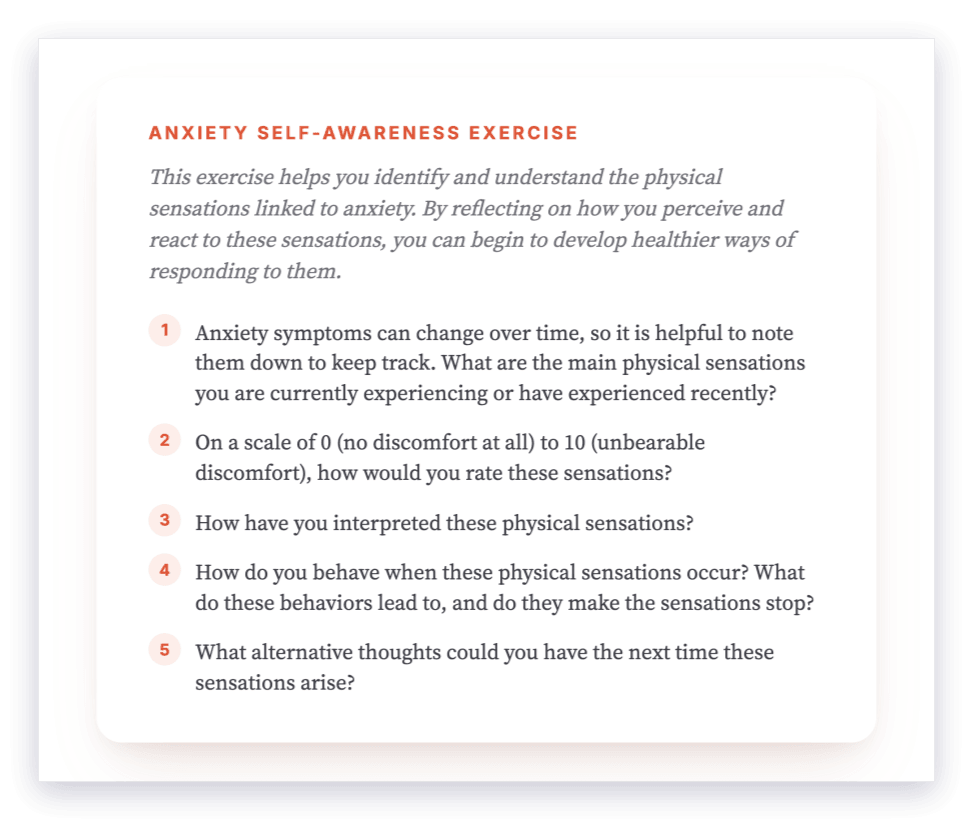
This five-question guided exercise is structured around the full sensation-to-response chain, grounded strictly in what the patient has actually lived.
The first question invites the patient to name their recent physical sensations in concrete, personal terms, drawing on the premise built into the question itself: symptoms evolve, and tracking them is clinically useful. The second question introduces a 0-to-10 intensity rating, giving subjective distress a communicable number you can work with across sessions.
Question three moves into the cognitive layer: how has the patient interpreted those sensations? This is where catastrophic appraisals typically surface, the conviction that a racing heart means cardiac crisis, or that trembling signals loss of control. Question four shifts to behavior, asking what the patient does when sensations arise and, critically, whether those behaviors actually make the sensations stop. This question maps safety behaviors and avoidance responses directly, in the patient's language, and connects naturally to the broader picture captured by resources like Safety Behaviors and Changing Avoidance.
The fifth and final question asks the patient to generate alternative thoughts for the next time those sensations appear, making the exercise a genuine first step in cognitive restructuring rather than pure monitoring.
This exercise is available to your patients through the patient app of SessionFuel, the mobile application reserved for patients of clinicians who use SessionFuel: you assign it as homework and your patient completes it directly on their phone, on their own, between appointments.
The image above lists the five questions in order with a brief framing statement. It is a static preview only; the full guided exercise, with patient-facing instructions and space for the patient to write their answers, is experienced by the patient in the app, not in this image.
Key insight: The exercise's real clinical value lies in question four. When a patient writes, in their own words, that their behaviors do not actually stop the sensations, the functional analysis is already half done before they walk back through your door.
750+ clinical tools
A library built with and for clinicians, ready to use in session and extend between appointments.
Access all the toolsUse it with your patients
Share this tool in the mobile app and follow the work between sessions.
How to integrate this as between-session homework
This exercise suits any patient working on anxiety, from those with panic presentations to patients with health anxiety or generalised somatic tension. It is particularly useful early in a CBT formulation phase, when you need the patient to begin self-monitoring without the added complexity of a full thought record. If your patient is already familiar with the Exploring Your Anxiety Experience fiche or the CBT Maintaining Processes worksheet, this exercise consolidates that psychoeducation into lived, personal data.
To introduce it, you might frame the task simply: sensations change, and noting them between sessions helps you both work with the real picture rather than a reconstructed one. Patients who have previously struggled with purely cognitive exercises often find the somatic entry point more accessible.
When the patient brings their completed exercise back, the material is immediately usable. The intensity rating from question two gives you a baseline for tracking change. The interpretation in question three points directly to the cognitive distortions worth targeting, whether through Challenging Anxious Thoughts, Restructuring Anxious Thoughts, or the Anxiety Self-Reflection exercise as a natural next step. The behavioral responses named in question four anchor your discussion of the avoidance cycle. And the alternative thoughts drafted in question five give you raw material for collaborative refinement, building toward the kind of cognitive flexibility that makes coping skills for anxiety actually stick.
Your session continues in your patients' pocket
Use with a patientYour resources, available everywhere
The handouts, exercises, programs and audios above: you choose which ones to make available to your patients, in the mobile app dedicated to them.
And far more than a library
The app goes well beyond resources, to support your patients every day:
Related categories
Explore other clinical resources by category.
Anxiety
Clinical hub for anxiety disorders: CBT and ACT worksheets, psychoeducation sheets, and exercises for assessment and treatment across the anxiety spectrum.

Build awareness
Clinical worksheets and tools to build awareness in therapy: cognitive distortions, schemas, emotions, ACT and CBT resources for practitioners.

CBT
CBT worksheets, cognitive restructuring exercises & behavioral tools for clinicians. Evidence-based resources for every phase of cognitive behavioral therapy.

Trauma
Clinical hub on trauma and PTSD: assessment, differential diagnosis, treatment phases, and printable resources for practitioners. 155 chars.

Mood
Evidence-based worksheets and clinical tools for mood disorders: CBT, ACT, and positive psychology resources for psychologists and therapists.

Identity
Clinical resources for self-identity work in therapy: CBT, ACT, schema tools for clinicians addressing self-concept, core beliefs, and identity disruption.