
Clinical picture. M., a 34-year-old software engineer, presented with generalised anxiety centred on professional performance; he consistently avoided volunteering for team presentations, reinforcing a belief that public speaking would result in humiliation. The clinician introduced the restructuring worksheet in session, walking M. through the three questions: he listed evidence for and against his prediction of failure, identified two alternative readings of a past presentation that had gone adequately, and articulated what he would tell a colleague in the same situation. By the end of the session M. had produced a balanced thought he described as "less automatic," and he agreed to keep the sheet visible at his desk before the next scheduled meeting. At follow-up two weeks later he reported completing the presentation without leaving early, noting the prediction had not come true, which the clinician used to address the avoidance-belief loop directly.
Restructuring Anxious Thoughts: PDF Worksheet, Tools and Exercises
A printable PDF worksheet with structured visual tools and exercises to help patients challenge anxious thoughts and build realistic, balanced alternatives, a clear psychoeducation support for in-session use.
Clinical vignettes
Catastrophising Before a Work Presentation
Mind-Reading in a Social Anxiety Context
Clinical picture. T., a woman in her mid-twenties with a longstanding social anxiety disorder, reported leaving gatherings early because she was certain other guests found her dull; this pattern had narrowed her social life considerably over two years. During a standard session, the clinician used the worksheet to help T. examine the mind-reading pattern: she was asked to list factual observations from a recent dinner rather than inferred judgements, and she found the evidence column for "they think I'm boring" was largely empty. Generating three alternative explanations for a guest's brief silence, including that the guest was simply tired, did not eliminate T.'s discomfort but visibly loosened her certainty. She rated her belief in the original thought as 60 rather than 95 out of 100 by the session's end, a shift the clinician noted as a workable starting point rather than a resolution.
Explaining cognitive restructuring verbally rarely lands the first time. Patients nod, follow the logic, then leave the session still fused with the very predictions you just deconstructed together. This PDF worksheet on restructuring anxious thoughts gives you a visual scaffold to anchor the explanation in session, so the concept sticks beyond the fifty-minute hour.
Use this resource with your patients
Handout, exercises and materials ready to use, right inside SessionFuel.
Why Anxious Thoughts Resist Verbal Explanation Alone
The central difficulty is not conceptual: most patients grasp, intellectually, that their catastrophic reading of a situation may be wrong. The problem is experiential. As the fiche puts it plainly, "knowing isn't enough, you need a method that works at the level of the thought itself." When the body is activated and the thought feels viscerally true, a spoken reframe lands as hollow reassurance.
A second friction point is the maintenance loop. Patients often fail to connect their avoidance behavior to the persistence of their anxiety. They experience relief after leaving early or seeking reassurance, but do not observe the mechanism by which the feared prediction is never disconfirmed. This is precisely the dynamic that needs to be shown, not just explained, and where a visual support earns its place.
A third issue: patients tend to confuse "balanced" with "positive." Without a concrete counter-example in front of them, many produce alternatives that are simply disguised reassurance ("it'll be fine"), which an anxious mind immediately rejects, and which can quietly function as another avoidance strategy. This is a nuance that cognitive distortions work and automatic thought identification exercises alone do not always resolve.
What the Worksheet Contains, and Why the Visual Format Matters
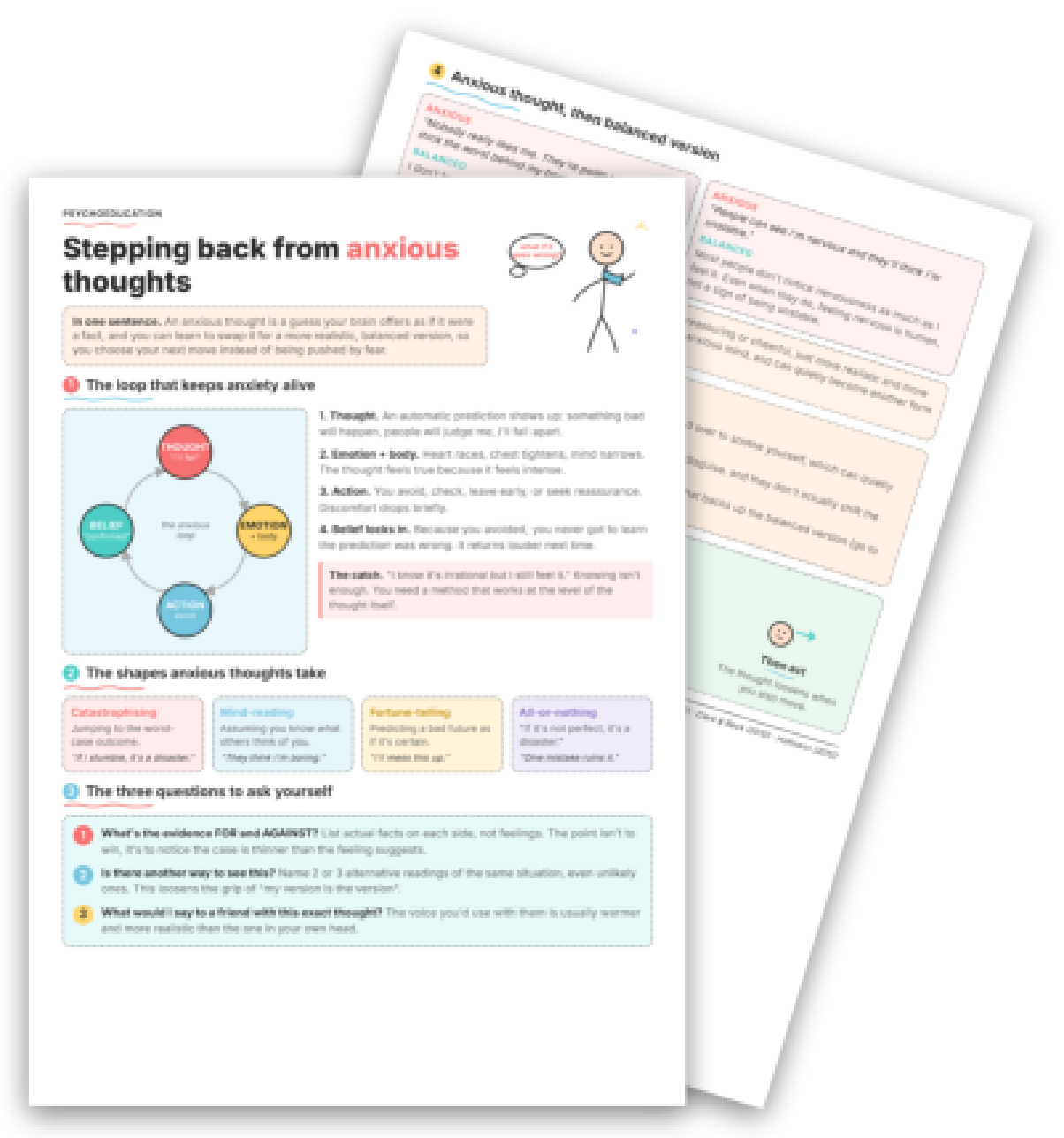
The fiche PDF is organized around four sequential panels, each building on the last.
Panel 1 diagrams the anxious loop as a circular four-step sequence: automatic thought, emotion plus somatic response, avoidance behavior, and belief reinforcement. Seeing the loop as a closed circuit, rather than hearing it described, helps patients locate exactly where their own maintenance pattern operates, and opens the question of where to intervene.
Panel 2 names and illustrates the four most clinically common thought shapes: catastrophising, mind-reading, fortune-telling, and all-or-nothing thinking. Short, concrete examples accompany each ("If I stumble, it's a disaster", "They think I'm boring"). Patients frequently identify their own dominant pattern at a glance, a recognition that would take considerably more dialogue to reach without the visual grid.
Panel 3 presents three structured challenge questions: evidence for and against, alternative readings of the same event, and the friend heuristic. These map directly onto the Socratic questioning sequence you are likely already using in TCC, and give you a precise vocabulary to share with the patient.
Panel 4 shows two worked examples side by side, anxious thought and balanced alternative. The fiche is explicit that "a good alternative doesn't have to be reassuring or cheerful, just more realistic and more nuanced." This single framing resolves the most common confusion patients bring when first attempting restructuring independently. A brief "To discuss in session" block closes the fiche with three specific clinical signals to watch: reassurance-seeking disguised as re-reading the balanced thought, alternatives that are merely positive self-talk, and cases where behavioural follow-through is needed to consolidate the cognitive shift.
> Key point: this worksheet is a visual support for in-session explanation, not a self-administered questionnaire. The clinician uses it to make the restructuring process transparent and repeatable; the patient leaves with a concrete reference, not a homework task to complete without a frame.
750+ clinical tools
A library built with and for clinicians, ready to use in session and extend between appointments.
Access all the toolsWhen and How to Introduce It in Session
This fiche fits naturally in early-to-mid treatment, once the CBT cognitive model has been introduced and the patient has begun noticing their automatic thoughts. It is particularly useful for patients with generalized anxiety disorder, social anxiety, or panic disorder who are articulate about their fears but stuck in the avoidance loop.
A low-threshold introduction: "I'd like to show you a simple map of what happens inside that loop we've been talking about, it may help us work on it together more concretely." Avoid framing it as a tool the patient needs to master alone. Work through Panel 1 together first, then ask which thought shape in Panel 2 resonates most.
For patients ready to go further between sessions, the Automatic Thoughts: A Guided Cognitive Restructuring Exercise and the Catastrophizing in CBT: A Structured Decatastrophizing Exercise extend the work autonomously. When avoidance is the primary maintenance mechanism, pairing this fiche with Building an Exposure Hierarchy gives the restructuring work a behavioural anchor, because, as the fiche notes, "the thought loosens when you also move."
Use it with your patients
Share this tool in the mobile app and follow the work between sessions.
Sources
- Beck, A. T., Emery, G., & Greenberg, R. L. (1985). Anxiety Disorders and Phobias: A Cognitive Perspective. Basic Books.
- Clark, D. A., & Beck, A. T. (2010). Cognitive Therapy of Anxiety Disorders: Science and Practice. Guilford Press.
- Beck, J. S. (2021). Cognitive Behavior Therapy: Basics and Beyond (3rd ed.). Guilford Press.
Your session continues in your patients' pocket
Use with a patientYour resources, available everywhere
The handouts, exercises, programs and audios above: you choose which ones to make available to your patients, in the mobile app dedicated to them.
And far more than a library
The app goes well beyond resources, to support your patients every day:
Related categories
Explore other clinical resources by category.

Anxiety
Clinical hub for anxiety disorders: CBT and ACT worksheets, psychoeducation sheets, and exercises for assessment and treatment across the anxiety spectrum.

Cognition
Printable cognitive therapy worksheets and clinical tools for therapists: CBT, ACT, schema work, defusion, distortions, and belief restructuring.

Build awareness
Clinical worksheets and tools to build awareness in therapy: cognitive distortions, schemas, emotions, ACT and CBT resources for practitioners.

Restructure
Clinical hub for cognitive restructuring worksheets: distortion identification, belief disputation, ABC model, and schema work for evidence-based practice.

CBT
CBT worksheets, cognitive restructuring exercises & behavioral tools for clinicians. Evidence-based resources for every phase of cognitive behavioral therapy.

Trauma
Clinical hub on trauma and PTSD: assessment, differential diagnosis, treatment phases, and printable resources for practitioners. 155 chars.