
Clinical picture. A., a woman in her early forties, presented with low mood, sleep disruption, and what she described as "constant walking on eggshells" at home. She was reluctant to call her situation abuse because her partner had never struck her. The clinician introduced the informational sheet and read through the covert column together, pausing at financial control and monitoring of her phone. A. became quiet, then said she had not realised that needing to ask permission to withdraw money was part of the same pattern as the cold-shoulder silences. She left the session with the sheet and returned the following week having circled seven items, which opened a more grounded conversation about safety planning.
What Is Domestic Abuse? PDF Worksheet, Tools and Exercises
A printable PDF fiche and clinical tools to support psychoeducation on domestic abuse: help patients name what is happening, reduce self-blame, and take first steps in session.
Clinical vignettes
Naming Covert Control in Session
Reframing Ambivalence, Not Weakness
Clinical picture. T., a man in his mid-thirties, had disclosed intermittent physical incidents at home but minimised them between sessions, often arriving with reasons why the situation was improving. The clinician used the sheet's section on why leaving is not simple to normalise his ambivalence rather than confront his minimisation directly. Reading aloud that hope and fear can coexist, and that staying does not signal weakness, visibly reduced T.'s defensiveness. He began to describe the tension-explosion-calm cycle in his own words, which gave the work a more accurate shared language going forward.
Patients experiencing intimate partner violence often arrive at your office describing relationship difficulties, low mood, or persistent anxiety, without ever naming abuse. Naming it is the first clinical task, and it is rarely simple when shame, ambivalence, and coercive control have already distorted the patient's frame of reference. This fiche PDF serves as a visual support that facilitates the explanation of domestic abuse in session, giving both clinician and patient a shared vocabulary before the harder clinical work begins.
Use this resource with your patients
Handout, exercises and materials ready to use, right inside SessionFuel.
Why Domestic Abuse Resists Verbal Explanation in Session
The core difficulty is definitional distortion. Patients under chronic coercive control have typically internalized the abuser's framing: what they experience is described as love, sensitivity, provocation, or normal conflict. Explaining at the oral level that control and fear are forms of abuse often bounces off these internalised narratives without traction, particularly early in the therapeutic relationship.
Covert abuse is especially invisible to patients. Monitoring of phone and location, financial restriction, and enforced isolation are rarely labelled as violence, either culturally or by the patient themselves. Without a structured visual layout distinguishing overt from covert patterns side by side, the clinician is working against a powerful cognitive distortion loop: "he's just protective," "she's just anxious," and so on. The fiche breaks this loop by making both categories concrete and equivalent in one glance.
There is also the minimisation dynamic. Patients who acknowledge individual incidents frequently add "but it wasn't that bad" or "it doesn't happen often." Without a visual reference that explicitly normalises these minimising moves as predictable responses to chronic threat, the clinical conversation can stall precisely when it should open.
What the Fiche Contains: A Visual Support for the Explanation
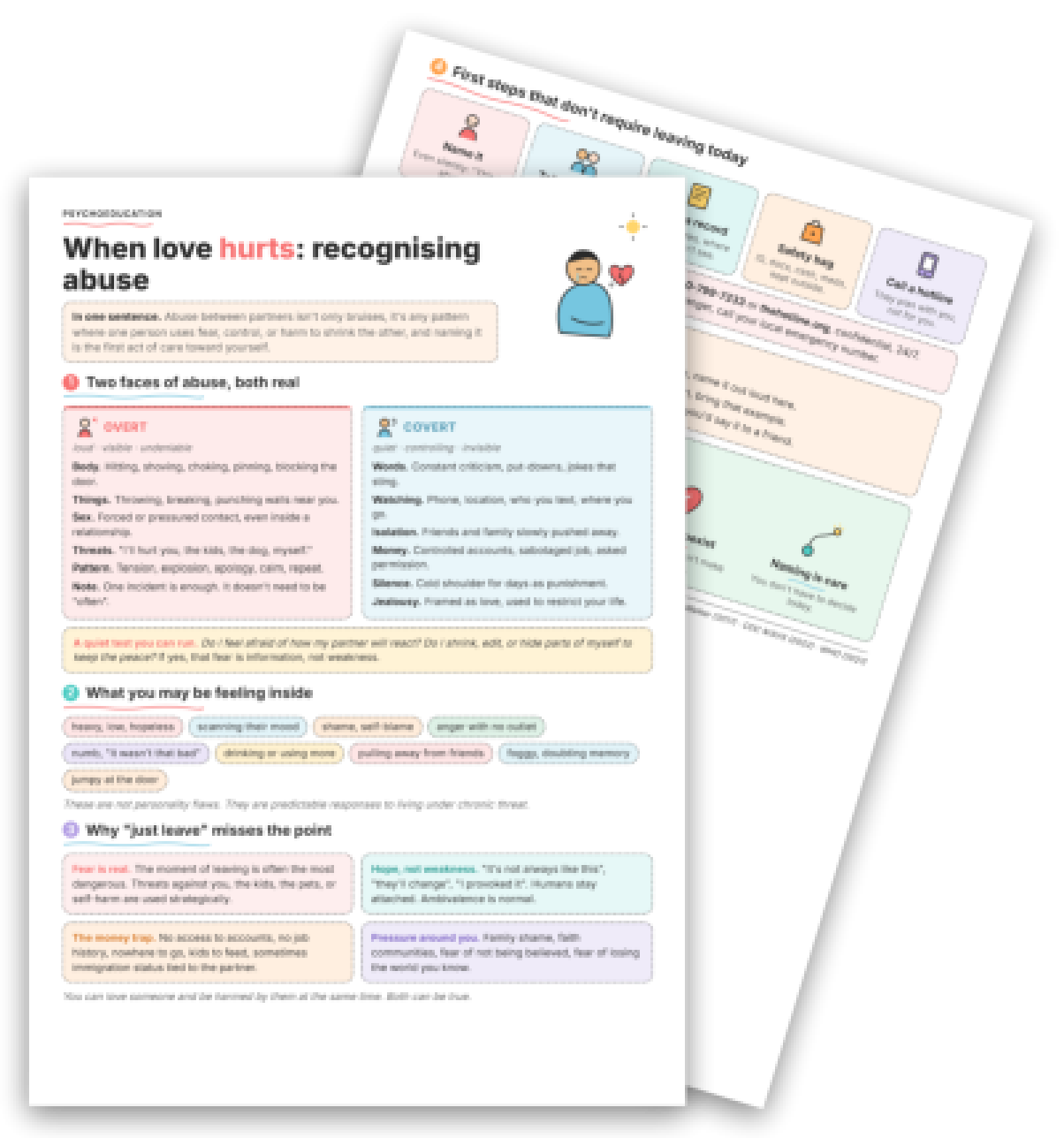
The fiche is structured across four numbered sections and is designed to be used by the clinician as a shared psychoeducation tool during the session, not a questionnaire the patient completes alone.
Section 1 presents two parallel columns: overt and covert abuse. The overt column covers physical violence, property destruction, sexual coercion, and threats. The covert column covers verbal degradation, surveillance, isolation tactics, financial control, and the use of silence as punishment. Laying these side by side visually communicates what an oral explanation struggles to: both are real, both are named, and neither requires frequency to count. The fiche states plainly, "One incident is enough. It doesn't need to be 'often'," a formulation worth quoting directly to patients who minimise.
The section also includes a brief self-assessment framed as "a quiet test you can run": two questions about fear and self-editing that the clinician can read aloud and sit with together. This makes the abstract concept of psychological coercion immediately personal without requiring the patient to self-label.
Section 2 maps somatic and psychological sequelae: hypervigilance, emotional numbing, shame, increased substance use, memory fog, social withdrawal. Presenting these as "predictable responses to living under chronic threat" rather than personality flaws is a direct counter to the self-blame narrative. For patients with features of complex PTSD or a mistrust and abuse schema, this reframe lands differently when it appears on a printed page rather than spoken in the room.
Section 3 addresses the "just leave" myth with clinical precision: the lethality spike at separation, the role of hope and ambivalence, financial and immigration entrapment, and community or faith-based pressure. This section is particularly useful when working with patients whose avoidance is misread as passivity, or with colleagues who may need a reminder about how abusers strategically justify and maintain abuse.
Section 4 lists five concrete first steps that do not require leaving: naming the situation internally, telling one person, keeping a hidden record, preparing a safety bag, and calling a hotline. The section closes with three session prompts explicitly labelled "To discuss in session", which structure the debrief naturally.
> Key takeaway: The fiche is a visual support that facilitates the explanation of domestic abuse in session. It gives the patient a concrete reference to take home, not a form to fill in, and gives the clinician a scaffold to work from rather than a definition to defend.
Clinical library
750+ clinical tools
A library built with and for clinicians, ready to use in session and extend between appointments.
Access all the toolsSeveral resource types
Psychoeducation handouts
Understand at a glance
Interactive exercises
To do and fill in
Interactive programs
A structured path
Audios
Meditation and relaxation
Psychometric tests
Automatic scoring
When and How to Introduce the Fiche
The fiche is best introduced once a degree of alliance thérapeutique is established, typically not in the first session, but when the patient has touched on relationship fear or control even obliquely. You might frame it with: "I'd like to show you something that a lot of people find useful for putting words to experiences that can be hard to describe." Avoid pathologising the relationship before the patient is ready; let the visual do the work.
It is particularly well-suited to patients presenting with PTSD symptoms, trauma reactions, or schemas of shame and defectiveness whose origins remain unclear. It also pairs naturally with cycle of abuse psychoeducation, gaslighting recognition work, and early boundary-setting exploration.
For patients in acute crisis, pair the fiche with a coping in crisis resource and ensure the hotline information in Section 4 is highlighted explicitly. With patients who are not yet ready to name abuse, the fiche can be left with them without requiring any label: the section prompts create a container for what may emerge in later sessions.
The fiche does not replace a structured safety assessment or a trauma-informed formulation. It opens the conversation, stabilises the vocabulary, and leaves the patient with something tangible to return to between sessions.
Use it with your patients
Share this tool in the mobile app and follow the work between sessions.
Sources
- Stark, E. (2022). Coercive Control: The Entrapment of Women in Personal Life. Oxford University Press.
- Walker, L. E. A. (2016). The Battered Woman Syndrome (4th ed.). Springer Publishing.
- Herman, J. L. (1992). Trauma and Recovery: The Aftermath of Violence - From Domestic Abuse to Political Terror. Basic Books.
- Centers for Disease Control and Prevention (CDC) (2026). About Intimate Partner Violence.
- Breiding, M. J., Basile, K. C., Smith, S. G., Black, M. C., Mahendra, R. R. (2015). Intimate Partner Violence Surveillance: Uniform Definitions and Recommended Data Elements, Version 2.0. National Center for Injury Prevention and Control, Centers for Disease Control and Prevention.
- National Domestic Violence Hotline. Get Help - National Domestic Violence Hotline.
Patient mobile app
Your session continues in your patients' pocket
Use with a patientYour resources, available everywhere
The handouts, exercises, programs and audios above: you choose which ones to make available to your patients, in the mobile app dedicated to them.
Psychoeducation handoutsInteractive exercisesInteractive programsAudiosPsychometric tests
And far more than a library
The app goes well beyond resources, to support your patients every day:
Standardized tests
Therapy journal
Gamification
Wellbeing challenges
Introspection prompts
Therapist homework
Related categories
Explore other clinical resources by category.

Trauma
Clinical hub on trauma and PTSD: assessment, differential diagnosis, treatment phases, and printable resources for practitioners. 155 chars.

Mood
Evidence-based worksheets and clinical tools for mood disorders: CBT, ACT, and positive psychology resources for psychologists and therapists.

Identity
Clinical resources for self-identity work in therapy: CBT, ACT, schema tools for clinicians addressing self-concept, core beliefs, and identity disruption.

Relationships
Clinical worksheets and tools on relational functioning: attachment, schemas, assertiveness, and communication skills for therapists. Printable PDF resources.

Understand
Clinical hub for the therapeutic aim 'Understand': worksheets and tools to build patient insight across CBT, ACT, schema therapy and more.

CBT
CBT worksheets, cognitive restructuring exercises & behavioral tools for clinicians. Evidence-based resources for every phase of cognitive behavioral therapy.