
Clinical picture. M., a man in his late thirties, presented with a three-year history of repeatedly checking that the gas hob was off before leaving the house, sometimes returning five or six times before he could drive away. He described the intrusive thought of a house fire as proof that he had been careless, not as ordinary mental noise. During psychoeducation the clinician walked through the four-petal cycle with him, locating each step in his own account: the appraisal that the thought signalled real danger, the belief that any harm caused by leaving would be entirely his fault, the checking ritual and the brief relief that followed, and the progressive avoidance of cooking before appointments. M. could identify that each successful check had reinforced the belief that the thought had been genuinely dangerous, which he acknowledged made the next departure harder rather than easier. No commitment to change was made at this session; the goal was recognition of the loop.
What Keeps OCD Going: PDF Worksheet, Tools and Exercises
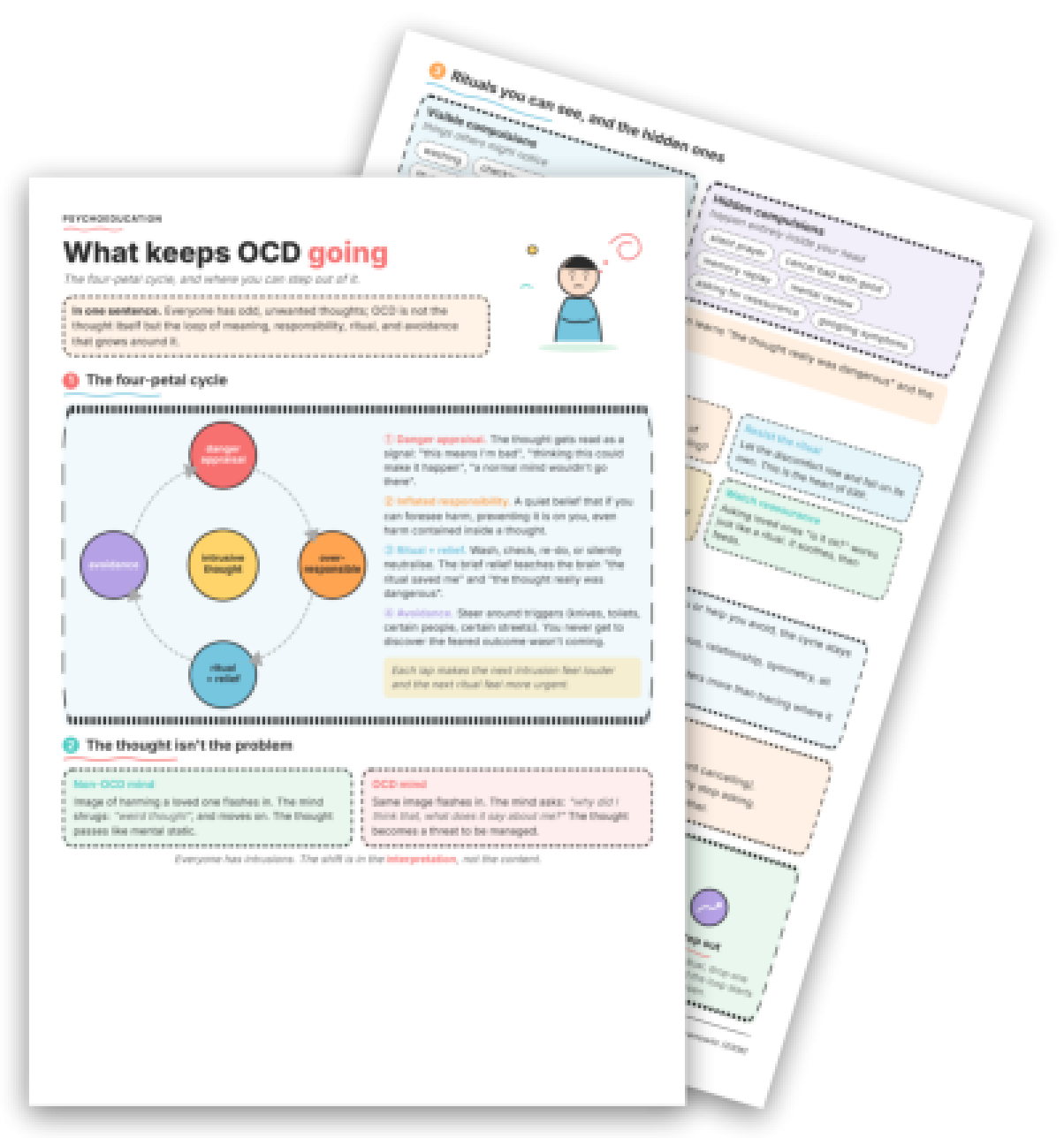
A printable fiche PDF mapping the four-petal maintenance cycle of OCD, with visual tools and exercises to support psychoeducation in clinical practice.
Clinical vignettes
Checking Rituals and the Relief Trap
Mental Neutralising Missed as a Compulsion
Clinical picture. T., a woman in her mid-twenties, had been assessed for generalised anxiety before being referred for a second opinion; she reported no visible rituals and her distress centred on recurrent intrusive images of harming a family member. What the initial assessment had not captured was a covert compulsion: each time an image arose, T. silently rehearsed a counter-image of herself being a caring person and mentally reviewed the previous day for evidence of bad intent. The clinician introduced the informational sheet on what keeps OCD going and pointed to the hidden-compulsion column, which T. read with visible recognition. She noted that the mental review gave relief for roughly ten minutes before the next intrusion arrived, consistent with the cycle described. Naming the covert ritual as a compulsion rather than a coping strategy was the first step in reframing the treatment target.
Explaining what keeps OCD alive is rarely the diagnostic challenge, patients often arrive knowing their rituals are irrational. The clinical problem is showing them, concretely, why insight alone breaks nothing. This fiche PDF gives you a visual scaffold to map the maintenance cycle in session and make the loop legible, not just named.
Use this resource with your patients
Handout, exercises and materials ready to use, right inside SessionFuel.
Why OCD's Maintenance Loop Resists Verbal Explanation
When you describe danger appraisal and inflated responsibility orally, patients usually nod. What they miss is the mechanical inevitability: how each step feeds the next so that the ritual, however brief its relief, guarantees a louder intrusion next time. Spoken explanation tends to flatten this into a list of features rather than a self-reinforcing system.
The same gap appears with hidden compulsions. Patients who understand "washing and checking" often have no framework for intrusive-thought neutralising rituals: silent cancelling, mental reviewing, or reassurance-seeking. They don't recognise these as compulsions, so they don't report them and you can't target them. A visual that places visible and hidden compulsions side by side changes that conversation immediately.
Thought-action fusion compounds the difficulty further. Until a patient sees the pathway from intrusion to appraisal to responsibility spike laid out as a sequence, they experience OCD as one undifferentiated state of wrongness rather than a loop they can step out of. The Thought-Action Fusion fiche addresses that specific cognition; the four-petal model provides the broader architecture.
750+ clinical tools
A library built with and for clinicians, ready to use in session and extend between appointments.
Access all the toolsWhat the Fiche Contains: A Visual Map of the Four-Petal Cycle
The fiche is organised across five labelled panels, grounded in the Salkovskis (1985) and Rachman (1997) formulations of OCD maintenance.
Panel 1 diagrams the four-petal cycle itself: intrusive thought, danger appraisal, inflated responsibility, ritual + relief, and avoidance feeding back into the loop. The circular layout makes the self-reinforcing logic visible in a way no verbal account matches.
Panel 2 contrasts the non-OCD mind and the OCD mind head to head: "The mind shrugs: 'weird thought', and moves on" versus the same image becoming "a threat to be managed." This paired format normalises intrusions without minimising distress, and is often the first moment patients feel genuinely less pathologised.
Panel 3 separates visible compulsions (washing, checking locks, re-reading, ordering) from hidden compulsions (silent prayer, memory replay, mental review, googling symptoms, reassurance-seeking). Seeing both columns together is frequently when patients first name a covert ritual they had never labelled as one.
Panel 4 maps six specific break points: re-labelling the thought, testing the danger appraisal, resisting the ritual, dropping one avoidance, spotting mental rituals, and watching reassurance. These map directly onto ERP targets and bridge naturally into building an exposure hierarchy in the subsequent phase.
Panel 5 condenses three clinical facts worth stating aloud: family accommodation keeps the cycle fed; the theme varies but the machinery is identical across contamination, harm, religious, and symmetry OCD; tracing the origin matters less than dismantling what keeps it running today.
A "To discuss in session" block closes the fiche with three conversation starters tied to hidden rituals, reassurance-seeking, and choosing the first avoidance to drop.
> Key point: The fiche is a visual support that facilitates your explanation in session, not a self-guided questionnaire. Its value is the shared reference it creates while you talk through the cycle together; the patient leaves with a concrete map, not a completed form.
Use it with your patients
Share this tool in the mobile app and follow the work between sessions.
When and How to Introduce the Fiche
This resource fits best at the formulation stage: after an initial picture of intrusions, rituals, and avoidance has emerged, perhaps following a first pass with the OCD symptoms checklist, and before moving to active ERP. Introducing it too early, before the patient has found their own language for the experience, can feel generic.
A useful opener: "I'd like to show you a diagram that captures what we've been describing, it often makes the pattern feel less like a personal failing and more like a system." This framing moves toward mechanism without labelling.
Walk through the cycle using the patient's own examples rather than the fiche's generic ones. Pause on the visible versus hidden compulsions panel and ask directly about mental reviewing and reassurance-seeking, most patients with checking and certainty-seeking patterns have more covert rituals than they initially report. The reassurance-seeking exercise can then follow as structured between-session work once the pattern is named.
One practical limit: for patients with high magical ideation, the "test the danger" break point can temporarily spike anxiety if introduced before a solid ERP rationale is in place. Pair it with a habituation explanation and, where indicated, the Theory A / Theory B frame.
After the session, the OCD therapy blueprint provides the full treatment roadmap, and the OCD compulsion stopping criterion exercise builds directly on the vocabulary the fiche establishes. The fiche does not carry the treatment; it makes the explanation stick.
Your session continues in your patients' pocket
Use with a patientYour resources, available everywhere
The handouts, exercises, programs and audios above: you choose which ones to make available to your patients, in the mobile app dedicated to them.
And far more than a library
The app goes well beyond resources, to support your patients every day:
Related categories
Explore other clinical resources by category.

Anxiety
Clinical hub for anxiety disorders: CBT and ACT worksheets, psychoeducation sheets, and exercises for assessment and treatment across the anxiety spectrum.

Understand
Clinical hub for the therapeutic aim 'Understand': worksheets and tools to build patient insight across CBT, ACT, schema therapy and more.

Build awareness
Clinical worksheets and tools to build awareness in therapy: cognitive distortions, schemas, emotions, ACT and CBT resources for practitioners.

CBT
CBT worksheets, cognitive restructuring exercises & behavioral tools for clinicians. Evidence-based resources for every phase of cognitive behavioral therapy.

Trauma
Clinical hub on trauma and PTSD: assessment, differential diagnosis, treatment phases, and printable resources for practitioners. 155 chars.

Mood
Evidence-based worksheets and clinical tools for mood disorders: CBT, ACT, and positive psychology resources for psychologists and therapists.