
Clinical picture. M., a man in his mid-forties, presented with persistent health-related death anxiety following a benign cardiac arrhythmia diagnosed two years prior. He reported spending up to an hour each evening checking his pulse, searching symptoms online, and asking his wife for reassurance, then lying awake rehearsing worst-case scenarios about his children's future. The clinician introduced the four-petal model using the informational sheet, inviting M. to map the previous evening onto each loop rather than exploring the origin of the fear. M. identified all four petals active within a single two-hour window and noted, unprompted, that the reassurance he sought from his wife left him feeling more anxious by the following morning. This concrete mapping shifted the focus from why the fear existed to which loops were sustaining it, and M. agreed to target pulse-checking first as the most discrete and modifiable behaviour.
What Keeps Death Anxiety Going: PDF Worksheet, Tools and Exercises
A printable PDF fiche, clinical tools, and exercises to map death anxiety's four maintaining loops and make the formulation concrete in session.
Clinical vignettes
Four Petals Active in One Session
Avoidance List Quietly Expanding
Clinical picture. R., a woman in her early sixties, was referred after declining a close friend's funeral and subsequently withdrawing from a book club whose members had recently discussed a terminal diagnosis. She did not frame her difficulties as death anxiety, describing instead a vague sense of dread and an accumulating list of situations she preferred to sidestep. Using the informational sheet, the clinician introduced the concept of the avoidance petal and asked R. to write out every context she had avoided in the past six months; the list covered two columns. R. recognised that short-term relief had been reliable and that this reliability was precisely what had kept the list growing. No exposure work was agreed in that session; the psychoeducational step alone prompted R. to name the pattern as a maintenance mechanism rather than a reasonable precaution, which she described as a shift in how she understood her own behaviour.
When a patient presents with death anxiety, the explanatory model you reach for orally rarely lands cleanly. Patients hear that fear of death is rational, because it is, which makes it harder for them to see how their own behaviors are quietly amplifying it. This fiche PDF gives you a structured visual to make that maintaining logic concrete inside the session.
Use this resource with your patients
Handout, exercises and materials ready to use, right inside SessionFuel.
Why the maintaining loops resist verbal explanation
Death anxiety occupies an uncomfortable clinical middle ground: it feels both entirely rational and somehow embarrassing. When you sketch maintenance cycles on a whiteboard or describe them conversationally, patients tend to hear a description of their distress rather than a map of what they are actively doing to keep the fear alive.
The core difficulty is that each of the four maintaining loops provides short-term relief. Pulse-checking after a skipped heartbeat feels like responsible self-care. Googling a symptom feels like problem-solving. Asking a partner for reassurance feels like connection. Without a visual that names these as anxiety-feeding behaviors, your explanation lands as criticism rather than formulation, and the patient's defensiveness goes up before the insight has any chance to take hold.
This is compounded when safety behaviors or reassurance-seeking are already structured within a health anxiety presentation, a common overlap documented in Salkovskis's work on checking and certainty-seeking.
What the fiche contains, and what the visual layout shows that words cannot
The fiche opens with one precise sentence: "A normal worry about dying becomes a daily anxiety problem when four loops... quietly feed the fear back." That framing normalizes before naming pathology, which is exactly the sequence that protects the alliance.
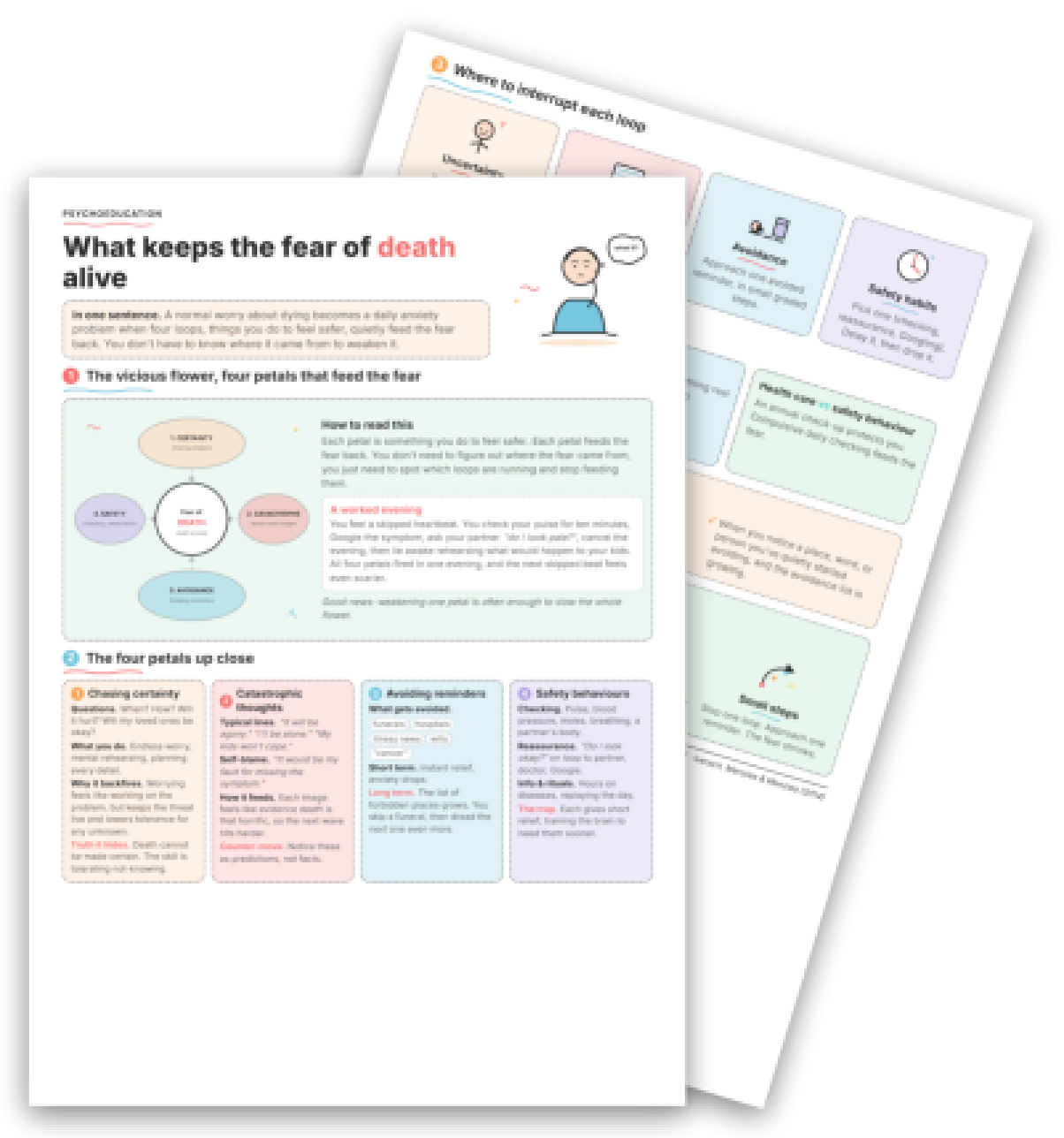
The central image is the "vicious flower": a petal diagram with fear of death at its core, surrounded by four petals labeled certainty-chasing, catastrophic imagery, avoidance, and safety behaviors. Seeing all four loops arranged simultaneously around a single hub makes the formulation argument visually undeniable in a way that a spoken list never does. The spatial logic, every petal feeds back to the centre, registers immediately.
Each petal then gets its own panel, structured consistently: what the patient does, why it backfires, and a counter-move. For catastrophic thoughts, the counter-move is: "Notice these as predictions, not facts." For certainty-chasing: drop the worry session and practise leaving questions unanswered. A worked scenario, a single skipped heartbeat triggering all four petals in one evening, ending in "the next skipped beat feels even scarier", shows concretely how the loops compound each other in real time.
A final panel maps four interruption points, one per loop, each framed as a specific behavioral action rather than an insight. The fiche also carries three distinctions, mortality awareness vs death anxiety, grief vs the loop, and annual health care vs compulsive checking, that pre-empt the objections patients invariably raise. The "To discuss in session" prompts at the bottom double as a ready-made agenda for the following appointment.
> To remember: this fiche is a visual support that facilitates the explanation of death anxiety's maintaining mechanisms in session. It is not a self-administered questionnaire; it is a shared formulation tool the clinician uses to make a complex model instantly readable, and that leaves the patient with a concrete reference to return to between appointments.
750+ clinical tools
A library built with and for clinicians, ready to use in session and extend between appointments.
Access all the toolsWhen and how to introduce it
Introduce the fiche once you have a working formulation and the patient has described at least one specific episode. A useful framing: "I'd like to show you something that maps what tends to keep fear of death active, it might help us name which part fits your situation most." Avoid flagging it as a psychoeducation sheet; present it as a way of looking at the problem together.
It works particularly well with patients who enter through health anxiety or intrusive catastrophizing, where the overlap with the CBT model of health anxiety is already explicit. It also fits naturally before building an exposure hierarchy or moving into graded exposure to death-related reminders.
Debrief by asking which petal fired most recently, not which feels most familiar in the abstract, behavioral specificity anchors the discussion faster. When intolerance of uncertainty appears to be the primary driver, the fiche pairs directly with a dedicated uncertainty tolerance program. Where the avoidance list has grown significantly, changing avoidance work and the catastrophic worry reframing tool are the logical next steps.
One caution: with patients in acute grief, use the fiche's own distinction between grief and the maintaining loop before introducing the petal model. Naming current distress as a "loop" prematurely risks misattunement and a rupture that costs more time than it saves.
The fiche does not replace the therapeutic frame; it makes the explanation stick.
Use it with your patients
Share this tool in the mobile app and follow the work between sessions.
Sources
- Menzies, R. E., Julien, A., Sharpe, L., Menzies, R. G., Helgadottir, F. D., Dar-Nimrod, I. (2023). Overcoming Death Anxiety: A Phase I Trial of an Online CBT Program in a Clinical Sample. Behavioural and Cognitive Psychotherapy.
- Salkovskis, P. M. (1991). The Importance of Behaviour in the Maintenance of Anxiety and Panic: A Cognitive Account. Behavioural and Cognitive Psychotherapy.
- Dugas, M. J., Robichaud, M. (2007). Cognitive-Behavioral Treatment for Generalized Anxiety Disorder: From Science to Practice. Routledge.
Your session continues in your patients' pocket
Use with a patientYour resources, available everywhere
The handouts, exercises, programs and audios above: you choose which ones to make available to your patients, in the mobile app dedicated to them.
And far more than a library
The app goes well beyond resources, to support your patients every day:
Related categories
Explore other clinical resources by category.

Anxiety
Clinical hub for anxiety disorders: CBT and ACT worksheets, psychoeducation sheets, and exercises for assessment and treatment across the anxiety spectrum.

Understand
Clinical hub for the therapeutic aim 'Understand': worksheets and tools to build patient insight across CBT, ACT, schema therapy and more.

Build awareness
Clinical worksheets and tools to build awareness in therapy: cognitive distortions, schemas, emotions, ACT and CBT resources for practitioners.

CBT
CBT worksheets, cognitive restructuring exercises & behavioral tools for clinicians. Evidence-based resources for every phase of cognitive behavioral therapy.

Trauma
Clinical hub on trauma and PTSD: assessment, differential diagnosis, treatment phases, and printable resources for practitioners. 155 chars.

Mood
Evidence-based worksheets and clinical tools for mood disorders: CBT, ACT, and positive psychology resources for psychologists and therapists.