
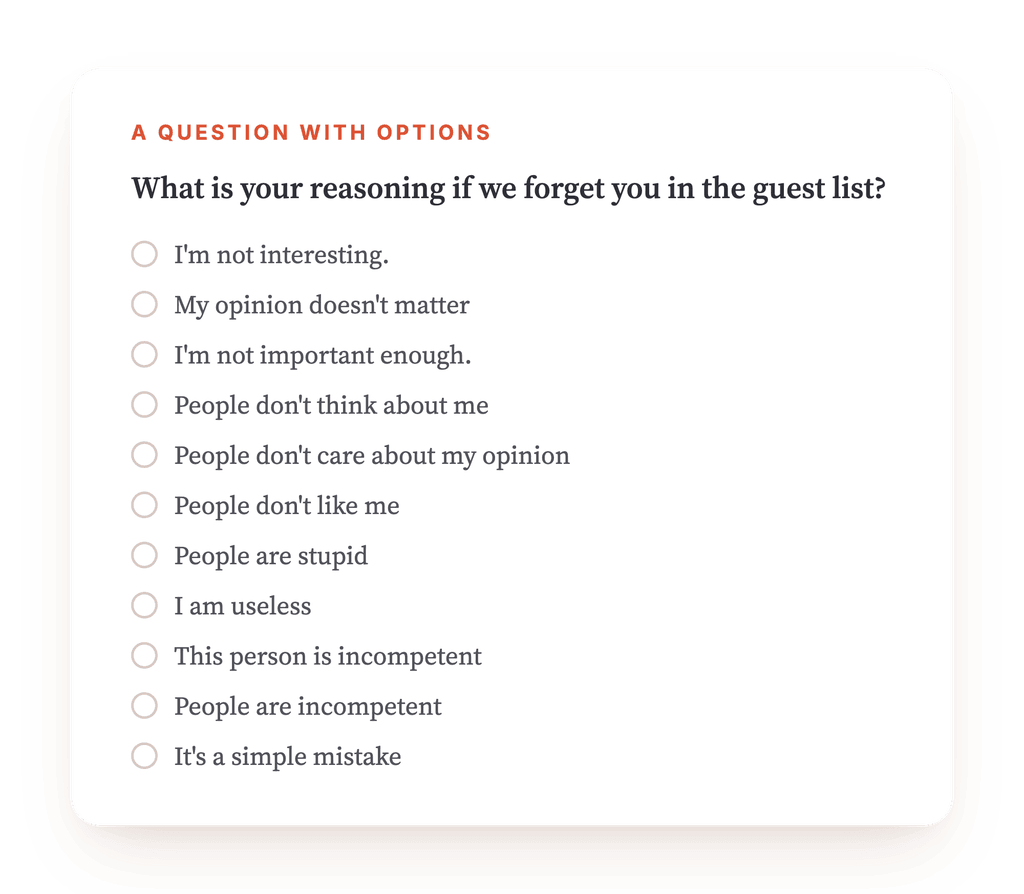
Clinical picture. M., a 34-year-old professional presenting with generalised anxiety, reported chronic worry about workplace performance and a persistent sense of being undervalued by colleagues. Between the first and second appointments, she completed Lesson 1 of the psychoeducation program, which invited her to identify automatic reasoning patterns using a concrete scenario (being left off a meeting invitation list). She returned having selected "my opinion does not matter" and, in the open-ended prompts, had written that childhood expectations of academic perfection were a likely source of this belief. The clinician used her written responses as a starting point for a collaborative functional analysis, without introducing new psychoeducational content during the appointment itself. M. noted that simply naming the belief as a hypothesis rather than a fact had reduced her avoidance of team discussions over the preceding week.
Anxiety and Limiting Beliefs: A 5-Lesson Clinical Program
A structured psychoeducation program helping patients identify, challenge, and replace the core beliefs that fuel their daily anxiety, lesson by lesson.
Clinical vignettes
Recognising a Limiting Belief in Session
Approval-Seeking Patterns Surfaced Through Lesson 2
Clinical picture. T., a 28-year-old presenting with social anxiety and low self-esteem, had a longstanding pattern of deferring to others' preferences and minimising his own needs. After completing Lesson 2 of the program, which addresses the tendency to grant excessive influence to others' judgements, he flagged several items in the self-assessment checklist, including "I need to be liked" and "I attach importance to what others think of my choices." He brought the completed lesson to the session, which gave the clinician a concrete, patient-generated account of his approval-seeking rather than a retrospective verbal summary. A brief discussion followed around one recent situation where he had changed a personal decision after an ambiguous comment from a friend; no formal restructuring was attempted at this stage, as the program's next lesson was expected to introduce that step.

Use this resource with your patients
Handout, exercises and materials ready to use, right inside SessionFuel.
What Makes Limiting Beliefs So Hard to Address in Therapy
Limiting beliefs sit beneath the surface of anxious thinking. Most patients arrive knowing they overthink or catastrophize, but they rarely see the layer underneath: the silent convictions about themselves, others, and the world that make automatic thoughts almost inevitable. Explaining this verbally is rarely enough. The belief feels like reality, not a hypothesis, and a purely oral explanation tends to slide off it.
What makes this particularly tricky is the breadth of the territory. Approval-seeking, fear of incompetence, distrust of others, perfectionist imperatives, each is a distinct cluster with its own emotional signature and its own maintaining loop. Covering all of them in a single consultation, with enough depth for genuine insight, is simply not realistic. Patients also need time to sit with each domain, apply it to their own experience, and begin constructing an alternative.
This is exactly the gap this program fills.
750+ clinical tools
A library built with and for clinicians, ready to use in session and extend between appointments.
Access all the toolsWhat the Program Contains
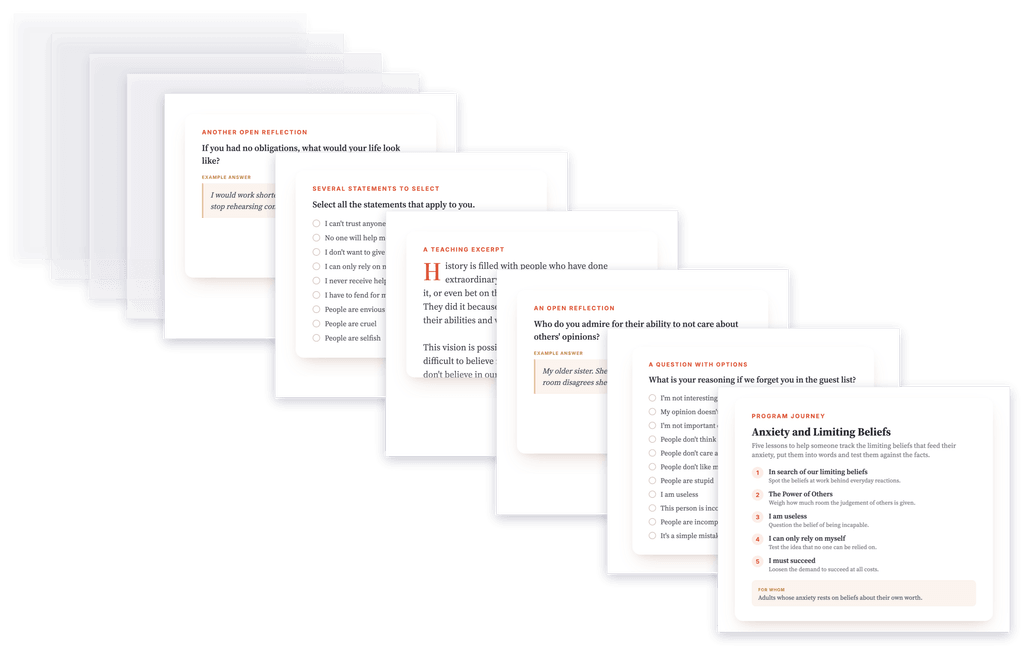
Anxiety and Limiting Beliefs is a five-lesson structured curriculum that guides patients through the major limiting-belief clusters linked to anxiety, one step at a time.
Lesson 1 lays the conceptual groundwork: what a belief is, how it functions as a reasoning habit, and where beliefs come from (developmental conditioning, early environment). Patients explore their "dream life" and name what blocks them, a first, personal contact with their own core beliefs.
Lessons 2 through 5 each address a specific belief domain. Lesson 2 targets approval-seeking and fear of judgment, the tendency to hand others too much power over one's self-worth, closely connected to the approval-seeking schema. Lesson 3 tackles self-doubt and feelings of incapacity, themes you will recognize from the failure schema and Fennell's CBT model of low self-esteem. Lesson 4 addresses mistrust and the belief that one can only rely on oneself, overlapping with the social isolation schema and mistrust/abuse schema. Lesson 5 focuses on perfectionism and the imperative to succeed, terrain also mapped by the unrelenting standards schema and the Cognitive Behavioral Model of Perfectionism.
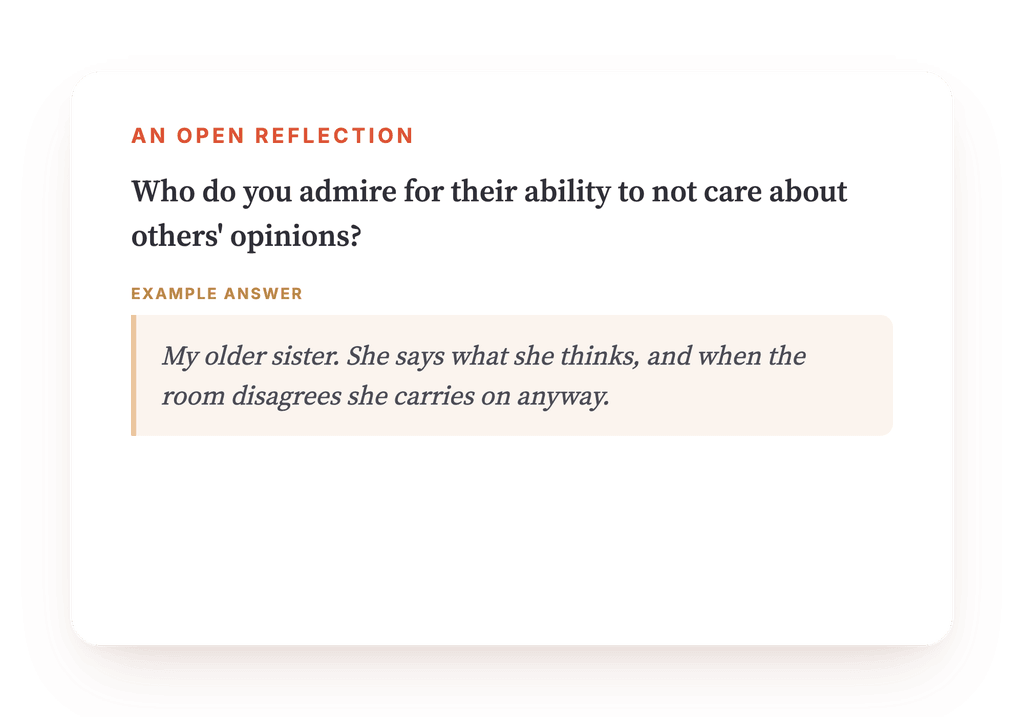
Each lesson follows the same arc: psychoeducation text, a multiple-choice self-assessment helping patients recognize which beliefs apply to them, open reflection prompts (dream life, role models, what they would say to a friend), emotional impact questions, and finally a new-belief selection step where patients actively choose alternative convictions they want to move toward. This last step is clinically significant: it is not abstract reframing but a concrete, chosen commitment that gives the next phase of work a real target.
This program is available to your patients through the patient mobile application of SessionFuel: you assign it directly from your SessionFuel account, and your patient works through each lesson autonomously on their phone, between your appointments.
The previews embedded here (overview map and sample lesson cards) show only a small fraction of the program. The complete curriculum contains far more lessons, steps, guided prompts, and multiple-choice exercises than what these excerpts reveal.
Key insight: The program does not just psychoeducate, it produces patient-generated material: chosen alternative beliefs, named role models, personal blockers, and emotional maps that belong to the patient and are ready to bring back to therapy.
Use it with your patients
Share this tool in the mobile app and follow the work between sessions.
Integrating It as Between-Session Work
Assign this program between two consultations once you have introduced the concept of limiting beliefs and the patient has begun to locate their anxious thinking in a cognitive model or cognitive case formulation.
It suits patients dealing with generalized anxiety, social anxiety, low self-esteem, or perfectionism who have enough cognitive access to work with self-reflection. It pairs naturally with tools like Deeper Core Beliefs or the Downward Arrow Technique if you want to deepen specific belief layers during your sessions.
When you assign it, frame it simply: the patient works through one or two lessons on their own, at their own pace, and brings what they produce back to the next appointment. At that point, the new-belief selections and reflection prompts become direct clinical material. Which alternative belief did they choose, and does it feel reachable? Which domain felt most charged? These responses let you move straight into cognitive restructuring or schema work without spending half the session reconstructing context.
For patients working on the perfectionism cluster (Lesson 5), the Demanding Standards and Clinical Perfectionism fiches make strong in-session complements. For those whose Lesson 2 material points toward a strong approval-seeking pattern, the Approval-Seeking in Therapy structured exercise can extend that reflection further.

Your session continues in your patients' pocket
Use with a patientYour resources, available everywhere
The handouts, exercises, programs and audios above: you choose which ones to make available to your patients, in the mobile app dedicated to them.
And far more than a library
The app goes well beyond resources, to support your patients every day:
Related categories
Explore other clinical resources by category.
Anxiety
Clinical hub for anxiety disorders: CBT and ACT worksheets, psychoeducation sheets, and exercises for assessment and treatment across the anxiety spectrum.

Identity
Clinical resources for self-identity work in therapy: CBT, ACT, schema tools for clinicians addressing self-concept, core beliefs, and identity disruption.

Cognition
Printable cognitive therapy worksheets and clinical tools for therapists: CBT, ACT, schema work, defusion, distortions, and belief restructuring.

Build awareness
Clinical worksheets and tools to build awareness in therapy: cognitive distortions, schemas, emotions, ACT and CBT resources for practitioners.

Restructure
Clinical hub for cognitive restructuring worksheets: distortion identification, belief disputation, ABC model, and schema work for evidence-based practice.

CBT
CBT worksheets, cognitive restructuring exercises & behavioral tools for clinicians. Evidence-based resources for every phase of cognitive behavioral therapy.