
Clinical picture. A, a 34-year-old professional with recurrent depressive episodes, reported intense shame after a team meeting in which a colleague said little and avoided eye contact. A was certain the colleague found his presentation incompetent, and this conviction was sustaining avoidance of future meetings. The clinician introduced the five-question exercise as a between-session task, asking A to describe the assumed thought and the emotions it triggered, then to list the observable behaviours that had fed that reading. Working through questions three and four, A identified that the colleague had recently been managing a personal difficulty, and acknowledged a longstanding sensitivity to perceived professional inadequacy rooted in early academic experiences. By the follow-up session, A had not yet spoken to the colleague but had drafted a brief, neutral message to check in; the exercise had loosened the certainty of the original interpretation enough to make that step feel manageable.
Mind-Reading Distortion: A Guided Restructuring Exercise
A five-question between-session exercise helping patients examine assumed thoughts, surface alternative readings, and test their interpretations.
Clinical vignettes
Testing an Assumed Judgment at Work
Mind-Reading in a Close Relationship
Clinical picture. M, a woman in her late twenties presenting with generalised anxiety, described a dinner at which her sister had been quiet and had left earlier than usual. M was convinced her sister was angry with her for something said weeks before, and the rumination was disrupting her sleep. Her therapist assigned the guided exercise, and M completed it in writing before the next appointment. Answering question two, she noted that her sister had also been checking her phone frequently, a behaviour she had not consciously registered until she wrote it down. Question five prompted her to consider a brief text message to her sister rather than waiting; her sister replied the same evening mentioning work stress, with no reference to any tension between them. M brought the completed worksheet to session, and the therapist used it to examine the pattern of jumping to relational threat as a default reading.
Why Mind-Reading Is So Difficult to Shift in Therapy
Mind-reading sits at the heart of many of the presentations you see week after week: social anxiety, relational conflict, chronic shame, anticipatory avoidance. The patient who says "I know exactly what she thought of me" has, from their own vantage point, no problem to solve. Their interpretation feels like perception, not inference. That is precisely what makes it so resistant to verbal challenge alone.
You can explain how mind-reading works as a cognitive distortion in session, show the jumping-to-conclusions mechanism on a worksheet, even walk through the distinction between fact and interpretation. Yet when the moment passes, the certainty tends to reassert itself. What clinicians need is a structure patients can apply as the distortion is happening, on their own, when you are not in the room.
This exercise is available to patients through the mobile patient app of SessionFuel: once you assign it, your patient completes the five questions directly on their phone, between consultations, without any input needed from you at that stage.
Use this resource with your patients
Handout, exercises and materials ready to use, right inside SessionFuel.
What the Exercise Contains
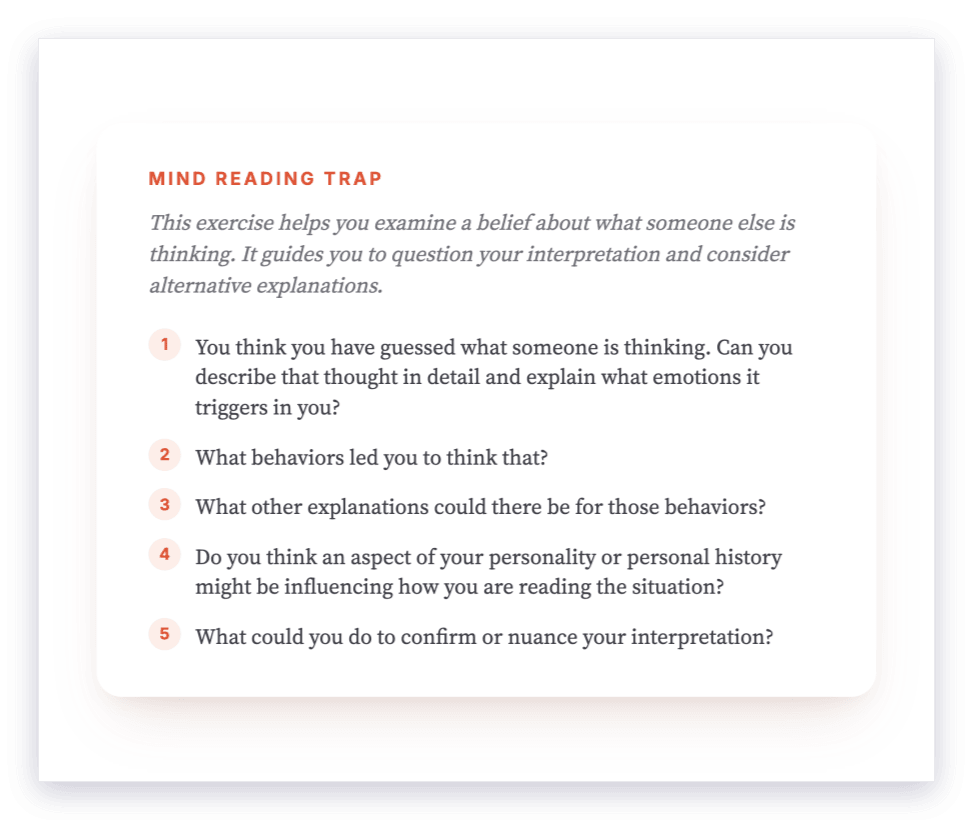
The image above lists the five questions in order. Note that this is a static preview only: the full guided experience, with patient-facing instructions and space to write, is delivered autonomously by the patient inside the SessionFuel patient app, not on this page.
The first question asks the patient to articulate the assumed thought and its emotional weight. This step alone is clinically valuable: many patients have never put the content of the assumed thought into words. The second question shifts from conclusion to evidence, asking which specific behaviors actually prompted the interpretation. This mirrors the Socratic move you would make in session, as described in Socratic questioning technique, but the patient generates it independently.
Question three invites alternative explanations, pushing the patient away from the single-track reading that characterises mind-reading. Question four goes one level deeper, asking whether personality or personal history might be colouring the read. This is where schema-level material can surface naturally, connecting to work on interpersonal beliefs and relational styles or, with the right patients, to earlier core belief work. The fifth question closes the loop with a behavioral commitment: what concrete step could the patient take to check or nuance the interpretation?
Key insight: The exercise does not ask the patient to decide their interpretation is wrong. It asks them to hold it as a hypothesis, which is a far more achievable and clinically honest demand.
The sequence moves from emotional awareness to evidence-gathering to perspective-taking to personal attribution to action. That arc maps directly onto perspective-taking work and the restructuring logic of tools like the five-column thought record.
750+ clinical tools
A library built with and for clinicians, ready to use in session and extend between appointments.
Access all the toolsUse it with your patients
Share this tool in the mobile app and follow the work between sessions.
Integrating This as Between-Session Work
This exercise suits a wide range of patients: those with social anxiety (see the stages of social anxiety model for context), patients with relational conflict or chronic mistrust, and anyone whose distress is frequently driven by emotional reasoning, where the feeling of certainty is taken as proof of accuracy.
Introduce it after you have named mind-reading together in session, ideally with a shared reference such as the mind-reading PDF worksheet or the broader arbitrary inference fiche. A natural prompt: "Next time you notice yourself certain about what someone was thinking, I'd like you to open the exercise before the feeling settles into fact."
Assign it between sessions, after a relevant clinical moment has been identified together. When the patient returns, their written answers become the raw material: you can examine which alternative explanations they generated (or struggled to generate), whether the personal-history question opened anything unexpected, and whether the behavioral step they chose was actually taken. Patients who found question three difficult often signal a rigidity worth exploring further, perhaps with cognitive distortions work or fact-versus-opinion exercises. Those who found question four uncomfortable may be close to schema-level material.
The exercise also pairs naturally with challenging automatic thoughts and cognitive restructuring sequences already running in your treatment plan. It is a focused, reusable tool: the same patient can complete it across several different episodes, building a pattern you can analyse together over time.
Your session continues in your patients' pocket
Use with a patientYour resources, available everywhere
The handouts, exercises, programs and audios above: you choose which ones to make available to your patients, in the mobile app dedicated to them.
And far more than a library
The app goes well beyond resources, to support your patients every day:
Related categories
Explore other clinical resources by category.

Behaviours
Clinical hub for behaviors in therapy: worksheets and tools for coping, eating disorders, CBT formulation, and maladaptive behavioral patterns.

Relationships
Clinical worksheets and tools on relational functioning: attachment, schemas, assertiveness, and communication skills for therapists. Printable PDF resources.

Cognition
Printable cognitive therapy worksheets and clinical tools for therapists: CBT, ACT, schema work, defusion, distortions, and belief restructuring.

Build awareness
Clinical worksheets and tools to build awareness in therapy: cognitive distortions, schemas, emotions, ACT and CBT resources for practitioners.

Restructure
Clinical hub for cognitive restructuring worksheets: distortion identification, belief disputation, ABC model, and schema work for evidence-based practice.

CBT
CBT worksheets, cognitive restructuring exercises & behavioral tools for clinicians. Evidence-based resources for every phase of cognitive behavioral therapy.