
Clinical picture. A, a man in his late twenties, presents with social anxiety and a pattern of abrupt withdrawal from colleagues after perceived slights. In session, he describes leaving a team meeting early after noticing a coworker glance at her phone while he was speaking; his immediate conclusion was that she found him boring and wanted him to stop. The clinician introduced the informational sheet on jumping to conclusions and worked with A to identify this as a mind-reading episode, mapping it onto the sheet's framework: the trigger, the leap, and what he had skipped, namely any consideration that she might have been waiting on an urgent message. Over the following week A logged two similar episodes and noted, without prompting, that he had no way to verify either verdict. The behaviour of early withdrawal reduced modestly, and he agreed to test one alternative explanation before leaving a social situation.
Jumping to Conclusions: PDF Worksheet, Tools and Exercises
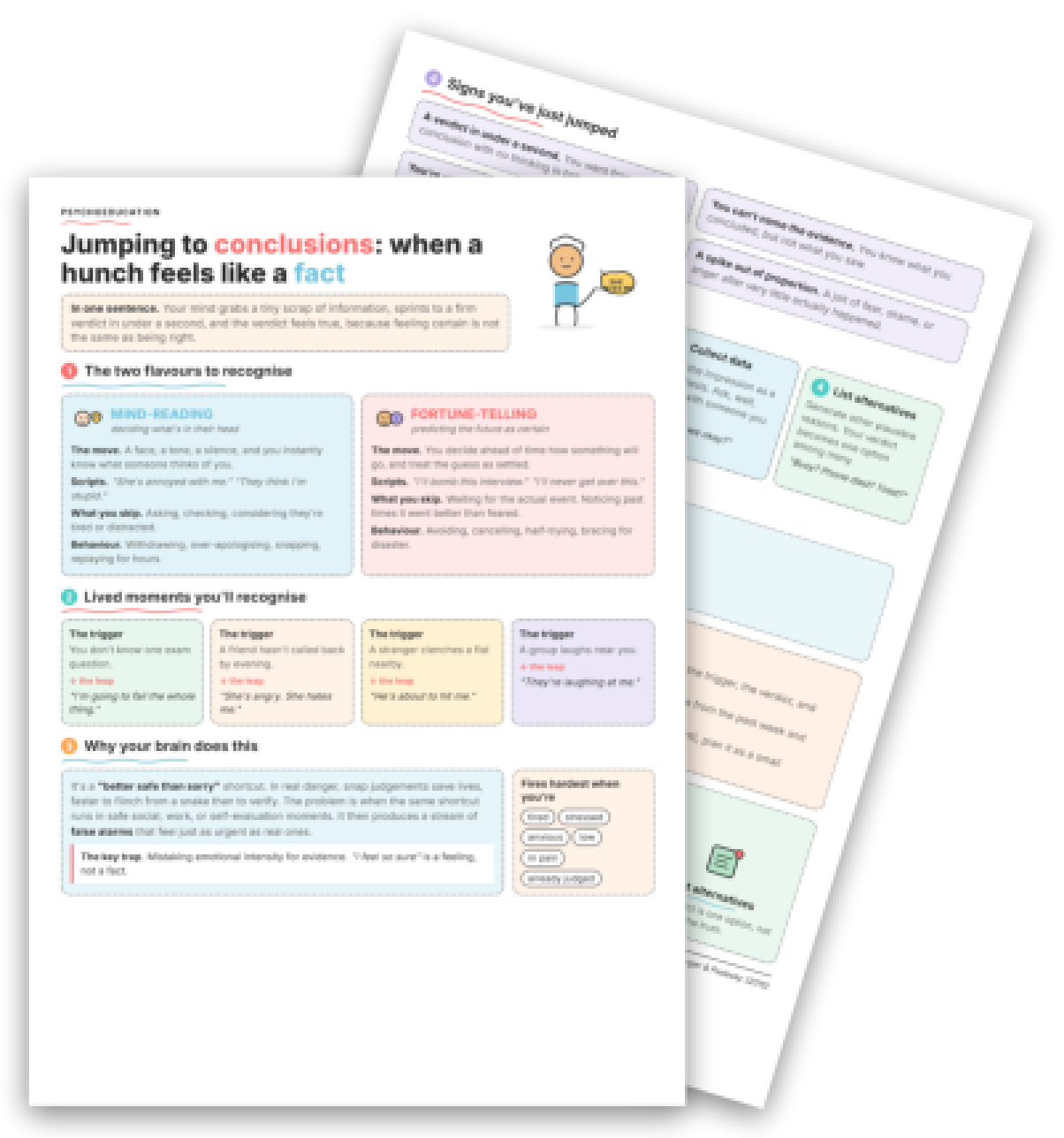
A psychoeducation PDF worksheet with visual panels, tools, and exercises to help clinicians explain mind-reading and fortune-telling clearly in session.
Clinical vignettes
Mind-Reading in Social Anxiety
Fortune-Telling Before a Job Interview
Clinical picture. R, a woman in her early forties recovering from a depressive episode, had cancelled two job interviews in as many months, each time reporting that she already knew she would perform poorly and embarrass herself. The clinician offered the jumping-to-conclusions sheet as a shared reference point, drawing her attention to the fortune-telling flavour and the observation that emotional intensity is not evidence. R recognised the script, noting she had used almost the same wording as the sheet's example: 'I'll bomb this.' She was asked to recall one past interview that had gone better than she had predicted; after a long pause she named one. The following appointment she reported attending a third interview; her prediction of failure had not materialised, though she remained cautious about reading too much into the outcome.
In CBT sessions, patients often nod when you name a cognitive distortion, then walk out still fusing with the very thought you just discussed. Jumping to conclusions is particularly resistant: the interpretive leap happens so fast, and the felt certainty so complete, that patients rarely register it as a cognitive event at all. This fiche PDF gives you a ready-made visual scaffold to slow that process down, right at the consultation table.
Use this resource with your patients
Handout, exercises and materials ready to use, right inside SessionFuel.
Why Jumping to Conclusions Is So Hard to Name in Session
The core difficulty isn't conceptual. It's phenomenological. When a patient mind-reads or fortune-tells, the conclusion doesn't feel like an inference; it feels like perception. Naming the distortion at an abstract level ("you're jumping to a conclusion") rarely loosens its grip. What actually helps is showing the micro-structure of the leap: trigger → instant verdict → behavior, with no visible thinking in between.
Oral explanation also tends to collapse two distinct sub-processes that warrant separate attention. Mind-reading ("she's annoyed with me") and fortune-telling ("I'll bomb this interview") share the same architecture but require different intervention targets. Without a visual that distinguishes both, patients leave session with a vague sense of "thinking too fast," rather than a precise clinical vocabulary they can deploy between appointments.
The problem intensifies wherever threat-detection runs chronically overactive: social anxiety, generalized anxiety disorder, low self-esteem, post-traumatic states. In these profiles, emotional reasoning ("I feel certain, so it must be true") fuses seamlessly with the leap and makes it feel irrefutable. That fusion is precisely what a single verbal explanation struggles to unpack.
What the Fiche Contains: A Visual Support for the Explanation
The fiche PDF maps the distortion across six structured panels, each targeting a distinct clinical lever.
- The two flavours: mind-reading (deciding what's in someone's head) and fortune-telling (treating a prediction as settled fact), each with typical scripts, what gets skipped, and the resulting behaviors.
- Lived moments: four trigger → leap pairings grounded in ordinary situations ("A friend hasn't called back by evening → 'She hates me'"), which patients can match to their own week far more readily than abstract descriptors.
- Why the brain does this: a brief neurobiological frame that positions the shortcut as a "better safe than sorry" heuristic, with a list of states that amplify it (tired, stressed, anxious, low, in pain, already judged).
- Signs you've just jumped: four behavioral and cognitive markers, including "you're already acting on it" and "a spike out of proportion".
- Four steps to slow the leap: notice and label, slow it down, collect data, list alternatives.
- Five questions to interrupt the leap, including "What facts go against it that I'm currently ignoring?"
The visual layout does something an oral explanation cannot: it externalizes the trigger → leap → behavior sequence as a spatial object the patient can point to, and it places the two sub-types side by side so their differences become immediately legible. A clinician can work through the panels selectively in session, then hand the fiche to the patient as a concrete reference for the coming week.
> Key takeaway: this fiche PDF is a psychoeducation support the clinician uses to explain jumping to conclusions during the session itself. It is not a self-administered questionnaire; it is a shared visual that builds a precise, usable vocabulary between clinician and patient.
750+ clinical tools
A library built with and for clinicians, ready to use in session and extend between appointments.
Access all the toolsWhen and How to Introduce the Fiche
This fiche fits naturally from the second or third session onward, once an automatic thought has surfaced in session and you want to contextualize it within a broader cognitive distortions framework. It pairs well with the CBT cognitive model and can precede more targeted work with a thought record or the fact-or-interpretation distinction.
A low-labeling introduction works best: "I'd like to show you something that might put a name on what's been happening for you." Avoid framing the patient as someone who jumps to conclusions; instead, present the fiche as a map of how the mind functions under pressure.
Work through panels 1 and 2 together in session. Ask which of the two flavours shows up most in their own experience. Panel 4 ("signs you've just jumped") functions well as a debrief tool after a recent activating event. Panels 5 and 6 can anchor between-session work: the mind-reading exercise and the fortune-telling exercise extend the fiche's four steps and five questions into structured homework. For patients ready for more targeted restructuring, the Arbitrary Inference worksheet offers a complementary clinical lens.
One practical limit: for patients in acute distress or early in the therapeutic alliance, panel 3 ("why the brain does this") can inadvertently feel minimizing. Introduce the neurobiological frame only once safety and validation are solidly in place.
The fiche doesn't replace the formulation; it makes one piece of it visible, portable, and usable between sessions.
Use it with your patients
Share this tool in the mobile app and follow the work between sessions.
Sources
- Burns, D. D. (1980). Feeling Good: The New Mood Therapy. William Morrow.
- Beck, A. T., Rush, A. J., Shaw, B. F., Emery, G. (1979). Cognitive Therapy of Depression. Guilford Press.
Your session continues in your patients' pocket
Use with a patientYour resources, available everywhere
The handouts, exercises, programs and audios above: you choose which ones to make available to your patients, in the mobile app dedicated to them.
And far more than a library
The app goes well beyond resources, to support your patients every day:
Related categories
Explore other clinical resources by category.

Anxiety
Clinical hub for anxiety disorders: CBT and ACT worksheets, psychoeducation sheets, and exercises for assessment and treatment across the anxiety spectrum.

Cognition
Printable cognitive therapy worksheets and clinical tools for therapists: CBT, ACT, schema work, defusion, distortions, and belief restructuring.

Understand
Clinical hub for the therapeutic aim 'Understand': worksheets and tools to build patient insight across CBT, ACT, schema therapy and more.

Build awareness
Clinical worksheets and tools to build awareness in therapy: cognitive distortions, schemas, emotions, ACT and CBT resources for practitioners.

CBT
CBT worksheets, cognitive restructuring exercises & behavioral tools for clinicians. Evidence-based resources for every phase of cognitive behavioral therapy.

Trauma
Clinical hub on trauma and PTSD: assessment, differential diagnosis, treatment phases, and printable resources for practitioners. 155 chars.