
Clinical picture. M., a 38-year-old project manager, presented with a moderate depressive episode and a persistent belief that he was performing poorly at work, despite no formal complaints from his employer. During a session focused on cognitive patterns, the clinician introduced the psychoeducation sheet on attentional and memory filtering, pointing out the asymmetry between how negative events are encoded versus how neutral or positive ones pass unregistered. M. recognised the pattern immediately when reading the memory example: asked to recall his week, he had spontaneously listed two errors and drawn a blank on the positive feedback he had received the day before. The clinician used this live observation as an anchor rather than an argument, inviting M. to treat the sheet as a reference between sessions. At the next appointment M. reported modest but genuine surprise at finding, when he actively searched, that good moments had in fact occurred.
Thoughts and Depression: PDF Worksheet, Tools and Exercises
A visual psychoeducation fiche helping clinicians explain the depressive cognitive filter in session and give patients a concrete reference to take home.
Clinical vignettes
Selective Recall in a Depressed Professional
Neutral Messages Read as Rejection
Clinical picture. A., a 52-year-old woman being seen for recurrent depression, described increasing social withdrawal over the preceding two months, linked in part to a growing conviction that friends had lost interest in her. The clinician introduced the psychoeducation sheet to name the interpretive bias rather than challenge her conclusions directly, focusing on the illustration of a neutral text message read as cold or dismissive. A. paused at the phrase "the feeling of truth is the bias doing its job" and said it captured something she had not been able to articulate before. She did not immediately revise her beliefs, which was expected at this stage, but she began distinguishing between "I feel certain they are annoyed" and "I am reading the message through the filter." That small linguistic shift became a workable entry point for subsequent sessions.
Explaining the depressive cognitive filter verbally is one of those things that sounds convincing in session and evaporates by the following week. Patients agree, nod, and still come back treating their harshest automatic thoughts as verified facts. This fiche PDF gives you a concrete visual anchor for that conversation, so the mechanism stays visible long after the session ends.
Use this resource with your patients
Handout, exercises and materials ready to use, right inside SessionFuel.
Why the depressive filter resists oral explanation
The core difficulty is not conceptual, it is experiential. When a patient is inside the filter, it does not feel like a distortion: it feels like accurate perception. Telling them that depression selectively amplifies negative thoughts tends to land as invalidating rather than illuminating, because their inner experience contradicts it. The standard TCC account of selective attention, interpretive bias, and memory bias (the three mechanisms documented in Gotlib and Joormann's work on depression and cognition) is clinically precise but hard to make visceral in a spoken exchange.
A side effect you will recognise: patients who intellectually accept the filter model still dismiss positive moments within hours and return to session with a week's worth of confirming evidence for their negative core beliefs. The model needs to be shown, not just explained.
750+ clinical tools
A library built with and for clinicians, ready to use in session and extend between appointments.
Access all the toolsWhat the fiche contains: a visual explanation for the filter
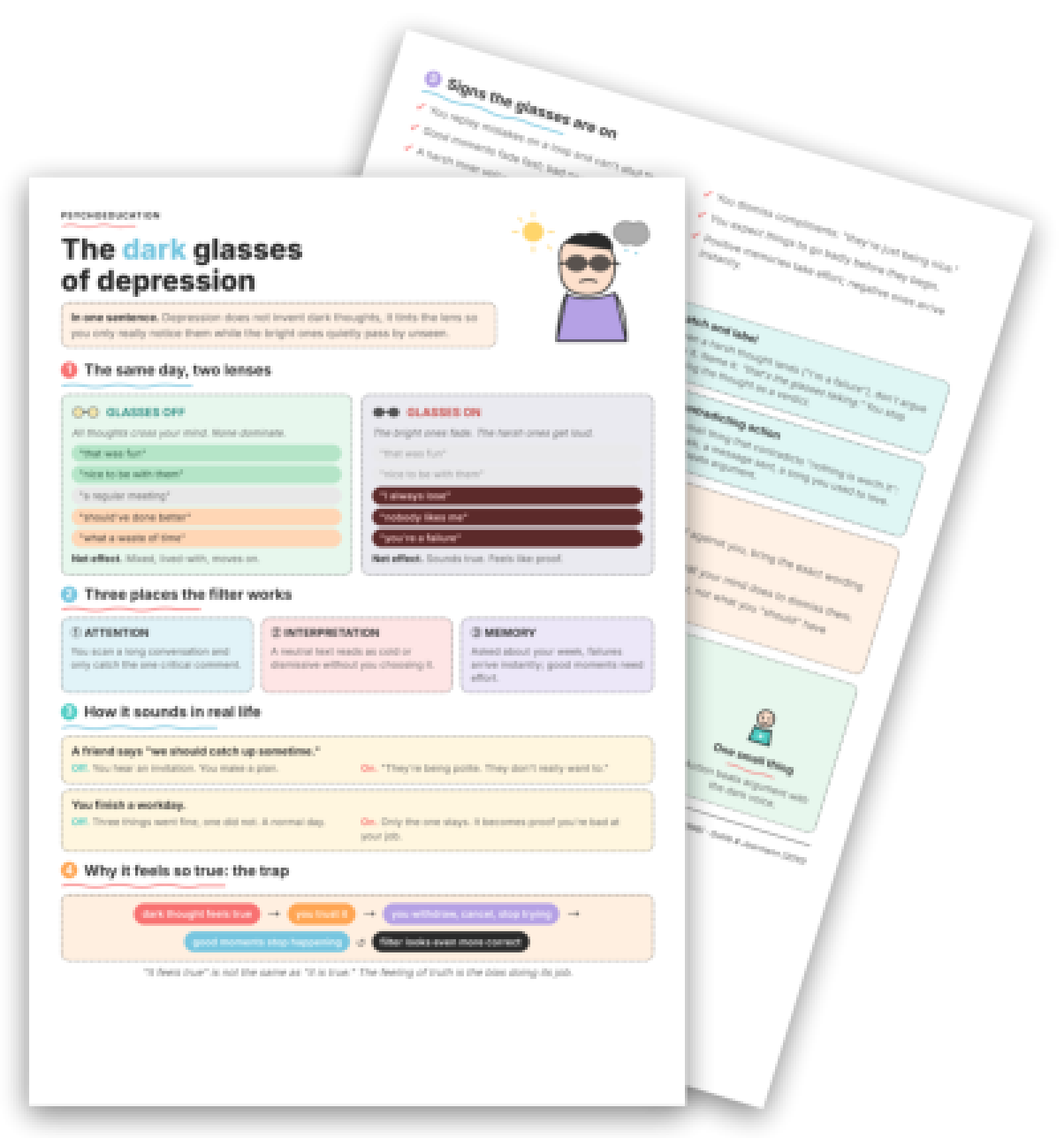
The fiche uses a "dark glasses" metaphor as its organising frame. Two side-by-side panels contrast the same day of thoughts, "that was fun," "nice to be with them," "should've done better", with and without the filter active. The "glasses on" panel shows how neutral and positive thoughts "fade" while harsh ones "get loud" and "feel like proof." That visual comparison does in a glance what ten minutes of oral explanation rarely achieves: it makes the asymmetry visible.
From there, the fiche maps three specific filtering mechanisms the clinician can walk through with the patient: attention (catching only the critical comment in a long conversation), interpretation (reading a neutral text as cold or dismissive), and memory (failures arriving instantly while good moments need real effort). This maps directly onto what Beck's original cognitive model and subsequent work on selective attention describe.
Section 4 presents the self-reinforcing trap as a looping diagram: dark thought feels true, the patient trusts it, withdraws and cancels, good moments stop happening, and the filter appears even more correct. This is the vicious cycle clinicians know well from the cycle of depression, and it is much easier to point to than to describe.
A checklist of six "signs the glasses are on" (replaying mistakes on a loop, dismissing compliments, positive memories requiring effort) gives both clinician and patient a shared vocabulary for monitoring. The fiche closes with four small rebalancing exercises (a three-things-at-day's-end log, a catch-and-label technique, a fairness question, and one contradicting action) and explicit session prompts for debriefing.
> Key point: This fiche is a visual support that facilitates the explanation of the depressive filter during the session itself. It is not a questionnaire the patient fills out alone: you use it to walk through the mechanism together, then hand it over as a reference to take home.
Use it with your patients
Share this tool in the mobile app and follow the work between sessions.
When and how to introduce the fiche in session
This fiche fits naturally after the initial anamnèse, once the formulation is sketched and the patient understands their difficulty in broad terms. It is particularly useful with patients who identify automatic thoughts with moderate ease but keep treating them as evidence rather than symptoms, and with those who arrive having dismissed a positive week as irrelevant.
A straightforward introduction: "I'd like to show you something that maps what we've been describing. It might make the mechanism easier to spot outside of here." Avoid framing it as a homework task at this stage: show it first, and let the patient locate themselves in the panels.
In the debrief, focus on which of the three filtering mechanisms (attention, interpretation, memory) feels most personally recognisable. That specificity makes later work on cognitive distortions and emotional reasoning more targeted. The rebalancing exercises in the fiche pair well with behavioral activation planning and coping skills for depression.
One limit worth naming: with patients in a severe depressive episode who experience the filter as completely fused with reality, this psychoeducation step may need to come later, once a minimal behavioural footing is established. For those patients, breaking action inertia often needs to come first.
The fiche does not replace the therapeutic frame. It makes a complex explanation clearer and leaves the patient a concrete reference when the glasses come back on between sessions.
Your session continues in your patients' pocket
Use with a patientYour resources, available everywhere
The handouts, exercises, programs and audios above: you choose which ones to make available to your patients, in the mobile app dedicated to them.
And far more than a library
The app goes well beyond resources, to support your patients every day:
Related categories
Explore other clinical resources by category.

Mood
Evidence-based worksheets and clinical tools for mood disorders: CBT, ACT, and positive psychology resources for psychologists and therapists.

Identity
Clinical resources for self-identity work in therapy: CBT, ACT, schema tools for clinicians addressing self-concept, core beliefs, and identity disruption.

Cognition
Printable cognitive therapy worksheets and clinical tools for therapists: CBT, ACT, schema work, defusion, distortions, and belief restructuring.

Understand
Clinical hub for the therapeutic aim 'Understand': worksheets and tools to build patient insight across CBT, ACT, schema therapy and more.

Build awareness
Clinical worksheets and tools to build awareness in therapy: cognitive distortions, schemas, emotions, ACT and CBT resources for practitioners.

CBT
CBT worksheets, cognitive restructuring exercises & behavioral tools for clinicians. Evidence-based resources for every phase of cognitive behavioral therapy.