
Clinical picture. R., a woman in her mid-thirties presenting with generalised anxiety, described spending most Sunday evenings replaying a terse exchange with her line manager, unable to stop asking herself why the interaction had gone wrong. The therapist introduced the five-column worksheet during session, walking through each step with a specific episode: the situation (Monday morning briefing, manager replied briefly to her question), the associated emotions (anxious 8, ashamed 6), and the automatic thought ("She thinks I am incompetent," rated 8/10 belief). Together they drafted a balanced alternative noting that the manager had been visibly rushed and had responded the same way to two other colleagues that morning; belief in the balanced thought settled at 5/10. R. re-rated her anxiety at 4 and her original belief at 3, and agreed to complete one column per ruminative episode before the next appointment as a between-session practice.
Restructuring Mental Ruminations: PDF Worksheet, Tools and Exercises
A printable PDF worksheet with five structured panels, visual comparisons, and ready-to-use exercises to help patients break ruminative loops and build balanced thinking in session.
Clinical vignettes
Five Columns for a Recurring Loop
Shifting from Rumination to Bounded Problem-Solving
Clinical picture. T., a man in his late twenties being seen for a first depressive episode, reported lying awake most nights asking himself abstract questions such as "Why do I always ruin things?" without reaching any conclusion. The therapist used the worksheet's rumination-versus-problem-solving contrast to make the distinction concrete: T. recognised that his nightly loop was open-ended and circular, whereas identifying one specific situation, a poorly received presentation at work, allowed them to work through the five columns in roughly twelve minutes. The balanced thought ("One presentation reflects preparation and nerves, not global competence") reduced rated belief in the automatic thought from 7 to 3. T. noted the exercise felt "smaller" than his usual mental loops, and the therapist framed this as a deliberate time boundary rather than avoidance, which he found plausible if not yet fully convincing.
Most patients come to session already convinced they are thinking about their problems. What they cannot see, without a visual scaffold, is that they are trapped inside them. This fiche PDF gives you a concrete, printable support to make that distinction visible the moment it matters, during the session itself.
Use this resource with your patients
Handout, exercises and materials ready to use, right inside SessionFuel.
Why Ruminative Loops Resist Verbal Psychoeducation
Explaining cognitive restructuring to a ruminative patient at the whiteboard tends to produce polite nodding, not genuine shifts. The difficulty is structural: rumination feels productive from the inside. As the fiche states plainly, "If I think a bit more, I'll figure it out. You won't." That paradox is exactly what patients fail to grasp from a verbal explanation alone.
Two clinical obstacles recur. First, patients conflate rumination with problem-solving, so the reframe feels dismissive rather than liberating. Second, the mechanism of automatic thoughts and their belief ratings (the cognitive backbone of Beck's model) stays abstract until patients see it move across a concrete example. Both obstacles are directly addressed by this worksheet's visual layout.
The fiche is especially relevant for presentations where the distinction between constructive and harmful rumination needs to be established early in the formulation, and for patients with generalized anxiety disorder or intolerance of uncertainty where the loop-versus-action split is clinically central.
750+ clinical tools
A library built with and for clinicians, ready to use in session and extend between appointments.
Access all the toolsWhat the Fiche Contains: Five Panels Built for In-Session Use
> To retain: this fiche is a visual support that facilitates psychoeducation during the session; you work through it together with the patient, it is not a questionnaire they complete alone at home.
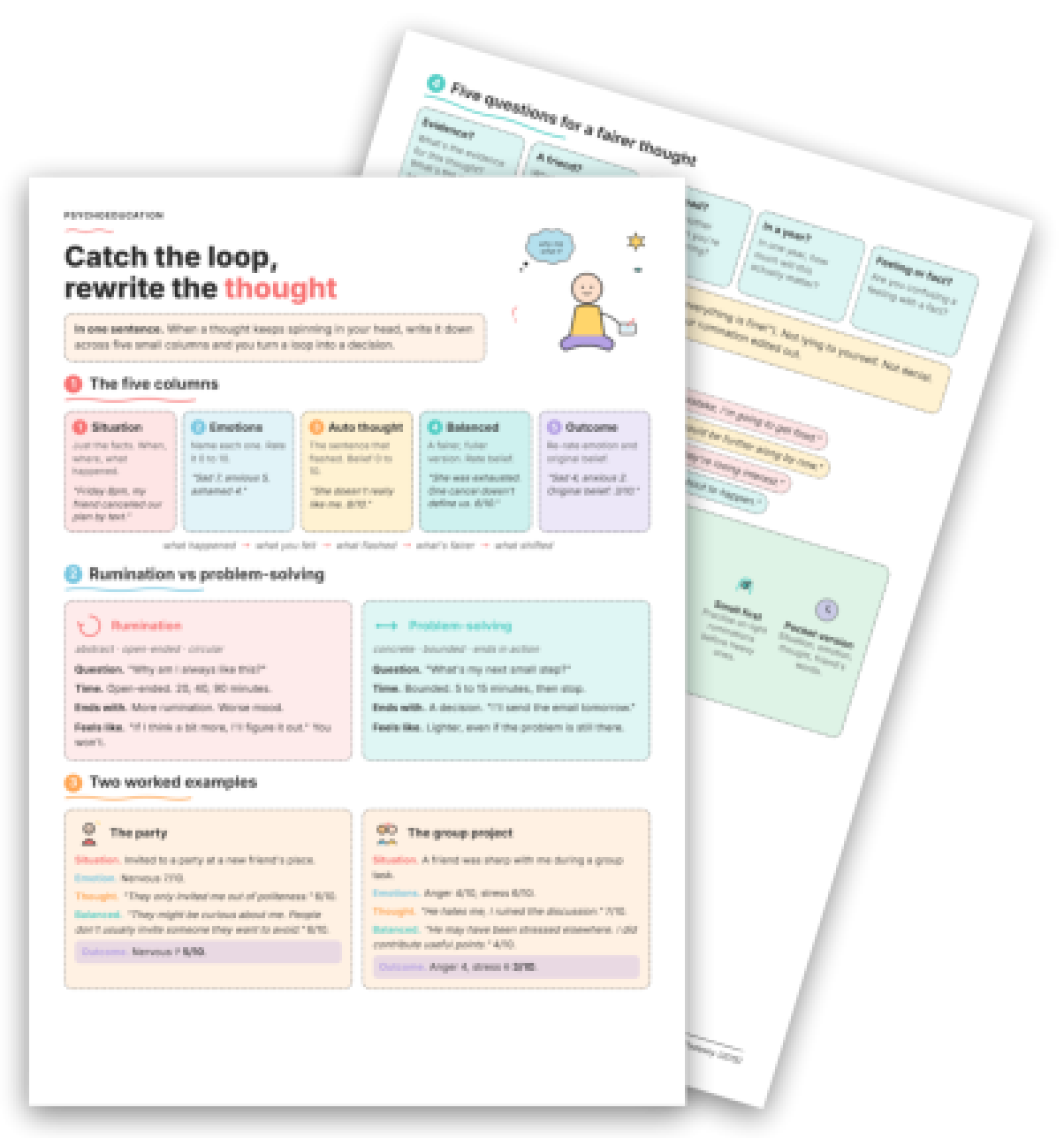
The sheet is organized into five numbered panels, each serving a distinct clinical function.
Panel 1 lays out the five-column thought record: Situation (facts only), Emotions (named and rated 0-10), Automatic thought (belief rated 0-10), Balanced thought, and Outcome (re-rating). A worked trigger anchors each column: "Friday 8pm, my friend cancelled our plan by text." Seeing the full sequence on a single page, with arrows connecting each step, shows patients what the restructuring actually does to belief intensity, something no verbal description replicates.
Panel 2 presents a two-column contrast: rumination (abstract, open-ended, circular, "Why am I always like this?") against problem-solving (concrete, bounded, ends with a decision). The visual side-by-side makes the metacognitive shift tangible. It pairs naturally with catching automatic thoughts as a preceding step.
Panel 3 offers two fully worked examples (a social invitation and a group-project conflict) that you can read through with the patient, pointing to how belief ratings drop across the columns.
Panel 4 lists five Socratic prompts for building a balanced thought: evidence for and against, the friend's-perspective question, alternative explanations, one-year projection, and the feeling vs. fact distinction. These are the same questions you would ask in a guided cognitive restructuring exercise, now printed and left in the patient's hands.
Panel 5 gives ten sample ruminations to practise on, ranging from "They didn't reply, I must have said something wrong" to "I always ruin everything." You can use these to model the five-column process on a low-stakes thought before the patient applies it to their own material.
A "To discuss in session" section signals three specific return points: 20+ minutes of unproductive looping, minimal belief shift after a column attempt, or a thought that keeps returning unchanged. This makes the fiche a natural bridge to the next appointment, not a standalone takeaway.
Use it with your patients
Share this tool in the mobile app and follow the work between sessions.
When and How to Introduce the Worksheet
Propose it from the second or third session, once the basic cognitive model is in place, or immediately after introducing cognitive distortions when the patient already recognizes their thinking patterns but cannot interrupt them.
A low-threshold introduction: "I want to show you something that maps what happens when a thought gets stuck. We'll go through it together right now, using an example you give me." Avoid framing it as homework to complete alone; the sheet works best when the clinician models the column-filling first, using one of the printed examples or a patient-generated one.
For debriefing: track whether belief ratings actually shift between columns 3 and 5. A patient whose belief barely moves is showing you either insufficient evidence work or a deeper core belief worth exploring. Those patients benefit from pairing this fiche with a structured rumination self-monitoring exercise between sessions, or a between-session audio tool to step back from loops.
For more chronic presentations, consider embedding the fiche within a structured psychoeducation program on rumination in depression. With adolescents or patients who resist written formats, Panel 3's worked examples often serve as the entry point: reading through someone else's loop is less threatening than filling in one's own.
The fiche does not replace the therapeutic formulation, but it gives both patient and clinician a shared vocabulary and a concrete visual trace of what changed, and what did not, from one session to the next.
Your session continues in your patients' pocket
Use with a patientYour resources, available everywhere
The handouts, exercises, programs and audios above: you choose which ones to make available to your patients, in the mobile app dedicated to them.
And far more than a library
The app goes well beyond resources, to support your patients every day:
Related categories
Explore other clinical resources by category.
Anxiety
Clinical hub for anxiety disorders: CBT and ACT worksheets, psychoeducation sheets, and exercises for assessment and treatment across the anxiety spectrum.

Mood
Evidence-based worksheets and clinical tools for mood disorders: CBT, ACT, and positive psychology resources for psychologists and therapists.

Cognition
Printable cognitive therapy worksheets and clinical tools for therapists: CBT, ACT, schema work, defusion, distortions, and belief restructuring.

Build awareness
Clinical worksheets and tools to build awareness in therapy: cognitive distortions, schemas, emotions, ACT and CBT resources for practitioners.

Restructure
Clinical hub for cognitive restructuring worksheets: distortion identification, belief disputation, ABC model, and schema work for evidence-based practice.

CBT
CBT worksheets, cognitive restructuring exercises & behavioral tools for clinicians. Evidence-based resources for every phase of cognitive behavioral therapy.