
Clinical picture. M., a man in his late thirties presenting with mild depression and chronic work-related stress, reported feeling disconnected from family life despite describing closeness as a core personal value. During a session focused on behavioral activation, the clinician introduced the values cultivation exercise and invited M. to complete it as structured homework before the next appointment. M. identified that he had not been initiating shared activities with his children and listed two concrete actions: a weekly board-game evening and a brief daily walk without his phone. At the following session he reported having carried out both actions twice each, noting a modest but tangible shift in his sense of coherence between what he believed and how he was spending his time.
Values Cultivation: A Guided Clinical Exercise for Therapists
Help patients close the gap between a cherished value and daily behavior with a focused three-question autonomous homework exercise.
Clinical vignettes
Reconnecting with Family Presence
Aligning Creativity with Daily Routine
Clinical picture. L., a woman in her mid-forties being seen for generalized anxiety, mentioned in passing that creativity mattered deeply to her yet she had not drawn or painted in over two years. The clinician offered the three-question exercise as an autonomous between-session task, encouraging L. to write her responses and log planned actions in her Mosaik routines. L. chose to dedicate thirty minutes on Tuesday and Saturday mornings to sketching, starting the following week and initially alone. She returned to the next session having completed one of the two planned sessions, and the clinician used this partial follow-through as a non-judgmental entry point to explore what had interfered, without framing the outcome as a failure.
The Clinical Gap This Exercise Targets
Values work sits at the heart of ACT-informed practice, yet the move from identifying a value to living it consistently is precisely where many patients stall. In consultation, you can name values together, map discrepancies using tools like the Exploring Values PDF worksheet or the Personal Values Clarification exercise, and even explore long-horizon aspirations through the 10-Year Goals exercise. But translating a named value into concrete, recurring behavior is a different clinical challenge, one that verbal discussion alone rarely resolves.
Without a structured prompt, patients tend to hold their value as a felt sense: something they know matters but have never operationalized. That gap between value and behavior persists quietly, feeding guilt, low motivation, or a nagging sense of inauthenticity. This exercise addresses that specific need. It takes one underserved value and builds a real behavioral commitment around it, step by step.
Use this resource with your patients
Handout, exercises and materials ready to use, right inside SessionFuel.
What the Exercise Contains
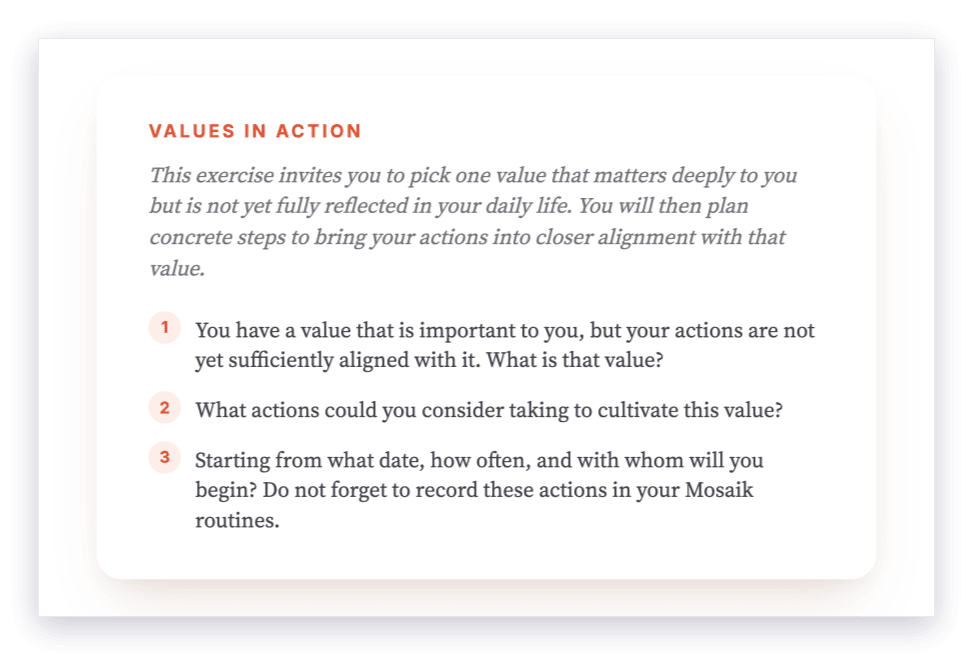
The exercise is built around three focused questions. The image above is a static preview listing those questions in order. What you see here is the question structure only; the full guided experience, with patient-facing instructions and space to write, is completed by the patient entirely on their own in the app, not in this image.
The first question asks the patient to name one specific value they care about but have not yet sufficiently enacted. The single-value focus is deliberate: it avoids the dispersal that comes from working on everything at once, mirroring the committed action step at the core of the ACT Hexaflex and the curriculum in ACT for Depression.
The second question generates concrete behavioral options: what actions, specifically, could serve this value? This generative step is the one patients rarely complete on their own. It connects naturally to work your patient may have started with Goal-Setting and Motivation or 6- and 12-Month Goal Setting.
The third question anchors commitment in time, frequency, and social context, asking for a start date, a rhythm, and a named person if relevant. The explicit prompt to record actions in Mosaik routines turns a good intention into a trackable habit, drawing on the behavioral logic behind Building New Habits.
Key insight: The exercise works because it narrows focus to a single value-action gap and immediately converts that insight into a scheduled, socially-anchored commitment, the conditions under which behavioral change actually holds.
This exercise is available to patients through the SessionFuel patient app, the dedicated mobile interface for patients whose clinician uses SessionFuel: you assign the exercise directly from your account, and your patient completes it on their own phone, between sessions, at their own pace.
750+ clinical tools
A library built with and for clinicians, ready to use in session and extend between appointments.
Access all the toolsUse it with your patients
Share this tool in the mobile app and follow the work between sessions.
Integrating This Exercise Between Sessions
This tool suits a broad patient profile. It is particularly well-suited to patients doing values-based work, goal clarification, or behavioral activation, especially those who have completed a broader inventory such as My Future Inventory or the Personal Meaning and Direction fiche and are now ready to act on a single priority. It also works well with patients who procrastinate or who report feeling disconnected from what matters to them.
Introduce it when a patient names a value they know matters but keeps sidelining. A simple framing: "Between now and our next appointment, I'd like you to work through this short exercise on your own. It focuses on one value and asks you to plan what you will do, when you will start, and who might be part of it."
When the patient returns, the material they bring gives you immediate clinical traction. You can explore what value they chose and why, whether the actions they generated feel authentic or obligatory, and whether the commitment held. Resistance at step three often opens rich territory, connecting to motivational dip patterns or the Stages of Change frame. Progress, conversely, is worth examining through the lens of Celebrating Personal Successes to consolidate the patient's sense of agency, and to prepare the ground for the next value they choose to cultivate.
Your session continues in your patients' pocket
Use with a patientYour resources, available everywhere
The handouts, exercises, programs and audios above: you choose which ones to make available to your patients, in the mobile app dedicated to them.
And far more than a library
The app goes well beyond resources, to support your patients every day:
Related categories
Explore other clinical resources by category.

Identity
Clinical resources for self-identity work in therapy: CBT, ACT, schema tools for clinicians addressing self-concept, core beliefs, and identity disruption.

Engage & motivate
Clinical hub: printable worksheets and exercises to build therapeutic engagement and motivation across ACT, CBT, and integrative practice. For clinicians.

ACT
Clinical hub for Acceptance and Commitment Therapy (ACT): worksheets, exercises, programs and audio resources for practitioners using the ACT model.

Anxiety
Clinical hub for anxiety disorders: CBT and ACT worksheets, psychoeducation sheets, and exercises for assessment and treatment across the anxiety spectrum.

Trauma
Clinical hub on trauma and PTSD: assessment, differential diagnosis, treatment phases, and printable resources for practitioners. 155 chars.

Mood
Evidence-based worksheets and clinical tools for mood disorders: CBT, ACT, and positive psychology resources for psychologists and therapists.