
Clinical picture. A patient referred to as R., a woman in her late thirties working in project management, presented with persistent fatigue, Sunday-evening dread, and increasing irritability at home. She described her situation as simply being "bad at handling pressure" and had not previously considered the organisational context as a contributing factor. The clinician introduced the five-source framework as a shared map, inviting R. to mark which sources felt active in her current role. She identified three: burnout from accumulated overtime, no clarity due to two line managers giving contradictory directives, and no support after a large product launch received no acknowledgment. This naming exercise shifted the conversation from self-blame toward a more differentiated analysis of what was modifiable by R. and what required a structural conversation with her employer.
Sources of Workplace Stress: PDF Worksheet, Tools and Exercises
A visual PDF worksheet and practical tools to help clinicians name the five sources of occupational stress in session, shift self-blame, and map concrete actions with patients.
Clinical vignettes
Naming the Load Before Fixing It
Autonomy Loss in a Restructured Role
Clinical picture. T., a man in his mid-forties with a history of recurrent depressive episodes, returned to therapy after a company restructure left him reporting to a new manager with a rigid micromanagement style. He could not account for why his motivation had dropped so sharply, given that his workload had not increased. The clinician used the informational sheet to walk through each source systematically, and T. recognised the no-autonomy category as the primary fit: decisions he had previously owned were now reviewed and often reversed without explanation. He also noted a secondary imbalance pattern, checking work messages late at night in an attempt to anticipate corrections. Psychoeducation reframed his low drive as a predictable response to a loss of control rather than a relapse signal, which reduced his catastrophising and supported a more targeted problem-solving focus in the following sessions.
Patients presenting with occupational distress often describe something diffuse and hard to pin down: a sense of being buried without knowing exactly by what. Without a shared taxonomy, sessions can stall on the complaint without ever reaching a named target. This PDF worksheet on sources of workplace stress gives you a visual scaffold to move the conversation from vague exhaustion to a specific, actionable problem, in the time you actually have.
Use this resource with your patients
Handout, exercises and materials ready to use, right inside SessionFuel.
Why workplace stress is so hard to unpack orally
The core difficulty is attributional. Patients frequently interpret work stress as a personal failing, a sign that they are not resilient enough, not organised enough, not tough enough. An oral reframe ("stress is about fit, not character") rarely holds after the session because nothing anchors it. The Demand-Control model (Karasek, 1979) and Maslach's burnout framework both locate occupational stress in the person-environment interface, yet transmitting that framing verbally, under clinical time pressure, seldom shifts self-blame durably.
A second difficulty is taxonomic. What patients call "burnout" often conflates several distinct mechanisms: chronic under-recovery, role ambiguity, micro-management, and social isolation can all produce the same felt presentation. Without differentiation, the clinician ends up addressing a symptom cluster rather than a source. The worksheet is the differentiating tool.
What the fiche contains: a named, visual map
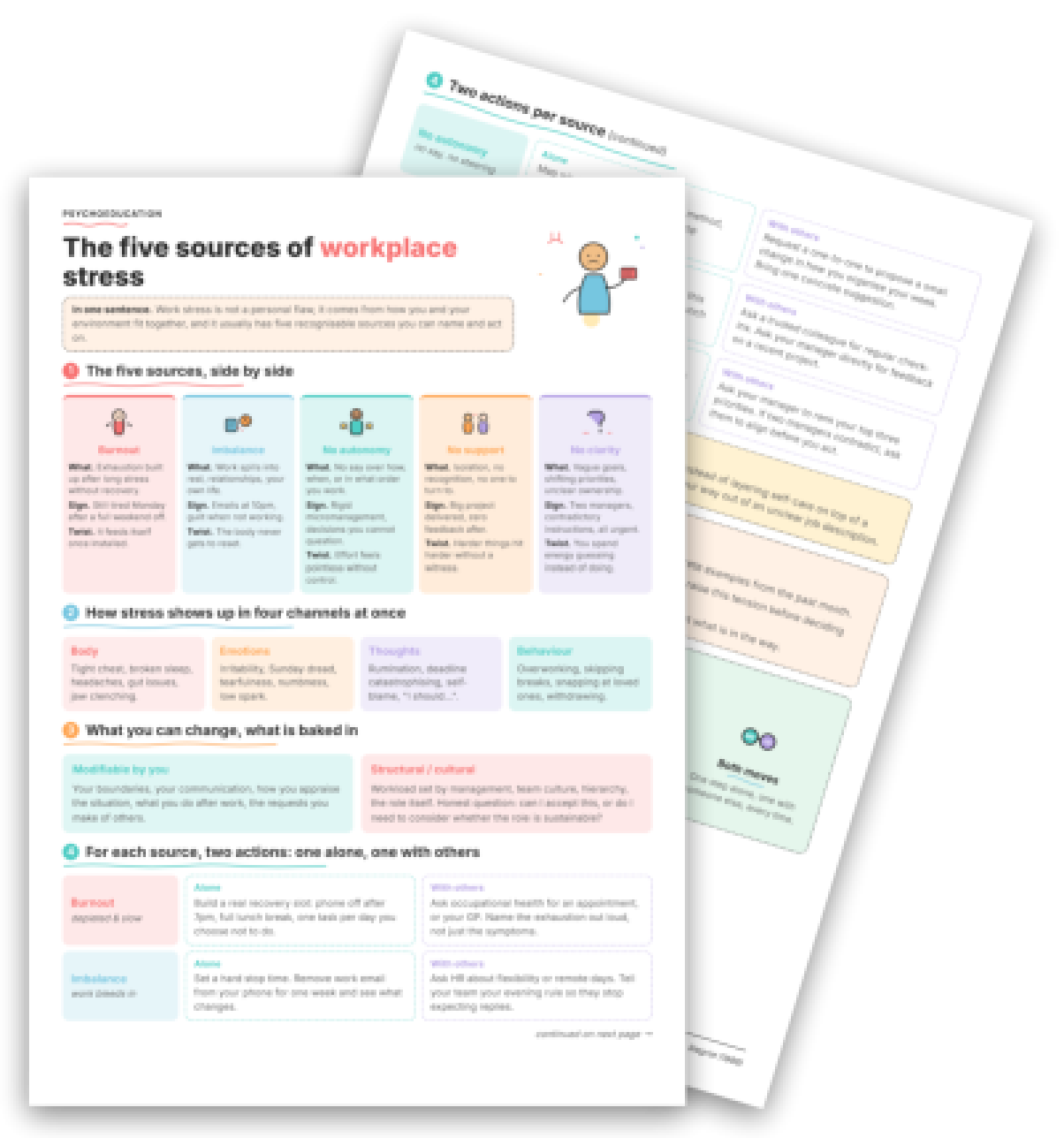
The fiche PDF organises occupational stress into five named sources displayed side by side: burnout, imbalance, no autonomy, no support, and no clarity. For each one, the layout provides a plain-language definition, a concrete observable sign, and a note on the self-perpetuating mechanism. The entry for lack of clarity, for instance, reads: "Vague goals, shifting priorities, unclear ownership" with the sign "Two managers, contradictory instructions, all urgent" and the twist "You spend energy guessing instead of doing."
A second panel maps how stress shows up across four channels simultaneously: body, emotions, thoughts, and behaviour. Seeing these four domains side by side helps patients stop treating somatic signals and affective reactivity as separate problems unrelated to work. A third section separates what is modifiable by the patient (boundaries, communication, appraisal, requests) from what is structural or cultural, and includes an explicit prompt about sustainability. You can use that distinction to introduce a control-influence-accept framework when the patient is spending energy on the unchangeable.
For each of the five sources, the fiche then offers two concrete action steps: one the patient takes independently, one that requires asking something of another person. This dual structure maps directly onto the clinical distinction between intrapersonal coping and environmental change. Patients who have never framed asking a manager to rank priorities as a legitimate coping move benefit from seeing it written alongside the solo actions.
The closing panel lists three explicit session prompts, including: "When an action step keeps failing week after week, name it so we can look at what is in the way", which structures the follow-up naturally without leaving it vague.
> Key takeaway: the fiche is a visual support that facilitates the explanation of workplace stress sources in session. It gives the patient a map they can point to rather than a complaint they have to re-generate from memory, and leaves them a concrete reference between sessions without becoming an autonomous homework assignment.
The visual layout does something the oral explanation cannot: it shows five distinct categories at a glance, making differential work immediate. A patient can circle two sources rather than building their own taxonomy from scratch. This shift from felt burden to named problem is what makes the subsequent coping work tractable.
750+ clinical tools
A library built with and for clinicians, ready to use in session and extend between appointments.
Access all the toolsWhen and how to introduce the fiche
The fiche fits from the second or third session onward, once the initial assessment has confirmed that work is a significant stressor. It is particularly useful with patients who intellectualise (the structure gives their analytical tendency a productive object), with those who minimise ("everyone is stressed, I just need to be tougher"), and with patients already showing early burnout signs who are not yet ready to name it.
Introduce it directly: "I have a one-pager that maps five specific sources of work stress. Let's look at it together and see which ones feel most familiar right now." This frames the exercise as collaborative mapping, not diagnostic labelling, and the word "familiar" is less threatening than "which of these do you have."
After scanning the fiche together, the debrief question is simple: which one or two sources are loudest this month? The answer then connects naturally to the rest of the care plan. For autonomy and overwork, assertiveness tools and work-life boundary work become the next step. For the clarity source, workplace pressure cognitive restructuring and professional life assessment extend the work. For the body and behaviour channels, adaptive versus maladaptive coping strategies and a bad workday reflection exercise offer structured between-session tools. Where broader psychosocial risk factors are involved, the fiche pairs well with a more systematic work-life balance self-assessment and a weekly work review exercise.
One limit worth naming: the worksheet is not suited to an acute workplace crisis (harassment, disciplinary procedure, imminent job loss) where immediate safety planning takes precedence. Use it once the acute situation is contained. It is also not a severity measure; for tracking burnout progression over time, the burnout maintenance worksheet and stress management tools carry that function.
The fiche does not replace the case formulation, but once the patient can say "this is a clarity problem, not an incompetence problem," the work of actually changing something can begin.
Use it with your patients
Share this tool in the mobile app and follow the work between sessions.
Sources
- Maslach, C., Leiter, M. P. (1997). The Truth About Burnout: How Organizations Cause Personal Stress and What to Do About It. Jossey-Bass.
- Health and Safety Executive (HSE). Work-Related Stress: Management Standards.
- Maslach, C., Leiter, M. P. (2022). The Burnout Challenge: Managing People's Relationships with Their Jobs. Harvard University Press.
Your session continues in your patients' pocket
Use with a patientYour resources, available everywhere
The handouts, exercises, programs and audios above: you choose which ones to make available to your patients, in the mobile app dedicated to them.
And far more than a library
The app goes well beyond resources, to support your patients every day:
Related categories
Explore other clinical resources by category.

Emotions
Clinical resources on emotion regulation: worksheets, coping tools, CBT, REBT, and ACT exercises for therapists working across diagnoses and age groups.

Transitions
Clinical hub for life transitions: tools, worksheets and exercises to support psychosocial adjustment, role change and identity work in practice.

Understand
Clinical hub for the therapeutic aim 'Understand': worksheets and tools to build patient insight across CBT, ACT, schema therapy and more.

Build awareness
Clinical worksheets and tools to build awareness in therapy: cognitive distortions, schemas, emotions, ACT and CBT resources for practitioners.

Engage & motivate
Clinical hub: printable worksheets and exercises to build therapeutic engagement and motivation across ACT, CBT, and integrative practice. For clinicians.
CBT
CBT worksheets, cognitive restructuring exercises & behavioral tools for clinicians. Evidence-based resources for every phase of cognitive behavioral therapy.