
Clinical picture. T., a 41-year-old secondary school deputy head, presents after six months of persistent fatigue, growing detachment from colleagues, and a sense that effort no longer translates into results. She reports sleeping poorly, having dropped her weekly runs, and spending evenings scrolling rather than resting. The clinician uses the four-cycle framework to map what is currently sustaining her state: an environment whose demands consistently exceed capacity, withdrawal coping that has eroded her main source of recovery, and a recurrent thought pattern centred on self-comparison. Rather than revisiting how burnout began, the session focuses on identifying which loop is most accessible right now. T. selects the recharge cycle as her entry point and agrees to reinstate one brief physical activity before the next appointment, an intervention modest enough to be realistic given her current energy level.
What Keeps Burnout Going: PDF Worksheet, Tools and Exercises for Clinical Practice
A visual PDF worksheet mapping the four self-feeding cycles that maintain burnout, with concrete tools and exercises to use as a psychoeducation support in session.
Clinical vignettes
Naming the Loop, Not the Origin
When Coping Becomes the Problem
Clinical picture. M., a 35-year-old software engineer, was referred after a period of sick leave following what his GP described as exhaustion with low mood. He describes having managed rising workload by cutting corners on documentation and avoiding team meetings, strategies that initially reduced pressure but have since generated a backlog and strained working relationships. During psychoeducation using the four-cycle model, M. recognises that his coping pattern has opened a second source of stress rather than closing the first. He also notices a cluster of ruminative thoughts at night, mainly around professional competence, which he had not previously connected to his sleep difficulties. The clinician and M. agree to work first on the thought cycle, using a brief written externalisation technique between sessions, while deferring the environmental negotiation until he has slightly more cognitive bandwidth.
When a patient returns from a two-week holiday still exhausted, the oral explanation of why rest alone isn't working is rarely enough to shift anything. Burnout persists not because patients rest poorly, but because several interlocking cycles keep refuelling it, and that architecture is almost impossible to grasp from a verbal account alone. This PDF worksheet gives you a shared visual map that makes the maintenance structure visible in a single session, along with tools and exercises to move directly from psychoeducation into formulation.
Use this resource with your patients
Handout, exercises and materials ready to use, right inside SessionFuel.
Why Burnout Maintenance Resists Verbal Explanation
Burnout's persistence is a different clinical question from its onset. Most patients arrive with two beliefs that block recovery: that burnout is a discrete event they should have recovered from already, and that the solution is simply more rest. Both beliefs are maintained by the same blind spot, which is that they can't see the system keeping it going.
The verbal explanation runs into trouble because the cyclical maintenance structure is invisible in spoken form. You can describe coping strategies that backfire, the progressive stripping of recharge activities, negative automatic thoughts about inadequacy, and environmental overload, but said sequentially, these sound like a list of problems, not a system. The crucial point, that each petal feeds the centre, only lands when a patient can see all four loops simultaneously on a page. Until then, they grasp each item in isolation and leave without understanding why addressing any single one in isolation doesn't shift the whole.
Inside the Fiche: A Visual Map of Four Cycles
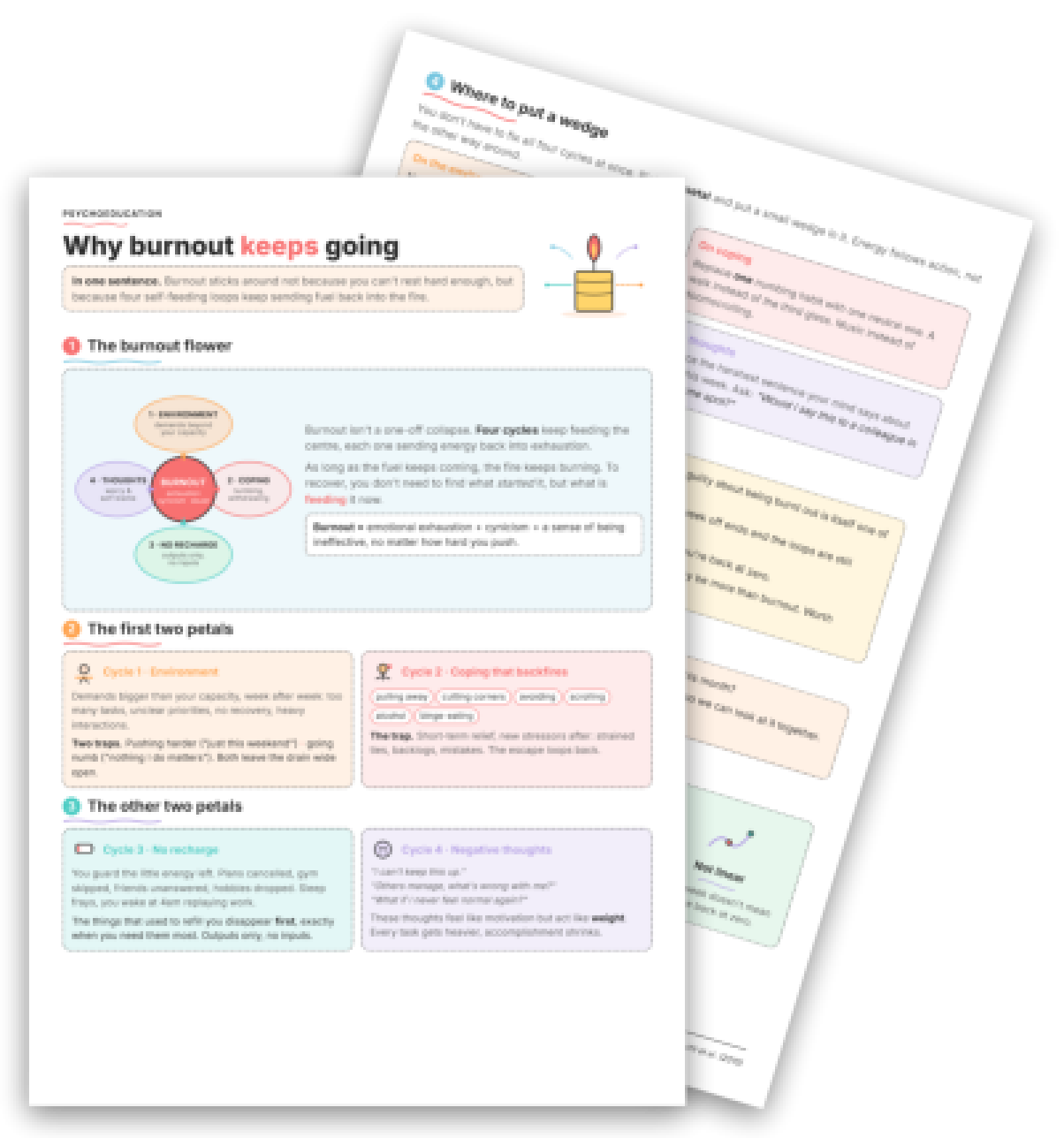
The PDF worksheet is structured across seven panels. Its clinical centrepiece is the burnout flower: a diagram placing exhaustion at the centre and four labelled petals around it. Each petal represents a named maintenance cycle.
- Cycle 1 (Environment): demands exceeding capacity, week after week, with no structural recovery window built in.
- Cycle 2 (Coping): behaviours including withdrawal, avoidance, scrolling, and numbing, which provide short-term relief while generating new stressors (backlogs, strained ties, mistakes). The worksheet lists these explicitly and maps their feedback loop, connecting naturally to work on adaptive versus maladaptive coping patterns.
- Cycle 3 (No recharge): the patient drops the activities that used to refill them, gym, friends, hobbies, precisely when those activities matter most. The fiche names this directly: "The things that used to refill you disappear first, exactly when you need them most."
- Cycle 4 (Negative thoughts): sentences such as "Others manage, what's wrong with me?" function as weight on every task, amplifying inefficacy. This loop connects to the cognitive distortions and self-critical thought patterns typical of burnout's late phase.
Panel 4 ("Where to put a wedge") translates the model into micro-interventions: one structural conversation, one swapped habit, one protected activity per week. Panel 5 flags common clinical blind spots, including the self-perpetuating role of guilt about being burnt out, and explicitly prompts referral when low mood extends beyond the occupational context. Panel 6 provides ready-made discussion prompts for the session debrief.
> Clinical takeaway: this fiche is a visual support designed to facilitate the explanation of burnout maintenance in session; it is not a self-assessment tool the patient completes alone, but a shared map you build meaning around together, leaving them with a concrete reference point between appointments.
750+ clinical tools
A library built with and for clinicians, ready to use in session and extend between appointments.
Access all the toolsWhen and How to Introduce It
This resource fits naturally once the initial burnout assessment is complete and you are moving into formulation, typically the second or third session. It is particularly effective with patients who intellectualise ("I know I should rest") without shifting behaviour, and with those where psychosocial risks at work form a clear structural backdrop.
A practical introduction: "I'd like to show you a diagram that explains why burnout doesn't disappear with a break. It maps four loops that keep it running. I want us to look at it together and see which ones feel most active for you right now." This framing positions the patient as an observer of a system, not a judge of their own character, which is especially important given the guilt cycle the fiche names explicitly.
In debrief, identify the dominant active cycle before selecting the first intervention. The "wedge" framing in panel 4 is particularly useful for patients paralysed by the scale of recovery: it reduces the task from overhauling everything to finding the smallest available point of leverage. You can pair the worksheet with tools such as the work-life balance self-assessment exercise or the workplace pressure cognitive restructuring exercise, depending on which cycle is loudest. When low mood and anhedonia clearly extend beyond the occupational domain, panel 5 of the fiche itself prompts a more thorough screening, making it a natural bridge to a depression assessment if warranted.
The fiche doesn't replace formulation or the therapeutic alliance. It makes the maintenance model concrete, names the system rather than the person, and leaves the patient with a reference they can actually use between sessions.
Use it with your patients
Share this tool in the mobile app and follow the work between sessions.
Sources
- Maslach, C., Schaufeli, W. B., & Leiter, M. P. (2001). Job Burnout. Annual Review of Psychology, 52, 397-422.
- Maslach, C., & Leiter, M. P. (1997). The Truth About Burnout: How Organizations Cause Personal Stress and What to Do About It. Jossey-Bass.
- (2010) A cognitive behavioural model for maintaining processes in burnout. the Cognitive Behaviour Therapist (Cambridge University Press).
- Bakker, A. B., Demerouti, E., & Sanz-Vergel, A. (2023). Job Demands-Resources Theory: Ten Years Later. Annual Review of Organizational Psychology and Organizational Behavior, 10, 25-53.
- Bakker, A. B., Demerouti, E., & Schaufeli, W. B. (2020). Job Demands-Resources theory and self-regulation: new explanations and remedies for job burnout. Anxiety, Stress, and Coping, 34(1), 1-21.
Your session continues in your patients' pocket
Use with a patientYour resources, available everywhere
The handouts, exercises, programs and audios above: you choose which ones to make available to your patients, in the mobile app dedicated to them.
And far more than a library
The app goes well beyond resources, to support your patients every day:
Related categories
Explore other clinical resources by category.

Emotions
Clinical resources on emotion regulation: worksheets, coping tools, CBT, REBT, and ACT exercises for therapists working across diagnoses and age groups.

Transitions
Clinical hub for life transitions: tools, worksheets and exercises to support psychosocial adjustment, role change and identity work in practice.

Cognition
Printable cognitive therapy worksheets and clinical tools for therapists: CBT, ACT, schema work, defusion, distortions, and belief restructuring.

Understand
Clinical hub for the therapeutic aim 'Understand': worksheets and tools to build patient insight across CBT, ACT, schema therapy and more.

CBT
CBT worksheets, cognitive restructuring exercises & behavioral tools for clinicians. Evidence-based resources for every phase of cognitive behavioral therapy.

Anxiety
Clinical hub for anxiety disorders: CBT and ACT worksheets, psychoeducation sheets, and exercises for assessment and treatment across the anxiety spectrum.