
Clinical picture. M., a 34-year-old project manager, presents with occupational exhaustion and a persistent sense of stagnation; she reports feeling that her weeks "blur into one another" without any discernible progress. The clinician assigns the structured weekly review as homework, asking her to rate fulfillment, skill progression, and work-life balance on the provided scales and to note both high and low points. At the following session, M. returns with a fulfillment score of 4 out of 10 yet, when prompted by the question on pleasant moments, recalls having successfully mediated a team conflict, an event she had not spontaneously mentioned. This small, concrete positive became the entry point for exploring her tendency to discount competence-relevant experiences, and she identified one realistic improvement target for the coming week.
Weekly Work Review: A Structured Clinical Reflection Tool
Help patients assess weekly fulfillment, skill progression, and work-life balance through a guided autonomous reflection exercise assigned as homework.
Clinical vignettes
Weekly Review Surfaces Hidden Positives
Balance Scale Prompts Boundary Setting
Clinical picture. T., a 41-year-old consultant seen for work-related anxiety, tends to minimize his private-life difficulties and frames most sessions around performance concerns. Completing the weekly review between sessions, he rates his work-life balance at 2 out of 10, a score lower than he expected to give and that he brings to the session with visible discomfort. The clinician uses this self-generated number as a neutral starting point rather than an interpretation, asking T. to describe what a score of 4 might look like concretely. Over three weekly cycles of the exercise, T. began tracking a gradual shift in his balance rating alongside modest changes in evening availability, which he himself attributed to boundary adjustments trialled the previous week.
The clinical need: what resists a purely verbal approach
Patients struggling with professional dissatisfaction, chronic overload, or loss of motivation at work often arrive at sessions with a blurry sense that "things aren't going well" but can't quite name what, specifically, shifted during the past week. Without a structured frame, this vagueness is hard to work with. A conversational check-in during the session relies on recall that is already filtered by mood and the urgency of the moment.
The deeper difficulty is that fulfillment, learning, and balance are not naturally quantified concepts. Patients rarely spontaneously distinguish between a week where they felt stagnant versus one where they felt drained by relational conflict. Prompting them to separate these dimensions, and to rate each one, creates traction that words alone rarely achieve. This is the clinical gap the exercise addresses: it gives patients a repeatable structure for self-observation, producing material that is specific, comparable across weeks, and immediately usable in therapy.
Tools like the Work-Life Balance Assessment or the Professional Life Assessment address broader, more static pictures of professional life. This exercise is designed for ongoing weekly tracking, making it a natural complement.
Use this resource with your patients
Handout, exercises and materials ready to use, right inside SessionFuel.
What the exercise contains
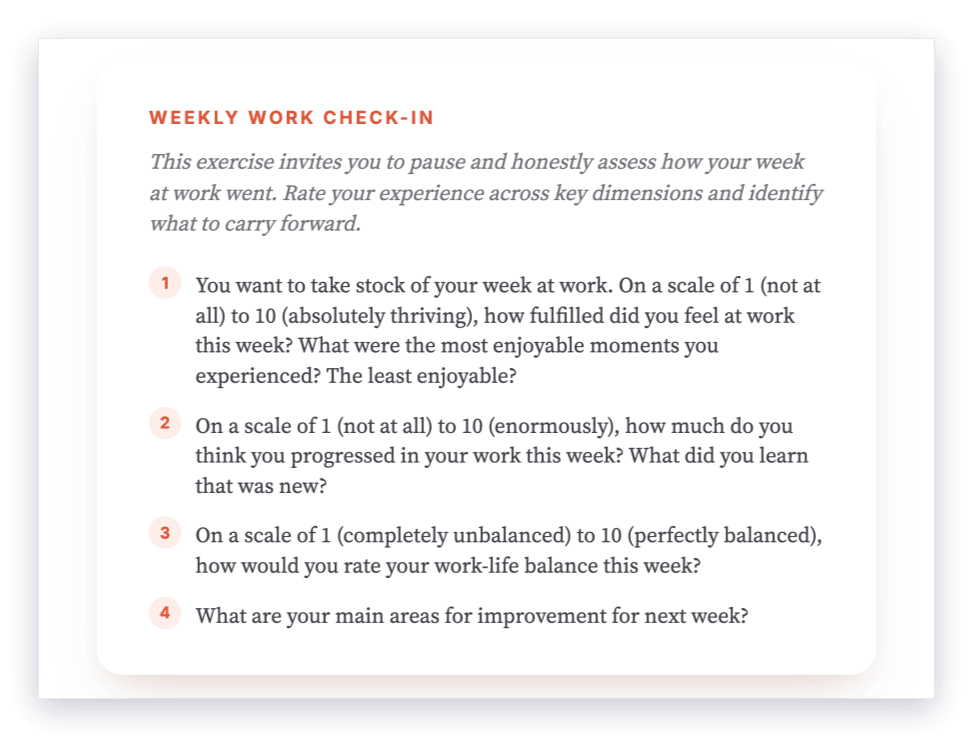
The exercise guides patients through four sequentially ordered questions. The image above lists them as a static preview so you can evaluate their relevance at a glance. The full guided experience, with patient-facing instructions and space to write responses, is delivered through the app directly to the patient, not through this image.
The four questions move from hedonic appraisal (how enjoyable was this week, concretely?) to eudaimonic appraisal (did I grow, did I learn?), then to balance perception, and finally to prospective action. Each of the first three questions includes a numeric scale that creates a trackable data point across sessions, alongside an open qualitative prompt that yields the clinical material worth exploring.
The final question, asking patients to name their main improvement priorities for the coming week, is deliberately action-oriented. It closes a loop: the patient does not just observe and rate, they commit to a direction. This four-part arc makes the exercise more than a diary entry. It is a concrete clinical support that structures self-monitoring and feeds directly into the therapeutic conversation.
This exercise is available to patients through the mobile application that is the dedicated patient-side interface of SessionFuel: the clinician assigns it as homework in SessionFuel, and the patient completes it directly on their phone, on their own, between consultations.
750+ clinical tools
A library built with and for clinicians, ready to use in session and extend between appointments.
Access all the toolsIntegrating it as between-session practice
This exercise suits a wide range of profiles: patients navigating workplace stress, mild burnout, or low professional fulfillment, as well as those rebuilding engagement after a period of sick leave or role change. It also works well for patients in goal-oriented phases of therapy, pairing naturally with exercises such as Staying Motivated, Goal-Setting and Motivation, or the Eisenhower Urgency-Importance Matrix.
To introduce it, you might frame it simply: "Between now and our next appointment, I am going to ask you to take ten minutes at the end of the week to answer four structured questions about your experience at work. You'll do this on your own, on your phone, and we'll look at what you noticed together." For patients ambivalent about self-monitoring, emphasizing the brevity and the concrete format (scales plus open answers) lowers the bar considerably.
When the patient returns, the numeric scores across the three scales give you an immediate read on where the week sat, without needing a lengthy preamble. The qualitative answers, particularly the named pleasant and unpleasant moments and the stated improvement priorities, are the richest material. Push gently on the gap between what the patient valued and what actually occupied their time, a tension that often connects to the Work-Life Boundaries conversation or, in more entrenched cases, to Psychosocial Risks at Work.
Repeated over several weeks, the scales become a longitudinal clinical signal: a drop in the learning score across three consecutive weeks tells a different story than a single difficult week. The improvement priorities give you a thread to pick up the following session, reinforcing accountability and continuity.
Key insight: The exercise's clinical value compounds over time. A single completed instance is useful; a series of completed instances makes patterns visible that neither the patient nor the clinician could have reconstructed from memory alone.
Use it with your patients
Share this tool in the mobile app and follow the work between sessions.
Articulations and adaptations
For patients also doing the Weekly Behavioral Review or Processing a Bad Day, assign this exercise on a different day of the week to avoid fatigue. For patients in a growth-oriented phase, the learning question in step two connects naturally to Growth Mindset psychoeducation. For those rebuilding self-worth through professional achievement, pairing this exercise with Celebrating Personal Successes adds a reparative layer: the patient tracks progress and then explicitly owns it.
Your session continues in your patients' pocket
Use with a patientYour resources, available everywhere
The handouts, exercises, programs and audios above: you choose which ones to make available to your patients, in the mobile app dedicated to them.
And far more than a library
The app goes well beyond resources, to support your patients every day:
Related categories
Explore other clinical resources by category.

Transitions
Clinical hub for life transitions: tools, worksheets and exercises to support psychosocial adjustment, role change and identity work in practice.

Positive psychology
Positive psychology clinical resources for therapists: worksheets, exercises & programs on well-being, strengths, gratitude, and resilience-based practice.

Solution-focused
Clinical hub for Solution Focused Therapy resources: worksheets, exercises and programs for goal-oriented, strengths-based practice across individual and couple work.

Anxiety
Clinical hub for anxiety disorders: CBT and ACT worksheets, psychoeducation sheets, and exercises for assessment and treatment across the anxiety spectrum.

Trauma
Clinical hub on trauma and PTSD: assessment, differential diagnosis, treatment phases, and printable resources for practitioners. 155 chars.

Mood
Evidence-based worksheets and clinical tools for mood disorders: CBT, ACT, and positive psychology resources for psychologists and therapists.