
Clinical picture. M., a nurse in his late thirties, presented with work-related anxiety and a pattern of carrying workplace frustrations into the evening, disrupting sleep and weekend functioning. Between sessions, his clinician suggested he complete the five-question exercise after the next difficult shift rather than calling a family member to vent. M. returned having written extensively about a conflict with a senior colleague; working through questions three and four, he identified that while he could not control the colleague's behaviour, he had successfully managed two complex patients that same afternoon. The structured format appeared to reduce the habitual rumination cycle he described: he reported falling asleep within a normal timeframe that evening. The clinician used his written responses as the starting point for the following session, focusing on locus-of-control patterns.
Processing a Bad Workday: A Guided Reflection Exercise
A five-question autonomous exercise helping patients process work stress, name emotions, and build protective strategies between sessions.
Clinical vignettes
Rumination After a Difficult Shift
Catastrophising Interrupted by Written Reflection
Clinical picture. A., a project manager in her mid-forties being followed for generalised anxiety, reported that bad workdays reliably triggered global self-critical thoughts and a conviction that her professional situation was deteriorating. Her clinician introduced the exercise as an intersession tool, explaining each question briefly and noting that question five was not obligatory on the first attempt. After a day during which a client presentation was poorly received, A. completed the exercise and found question four unexpectedly difficult, initially listing no positive elements. On a second reading she added two small items, which she described as a minor but genuine shift in perspective. At the next appointment she noted the written format had made her appraisal feel less catastrophic and more provisional.
The Clinical Need: When a Bad Day Hardens Into a Pattern
A difficult workday sits at the intersection of emotion regulation, cognitive appraisal, and coping flexibility. Patients can describe feeling exhausted or demoralised, yet struggle to say what actually happened, which part hit hardest, and whether anything was within their power to change. Spoken in the consultation room, these distinctions blur together easily.
The barrier is rarely a lack of insight. It is the absence of structure at the moment it matters most: alone, after the working day ends, when the emotional charge is still live. A clinician can introduce the control-versus-acceptance distinction verbally, but without a scaffold to apply it to a real, recent event, patients frequently default to rumination. Resources like Control, Influence, Accept or the Coping Strategies Map address this conceptually; this exercise gives patients a private, sequential space to work through the same moves on something that actually happened to them today.
Work stress also carries specific clinical weight. Repeated difficult days seed burnout, erode work-life boundaries, and can amplify patterns of frustration intolerance. Catching a single bad day before it consolidates into a rigid narrative is genuinely preventive work.
Use this resource with your patients
Handout, exercises and materials ready to use, right inside SessionFuel.
What the Exercise Contains
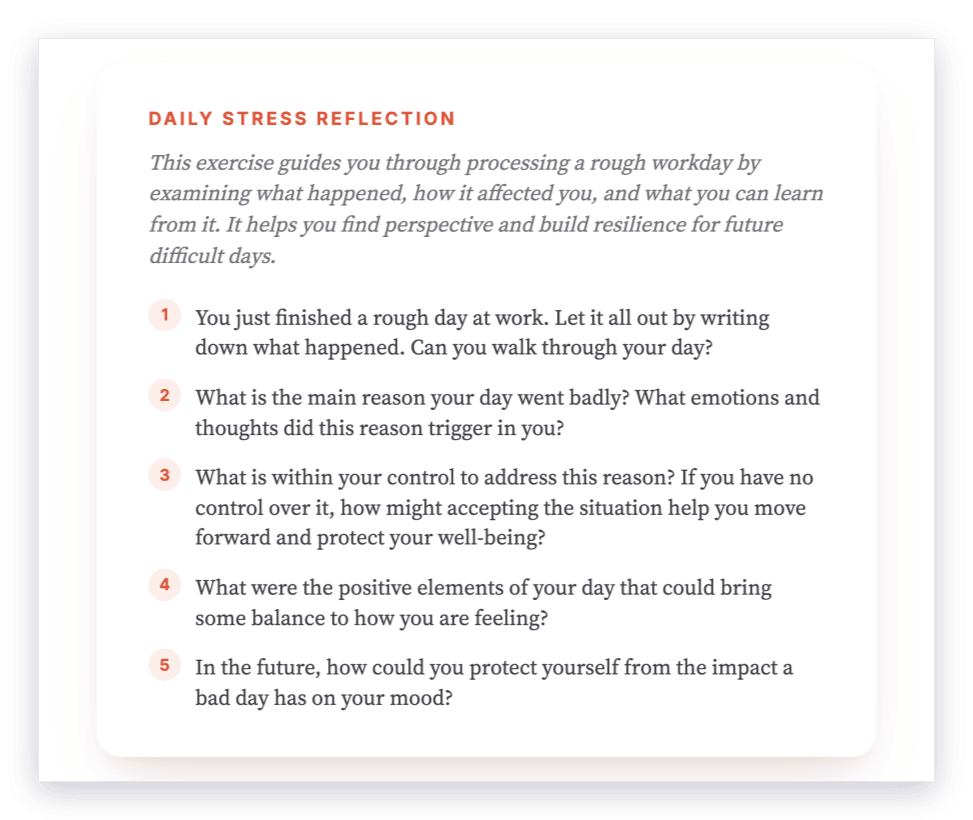
The exercise moves through five sequential questions. The first invites free expressive writing: the patient recounts their bad day without filter, a form of structured venting that externalises the event before any analysis begins. The second sharpens focus onto the primary trigger and names the emotions and thoughts it generated. This is the hinge question. It pulls the patient from narrative into emotional specificity, the kind of precision that Behavior, Emotion, Underlying Need targets more broadly.
The third question introduces the locus-of-control distinction: what can the patient act on, and if nothing is controllable, how might acceptance function as a forward-moving posture rather than resignation? This maps directly onto ACT-informed work and the Active Acceptance framework. The fourth question asks for positive elements of the same day, deliberately countering negativity bias without dismissing the difficulty; the Finding the Positive worksheet explores this attentional retraining in more depth. The fifth looks ahead: what protective strategies could reduce the impact of a similar day in future?
The image above lists these five questions in order, with a brief introductory sentence for each. It is a static preview only. The patient never uses this image. The full guided exercise, with patient-facing instructions and dedicated writing space, is experienced by the patient directly in the app, on their own, between appointments.
This exercise is available to patients through the mobile application that is the dedicated patient-side interface of SessionFuel: the clinician assigns it as between-session homework, and the patient opens it directly on their phone and completes it at their own pace.
Key takeaway: A single structured reflection on a bad workday interrupts the rumination-to-avoidance loop before the emotional trace hardens into a stable negative narrative about work, self-efficacy, or fairness.
750+ clinical tools
A library built with and for clinicians, ready to use in session and extend between appointments.
Access all the toolsUse it with your patients
Share this tool in the mobile app and follow the work between sessions.
Integrating This as Between-Session Homework
This exercise suits a broad range of presentations: workplace stress and early burnout, adjustment difficulties, generalised anxiety with occupational triggers, and patients who report difficulty switching off after work. It fits naturally alongside the stress management basics and complements broader occupational work using Psychosocial Risks at Work.
Introduce it after a session where the patient has mentioned a difficult day, or proactively ahead of a known high-pressure period. Assign it through SessionFuel so the patient receives it on their phone and completes it autonomously, between this appointment and the next one.
At the following session, the written responses become a clinical document. Use question two to sharpen emotional vocabulary together. Use question three to assess whether the patient leaned toward control or acceptance, and whether that choice was proportionate. Question five often generates concrete behavioural intentions that can be formalised through Work-Life Balance Assessment, Building New Habits, or the Workplace Pressure restructuring exercise as a natural follow-up. For patients with a persistently entrenched negative filter, pairing this exercise with Professional Life Assessment opens the broader occupational picture when the clinical formulation calls for it.
Your session continues in your patients' pocket
Use with a patientYour resources, available everywhere
The handouts, exercises, programs and audios above: you choose which ones to make available to your patients, in the mobile app dedicated to them.
And far more than a library
The app goes well beyond resources, to support your patients every day:
Related categories
Explore other clinical resources by category.

Emotions
Clinical resources on emotion regulation: worksheets, coping tools, CBT, REBT, and ACT exercises for therapists working across diagnoses and age groups.

Transitions
Clinical hub for life transitions: tools, worksheets and exercises to support psychosocial adjustment, role change and identity work in practice.

ACT
Clinical hub for Acceptance and Commitment Therapy (ACT): worksheets, exercises, programs and audio resources for practitioners using the ACT model.

CBT
CBT worksheets, cognitive restructuring exercises & behavioral tools for clinicians. Evidence-based resources for every phase of cognitive behavioral therapy.

Anxiety
Clinical hub for anxiety disorders: CBT and ACT worksheets, psychoeducation sheets, and exercises for assessment and treatment across the anxiety spectrum.
Trauma
Clinical hub on trauma and PTSD: assessment, differential diagnosis, treatment phases, and printable resources for practitioners. 155 chars.