
Clinical picture. A, a 38-year-old teacher on sick leave for occupational burnout, reported waking each morning feeling "already defeated" before the day had started. She attributed the morning fog to evidence that she was fundamentally unwell and used it to justify staying in bed past 9 a.m., which in turn disrupted her night sleep. The clinician introduced the psychoeducational sheet on waking refreshed, focusing on the physiological basis of sleep inertia and its typical 15-to-30-minute window. A was visibly relieved to have a mechanistic explanation and agreed to trial two changes: moving her phone across the room and opening her curtains before bed. At the following session she noted that getting up in one go felt "less like a battle" and that her mood at 8 a.m. had improved, though she remained cautious about broader recovery claims.
Waking Up Refreshed: PDF Worksheet, Tools and Exercises for Clinical Practice
A visual psychoeducation sheet clinicians can use in session to reframe sleep inertia, dismantle the snooze habit, and co-build a morning routine that actually holds.
Clinical vignettes
Sleep Inertia Reframed in Burnout Recovery
Snooze Habit Addressed in Anxiety Treatment
Clinical picture. M, a 27-year-old graduate student presenting with generalised anxiety, described a morning routine anchored around repeated snooze cycles, fragmented dozing and phone scrolling before rising. He identified mornings as the period of highest anticipatory worry, yet had never connected his wake-up habits to that pattern. During a session focused on behavioural activation, the clinician used the informational sheet to map M's current morning against the contrasting "new morning" sequence, without prescribing the full routine at once. M chose to start with a single concrete change, placing his phone on his desk overnight, and reported the following week that being forced to stand up had shortened the transition from sleep to wakefulness and reduced, modestly but noticeably, the window in which rumination took hold.
Patients who struggle to get out of bed rarely describe it as a physiological state. They call it laziness, weakness, or proof that something is fundamentally wrong. That misattribution is where the clinical work stalls, and where this fiche PDF earns its place in the session.
Use this resource with your patients
Handout, exercises and materials ready to use, right inside SessionFuel.
Why Morning Difficulty Resists Oral Explanation
Sleep inertia is well-characterised in the literature (Hilditch, 2019; Trotti, 2017): the 15-to-30-minute window of grogginess after waking is a genuine neurophysiological transition, not a moral failing. Patients intellectually accept this when you say it once; they do not update their self-narrative. The verbal explanation disappears between sessions, and the self-critical interpretation returns with the next alarm.
There is a second obstacle. Morning difficulty is almost always overdetermined: fragmented sleep from repeated snoozing, post-snooze adenosine rebound, absent morning light exposure, and absent behavioral anchors all stack onto each other. Explaining each lever one at a time in an oral account produces a list the patient cannot visualize or hold. The common confusions that sustain the problem, including "snooze = rest," "fog = bad night," and the fatalistic "I'm just not a morning person," need to be shown, not just stated. A visual support that lays them side by side makes the correction stick.
This is particularly relevant in work with patients presenting low-grade depressive symptoms, where behavioral activation is already on the agenda (see the Sleep Hygiene PDF worksheet and the CBT model of insomnia for the maintenance loops these patients often carry).
What the Fiche Contains: A Visual Tool for In-Session Explanation
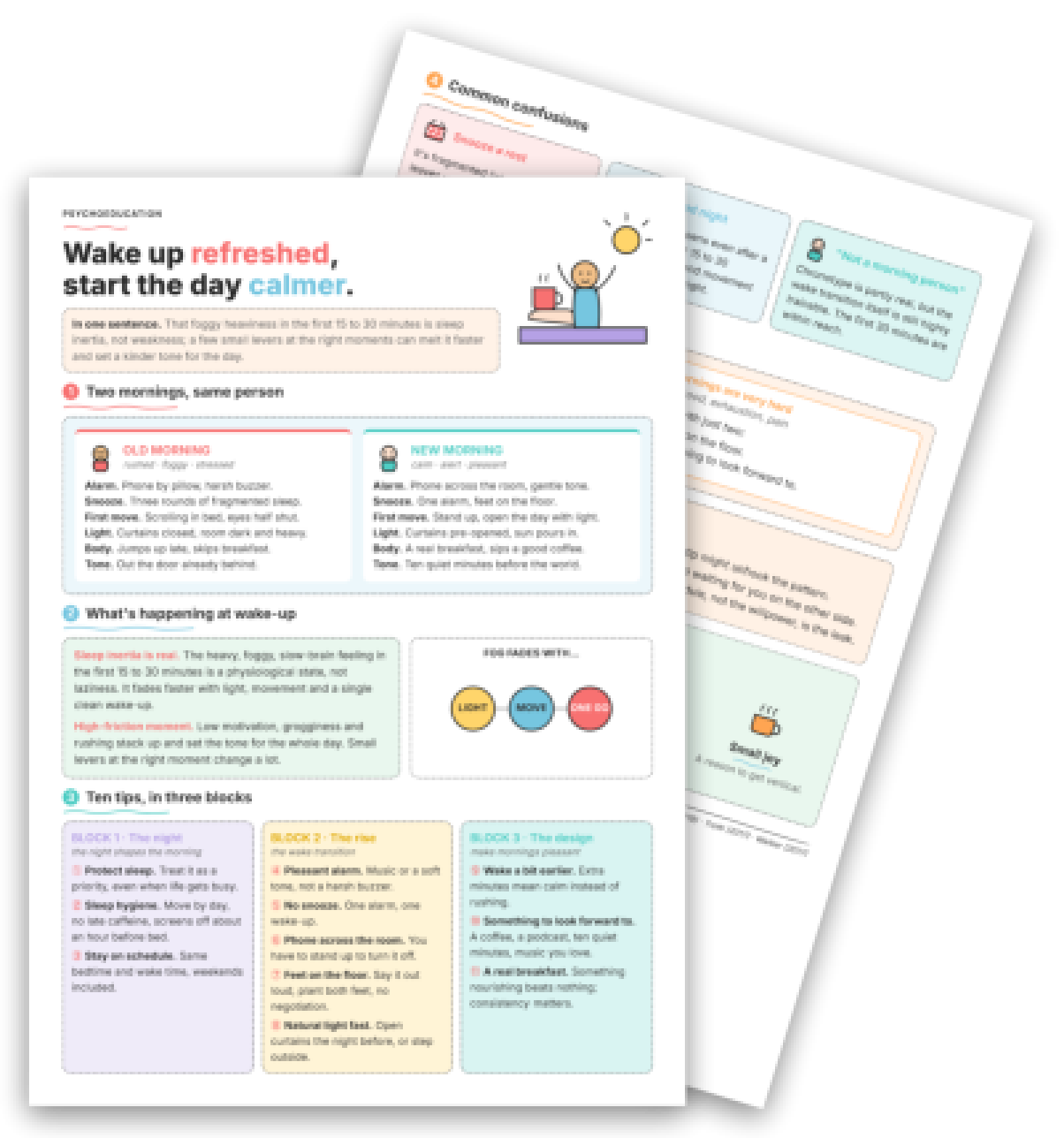
The fiche PDF is structured into five panels, each serving a distinct explanatory function.
- Panel 1, "Two mornings, same person": a side-by-side contrast of an old morning ("rushed, foggy, stressed") and a new morning ("calm, alert, pleasant"), alarm by alarm, action by action. This is the visual anchor. Patients who would deflect a verbal description often recognize themselves immediately when they see the sequence in print.
- Panel 2, Sleep inertia explained: a brief, destigmatizing account of the physiological fog, with the key formula "it fades faster with light, movement and a single clean wake-up", ready to quote directly.
- Panel 3, Ten tips, organised in three blocks: the night, the wake transition, and the deliberate design of pleasant mornings. The three-block structure prevents the common problem of patients fixating on alarm settings while ignoring sleep scheduling.
- Panel 4, Common confusions: named and corrected on the page, including the chronotype caveat ("The first 30 minutes are within reach").
- Panel 5, How to use this list: framing instructions for the patient, plus a short "if mornings are very hard" pathway for patients with low mood, exhaustion, or pain, and a set of session discussion prompts already formatted for clinical use.
> Key takeaway: the fiche is a visual support that facilitates the explanation of sleep inertia and morning routine in session. It replaces a verbal enumeration with a layout the patient can scan, recognize, and take home as a concrete reference, not as a homework form to fill in alone.
The visual logic of Panel 1 does work that a spoken description cannot: it shows the cumulative stacking of friction across the morning sequence, making it obvious why the tone is already set before the patient leaves the house.
750+ clinical tools
A library built with and for clinicians, ready to use in session and extend between appointments.
Access all the toolsWhen and How to Propose It
The fiche fits naturally from the second or third session onward, once you have a working picture of the patient's sleep patterns and morning behavior. It is particularly well-indicated in three clinical situations: patients presenting with insomnia or disrupted sleep, those in behavioral activation work for depression, and patients working on building new daily habits or habit stacking.
You might introduce it this way: "I'd like to show you something about what physically happens in the first minutes after you wake. It might change how you interpret that foggy feeling." This framing bypasses the self-blame loop before it activates.
Debrief in the next session using the built-in discussion prompts: "When you notice you've snoozed three times this week, name which tip might unhook the pattern." These are not rhetorical; they are concrete behavioral self-monitoring anchors that extend the session's work.
For patients whose mornings are heavily shaped by depressive withdrawal and avoidance, the "if mornings are very hard" pathway in Panel 5 keeps the intervention dose-appropriate: just two anchors, feet on the floor and one thing to look forward to, rather than a full ten-tip overhaul. Pair it with the Activity Menu for behavioral activation when building that "one thing to look forward to" feels genuinely difficult. The fiche also connects naturally with Exercise for Mental Health and Coping Skills for Depression when morning routine is part of a broader stabilization plan.
The sheet does not replace the formulation or the therapeutic relationship. It makes one specific explanation crisper and leaves the patient a reference they can actually use at 6:30 in the morning, without you in the room.
Use it with your patients
Share this tool in the mobile app and follow the work between sessions.
Sources
- Hilditch, C. J., McHill, A. W. (2019). Sleep inertia: current insights. Nature and Science of Sleep.
- Alvarenga, M. V., Carvalho, T. M., Lopes, T. V., Goncalves, E. M., Paiva, G. A., Cruz, M. L. (2025). The role of sunlight in sleep regulation: analysis of morning, evening and late exposure. BMC Public Health.
- Kim, H., Kim, D. Y., Byun, J. I., Shin, W. C., Jung, K. Y. (2025). Morning sleep inertia and its associated factors: Findings from a nationwide study. PLOS ONE.
Your session continues in your patients' pocket
Use with a patientYour resources, available everywhere
The handouts, exercises, programs and audios above: you choose which ones to make available to your patients, in the mobile app dedicated to them.
And far more than a library
The app goes well beyond resources, to support your patients every day:
Related categories
Explore other clinical resources by category.

Mood
Evidence-based worksheets and clinical tools for mood disorders: CBT, ACT, and positive psychology resources for psychologists and therapists.
Health
Somatic health clinical resources for practitioners: worksheets, psychoeducation, and exercises for somatic symptom disorder, chronic pain, and more.

Understand
Clinical hub for the therapeutic aim 'Understand': worksheets and tools to build patient insight across CBT, ACT, schema therapy and more.

CBT
CBT worksheets, cognitive restructuring exercises & behavioral tools for clinicians. Evidence-based resources for every phase of cognitive behavioral therapy.

Anxiety
Clinical hub for anxiety disorders: CBT and ACT worksheets, psychoeducation sheets, and exercises for assessment and treatment across the anxiety spectrum.
Trauma
Clinical hub on trauma and PTSD: assessment, differential diagnosis, treatment phases, and printable resources for practitioners. 155 chars.