
Clinical picture. T., a boy aged 7, was referred for oppositional behaviour and low frustration tolerance; his mother reported that praise felt hollow to him and that reward charts had repeatedly failed. During a parent guidance session, the clinician reviewed the psychoeducation sheet on rewards and consequences, focusing on the distinction between effort-labelled praise and trait-labelled praise, and on the principle of catching incompatible behaviour. The mother was asked to notice and name aloud, at least three times daily, any moment when T. persisted at a task rather than abandoning it, using specific language such as "you stayed with that even when it got hard." At the two-week review she reported fewer escalations before homework and, notably, that T. had begun prompting her to "check if he was being good" during reading time, suggesting early internalisation of the contingency.
Rewards and Consequences: PDF Worksheet, Tools and Exercises
A structured PDF worksheet with visual tools and exercises to help clinicians explain behavioral reinforcement principles to parents, clearly and efficiently in session.
Clinical vignettes
Praise Effort, Catch the Quiet Moment
Specificity Resolves a Stalled Chart
Clinical picture. M., a girl aged 9 with an ADHD diagnosis, had been on a home behaviour chart for six weeks with negligible effect; her father described the target as "be responsible," and the reward as "something nice at the weekend." The clinician used the informational sheet to illustrate the vague-versus-specific contrast, helping the father break the target into three observable steps, each completable within ten minutes, and replacing the weekend reward with a concrete 20-minute activity chosen by M. immediately after each successful sequence. The father was also guided on the 75% rule, reducing the number of required steps on school mornings to avoid repeated failure. Within three weeks the chart showed consistent completion on four out of five school days, and the father reported less negotiation at the door.
Parents working with you often arrive with a functional grasp of behavioral principles, and a chronic difficulty applying them under pressure. The same parent who nods at operant conditioning in session goes home and threatens a two-week screen ban in the middle of a meltdown, then quietly walks it back. This PDF worksheet on rewards and consequences is a visual support that makes the explanation stick, because it externalizes the principles onto the page during the session rather than leaving them as abstract instructions the parent is supposed to remember.
Use this resource with your patients
Handout, exercises and materials ready to use, right inside SessionFuel.
Why Rewards and Consequences Resist Verbal Explanation Alone
The failure point is rarely knowledge. It is specificity and consistency, and those two qualities are hard to hold in mind when a child is dysregulated and a parent is flooded. Behavioral parent training (Kazdin, 2008) has consistently shown that the gap between understanding reinforcement in principle and implementing it accurately at home is closed by concrete behavioral rehearsal, not more explanation.
Verbal psychoeducation also tends to collapse the nuance that matters most: what counts as a reward versus a bribe, why revoking an earned reward is categorically different from adjusting a future one, and why an enormous consequence delivered once is less effective than a small, predictable one delivered every time. These distinctions are genuinely difficult to track across a 50-minute session. A visual layout anchors them in the room and lets you revisit specific points without re-explaining from scratch.
What the Worksheet Contains
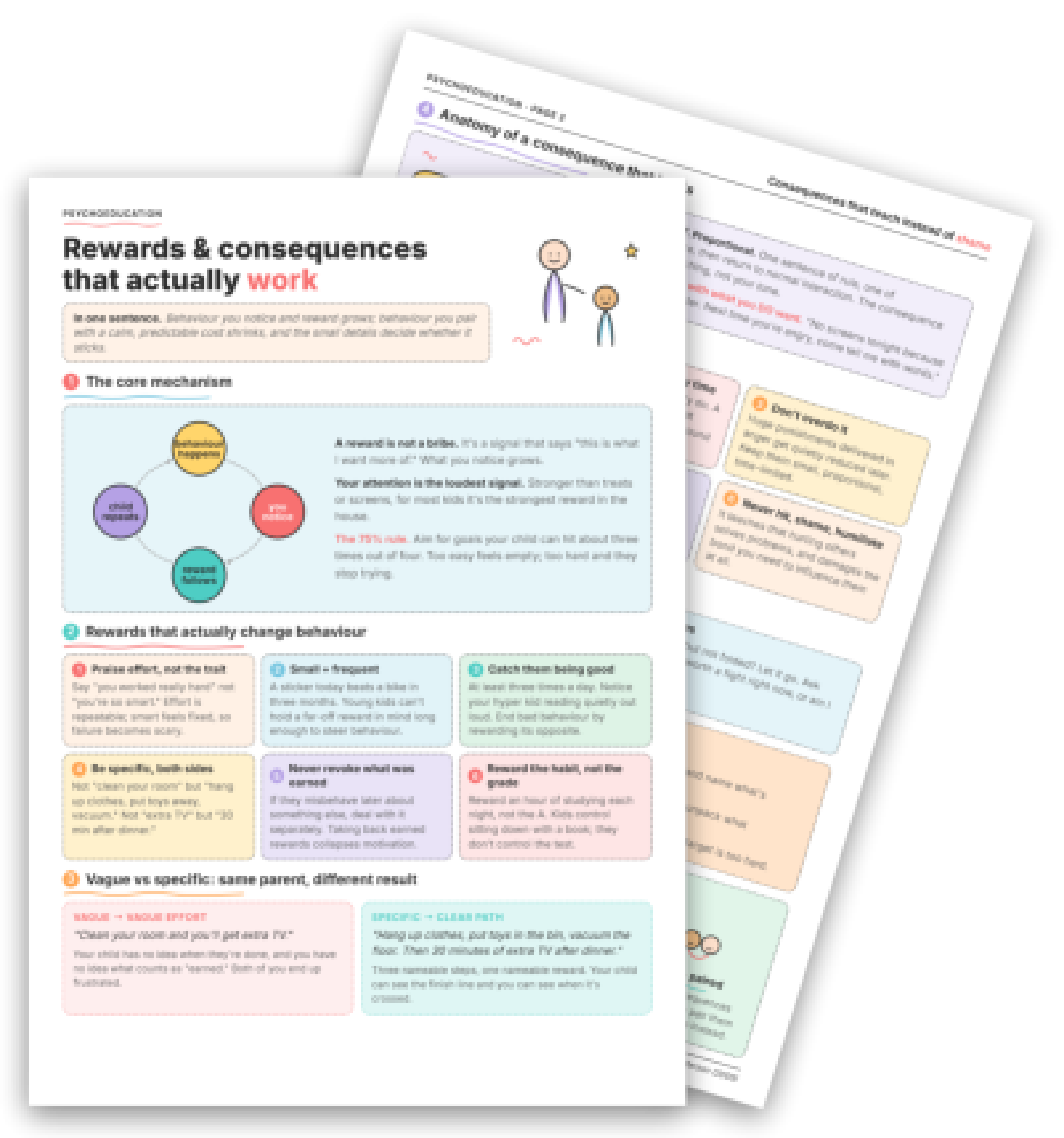
The fiche is structured across six clearly labeled panels, each targeting a different implementation failure point. Page one opens with a flow diagram of the core reinforcement mechanism (behaviour happens, you notice, reward follows, child repeats), accompanied by the framing that anchors the whole tool: "Your attention is the loudest signal. Stronger than treats or screens."
The next panel covers six specific reward principles, including effort-focused praise over trait praise (connecting directly to growth mindset research and Dweck, 2006), small and frequent over delayed rewards, and a rule against revoking what was already earned. The 75% rule (goals the child can meet three times out of four) is spelled out as a concrete calibration criterion, not just an analogy.
Panel three is the section that consistently generates the most discussion in session: a side-by-side contrast between a vague reward contract and a specific one, using the same situation. "Clean your room and you'll get extra TV" sits next to "Hang up clothes, put toys in the bin, vacuum the floor. Then 30 minutes of extra TV after dinner." The visual juxtaposition makes visible what an oral explanation rarely does: that both parent and child end up frustrated when the finish line is undefined.
Page two covers the anatomy of a well-delivered consequence (calm, brief, proportional, always paired with the desired alternative), six rules for consequences that teach rather than shame, a section on strategic ignoring, and a boxed "To discuss in session" prompt list. These prompts flag three recurring clinical situations: threatening consequences the parent won't follow through on, revoking earned rewards in anger, and rules that keep breaking because the target is calibrated too high.
> Key takeaway: This worksheet is a visual psychoeducation support for in-session use, not a take-home quiz. Its function is to make the explanation of rewards and consequences clear while the clinician is present, and to leave the parent with a concrete reference to return to.
750+ clinical tools
A library built with and for clinicians, ready to use in session and extend between appointments.
Access all the toolsWhen and How to Introduce It in Session
The worksheet fits naturally into parent guidance sessions at any stage of child or adolescent work, and it is particularly well-suited when the presenting concern involves behavioral dysregulation, ADHD management, strong-willed temperament, or persistent crying and whining cycles. It pairs well with a token reward system once the underlying principles are clear, and complements parent-child communication work by giving parents a behavioral lever alongside a relational one.
Introduce it before moving into consequence-setting, not after. A framing that works well: "Before we build the plan, let's look at what the research says actually changes behavior, because some of it is counterintuitive." This positions the fiche as clinical knowledge, not parental remediation, which protects the alliance.
Debrief by going directly to the vague-versus-specific panel and asking the parent to rewrite one rule they currently use. The "To discuss in session" prompts on page two are worth reading aloud: they name the implementation failures most parents have already encountered but haven't yet named, which often opens significant clinical material. For profiles involving screen addiction concerns or parenting fundamentals more broadly, the fiche slots cleanly into a larger psychoeducation arc.
The worksheet does not replace case formulation or the behavioral analysis that informs it. What it does is close the distance between what you explain and what the parent can actually use at home.
Use it with your patients
Share this tool in the mobile app and follow the work between sessions.
Sources
- Kazdin, A. E. (2005). Parent Management Training: Treatment for Oppositional, Aggressive, and Antisocial Behavior in Children and Adolescents. Oxford University Press.
- Kazdin, A. E. (2008). The Kazdin Method for Parenting the Defiant Child. Houghton Mifflin.
- Dweck, C. S. (2006). Mindset: The New Psychology of Success. Ballantine Books.
- Centers for Disease Control and Prevention (CDC) (2019). How to Use Rewards.
Your session continues in your patients' pocket
Use with a patientYour resources, available everywhere
The handouts, exercises, programs and audios above: you choose which ones to make available to your patients, in the mobile app dedicated to them.
And far more than a library
The app goes well beyond resources, to support your patients every day:
Related categories
Explore other clinical resources by category.

Relationships
Clinical worksheets and tools on relational functioning: attachment, schemas, assertiveness, and communication skills for therapists. Printable PDF resources.

Understand
Clinical hub for the therapeutic aim 'Understand': worksheets and tools to build patient insight across CBT, ACT, schema therapy and more.

Build skills
Skill-building resources for clinicians: printable worksheets and exercises for coping, assertiveness, and communication skills training in therapy.

CBT
CBT worksheets, cognitive restructuring exercises & behavioral tools for clinicians. Evidence-based resources for every phase of cognitive behavioral therapy.

Anxiety
Clinical hub for anxiety disorders: CBT and ACT worksheets, psychoeducation sheets, and exercises for assessment and treatment across the anxiety spectrum.

Trauma
Clinical hub on trauma and PTSD: assessment, differential diagnosis, treatment phases, and printable resources for practitioners. 155 chars.