
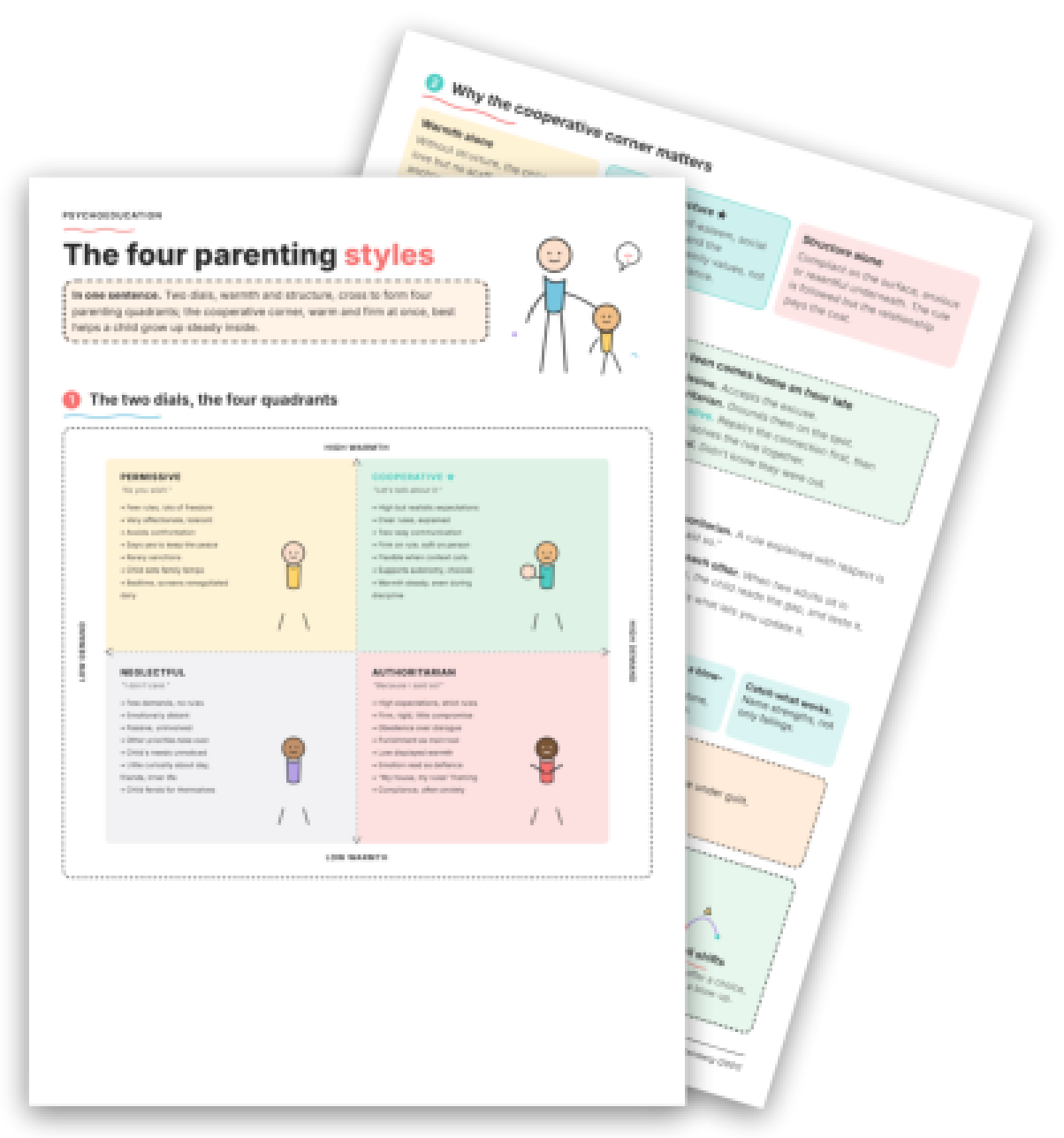
Clinical picture. A father in his early forties, referred to here as M., sought consultation after his nine-year-old son's school flagged repeated boundary-testing behaviour in class. M. described himself as close and involved, yet bedtime negotiations lasted over an hour nightly and screen time had no fixed limit. The clinician introduced the four-quadrant framework during a parent guidance session, using the informational sheet to map M.'s style visually. M. identified readily with the permissive quadrant and noted, without prompting, that he feared his son's anger more than he feared the absence of structure. Over the following two sessions, the work shifted toward adding predictable rules while preserving the genuine warmth already present, a small adjustment in the structure dial rather than a relational overhaul.
The Four Parenting Styles: PDF Worksheet, Tools and Exercises
A visual PDF worksheet clinicians can use in session to map warmth and structure, name the four parenting quadrants, and open concrete conversations about co-parenting and style drift.
Clinical vignettes
Recognising a Permissive Pattern
Softening an Authoritarian Style
Clinical picture. A mother referred to as T., mid-thirties, presented with concerns about her twelve-year-old daughter's withdrawal and refusal to speak at home. T. described a household with clear rules, consistent consequences, and very little room for negotiation, a pattern she linked to her own upbringing. The clinician offered the four-parenting-styles sheet as a non-judgmental starting point, framing warmth and structure as two separate and adjustable dimensions rather than a single fixed trait. T. was visibly relieved that the authoritarian quadrant was described in terms of a dial that could be moved, not a character flaw. She left the session with one concrete intention: to ask her daughter one open question per day without following it with a correction, testing whether a small increase in warmth changed the relational temperature before any rule was revised.
Most parents who come to you with a parenting concern have absorbed some version of the four parenting styles from a parenting book or a school meeting. What they rarely have is a clear, spatially organised map of where they actually sit, and where they drift under stress. This PDF worksheet provides exactly that: a visual framework you can point to in session to move the conversation from vague self-appraisal to specific, observable behaviour.
Use this resource with your patients
Handout, exercises and materials ready to use, right inside SessionFuel.
Why Parenting Styles Resist Verbal Explanation Alone
The core difficulty is that parents tend to hold an idealised self-image that oral questioning alone does not disturb. Ask "Are you strict?" and most will say "I try to be firm but fair." That answer fits every quadrant equally. What shifts the conversation is showing the warmth axis and the structure axis as two independent dials, making it immediately visible that warmth and firmness are not opposites but orthogonal variables.
A second layer of resistance comes from intergenerational transmission. Parents are often replicating a style they received without having named or evaluated it. The fiche makes this inheritance concrete enough to examine. The panel on what the fiche calls "stress pulls you toward authoritarian, guilt pulls you toward permissive" tends to land as a recognition, not a confrontation, which is precisely what opens reflective work rather than defensive closure.
For co-parenting situations, there is a third difficulty: each parent may sit in a different quadrant on the same scene, and neither has named the gap. Oral discussion of this tends to slide into blame. A shared visual removes the dyadic charge; both people look at the map together rather than at each other.
Clinicians working with children's fundamental needs by developmental stage, or running sessions alongside the Parenting Fundamentals program, will find the style map a useful anchor for the psychoeducation already in progress.
750+ clinical tools
A library built with and for clinicians, ready to use in session and extend between appointments.
Access all the toolsWhat the Fiche Contains: A Visual Support for In-Session Explanation
The worksheet is organised across five panels that build progressively, making it suited to in-session walkthrough rather than independent reading.
- Panel 1 presents the two-dial, four-quadrant grid: high/low warmth crossed with low/high demand, producing the Permissive, Cooperative, Authoritarian, and Neglectful corners. Each quadrant carries six to eight specific behavioural descriptors (for instance, the authoritarian corner lists "obedience over dialogue" and "emotion read as defiance"), concrete enough to trigger recognition without requiring a self-report scale.
- Panel 2 explains why the cooperative quadrant matters, contrasting warmth alone (love without scaffolding), structure alone (compliance without relationship), and the combination ("best supports self-esteem, social skills, regulation, and the internalisation of family values").
- Panel 3 applies the grid to two recurring scenes: the child refusing to brush their teeth, and the teenager arriving home an hour late. Each scene is played out across all four quadrants in one line, making the behavioural difference strikingly visible.
- Panel 4 offers four clinical reframes worth pausing on, including the intergenerational note: "Style is largely inherited from how you were parented. Spotting the inheritance is what lets you update it."
- Panel 5 closes with small shifts toward cooperative and three prompts explicitly labelled "To discuss in session," covering style drift under stress, recurring rule-versus-connection conflicts, and co-parent quadrant divergence.
> Key point: This fiche is a visual support that facilitates the explanation of the four parenting styles in session. It is not a self-administered questionnaire; it is a shared reference the clinician walks through with the patient, creating a common vocabulary and leaving a concrete take-home reference.
For parents of children with specific profiles, the grid pairs naturally with the ADHD Parenting Tips worksheet, the Strong-Willed Children program, or the Children's Crying and Whining program, all of which involve explicit limit-setting scenarios where quadrant awareness is directly actionable.
Use it with your patients
Share this tool in the mobile app and follow the work between sessions.
When and How to Introduce the Fiche
The worksheet fits best at the formulation or early intervention phase, once the presenting concern is mapped and the parent has enough alliance to look at their own behaviour without feeling evaluated. Introducing it too early, before a working alliance is established, risks activating the exact defensiveness you want to bypass.
A low-threat framing: "There is a model researchers use to describe parenting patterns that I find useful. I'd like to show you where most parents land and see if any of it resonates with what you've been describing." This positions the grid as descriptive, not diagnostic, and removes any implicit accusation.
For co-parent sessions, hand each parent a copy and ask them independently to mark where they think they sit on the warmth and structure axes before sharing. The gap, when it exists, becomes visible without either party having to assert it verbally, which is far more useful than a debate about who is "the strict one."
The debrief is where most of the clinical work happens. Which quadrant did they place themselves in? Which did their co-parent place them in? When does the style shift, and toward which corner? Parents working on early maladaptive schemas will often recognise the intergenerational engine behind their default quadrant without much prompting once the visual is in front of them. For parents managing childhood anxiety, connecting the worksheet to the Anxiety in Children and Adolescents program or the 50 Coping Strategies for Children and Adolescents worksheet gives the style work immediate behavioural traction.
The fiche does not replace the clinical formulation; it gives the parent a map they can return to between sessions when the next difficult moment arrives.
Your session continues in your patients' pocket
Use with a patientYour resources, available everywhere
The handouts, exercises, programs and audios above: you choose which ones to make available to your patients, in the mobile app dedicated to them.
And far more than a library
The app goes well beyond resources, to support your patients every day:
Related categories
Explore other clinical resources by category.

Relationships
Clinical worksheets and tools on relational functioning: attachment, schemas, assertiveness, and communication skills for therapists. Printable PDF resources.

Understand
Clinical hub for the therapeutic aim 'Understand': worksheets and tools to build patient insight across CBT, ACT, schema therapy and more.

Build awareness
Clinical worksheets and tools to build awareness in therapy: cognitive distortions, schemas, emotions, ACT and CBT resources for practitioners.

Build skills
Skill-building resources for clinicians: printable worksheets and exercises for coping, assertiveness, and communication skills training in therapy.
CBT
CBT worksheets, cognitive restructuring exercises & behavioral tools for clinicians. Evidence-based resources for every phase of cognitive behavioral therapy.

Systemic & narrative
Systemic family narrative therapy resources for clinicians: worksheets, psychoeducation programs, and exercises for couples, families, and groups.