
Clinical picture. A father in his early forties was referred following his 9-year-old son's school refusal, which the family attributed partly to late-night gaming. During the initial session, the clinician introduced a structured psychoeducation program on screen dependency and assigned the first lesson for the father to work through before the next appointment. Engaging with the lesson's guided prompts, he reflected on what positive uses he could actively encourage alongside setting limits, rather than removing devices outright. At the follow-up, he reported that naming both the risks and the genuine social functions of screens had shifted his stance from blanket prohibition toward negotiated household rules. The son's bedtime compliance improved modestly over the following two weeks, though the clinician noted this as an early indicator rather than a resolved pattern.
Children's Screen Addiction: A Parent Psychoeducation Program
Help parents recognize device dependency in children, understand its forms, and apply structured, concrete reduction strategies at home.
Clinical vignettes
Parent Mapping a Child's Screen Habits
Recognising Early Addiction Signs in an Adolescent
Clinical picture. A mother sought consultation after her 13-year-old daughter became markedly irritable whenever her phone was taken away, and had begun withdrawing from family meals. The clinician introduced the second lesson of the program, which focuses on identifying early behavioural signs of screen dependency such as agitation and social withdrawal, and asked the mother to complete it between sessions. Working through the multiple-choice prompts, she recognised several described patterns in her daughter's daily behaviour and noted them in writing before the next appointment. This structured observation gave the clinician concrete, parent-reported data to anchor the subsequent conversation and helped the mother move from vague worry toward specific, observable targets for intervention.
Use this resource with your patients
Handout, exercises and materials ready to use, right inside SessionFuel.
The clinical challenge: what words alone cannot resolve
Parents who come to you worried about their child's device use sit in a peculiar bind. Most oscillate between minimizing ("all kids are like this") and catastrophizing ("they are completely addicted"). Neither position is clinically useful. What they genuinely struggle to build, through conversation alone, is a calibrated, nuanced framework: one that names the real risks without demonizing technology, distinguishes normal heavy use from functional dependency, and offers concrete tools rather than vague time-limit advice.
The verbal psychoeducation you can deliver in a consultation has real limits here. Escalation patterns (agitation, then irritability, then full meltdown) are hard to hear abstractly; parents need to recognize them in a structured sequence, with time to reflect on their own child. Similarly, the four distinct dependency profiles (social media, gaming, general internet, online shopping) each require separate recognition criteria that oral explanation compresses too quickly. This is exactly where a structured, step-by-step program assigned as between-session homework fills the gap.
750+ clinical tools
A library built with and for clinicians, ready to use in session and extend between appointments.
Access all the toolsWhat this program contains
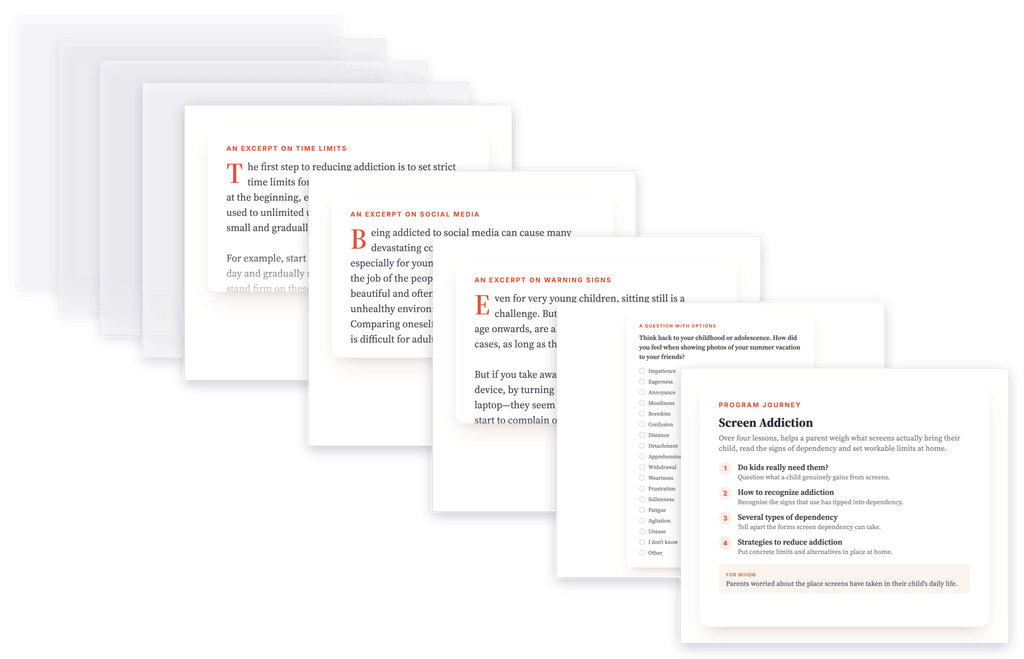
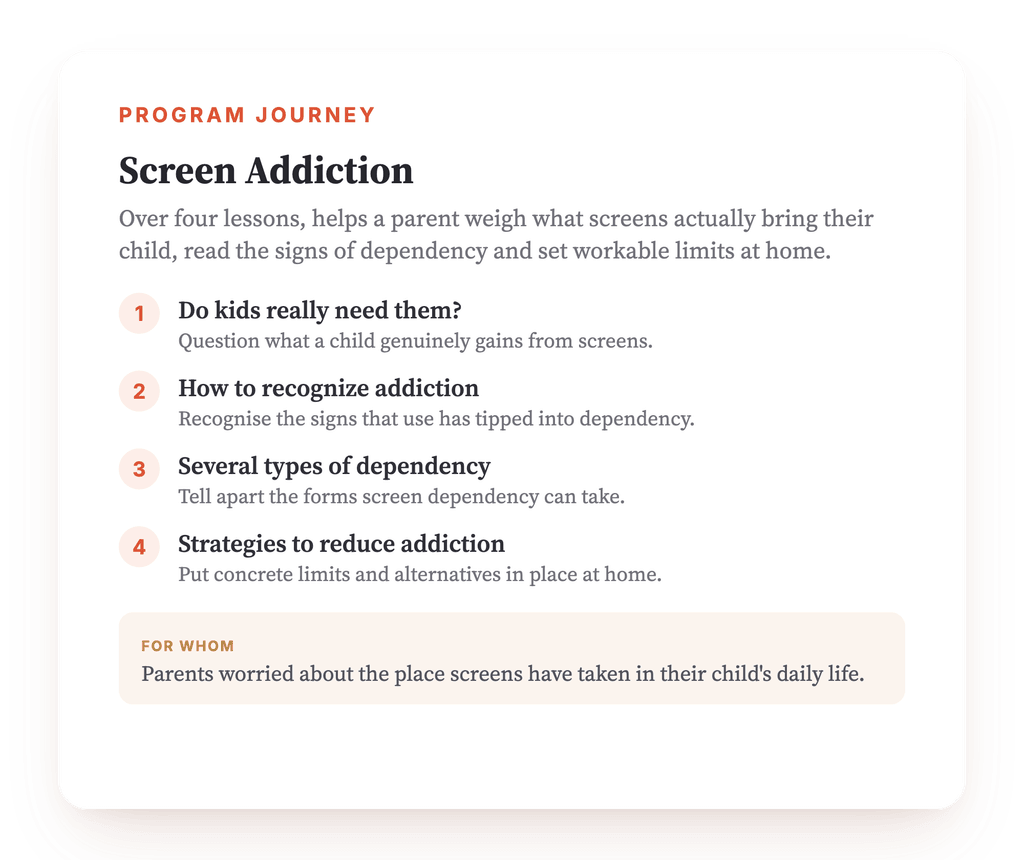
The program is organized into four lessons, each building on the last.
Lesson 1 opens by questioning the all-or-nothing framing: the goal is not zero screen time but responsible, balanced use. It covers both the positive functions of devices (social connection, knowledge, inspiration) and their risks for mental health, including social comparison dynamics. Parents are invited to reflect on what they can actively model and communicate to their children about social media not reflecting real life.
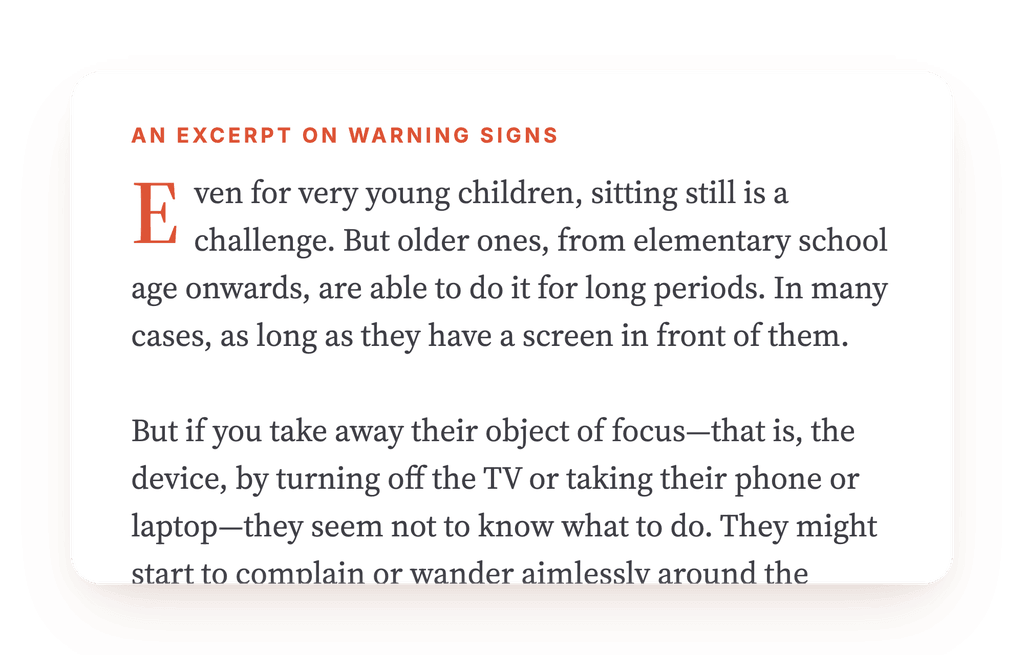
Lesson 2 maps the behavioral escalation sequence parents should watch for: restlessness when devices are removed, then irritability and nervous behavior, then full-blown tantrums, and finally a loss of interest in any non-screen activity. Seeing these as a progression rather than isolated incidents changes how parents interpret what they witness at home.
Lesson 3 differentiates four types of dependency with their own clinical fingerprints: social media addiction and its particular impact on young, impressionable self-image; gaming dependency and its characteristic aggression arc; diffuse internet use (video consumption, mindless browsing); and online purchasing in teenagers with disposable income. Each type is approached through guided prompts that push parents to evaluate their own habits as well as their child's.
Lesson 4 turns to concrete reduction strategies: setting firm time boundaries, promoting offline activities (sport, reading, family games), building screen-free family moments (mealtimes, pre-bedtime), and implementing a reward-and-consequence system grounded in behavioral principles. Open family communication is positioned as the connecting thread.
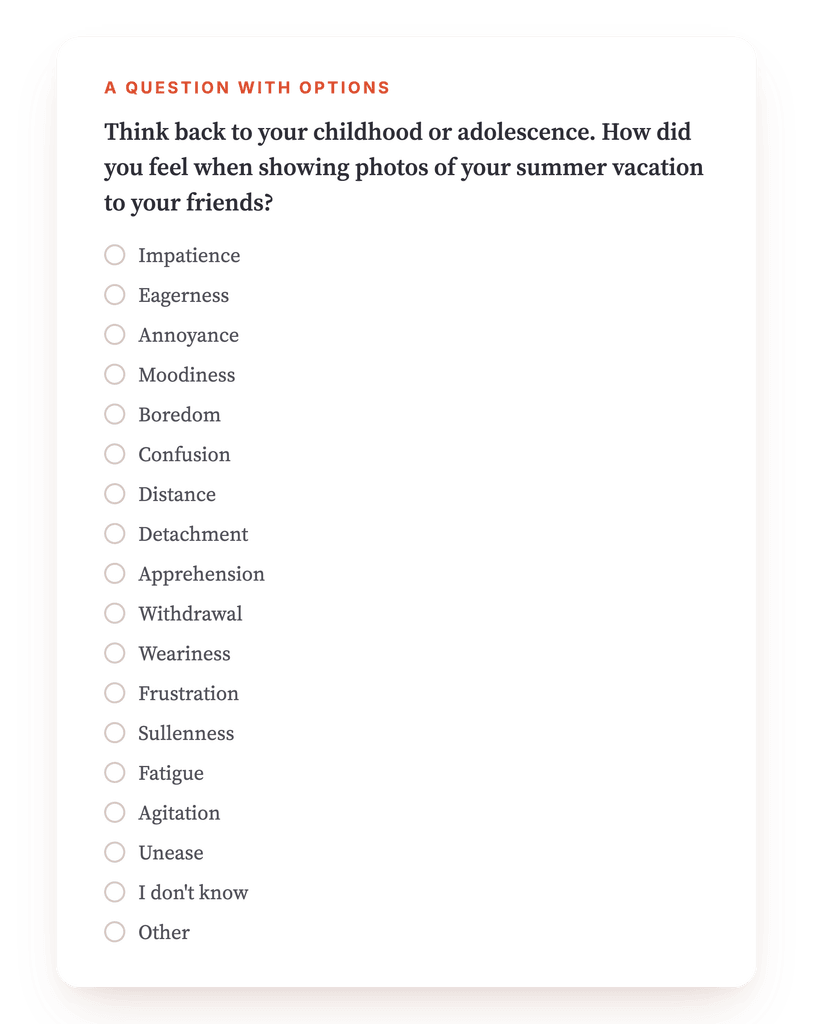
The preview images embedded here (the program overview map and a few sample cards) show only a small fraction of what the full program contains. The complete curriculum includes many more steps, guided reflection prompts, and multiple-choice questions than these aperçus suggest.
This program is available to patients through the mobile application that is the dedicated patient-side interface of SessionFuel: once you assign it in your SessionFuel account, your patient receives it directly on their phone and works through each lesson independently, at their own pace, between appointments.
Key insight: Screen dependency in children is rarely about the device itself. It is about the absence of an alternative framework for belonging, stimulation, and self-regulation. This program helps parents build that framework, gradually, at home.
Use it with your patients
Share this tool in the mobile app and follow the work between sessions.
How to assign and use it in your practice
This program suits parents of school-age children and teenagers presenting with behavioral difficulties around device removal, declining interest in offline activities, or family conflict over screen time. It also works well when a parent has vague concern but lacks the vocabulary to assess severity.
Introduce it as structured homework to carry out between two consultations, framing each lesson as a short, focused reflection to complete at home. Emphasize that the program is not a replacement for your work together but a way to make that work more concrete and more portable.
When your patient returns, the written answers they have produced across the guided prompts become direct clinical material. Their response to "what would you say to your child if you suspected a gaming dependency?" or "how are you modelling responsible internet use?" often surfaces parental guilt, co-dependency patterns, or their own screen habits, all of which feed directly into your next consultation. Pair the lesson on reward systems with the Rewards and Consequences: PDF Worksheet or the Token Reward System: PDF Worksheet for parents who need a more visual behavioral tool to take home.
For parents where the child's rigidity around screens intersects with emotional regulation difficulties, the Strong-Willed Children: A Parent Psychoeducation Program makes a natural companion assignment. If social media comparison is surfacing in an adolescent, the Anxiety in Children and Adolescents: A Parent Psychoeducation Program covers overlapping terrain. For the parenting relationship itself, Expressing Appreciation to Children: A Clinical Program and Parenting Fundamentals: A 6-Lesson Psychoeducation Program offer complementary structural work. When coping skills are a priority, the Coping Skills for Addictions: PDF Worksheet gives parents a concrete framework they can also read alongside their child's therapist. The Four Parenting Styles: PDF Worksheet is useful if the conversation reveals permissive or inconsistent limit-setting as the underlying driver of screen overuse.

Your session continues in your patients' pocket
Use with a patientYour resources, available everywhere
The handouts, exercises, programs and audios above: you choose which ones to make available to your patients, in the mobile app dedicated to them.
And far more than a library
The app goes well beyond resources, to support your patients every day:
Related categories
Explore other clinical resources by category.

Behaviours
Clinical hub for behaviors in therapy: worksheets and tools for coping, eating disorders, CBT formulation, and maladaptive behavioral patterns.

Relationships
Clinical worksheets and tools on relational functioning: attachment, schemas, assertiveness, and communication skills for therapists. Printable PDF resources.

Understand
Clinical hub for the therapeutic aim 'Understand': worksheets and tools to build patient insight across CBT, ACT, schema therapy and more.

Anxiety
Clinical hub for anxiety disorders: CBT and ACT worksheets, psychoeducation sheets, and exercises for assessment and treatment across the anxiety spectrum.

Trauma
Clinical hub on trauma and PTSD: assessment, differential diagnosis, treatment phases, and printable resources for practitioners. 155 chars.

Mood
Evidence-based worksheets and clinical tools for mood disorders: CBT, ACT, and positive psychology resources for psychologists and therapists.