
Clinical picture. M., a woman in her mid-forties, presented with chronic fatigue and low-grade resentment toward her adult siblings, whom she described as "always needing something." She had never connected her exhaustion to a pattern of boundary functioning, and initially framed her difficulty saying no as a personal failing. The clinician introduced the porous-to-rigid spectrum from the psychoeducational sheet, naming her pattern as porous rather than weak or selfish. M. recognised the example of agreeing to a weekend favour while already depleted and said, quietly, "That is every Sunday for me." By the following session she had declined one request without apologising, which she reported as small but notable.
Boundaries: PDF Worksheet, Tools and Exercises for Clinical Practice
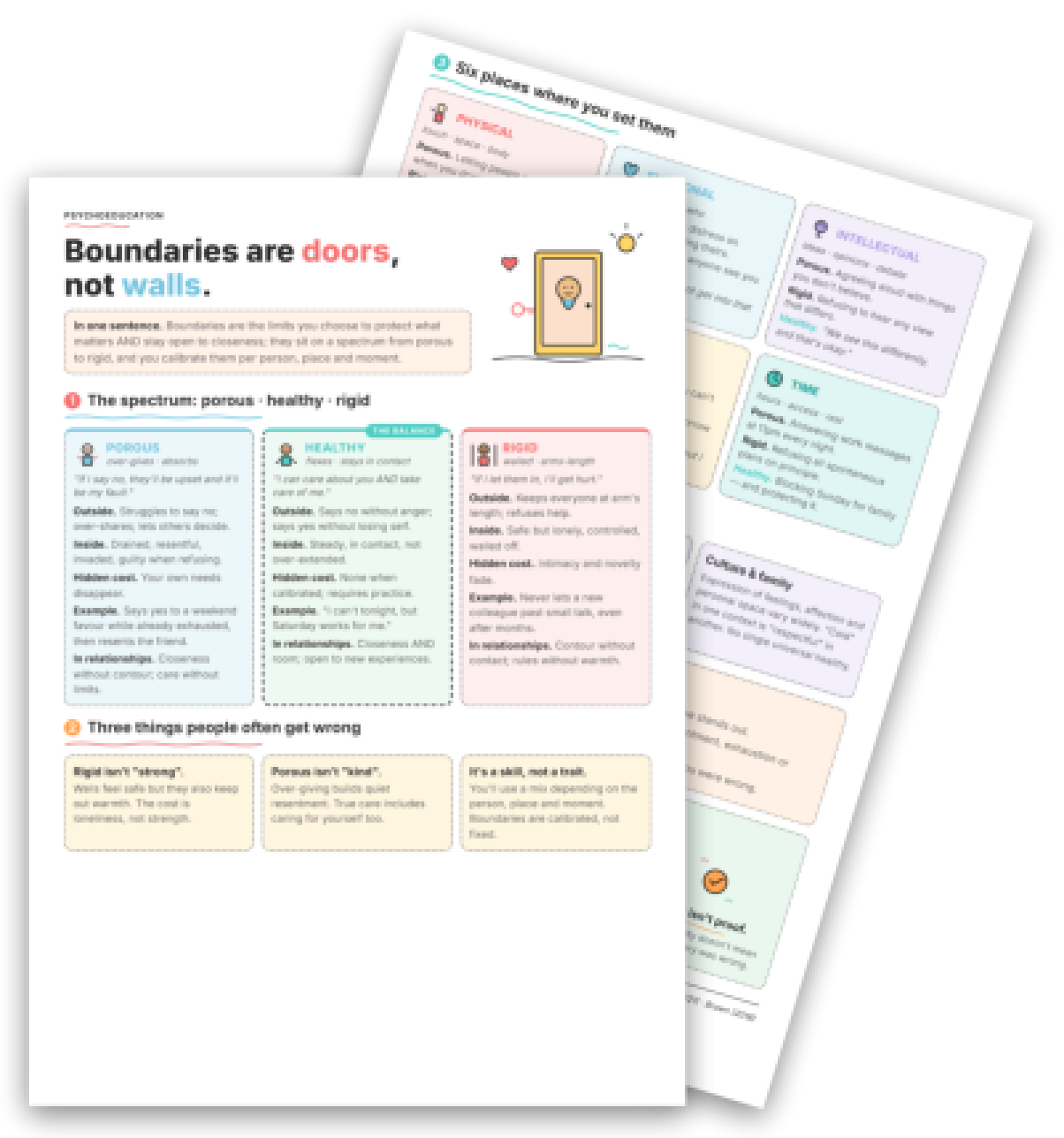
A visual psychoeducation fiche helping clinicians explain the porous-healthy-rigid spectrum and six boundary domains clearly in session.
Clinical vignettes
Psychoeducation Reframes Over-Giving Pattern
Rigid Stance Explored Without Pressure
Clinical picture. T., a man in his early thirties with a history of relational trauma, described keeping all colleagues at arm's length and attributed this to "just being private." The clinician used the informational sheet to distinguish privacy as a value from rigidity as a protective reflex, without pathologising either. T. noted the phrase "contour without contact" and said it described his friendships accurately, though he had not previously seen a cost in it. No change was prescribed; the session closed with T. naming, for the first time, that loneliness was present alongside the sense of safety. That acknowledgement became a reference point in subsequent work.
"Boundaries" is one of those concepts patients hear everywhere before they arrive in your consulting room, yet most carry a muddled or binary version of it. This fiche PDF offers a structured, visual psychoeducation support you can use in session to replace that muddle with a workable clinical map.
Use this resource with your patients
Handout, exercises and materials ready to use, right inside SessionFuel.
Why "Boundaries" Consistently Misfires Verbally
The core difficulty is not comprehension but miscategorization. Patients who over-give tend to interpret any limit-setting as coldness or rejection, while those with a history of relational trauma often equate firm limits with the rigid, walled-off self-protection they already know. Explaining the spectrum orally runs straight into this: the patient who needs to hear "a boundary is a door, not a wall" is precisely the one who will default to one pole or the other as soon as the session ends.
A second resistance comes from the multiplicity of domains. Patients can acknowledge physical over-extension while completely blind-spotting material or time domains, and the dynamic is clinically different in each. Without a visual scaffold, it is hard to hold six domains in mind simultaneously, and the conversation tends to collapse onto whichever domain the patient finds easiest to discuss.
This is where schemas like Self-Sacrifice or patterns mapped in the 12 Beliefs That Damage Relationships worksheet intersect with boundary work: the underlying belief often determines which domain is most defended and which is most porous.
What the Fiche Contains: A Visual Map Patients Can Actually Hold
The fiche is structured around four numbered sections, all grounded in a single guiding metaphor: "Boundaries are doors, not walls."
Section 1 presents the porous-healthy-rigid spectrum as a side-by-side three-column layout. Each position is rendered across five dimensions: behavioural presentation, inner experience, hidden cost, a concrete everyday example, and the relational quality it produces. The porous column includes the anchoring thought "If I say no, they'll be upset and it'll be my fault"; the rigid column carries "If I let them in, I'll get hurt." The visual side-by-side comparison does something oral explanation cannot: it shows simultaneously that both poles share the same hidden cost (connection at the expense of self, or safety at the expense of intimacy), which patients grasp immediately when they see it laid out.
Section 2 dismantles three common distortions directly: rigid isn't "strong," porous isn't "kind," and limits are a calibrated skill, not a fixed personality trait. Each misconception is stated, then refuted in one sentence.
Section 3 maps six domains (physical, emotional, intellectual, sexual, material, time) using the same porous-healthy-rigid logic in each. This is clinically useful for the boundary-styles conversation, and pairs well with Boundary Types and Three Types of Boundaries when a patient needs more granular work in one domain. The material domain entry ("Lending money you can't afford to lose, again") and the time domain entry ("Answering work messages at 11pm every night") tend to produce immediate recognition even in patients who initially resist the concept.
Section 4 covers what shapes an individual's calibration point: values, setting, and cultural or family background. Three "To discuss in session" prompts close the fiche, giving the patient a concrete agenda to bring to the next appointment.
> Key takeaway: This fiche is a visual support that facilitates in-session explanation, not a questionnaire to fill out at home. You use it to walk through the spectrum together, anchor a shared vocabulary, and leave the patient with a concrete reference to consult between appointments.
Clinical library
750+ clinical tools
A library built with and for clinicians, ready to use in session and extend between appointments.
Access all the toolsSeveral resource types
Psychoeducation handouts
Understand at a glance
Interactive exercises
To do and fill in
Interactive programs
A structured path
Audios
Meditation and relaxation
Psychometric tests
Automatic scoring
When and How to Introduce It
This fiche fits naturally from session two or three onward, once the anamnèse is complete and initial formulation hypotheses are live. It is particularly indicated when avoidance of conflict is prominent, when the patient endorses frequent resentment or exhaustion in relational contexts, or when assertiveness deficits have already surfaced. You can pair it directly with assertiveness tools or assertive communication exercises once the conceptual frame is in place.
Introduce it simply: "I'd like to show you a map that may help us put words to what we've been circling around." Avoid leading with the word "boundaries" before the patient has seen the spectrum; the concept will mean more once they have pointed to their own column.
For debriefing, ask which domain produced the most recognition in Section 3, and which of the three "To discuss in session" prompts applies this week. Patients working on setting personal limits or how to say no can use the fiche as a reference sheet for behavioral experiments between sessions. The Healthy Boundaries and Setting Personal Boundaries resources extend the work once the conceptual scaffold is in place.
One limit to note: with patients presenting active attachment trauma or a mistrust/abuse schema, the rigid column may activate defensive shame. In those cases, introduce Section 1 from the healthy column outward rather than reading left to right.
The fiche does not replace your formulation; it makes one component of it visible and portable.
Use it with your patients
Share this tool in the mobile app and follow the work between sessions.
Sources
- Katherine, A. (1993). Boundaries: Where You End and I Begin. Fireside / Simon and Schuster.
- Cloud, H., Townsend, J. (1992). Boundaries: When to Say Yes, How to Say No to Take Control of Your Life. Zondervan.
- Katherine, A. (2000). Where to Draw the Line: How to Set Healthy Boundaries Every Day. Touchstone / Simon and Schuster.
- Zhovnirchuk, O., Khomych, H. (2024). Personal boundaries: definition, role, and impact on mental health. Personality and Environmental Issues.
Patient mobile app
Your session continues in your patients' pocket
Use with a patientYour resources, available everywhere
The handouts, exercises, programs and audios above: you choose which ones to make available to your patients, in the mobile app dedicated to them.
Psychoeducation handoutsInteractive exercisesInteractive programsAudiosPsychometric tests
And far more than a library
The app goes well beyond resources, to support your patients every day:
Standardized tests
Therapy journal
Gamification
Wellbeing challenges
Introspection prompts
Therapist homework
Related categories
Explore other clinical resources by category.

Identity
Clinical resources for self-identity work in therapy: CBT, ACT, schema tools for clinicians addressing self-concept, core beliefs, and identity disruption.
Relationships
Clinical worksheets and tools on relational functioning: attachment, schemas, assertiveness, and communication skills for therapists. Printable PDF resources.

Understand
Clinical hub for the therapeutic aim 'Understand': worksheets and tools to build patient insight across CBT, ACT, schema therapy and more.

Build awareness
Clinical worksheets and tools to build awareness in therapy: cognitive distortions, schemas, emotions, ACT and CBT resources for practitioners.

CBT
CBT worksheets, cognitive restructuring exercises & behavioral tools for clinicians. Evidence-based resources for every phase of cognitive behavioral therapy.

Humanistic
Printable clinical resources for humanistic therapy: worksheets, exercises, and psychoeducation programs for practitioners using person-centered and experiential approaches.