
Clinical picture. M., a woman in her early forties, presents with chronic fatigue and low-grade resentment toward colleagues. She describes routinely agreeing to cover others' shifts and taking on tasks outside her role, while privately feeling taken advantage of. The clinician introduces the three-boundary styles worksheet in session, asking M. to read the porous column aloud and note what resonates. She identifies quickly with the phrase "yes when you mean no" and, for the first time, names the pattern as a habitual style rather than a character flaw. Over the following two sessions she begins tracking situations where her stated answer and her felt response diverge, which she brings back as concrete material for further work.
Three Types of Boundaries: PDF Worksheet, Tools and Exercises for Clinical Practice
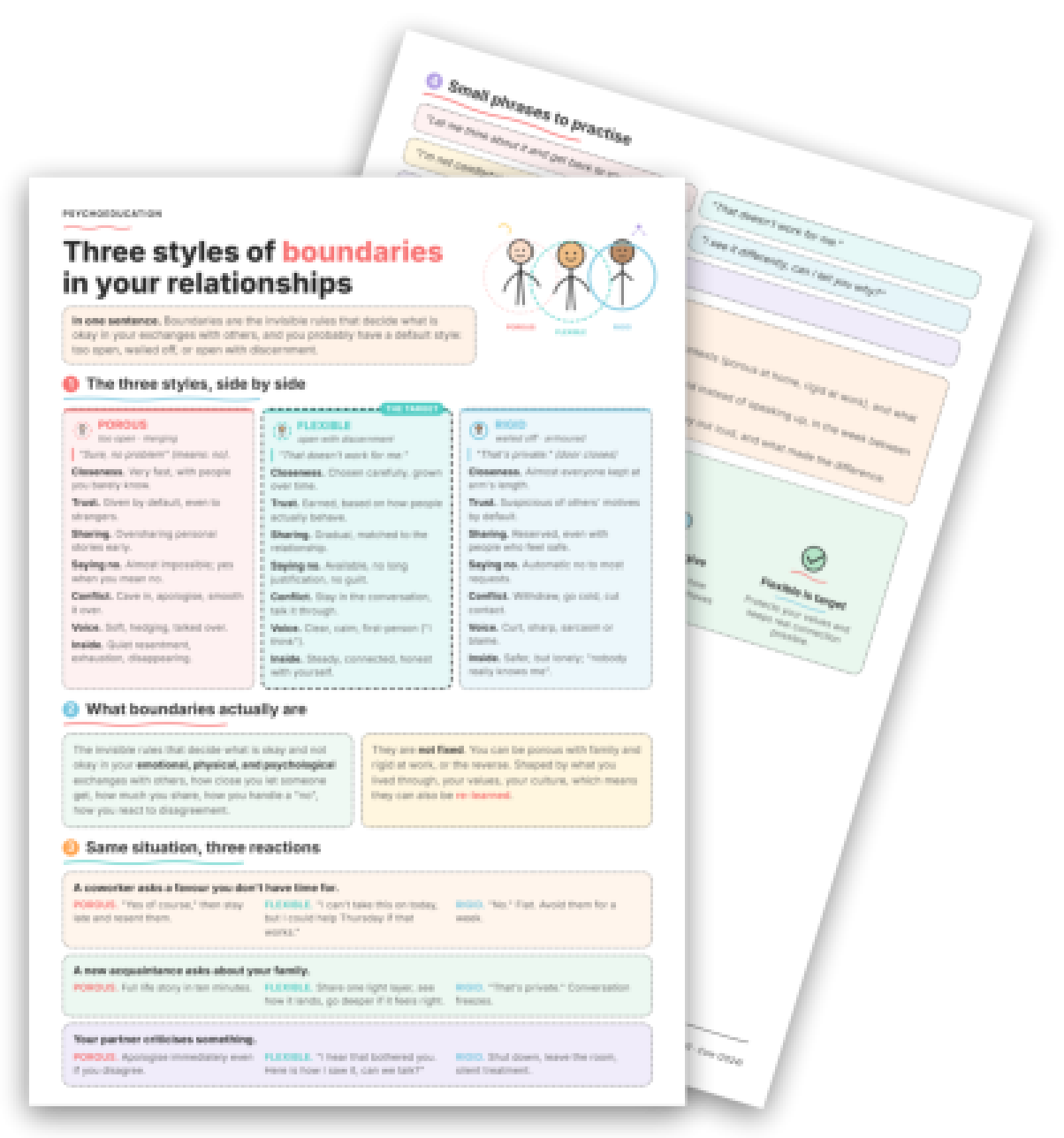
A visual psychoeducation tool helping clinicians explain porous, rigid, and flexible boundary styles in session and give patients a concrete relational reference to keep.
Clinical vignettes
Recognising a Porous Pattern at Work
Rigid Style and Relational Isolation
Clinical picture. T., a man in his mid-fifties referred after a second relationship breakdown, describes himself as self-sufficient and dismissive of what he calls "emotional dependency" in others. He is initially sceptical of psychoeducational material, so the clinician offers the worksheet as optional reading between sessions rather than a guided in-session exercise. T. returns the following week having annotated the rigid column, noting the phrase "safer, but lonely; nobody really knows me" with a question mark. This small opening allows the clinician to explore how the protective function of his boundary style, likely shaped by earlier experiences, now conflicts with his stated wish for genuine closeness. The worksheet serves as a shared reference point without requiring T. to frame the issue in explicitly emotional terms.
Explaining boundary styles to a patient who oscillates between self-erasure and sudden withdrawal is one of those moments where naming the concept ("your boundaries are unclear") risks producing a nod rather than genuine insight. This fiche PDF is a visual support designed to make the distinction between porous, rigid, and flexible boundaries concrete in session, not just labelled.
Use this resource with your patients
Handout, exercises and materials ready to use, right inside SessionFuel.
Why boundary styles resist verbal explanation
The three-style model is clinically useful, but its precision tends to flatten when delivered orally. Patients hear "find the middle" rather than grasping that each style carries a distinct internal experience, a distinct relational pattern, and often a distinct survival history. Without a side-by-side structure, the felt difference between chronic appeasement and chronic armoring collapses into a single undifferentiated "problem with limits."
A second difficulty: context-dependency. Many patients are porous with a critical parent and rigid at work, or the reverse. Trying to describe this verbally forces linear narration; a column layout shows it instantly. Patients whose patterns map onto early maladaptive schemas (self-sacrifice, subjugation, emotional inhibition) in particular tend to misread their own style because they have no external frame to compare it against. The Self-Sacrifice Schema and Subjugation Schema resources work well alongside this one precisely for that reason.
What the fiche contains: a visual tool for in-session use
The fiche is structured in four numbered sections, built for explanation during the appointment rather than solo reading.
Section 1 is the spine of the fiche: a three-column comparison of the porous, flexible, and rigid styles across eight dimensions (closeness, trust, sharing, saying no, conflict, voice, and internal experience). The flexible column is explicitly marked as "THE TARGET." What this layout achieves that speech cannot: a patient can scan the "Inside" row and locate themselves, "Quiet resentment, exhaustion, disappearing" or "Safer, but lonely; 'nobody really knows me'," without you having to make the attribution for them. The visual structure does the confrontation gently.
Section 2 grounds the concept: boundaries are described as learned, context-sensitive, and modifiable, which immediately reduces shame and opens the assertiveness work or communication style exploration that typically follows.
Section 3 gives three worked scenarios: a coworker's favour, a new acquaintance asking about family, a partner's criticism. Each scenario shows all three reactions side by side. Patients who struggle to identify their style in the abstract often locate themselves immediately in a scenario. You can use this panel to introduce behavioral experiments between sessions.
Section 4 lists five ready-to-use phrases ("Let me think about it and get back to you," "I care about this, and I also need some space tonight"). These map directly onto the kind of graduated assertiveness practice outlined in Setting Boundaries: How to Say No and I-Messages.
The fiche closes with "To discuss in session" prompts, cueing the patient toward the precise observations most useful to bring back: when their style shifts between contexts, moments when a phrase worked or felt impossible, and what made the difference.
> Key point: the fiche is a visual support that facilitates the explanation of boundary styles in session; it is not a self-assessment questionnaire to complete alone, but a shared reference that makes the psychoeducation visible, speeds up the vocabulary-building, and gives the patient something concrete to take away.
Clinical library
750+ clinical tools
A library built with and for clinicians, ready to use in session and extend between appointments.
Access all the toolsSeveral resource types
Psychoeducation handouts
Understand at a glance
Interactive exercises
To do and fill in
Interactive programs
A structured path
Audios
Meditation and relaxation
Psychometric tests
Automatic scoring
When and how to introduce the fiche
This fiche fits naturally from the second or third session, once the presenting relational pattern has emerged in the anamnesis, before exposure or assertiveness work begins. It is particularly indicated when:
- Recurrent relational fatigue is present (chronic yes-saying, resentment, burnout of the kind tracked in boundary exploration worksheets)
- Attachment-related schemas are central, especially abandonment fear (see The Abandonment Schema) or beliefs that damage relationships (see 12 Beliefs That Damage Relationships)
- The patient uses passive or passive-aggressive communication but cannot yet name why
Introduce it simply: "I want to show you a framework for what we've been describing. This is a three-column comparison, not a diagnostic grid. See which column feels most familiar first." Let the patient point before you interpret.
Debriefing centers on two questions: which style they recognized in a current relationship, and what they imagine would need to shift internally (not just behaviorally) for the flexible column to feel accessible. The phrases in Section 4 can become the first concrete practice target, supported by assertive communication exercises or active listening skills as the work deepens.
One limit: patients with significant trauma histories may locate themselves in the rigid column and experience the "flexible is target" framing as invalidating. Take a moment before sharing the fiche to frame rigidity explicitly as a protective adaptation rather than a deficit, and pair it with communication styles and inner experience if the somatic dimension needs attending to.
The fiche does not replace the formulation. What it does is give you a shared vocabulary, faster, and leave the patient with a legible reference between sessions.
Use it with your patients
Share this tool in the mobile app and follow the work between sessions.
Sources
- Minuchin, S. (1974). Families and Family Therapy. Harvard University Press.
- Tawwab, N. G. (2021). Set Boundaries, Find Peace: A Guide to Reclaiming Yourself. TarcherPerigee.
Patient mobile app
Your session continues in your patients' pocket
Use with a patientYour resources, available everywhere
The handouts, exercises, programs and audios above: you choose which ones to make available to your patients, in the mobile app dedicated to them.
Psychoeducation handoutsInteractive exercisesInteractive programsAudiosPsychometric tests
And far more than a library
The app goes well beyond resources, to support your patients every day:
Standardized tests
Therapy journal
Gamification
Wellbeing challenges
Introspection prompts
Therapist homework
Related categories
Explore other clinical resources by category.

Identity
Clinical resources for self-identity work in therapy: CBT, ACT, schema tools for clinicians addressing self-concept, core beliefs, and identity disruption.

Relationships
Clinical worksheets and tools on relational functioning: attachment, schemas, assertiveness, and communication skills for therapists. Printable PDF resources.

Understand
Clinical hub for the therapeutic aim 'Understand': worksheets and tools to build patient insight across CBT, ACT, schema therapy and more.

Build awareness
Clinical worksheets and tools to build awareness in therapy: cognitive distortions, schemas, emotions, ACT and CBT resources for practitioners.

CBT
CBT worksheets, cognitive restructuring exercises & behavioral tools for clinicians. Evidence-based resources for every phase of cognitive behavioral therapy.

Systemic & narrative
Systemic family narrative therapy resources for clinicians: worksheets, psychoeducation programs, and exercises for couples, families, and groups.