
Clinical picture. M., a woman in her early forties, presented with persistent fatigue and low-grade irritability she attributed to work overload. During session, she described routinely covering weekend shifts for colleagues and feeling unable to refuse, though she privately resented each request. The clinician introduced the informational sheet and invited her to read the section on strong emotions as signals, asking what had not sat right in a recent situation. M. identified, with some surprise, that her resentment had been consistent and specific rather than diffuse, pointing to a pattern of boundary erosion rather than a mood disorder. In the following week she used the values-as-compass tip to decline one request, noting less internal conflict than she had anticipated.
Healthy Boundaries: PDF Worksheet, Tools and Exercises for Clinical Practice
A visual PDF worksheet with six concrete tips, ready-to-use scripts, and psychoeducation tools to help clinicians explain healthy boundaries clearly in session.
Clinical vignettes
Resentment as a Boundary Signal
Passive Style Recognised, Assertive Tried
Clinical picture. T., a man in his late twenties with a history of social anxiety, described a recurring difficulty with a flatmate whose intrusive behaviour left him feeling trapped. He could articulate what bothered him clearly in session but defaulted to vague, apologetic language in the moment, consistent with the passive style described in the sheet. The clinician used the three-style comparison as a reference point and asked T. to draft a specific, calm statement he could use at home, following the assertive model. T. returned the next session reporting he had delivered a brief, direct sentence without excessive justification; the flatmate had responded without conflict. He noted the outcome was less about the flatmate changing and more about his own sense of agency.
Explaining healthy boundaries to a patient verbally rarely lands the first time. They hear "protect yourself" and picture withdrawal; they hear "say no" and feel permission to cut off. This fiche PDF gives you a structured visual support to introduce the concept precisely, without those common misreadings, and leaves the patient with a concrete reference to consult between sessions.
Use this resource with your patients
Handout, exercises and materials ready to use, right inside SessionFuel.
Why Boundaries Resist Verbal Explanation
The central difficulty is conceptual slippage. When a patient hears "boundary," they typically map it onto one of two poles: either a selfish refusal or a fragile plea. The wall-versus-boundary distinction that grounds most clinical work on this topic collapses at the patient's level unless it is shown, not just stated.
A second sticking point is the locus of control. Patients with high fawn responses or strong self-sacrifice schema patterns consistently confuse a boundary with a demand on the other person. They hear "if you yell, I'll end the call" as aggression toward the other, not as a statement about their own behaviour. Correcting this misread mid-session costs time and alliance. A visual representation of what you govern versus what you cannot control resolves it in seconds.
Finally, patients rarely link their chronic resentment or exhaustion to a specific missing limit. The abandonment schema, approval-seeking patterns, and fused identities all generate boundary diffusion that patients experience as a mood problem, not a relational one. Naming the mechanism requires a shared vocabulary you can build together, in session, with a visual anchor.
What the Fiche Contains: A Visual Tool for In-Session Psychoeducation
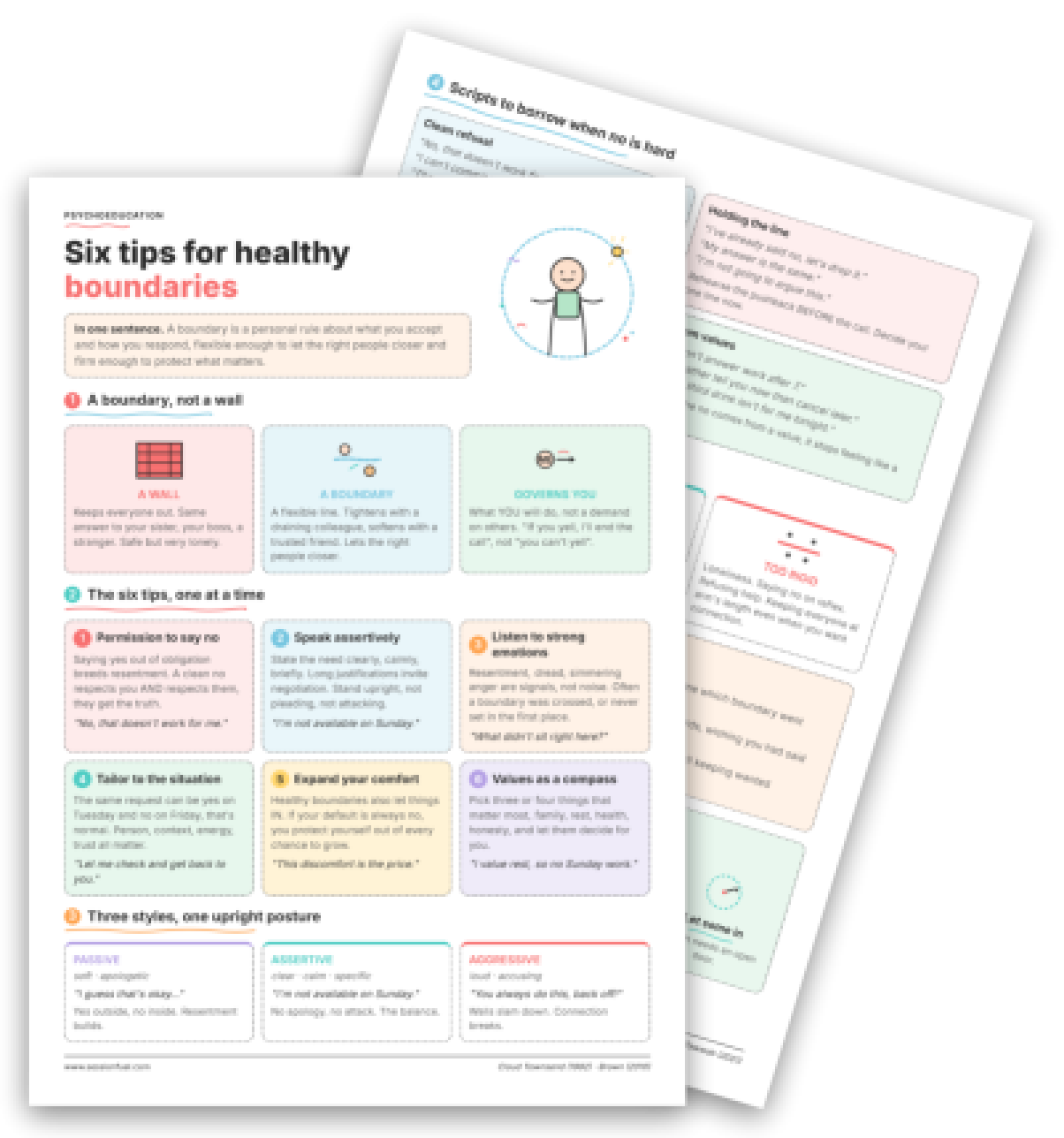
The fiche PDF is a five-panel psychoeducation sheet. It is not a self-assessment questionnaire; it is a support you use actively during the session to walk the patient through the concept step by step.
The first panel presents the wall-versus-boundary contrast visually, with a key clinical note: "a boundary governs YOU, what YOU will do, not a demand on others." This single frame typically resolves the locus-of-control confusion described above faster than any verbal explanation.
The second panel covers the six tips one at a time: permission to say no, assertive expression, reading strong emotions as signals, situational calibration, staying open to growth, and using personal values as a compass. Each tip comes with a model phrase patients can borrow directly.
The third panel shows three communication styles side by side: passive ("I guess that's okay..."), assertive ("I'm not available on Sunday."), and aggressive. Placing them in a comparative layout makes the assertive posture unambiguous in a way that a verbal description of "the middle ground" does not.
The fourth panel offers scripts organised by function: clean refusals, holding the line under pressure, buying time, and values-based declines. This is particularly useful for patients who rehearse limits intellectually but freeze when pushback arrives. You can use these scripts as role-play material directly from the sheet.
The fifth panel maps the too-porous / just-right / too-rigid spectrum, with the phenomenology of each position described in patient-accessible language. Three "To discuss in session" prompts at the bottom serve as ready-made debrief questions.
> Key takeaway: This fiche is a visual support that facilitates the explanation of healthy boundaries in session. It is not homework the patient fills in alone; it is a shared reference that builds a common vocabulary and leaves a concrete anchor the patient can return to.
750+ clinical tools
A library built with and for clinicians, ready to use in session and extend between appointments.
Access all the toolsWhen and How to Introduce the Fiche
The fiche fits best in the early-to-mid phase of work, once the presenting complaint is clear and the patient has articulated at least one relational context where resentment, exhaustion, or compulsive compliance features. It pairs naturally with assertiveness psychoeducation, communication styles work, and boundary exploration exercises.
Profiles who benefit most include patients presenting with chronic resentment they cannot yet name, those with boundary diffusion or identity enmeshment patterns, and those working on assertive communication skills within a DBT-informed frame. It also complements work-life boundary work when professional overload is the entry point.
A low-labelling introduction: "I'd like us to look at something together that might help us think through what's been happening with [specific person or context]." Avoid "you need better boundaries" framing before you have used the sheet together.
For debrief, the "To discuss in session" prompts on the fifth panel are ready to use: resentment with a specific person, situations where an obligatory yes was later regretted, and defaults that may have hardened from protection into isolation. Each maps directly onto a clinical hypothesis you are likely already holding.
One limit: for patients with a rigid schema around control or those in early stages of work on mistrust and abuse patterns, the wall panel can activate defensiveness. Preview the frame before displaying it, and anchor the conversation in the patient's own words before introducing the visual.
The fiche does not replace the conceptual and relational work of building limit-setting capacity; it makes the entry into that work faster, clearer, and more collaborative.
Use it with your patients
Share this tool in the mobile app and follow the work between sessions.
Sources
- Cloud, H., & Townsend, J. (1992). Boundaries: When to Say Yes, How to Say No to Take Control of Your Life. Zondervan.
- Brown, B. (2010). The Gifts of Imperfection: Let Go of Who You Think You're Supposed to Be and Embrace Who You Are. Hazelden.
- Smith, M. J. (1975). When I Say No, I Feel Guilty: How to Cope Using the Skills of Systematic Assertive Therapy. Bantam Books.
- Alberti, R., & Emmons, M. (2017). Your Perfect Right: Assertiveness and Equality in Your Life and Relationships (10th ed.). New Harbinger Publications.
- Chernata, T. (2024). Personal boundaries: definition, role, and impact on mental health. Personality and Environmental Issues.
Your session continues in your patients' pocket
Use with a patientYour resources, available everywhere
The handouts, exercises, programs and audios above: you choose which ones to make available to your patients, in the mobile app dedicated to them.
And far more than a library
The app goes well beyond resources, to support your patients every day:
Related categories
Explore other clinical resources by category.

Identity
Clinical resources for self-identity work in therapy: CBT, ACT, schema tools for clinicians addressing self-concept, core beliefs, and identity disruption.

Relationships
Clinical worksheets and tools on relational functioning: attachment, schemas, assertiveness, and communication skills for therapists. Printable PDF resources.

Build awareness
Clinical worksheets and tools to build awareness in therapy: cognitive distortions, schemas, emotions, ACT and CBT resources for practitioners.

Build skills
Skill-building resources for clinicians: printable worksheets and exercises for coping, assertiveness, and communication skills training in therapy.

Engage & motivate
Clinical hub: printable worksheets and exercises to build therapeutic engagement and motivation across ACT, CBT, and integrative practice. For clinicians.

ACT
Clinical hub for Acceptance and Commitment Therapy (ACT): worksheets, exercises, programs and audio resources for practitioners using the ACT model.