
A mother brought her 8-year-old son, referred to here as patient T., following teacher complaints about disruptive behaviour at home and school. During a parent coaching session, the clinician introduced the concept of scanning for the problem's absence, noting that a quiet evening without argument counted as behaviour worth naming aloud. The mother initially struggled to identify such moments, reporting that calm felt unremarkable and therefore easy to overlook. With prompting, she recalled that T. had sat through dinner the previous night without incident, and the clinician coached her to say something specific and immediate the next time that happened. At the following session she reported using the phrase "you were really calm at dinner tonight" and noted that T. had looked up briefly and then smiled, which she described as unusual for him.
Using Praise Effectively: PDF Worksheet, Tools and Exercises for Clinical Practice
A printable PDF worksheet with structured tools and exercises to help clinicians teach parents how to use praise as a deliberate behaviour-change lever in their family.
Clinical vignettes
Reorienting a Parent's Attention Toward Absence of Problem
Shifting Praise From Outcome to Effort
Patient L., a 12-year-old with a long history of school avoidance, was seen alongside her father, who habitually praised grades and finished assignments while remaining silent about the process. The clinician used the session to distinguish effort, which the child controls, from outcome, which she does not, and explained that outcome-contingent praise can quietly attach worth to results. The father was asked to rehearse a phrase targeting the act of sitting down to work rather than what the work produced. Over three weeks he practised saying "you really stuck with that, even when it got hard" after homework sessions, regardless of whether the work was completed correctly. L.'s avoidance did not resolve quickly, though her father reported less conflict at the desk and described her as slightly more willing to begin tasks.
Most parents arrive in session believing they already know how to praise a child. What they mean, if you press them, is that they say "good job" occasionally. Getting from that reflex to deliberate, behaviour-contingent positive reinforcement is harder to convey verbally than it sounds, and the gap between understanding the principle and changing a habitual attention pattern is where psychoeducation alone often stalls. This fiche PDF fills that gap: a visual support you use in session to make the mechanism concrete, then send home as a reference.
Use this resource with your patients
Handout, exercises and materials ready to use, right inside SessionFuel.
Why Praise Resists Explanation in Session
The core difficulty is attentional bias. As the fiche frames it plainly: "Adults are wired to spot problems." Parents aren't withholding praise out of indifference; they are genuinely not scanning for behaviours worth naming. When you explain positive reinforcement orally, the parent nods, then goes home and notices the problem again within the hour.
A second layer is conceptual confusion. Many parents equate praise with approval, which creates resistance in those who grew up in critical households (praise feels performative or manipulative) and in those managing a child with ADHD, oppositional features, or strong-willed temperament (the child seems to do nothing praiseworthy). The fiche directly addresses both: it separates effort from outcome, and it introduces the idea that even the absence of a problem, "the usual issue NOT happening," counts as something to name.
A third stumbling block is the 4:1 ratio. Telling a parent verbally that they should aim for four positive interactions per corrective one rarely sticks. Seeing it as a labelled ratio on a page, next to the explicit consequence of getting it backwards (negative attention can feel like being seen), tends to shift something.
What the Fiche Contains: Four Panels That Make the Concept Visual
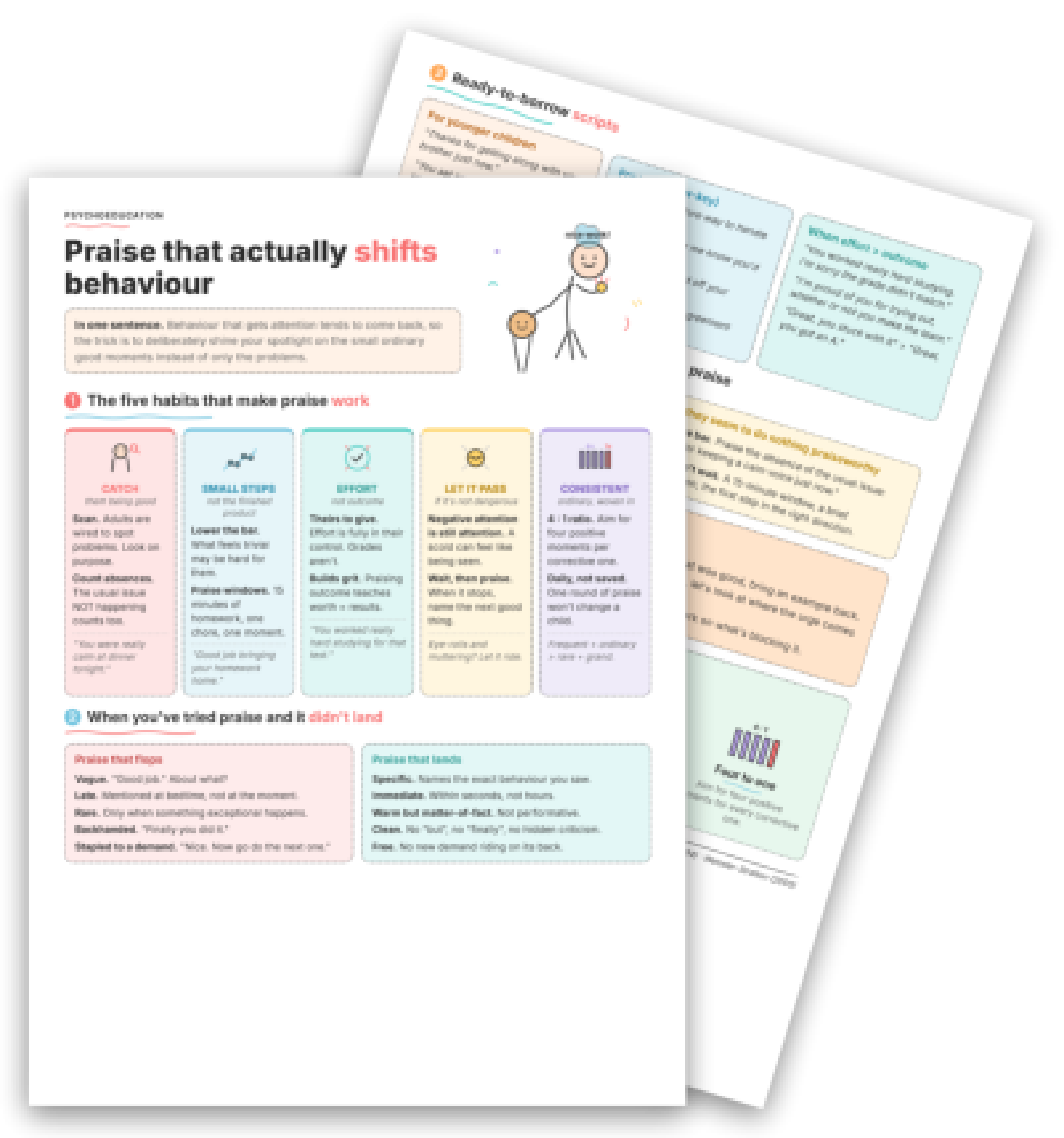
The fiche is structured in four numbered sections, each serving a distinct clinical purpose.
- Section 1: The five habits that make praise work. Five clearly labelled principles: catch them being good, praise small steps not the finished product, praise effort not outcome, let non-dangerous behaviour pass (extinction logic), and build a consistent 4:1 ratio. Each principle carries a short rationale and a model phrase, so the parent sees the mechanism and hears what it sounds like simultaneously.
- Section 2: Praise that flops vs. praise that lands. A direct two-column contrast: vague, late, rare, backhanded, or demand-stapled praise on one side; specific, immediate, warm, clean, and free praise on the other. This visual opposition is faster than any spoken explanation and bypasses the defensive response that often follows correction.
- Section 3: Ready-to-borrow scripts. Differentiated by age group: language-calibrated examples for younger children, deliberately understated phrases for adolescents ("That was a mature way to handle it"), and effort-framing for situations where the outcome didn't match the work ("I'm proud of you for trying out, whether or not you make the team"). Parents who grew up without modelled praise need these not as suggestions but as rehearsable templates.
- Section 4: When it feels unnatural or there's nothing to praise. A brief normalising frame for parents with low praise histories, plus a "To discuss in session" section that flags three specific patterns to bring back: defaulting to "good job" without specifying, stapling praise to a demand, and praise that still feels fake after a week of trying.
> Key takeaway: The fiche is a visual support that facilitates the explanation of deliberate praise in session, not a worksheet the parent fills out alone. The side-by-side contrasts and ready-made scripts let you point, discuss, and debrief in real time, then leave the parent with a reference that names exactly what to try at home.
750+ clinical tools
A library built with and for clinicians, ready to use in session and extend between appointments.
Access all the toolsWhen and How to Introduce This Fiche
The fiche fits naturally in the second or third session of a parent guidance work, once the presenting behaviour has been mapped and the parent has reflected on their current response patterns. It complements operant conditioning psychoeducation and pairs well with rewards and consequences frameworks or token economy tools when a more structured behaviour plan is indicated.
A low-resistance introduction: "I'd like to show you something about how attention shapes behaviour, because I think it might reframe what you're already doing at home." Avoid framing it as a correction of past parenting; the fiche's own normalising language ("It will feel awkward. That's normal.") does much of that work itself.
For parents with a critical parenting history, the effort-vs-outcome distinction in Section 3 often anchors the most clinically productive discussion. For parents of adolescents, the low-key teen scripts reduce the fear of sounding patronising. If you are working within a broader parenting fundamentals program or alongside parent-child communication work, the fiche slots into the reinforcement module without redundancy.
One contraindication worth noting: when the parent-child relationship is acutely dysregulated, or when DMDD or significant trauma is active in the child, introducing praise skills too early can feel dismissive of the parent's distress. In those contexts, establish safety and emotional regulation first; the fiche works best when the parent has enough regulatory capacity to experiment at home.
Debriefing is straightforward: ask the parent to bring back one example from Section 4's prompt list. If praise still feels stuck or artificial after a week, that resistance is clinical material, not a failure of the exercise.
Use it with your patients
Share this tool in the mobile app and follow the work between sessions.
Sources
- Kazdin, A. E. (2013). The Everyday Parenting Toolkit: The Kazdin Method for Easy, Step-by-Step, Lasting Change for You and Your Child. Houghton Mifflin Harcourt.
- Kazdin, A. E. (2005). Parent Management Training: Treatment for Oppositional, Aggressive, and Antisocial Behavior in Children and Adolescents. Oxford University Press.
- McNeil, C. B., Hembree-Kigin, T. L. (2011). Parent-Child Interaction Therapy (2nd ed.). Springer.
Your session continues in your patients' pocket
Use with a patientYour resources, available everywhere
The handouts, exercises, programs and audios above: you choose which ones to make available to your patients, in the mobile app dedicated to them.
And far more than a library
The app goes well beyond resources, to support your patients every day:
Related categories
Explore other clinical resources by category.

Behaviours
Clinical hub for behaviors in therapy: worksheets and tools for coping, eating disorders, CBT formulation, and maladaptive behavioral patterns.

Relationships
Clinical worksheets and tools on relational functioning: attachment, schemas, assertiveness, and communication skills for therapists. Printable PDF resources.

Understand
Clinical hub for the therapeutic aim 'Understand': worksheets and tools to build patient insight across CBT, ACT, schema therapy and more.

Build skills
Skill-building resources for clinicians: printable worksheets and exercises for coping, assertiveness, and communication skills training in therapy.

CBT
CBT worksheets, cognitive restructuring exercises & behavioral tools for clinicians. Evidence-based resources for every phase of cognitive behavioral therapy.

Anxiety
Clinical hub for anxiety disorders: CBT and ACT worksheets, psychoeducation sheets, and exercises for assessment and treatment across the anxiety spectrum.