
Clinical picture. A 9-year-old boy, referred to as T., was brought in by his parents after his school requested a psychological assessment following repeated incidents of throwing objects and yelling at peers during transitions between activities. His mother described an almost daily irritable baseline at home as well, with four to five explosive episodes per week over the past 14 months, triggered by minor frustrations such as losing a board game or being asked to stop screen time. The clinician reviewed the DSM-5 criteria systematically using the informational sheet with the parents, confirming that the outbursts were grossly disproportionate, present in both home and school settings, and that no symptom-free stretch longer than two weeks had occurred. Crucially, there was no history of elevated or expansive mood, ruling out a manic episode and satisfying criterion I. A provisional DMDD diagnosis was documented, and the parents reported that having the criteria laid out clearly reduced their tendency to attribute the behaviour solely to poor parenting.
DMDD Diagnostic Criteria: PDF Worksheet, Tools and Exercises
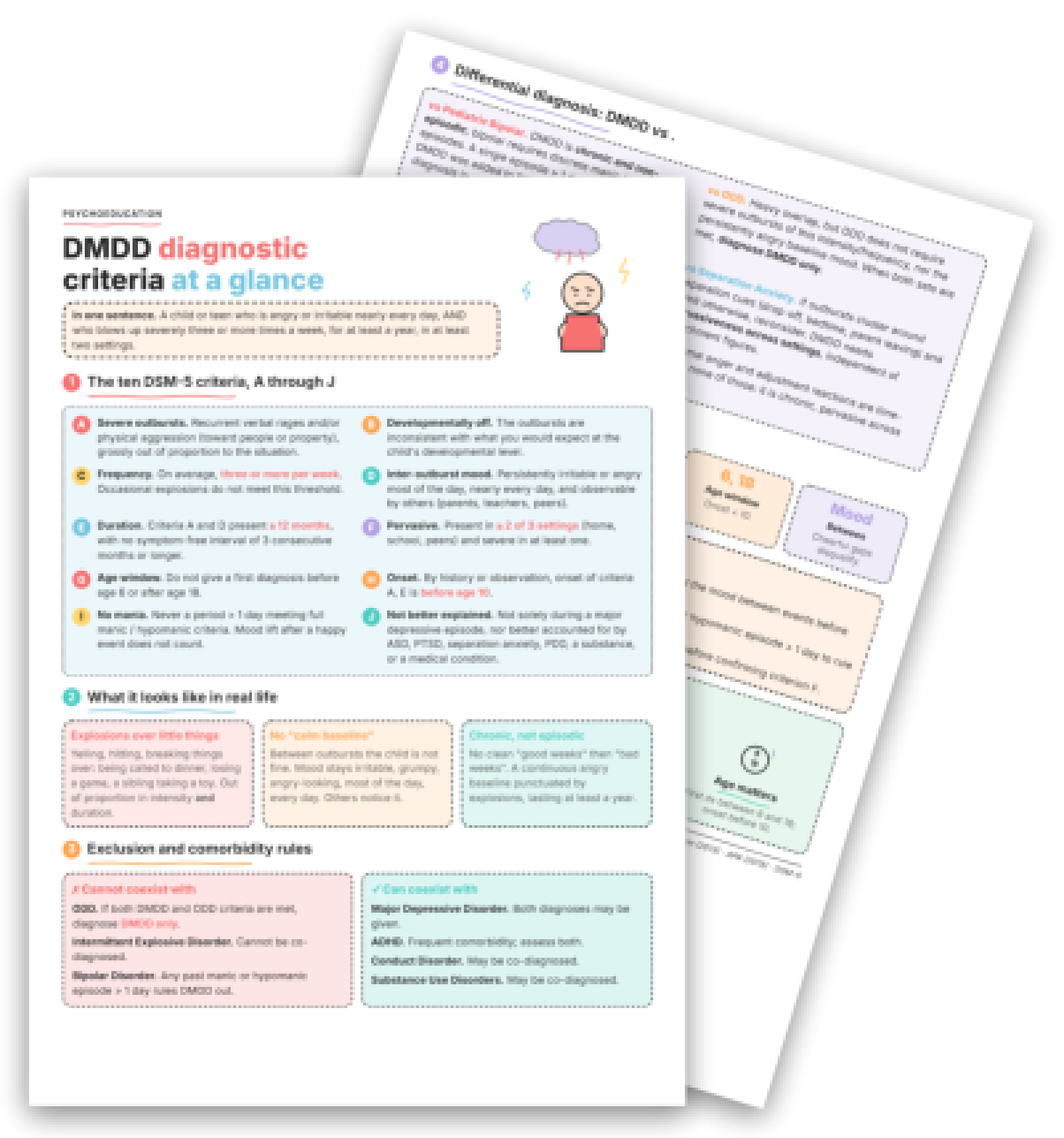
A printable PDF worksheet covering all ten DSM-5 DMDD criteria, comorbidity rules, and differential diagnosis anchors to support in-session formulation with families and teams.
Clinical vignettes
Ruling In DMDD Across Two Settings
Distinguishing DMDD From Adjustment Difficulties
Clinical picture. M., an 11-year-old girl, was referred after 18 months of what her teachers described as a persistently hostile demeanour and frequent verbal rages in class, with her parents noting the same pattern at home and during after-school activities. During the intake, the clinician used the DSM-5 DMDD criteria as a structured reference point, working through each criterion with both parents present. Criterion E was met clearly, as the irritable baseline and frequent outbursts had persisted beyond 12 months with no remission period of 3 consecutive months. The clinician noted that the onset predated a family relocation by several months, making an adjustment disorder a less adequate explanation, and that ASD and PTSD had been previously assessed and excluded. The diagnostic formulation named DMDD as the primary working diagnosis, with a note to reassess comorbid anxiety symptoms that did not fully account for the clinical picture.
Chronic, severe irritability in children and adolescents sits at the centre of some of the most contested diagnostic territory in child and adolescent psychiatry. This fiche PDF gives you a single printable reference to anchor the DMDD formulation conversation in session, whether you are working with a family, a supervisee, or an interdisciplinary team.
Use this resource with your patients
Handout, exercises and materials ready to use, right inside SessionFuel.
Why DMDD Resists Clear Explanation in Session
DMDD was introduced in DSM-5 specifically to curb bipolar disorder over-diagnosis in chronically irritable youth, and that origin shapes the entire diagnostic logic. The problem in practice is that families rarely arrive with clean histories. Parents describe "meltdowns" without tracking frequency; teachers report "constant anger" without distinguishing inter-outburst mood from discrete episodes; and the child often cannot tell you whether the baseline ever really lifts.
When you walk a parent through criteria A-J from memory, the numerical thresholds evaporate almost immediately. They hear "explosive" and believe they understand; they miss that criterion D requires a persistently irritable mood observable by others between outbursts, not only during them. And the anchoring numbers, three or more episodes per week, no symptom-free window of three consecutive months, at least two settings, are forgotten by the time the family reaches the waiting room.
The same friction surfaces in differential work. Separating DMDD from bipolar warning signs, from co-occurring ADHD, from anxiety-driven low frustration tolerance in children, or from a strong-willed temperament that never meets diagnostic threshold, requires exactly the granular detail parents most reliably misremember.
What the Fiche Contains: a Visual Reference for the Diagnostic Conversation
The fiche is organised across six numbered panels. It is a visual support that facilitates the explanation of DMDD criteria in session, not a questionnaire for the family to complete alone.
Panel 1 lays out all ten DSM-5 criteria, A through J, with their thresholds written out explicitly: "three or more per week" for frequency (criterion C), "≥ 12 months with no symptom-free interval of 3 consecutive months" for duration (criterion E). Having these figures visible on paper transforms a diffuse oral explanation into a working surface you can navigate with the family.
Panel 2 translates criteria into observable behaviour: "Yelling, hitting, breaking things over: being called to dinner, losing a game, a sibling taking a toy." Clinically, this validates parental experience while anchoring their account in diagnostic language.
Panel 3 states the exclusion and comorbidity rules in two clear columns. DMDD cannot coexist with ODD or Bipolar Disorder (any hypomanic episode lasting more than one day rules it out), but may coexist with MDD, ADHD, conduct disorder, and substance use disorders.
Panel 4 walks through differential diagnosis against five comparators. Panel 5 offers a summary grid of the anchors most often missed in practice, distilled into five numbers: ≥3/week, 2 of 3 settings, 12 months, age window 6-18, onset before age 10, with a clear note that "cheerful gaps disqualify", meaning a genuinely pleasant inter-outburst baseline rules DMDD out. Panel 6 closes with three targeted clinical prompts for use directly in session.
> To retain: this fiche is a visual support that facilitates the explanation of DMDD diagnostic criteria during the session. It is not a take-home handout. Its value is the shared, readable reference it creates between clinician and family during the formulation conversation.
750+ clinical tools
A library built with and for clinicians, ready to use in session and extend between appointments.
Access all the toolsWhen and How to Propose It
Introduce the fiche during the formulation session, once the initial history-taking is complete and you are ready to present a diagnostic hypothesis. A direct opening works well: "I'd like to go through the criteria with you so we can think together about what fits and what doesn't." You then work through panels 1 and 5 together, inviting parents to confirm or qualify each threshold, frequency, settings, inter-outburst mood, from their own observations.
Panel 6's clinical prompts also make the fiche a reliable anchor in supervision or interdisciplinary consultation when a colleague needs rapid orientation to the diagnostic boundary. Once formulation is settled, pair it with anger management tools, anger psychoeducation resources, and 50 coping strategies for children and adolescents when building the intervention plan, or with token reward systems, anger thermometers, and emotion regulation skills when structuring behavioural work. For parents managing ADHD comorbidity in parallel, ADHD parenting tools and resources on understanding the anger iceberg extend naturally from the same conversation.
One clear limit: the fiche covers what meets criteria, not how to intervene. It anchors the beginning of the formulation, not the treatment itself.
Use it with your patients
Share this tool in the mobile app and follow the work between sessions.
Sources
- American Psychiatric Association (2013). Diagnostic and Statistical Manual of Mental Disorders, Fifth Edition (DSM-5). American Psychiatric Publishing.
- National Institute of Mental Health (NIMH). Disruptive Mood Dysregulation Disorder: The Basics.
Your session continues in your patients' pocket
Use with a patientYour resources, available everywhere
The handouts, exercises, programs and audios above: you choose which ones to make available to your patients, in the mobile app dedicated to them.
And far more than a library
The app goes well beyond resources, to support your patients every day:
Related categories
Explore other clinical resources by category.

Mood
Evidence-based worksheets and clinical tools for mood disorders: CBT, ACT, and positive psychology resources for psychologists and therapists.

Emotions
Clinical resources on emotion regulation: worksheets, coping tools, CBT, REBT, and ACT exercises for therapists working across diagnoses and age groups.

Understand
Clinical hub for the therapeutic aim 'Understand': worksheets and tools to build patient insight across CBT, ACT, schema therapy and more.

CBT
CBT worksheets, cognitive restructuring exercises & behavioral tools for clinicians. Evidence-based resources for every phase of cognitive behavioral therapy.

Anxiety
Clinical hub for anxiety disorders: CBT and ACT worksheets, psychoeducation sheets, and exercises for assessment and treatment across the anxiety spectrum.

Trauma
Clinical hub on trauma and PTSD: assessment, differential diagnosis, treatment phases, and printable resources for practitioners. 155 chars.