
Clinical picture. A boy aged 9, referred by his GP after missing roughly three weeks of school across one term, presented with daily stomach aches and vomiting on school mornings. His mother reported that symptoms resolved within the hour if she agreed to keep him home, and that he slept in the parental bed on most nights, distressed when asked to return to his own room. During the assessment, he described persistent worry that his mother would be involved in a road accident while he was at school, and he had experienced two nightmares in the previous month in which he could not find her. The clinician used the DSM-5 criteria as a structured checklist during the feedback session with both parents, identifying at least five of the eight symptom clusters and confirming a duration well beyond the four-week threshold. This gave the family a shared language for what they were observing and helped them distinguish the disorder from ordinary developmental anxiety, which was a useful first step before beginning a graded exposure plan.
Separation Anxiety Disorder: DSM-5 Criteria, PDF Worksheet, Tools and Exercises
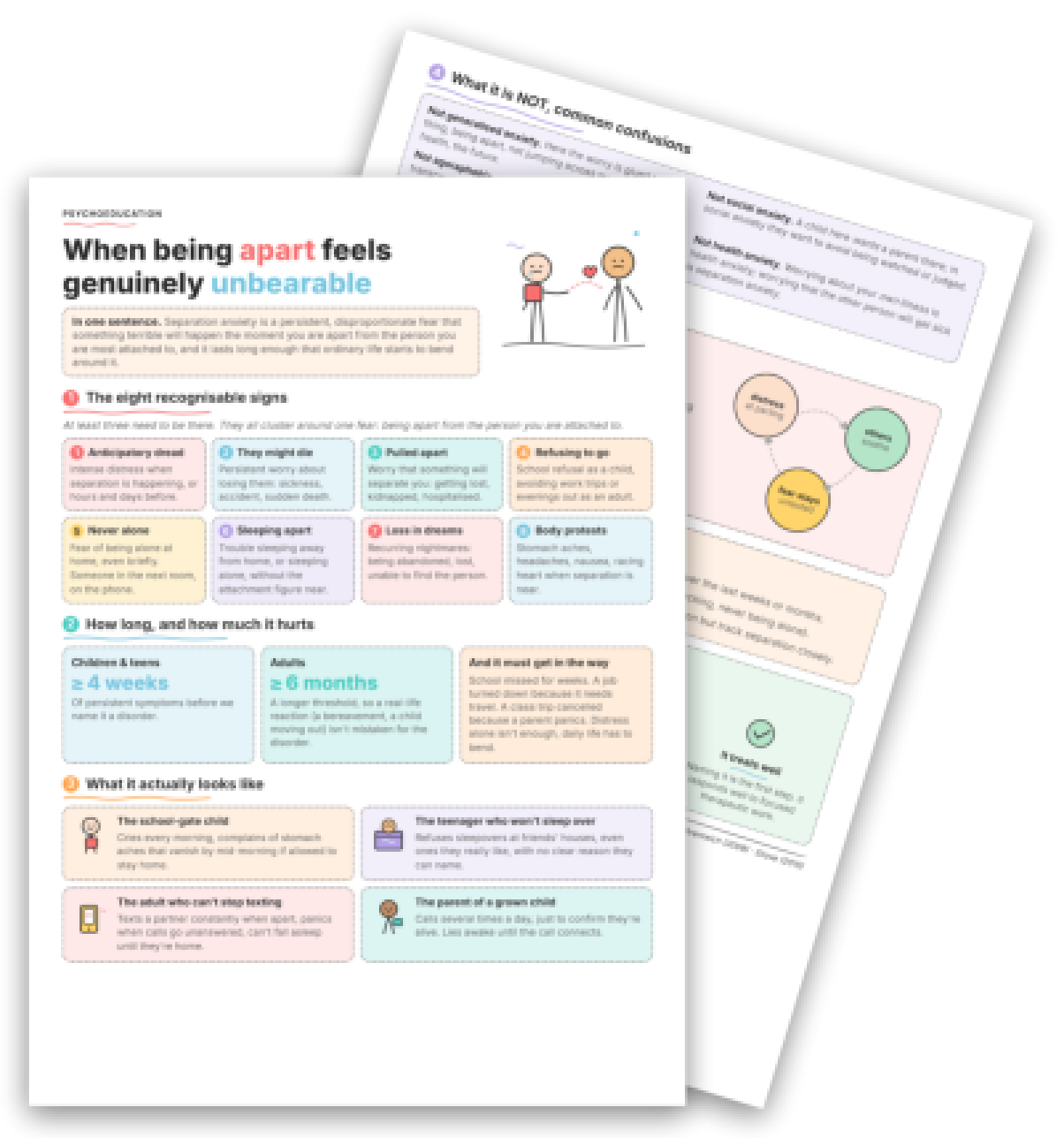
A visual PDF worksheet presenting the eight DSM-5 signs, duration thresholds, differential confusions, and the accommodation loop, tools and exercises for clinical psychoeducation.
Clinical vignettes
School Refusal Masking Separation Anxiety
Adult Separation Anxiety Missed for Years
Clinical picture. A woman in her mid-thirties was referred for what her GP had documented as generalised anxiety; she had declined two promotions over four years because both roles required occasional overnight travel. In the initial interview she described lying awake when her partner worked late shifts, needing him to check in by phone every two hours, and experiencing episodes of nausea and chest tightness whenever a trip away was discussed. She was surprised to learn that separation anxiety disorder is diagnosed in adults, having assumed it was a childhood condition. The clinician walked through the DSM-5 criteria with her, noting that her symptom pattern had been present for closer to three years and was measurably narrowing her professional and social life. Naming the diagnosis did not resolve her avoidance, but it did allow treatment planning to shift from broad anxiety management toward attachment-focused work and a structured approach to tolerating separation.
Separation anxiety disorder is one of the most under-identified presentations in adult outpatient practice. The DSM-5 dropped the childhood-onset criterion in 2013, yet many patients still arrive after years of being formulated as generalised anxiety, relationship dependency, or health anxiety, simply because no one mapped the attachment-specific structure of their worry. This PDF worksheet gives you a concrete visual support to do exactly that, in session, without a lengthy detour through the diagnostic manual.
Use this resource with your patients
Handout, exercises and materials ready to use, right inside SessionFuel.
Why Separation Anxiety Is So Often Missed in Consultation
The central clinical difficulty is not the severity of the presentation, it is its apparent shapeshifness. A patient who texts their partner obsessively, cannot sleep when alone, and cancels professional travel looks, on the surface, like someone with avoidance patterns, attachment insecurity, or an abandonment schema. The discriminating feature, that distress is anchored to one specific person, not to places, social evaluation, or somatic symptoms, is easy to miss at oral anamnèse, especially when the patient themselves cannot name it.
The four differential confusions in the fiche capture the exact distinctions that trip up assessment. Separation anxiety is not generalised anxiety (the worry is glued to one theme), not social anxiety (the patient wants their person there, not to escape being judged), not agoraphobia (it is who is missing that triggers the fear, not the place itself), and not health anxiety (the feared illness belongs to the other person, not the self). Hearing this distinction once, aloud, rarely produces genuine clarity. Seeing it laid out on a single page does.
What the Fiche Contains: A Visual Support for DSM-5 Mapping
The worksheet is structured across five numbered sections, designed to be worked through collaboratively rather than handed to the patient to read alone.
- Section 1 lists the eight DSM-5 signs, from anticipatory dread and worry that "something will separate you" to somatic complaints and recurring loss-themed nightmares, with the explicit note that at least three must be present. The numbered format makes the clustering criterion tangible and reduces the risk of over-diagnosing on one or two prominent features.
- Section 2 presents the duration thresholds side by side: four weeks for children and adolescents, six months for adults. The adult threshold is explained directly on the fiche ("so a real-life reaction isn't mistaken for the disorder"), which pre-empts a common patient objection.
- Section 3 offers four brief clinical vignettes, the school-gate child, the teenager who refuses sleepovers, the adult who cannot stop texting, the parent calling several times daily, spanning the full age range. These ground the abstract criteria in recognisable behaviour without requiring you to generate examples on the spot.
- Section 4 presents the differential confusions as parallel statements, one concept per line. Visually scanning the column makes the principle of one fear, one figure immediately apparent.
- Section 5 maps the accommodation loop as a three-node cycle: distress at parting → others soothe → fear stays untested. This is the section most worth dwelling on; it externalises the systemic maintenance mechanism that families and partners rarely recognise as a problem until you show it to them.
> Key point: the fiche is a visual support that facilitates psychoeducation in session, not a questionnaire the patient completes alone. Its function is to give you a shared language and a concrete diagram to reference when naming the accommodation cycle or grounding the differential.
750+ clinical tools
A library built with and for clinicians, ready to use in session and extend between appointments.
Access all the toolsWhen and How to Introduce the Fiche
Consider bringing it out from the second or third session onward, once the anamnèse has surfaced a pattern of distress organised around one attachment figure. It is particularly useful with adult patients who arrive describing "relationship anxiety" or "needing constant contact", presentations that risk being attributed entirely to early maladaptive schemas or enmeshment dynamics without the separation-anxiety structure being named.
A low-threshold introduction: "I'd like to look at something with you that might put a clearer frame on what we've been describing." Work through sections 1 and 2 together first, letting the patient self-identify the signs. Then move to section 5 and ask specifically who in their life adjusts their behaviour to manage the distress, this often opens the accommodation conversation for the first time.
For younger patients or adolescent work, the parent psychoeducation program on child and adolescent anxiety pairs well with this fiche, helping parents understand the accommodation loop from their own side. For the exposure planning that follows diagnostic clarity, building a graded exposure hierarchy is the logical next tool. The Remember panel at the bottom of the fiche carries one line worth reading aloud at the close: "It treats well." Brief, but useful for patients who have spent years being told their distress is simply a personality trait.
One limit to flag: the fiche maps DSM-5 criteria and is most useful early in the formulation phase. It does not replace a full longitudinal case formulation, and with patients whose attachment history is dense, developmental trauma, complex PTSD, early loss, the diagnostic frame will need to sit inside a broader clinical picture before treatment planning begins.
Use it with your patients
Share this tool in the mobile app and follow the work between sessions.
Sources
- American Psychiatric Association (2022). Diagnostic and Statistical Manual of Mental Disorders, Fifth Edition, Text Revision (DSM-5-TR). American Psychiatric Publishing.
- Merck Manuals (2025). Separation Anxiety Disorder. Merck Manual Professional Edition.
Your session continues in your patients' pocket
Use with a patientYour resources, available everywhere
The handouts, exercises, programs and audios above: you choose which ones to make available to your patients, in the mobile app dedicated to them.
And far more than a library
The app goes well beyond resources, to support your patients every day:
Related categories
Explore other clinical resources by category.

Anxiety
Clinical hub for anxiety disorders: CBT and ACT worksheets, psychoeducation sheets, and exercises for assessment and treatment across the anxiety spectrum.

CBT
CBT worksheets, cognitive restructuring exercises & behavioral tools for clinicians. Evidence-based resources for every phase of cognitive behavioral therapy.

Trauma
Clinical hub on trauma and PTSD: assessment, differential diagnosis, treatment phases, and printable resources for practitioners. 155 chars.

Mood
Evidence-based worksheets and clinical tools for mood disorders: CBT, ACT, and positive psychology resources for psychologists and therapists.

Identity
Clinical resources for self-identity work in therapy: CBT, ACT, schema tools for clinicians addressing self-concept, core beliefs, and identity disruption.

Emotions
Clinical resources on emotion regulation: worksheets, coping tools, CBT, REBT, and ACT exercises for therapists working across diagnoses and age groups.