
Clinical picture. A., a 34-year-old with a confirmed bipolar I diagnosis, presented to a routine outpatient appointment reporting that she finally felt "like herself again" after a depressive period of roughly six weeks. She described sleeping five hours a night without fatigue, had sent several late-night emails to colleagues, and was planning two large home renovation projects simultaneously. The clinician introduced the warning-signs framework, walking through the hypomania watchlist together, and A. recognized that "needing less sleep without tiredness" and a spike in new projects were patterns she had described before her last manic episode. She agreed to contact the service within 48 hours if sleep dropped further, and her mood stabilizer dose was reviewed that week rather than at the next scheduled appointment.
Bipolar Disorder Warning Signs: PDF Worksheet, Tools and Exercises
A structured PDF worksheet with visual tools and psychoeducation exercises to help patients spot prodromal shifts before a full bipolar episode takes hold.
Clinical vignettes
Early Hypomanic Shift Mistaken for Recovery
Identifying the Depressive Prodrome Earlier
Clinical picture. M., a 28-year-old with bipolar II disorder, came in noting only that social plans felt "a bit much" lately and that messages were piling up on his phone unanswered. He did not identify this as a mood shift, attributing it to a busy period at work. Using the depression watchlist from the warning-signs sheet, the clinician asked him to describe what the two weeks before his last depressive episode had looked like; M. then recognised the same pattern of cancelled plans and shortened replies had preceded that episode by roughly ten days. A brief behavioural activation plan was agreed and a check-in call was scheduled for the following week, which M. later reported had shortened the episode considerably compared with previous ones.
In bipolar disorder follow-up, the concept of a prodromal window rarely sticks when explained at the oral level alone. Patients nod, agree in principle, then miss the very markers they described to you months earlier, often because they were inside an episode before they recognised the shift. This PDF worksheet is a visual psychoeducation support you walk through with the patient in session, then leave in their hands as a durable, personalised reference.
Use this resource with your patients
Handout, exercises and materials ready to use, right inside SessionFuel.
Why Prodromal Signs Are Hard to Convey Without a Visual Support
The core clinical problem is not knowledge, it is timing and insight erosion. A patient can accurately describe their past episodes in detail, and still fail to act when the runway begins, because early hypomania feels like relief from depression, and early depression feels like ordinary fatigue. Explaining this dynamic verbally tends to produce intellectual agreement, not behavioural change.
Two additional mechanisms make oral explanation insufficient. First, the patient's introspective access narrows precisely when it matters most: full mania erodes judgement; full depression drains the will to act. The only real decision window is the early phase. Second, patients rarely track the subtle, pre-dramatic markers, the thirty-minute sleep shift, the slightly louder inner monologue, because the clinical discussion has historically focused on florid symptoms. Oral psychoeducation anchors memory to those louder signs, which arrive too late.
A visual support that displays both poles in parallel, maps signs across multiple domains, and links each sign to a pre-agreed action reframes the conversation. Instead of explaining the concept, you can point.
What the Fiche Contains: A Structured Map of the Prodromal Window
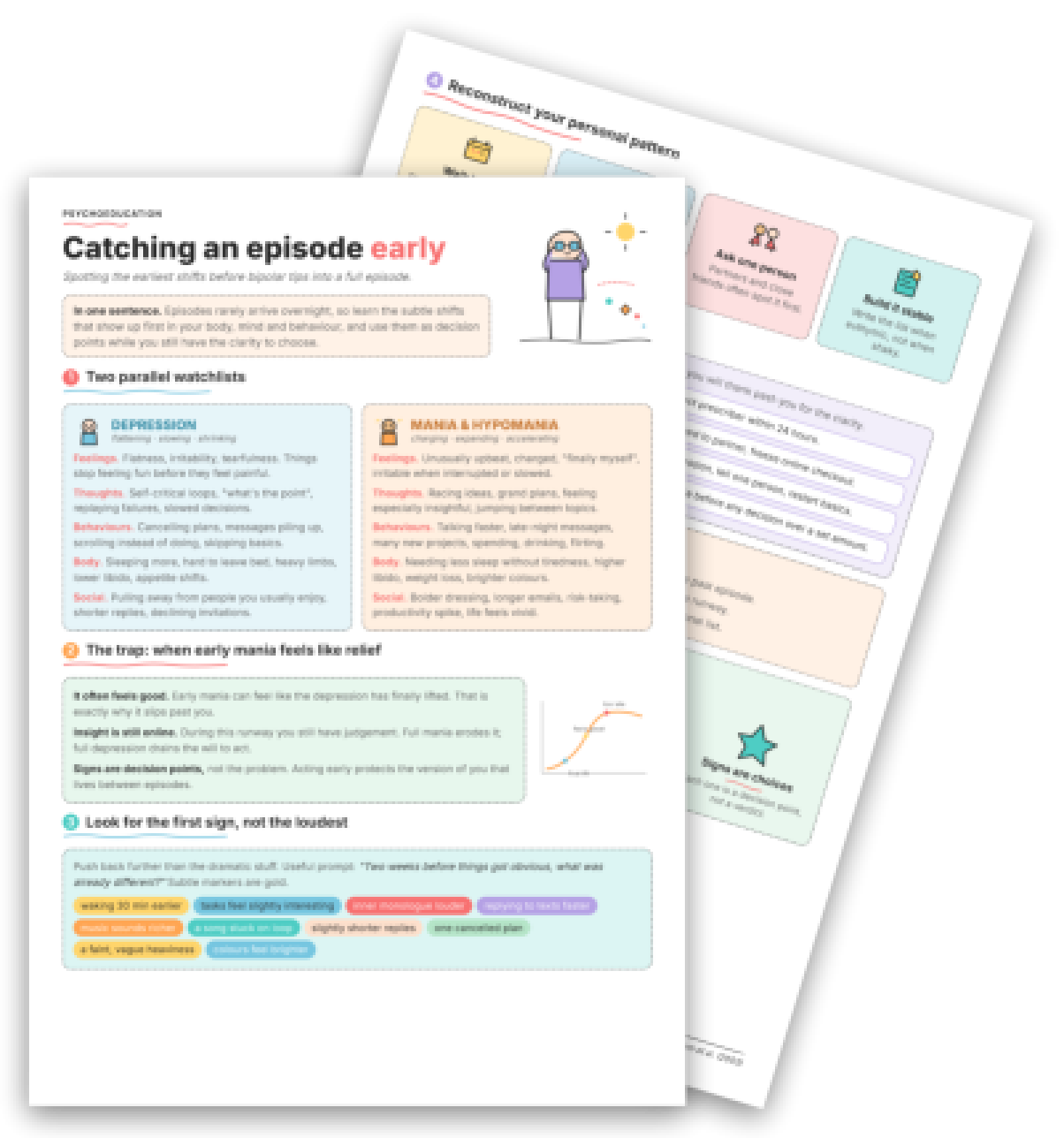
The worksheet is organised into five numbered panels. The first is a two-column watchlist contrasting depression (flattening · slowing · shrinking) and mania/hypomania (charging · expanding · accelerating), each broken into five domains: feelings, thoughts, behaviours, body, and social. This parallel layout does something a verbal explanation cannot: it lets the patient see that their two poles share the same structure, and immediately locate themselves on either side.
The second panel names the trap: "Early mania can feel like the depression has finally lifted. That is exactly why it slips past you." Showing this sentence to a patient, rather than saying it, tends to produce a qualitatively different response, recognition rather than abstraction.
Panel three shifts the clinical frame from dramatic to subtle, with a prompt the fiche phrases as "Two weeks before things got obvious, what was already different?" A concrete list of subtle markers follows: waking 30 minutes earlier, tasks feeling slightly interesting, replying to texts faster, one cancelled plan. This is clinically useful because it gives patients a vocabulary for the runway, not just the episode.
Panels four and five move toward personalisation and action. Panel four guides the patient to reconstruct their own pattern from journals, texts, photos, calendar entries, and one trusted person's account, a mini forensic exercise you can introduce and co-design in session. Panel five converts each identified sign into a pre-agreed response: for example, sleep dropping below six hours for two consecutive nights triggers prescriber contact within 24 hours, and spending urges trigger handing a card to a partner. This transforms the fiche from a list into something closer to an adaptive coping plan with a safety function.
> Key takeaway: This fiche is a visual support that facilitates the explanation of prodromal warning signs in session. It is not a checklist the patient fills out alone, it is a psychoeducation tool the clinician works through together with the patient, then leaves as a concrete, personalised reference for daily life.
750+ clinical tools
A library built with and for clinicians, ready to use in session and extend between appointments.
Access all the toolsWhen and How to Introduce the Fiche
Timing matters considerably. The fiche explicitly states: "Build your list while clear, not shaky", and the same principle applies to introducing it. Optimal windows are a stable euthymic phase, or the post-episode review once the patient has reconstituted enough to reflect. Introducing it inside an active episode, whether depressive or manic, reduces its impact significantly.
The fiche pairs naturally with a broader bipolar disorder psychoeducation discussion, and works especially well as a follow-on to sessions where you have already explored depression recognition or worked on emotion regulation. It can also complement behavioural activation planning, since behavioural discontinuities are among the earliest trackable signs.
To frame it with the patient, you might say: "Rather than me describing what the early signs tend to look like, I'd like us to go through this together so you end up with your own version, your actual list, not a generic one." This positions the fiche as a collaborative exercise, not a handout. Then walk through panels one and two together, pause on the trap panel, and use panel three's prompt to begin the patient's personal reconstruction. The pre-agreed response panel (five) is often best deferred to a second session, once the personal list is more consolidated.
Contraindication worth flagging: with patients who have limited insight into their bipolar history, or who are actively ambivalent about the diagnosis, the two-column format can trigger defensiveness if introduced too quickly. In those cases, starting with the understanding depression fiche or the mental health foundations program first, and returning to this worksheet once alliance is stronger, is the more viable route.
At the end of session, the fiche remains with the patient as a reference they helped build. Debriefing it at the following appointment, asking which signs on their personal list showed up, even faintly, since you last met, turns it from a static document into a living relapse prevention tool. For patients who struggle with rumination or cognitive rigidity during prodromal phases, pairing it with work on intolerance of uncertainty or decision-making at critical moments extends its reach into the action planning the fiche begins but the therapeutic relationship has to sustain.
The fiche does not replace clinical judgement or the care plan; it makes the conversation about early warning more concrete, more visual, and more likely to produce a patient who acts while they still can.
Use it with your patients
Share this tool in the mobile app and follow the work between sessions.
Sources
- Morriss, R. (2004). The early warning symptom intervention for patients with bipolar affective disorder. Advances in Psychiatric Treatment.
- Lam, D. H., Jones, S. H., Hayward, P. (2010). Cognitive Therapy for Bipolar Disorder: A Therapist's Guide to Concepts, Methods and Practice (2nd ed.). Wiley.
- Colom, F., Vieta, E. (2006). Psychoeducation Manual for Bipolar Disorder. Cambridge University Press.
Your session continues in your patients' pocket
Use with a patientYour resources, available everywhere
The handouts, exercises, programs and audios above: you choose which ones to make available to your patients, in the mobile app dedicated to them.
And far more than a library
The app goes well beyond resources, to support your patients every day:
Related categories
Explore other clinical resources by category.

Mood
Evidence-based worksheets and clinical tools for mood disorders: CBT, ACT, and positive psychology resources for psychologists and therapists.

Cognition
Printable cognitive therapy worksheets and clinical tools for therapists: CBT, ACT, schema work, defusion, distortions, and belief restructuring.

Build awareness
Clinical worksheets and tools to build awareness in therapy: cognitive distortions, schemas, emotions, ACT and CBT resources for practitioners.

Prevent relapse
Prevention as a therapeutic aim: clinical framing, risk stratification, and printable resources for relapse prevention and early intervention in mental health.

CBT
CBT worksheets, cognitive restructuring exercises & behavioral tools for clinicians. Evidence-based resources for every phase of cognitive behavioral therapy.

Anxiety
Clinical hub for anxiety disorders: CBT and ACT worksheets, psychoeducation sheets, and exercises for assessment and treatment across the anxiety spectrum.