
Clinical picture. M., a woman in her mid-thirties, presents with her partner after a recurring cycle of conflict: she sends multiple messages when he does not reply within the hour, escalates into an argument by evening, then feels ashamed once he re-engages. The therapist introduces the attachment styles handout during the third session, asking each partner to read the four descriptions independently before discussing. M. identifies immediately with the anxious profile, noting that the phrase "reassurance soothes briefly, then doubts again" named something she had never been able to articulate. Over the following two sessions she begins distinguishing between a genuine relational signal and a threat response triggered by silence, which allows the couple to interrupt one cycle before it reached the argument stage.
Four Attachment Styles in Relationships: PDF Worksheet, Tools and Exercises
A visual psychoeducation sheet clinicians can use in session to map attachment patterns, name the pursue-withdraw loop, and move toward earned security.
Clinical vignettes
Anxious Style Recognized in Couples Therapy
Avoidant Pattern Named, Not Pathologized
Clinical picture. T., a man in his late forties, attends individual sessions reporting that two long-term relationships ended because partners described him as "cold" or "checked out" during conflict. He dismisses emotional conversations as unproductive and recalls leaving the room during arguments, uncertain why he did so. The clinician uses the four-styles sheet as a psychoeducational anchor rather than a diagnostic label, framing the avoidant pattern as a learned self-regulation strategy rather than a character flaw. T. engages more readily once the material is presented this way, and he begins to identify the specific moment, during rising emotional intensity, when withdrawal becomes automatic. No behavioral change was reported within the same session, though T. returned the following week having stayed in one difficult conversation with his current partner rather than disengaging.
Attachment theory is one of the most clinically powerful frameworks in relational work, and one of the most consistently misheard. Patients nodding along to a verbal description of "anxious" or "avoidant" rarely arrive at the next session with anything more than a vague label stuck to themselves. This fiche PDF gives you a structured visual to lay open on the desk, so the concept clicks rather than floats.
Use this resource with your patients
Handout, exercises and materials ready to use, right inside SessionFuel.
Why Attachment Styles Are Hard to Land in Session
The first obstacle is identification. Patients hear a brief description of the four styles and immediately self-assign, often inaccurately, collapsing ambivalence ("I'm sometimes clingy AND I shut down") into the tidiest category. The second obstacle is application: even patients who correctly identify their dominant style struggle to connect it to what happens in the room with their partner, in real arguments, in real silences.
There is also a recurring set of confusions that consume session time unnecessarily. Patients conflate avoidant functioning with emotional absence ("he doesn't love me"), pathologise anxious functioning as a character flaw ("I'm just too needy"), or treat a single reaction as diagnostic of a stable style. These misreadings actively interfere with work on the abandonment schema, emotional dependency patterns, and fear of a partner leaving.
What the Fiche Contains, and What the Visual Does That Words Don't
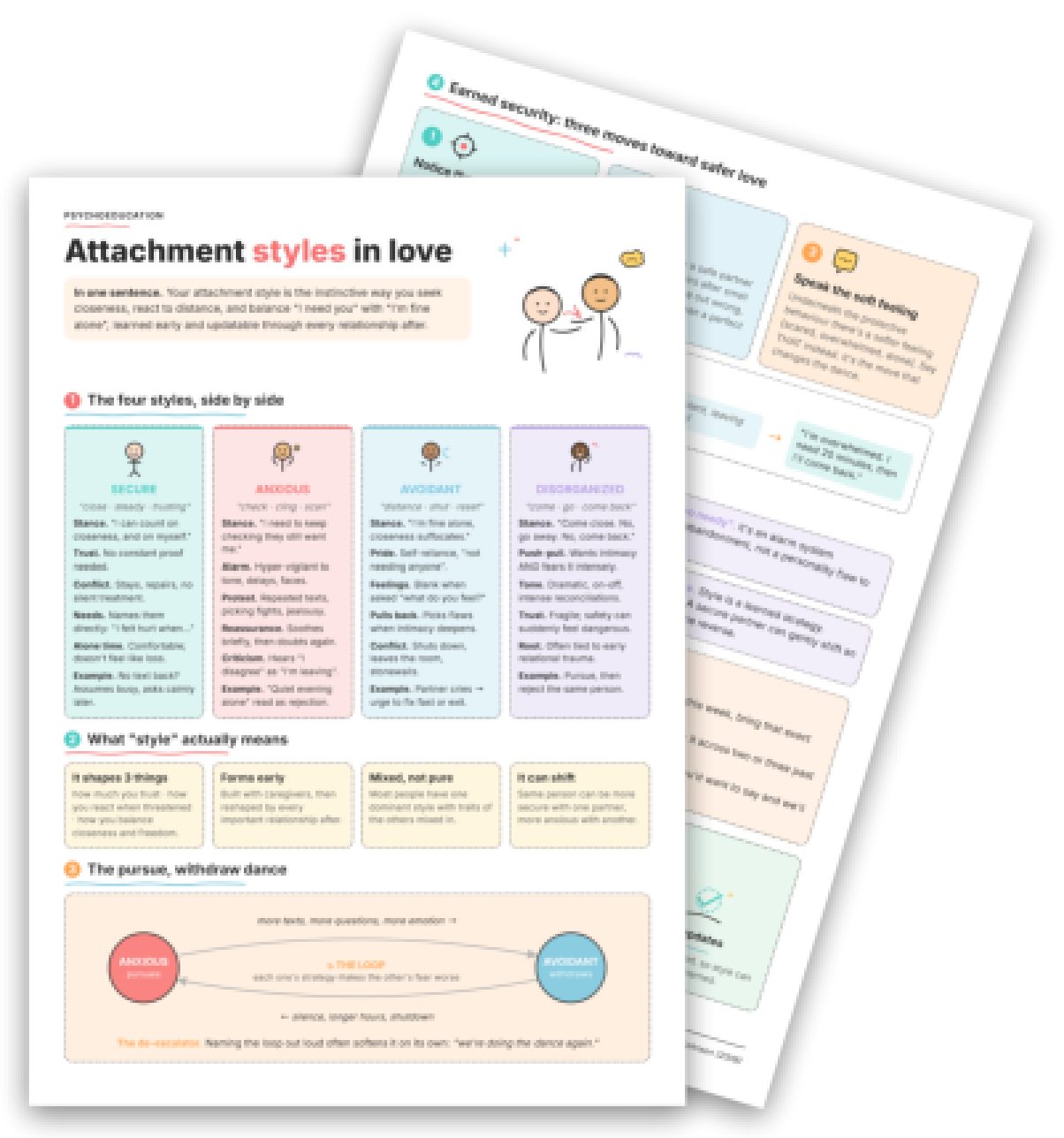
The sheet opens with a crisp one-liner that frames the clinical concept immediately: "Your attachment style is the instinctive way you seek closeness, react to distance, and balance 'I need you' with 'I'm fine alone'." That sentence alone tends to produce more recognition than five minutes of oral explanation.
Panel 1 presents the four styles side by side in a parallel grid: Secure, Anxious, Avoidant, and Disorganized. Each column follows the same structure, covering stance, alarm or trust threshold, conflict behaviour, how needs are expressed, and a concrete everyday example. The visual symmetry does the work: a patient can scan horizontally across rows (how do these four styles each handle conflict?) rather than processing one block of prose, then another. This is precisely what a verbal explanation cannot reproduce.
Panel 2 clarifies what "style" actually means in three dimensions: what it shapes (trust, threat response, closeness-autonomy balance), when it forms, and how it can shift across relationships and over time. This grounds the psychoeducation in Mikulincer and Shaver's research without requiring you to deliver a lecture.
Panel 3 is the pursue-withdraw loop rendered as a diagram, with the core clinical observation: "each one's strategy makes the other's fear worse." For couples work, this single visual often achieves more in three minutes than ten minutes of verbal formulation. It maps directly onto the EFT infinity loop described in the EFT Infinity Loop worksheet.
Panel 4 offers three concrete moves toward earned security (noticing the pattern mid-strategy, making small repairs, and "saying the soft feeling"), plus ready-made translation examples patients can borrow verbatim.
Panel 5 addresses the five most common confusions directly (avoidant ≠ doesn't love you; anxious ≠ personality flaw; one moment ≠ a style), and closes with three session-ready discussion prompts for the clinician.
> Key point: This sheet is a visual support that facilitates the explanation of attachment styles in session. It is not a self-administered questionnaire. The clinician uses it to structure psychoeducation, build shared vocabulary, and leave the patient with a concrete reference between appointments.
750+ clinical tools
A library built with and for clinicians, ready to use in session and extend between appointments.
Access all the toolsHow and When to Introduce the Fiche
This sheet fits naturally after the initial case formulation, once the relational history is sufficiently clear for the patient to recognise themselves in at least one column. In individual therapy, introduce it when attachment-driven patterns appear in the material: hypervigilance to tone, compulsive reassurance-seeking, shutdown during conflict. You might frame it simply: "I'd like to show you a map that might explain why this keeps happening between you two."
In couples work, it is particularly effective early, before conflict escalation has made psychoeducation feel like blame. The pursue-withdraw diagram can be shown to both partners simultaneously, which depersonalises the dynamic and opens space for fair fighting skills and vulnerability work.
For patients whose anxious style intersects with a fear of being abandoned or jealousy patterns, the "frequent confusions" panel is worth reading aloud together. For those presenting with disorganised features, introduce the sheet gradually; the disorganised column touches relational trauma directly and may need more scaffolding before it can be held without flooding.
One limit: the fiche does not replace a full attachment-focused formulation. Pair it with deeper work on secure attachment skills, trust in relationships, or, when relational beliefs are longstanding, the early maladaptive schemas framework. The sheet opens the door; the clinical work takes it from there.
Use it with your patients
Share this tool in the mobile app and follow the work between sessions.
Sources
- Ainsworth, M. D. S., Blehar, M. C., Waters, E., & Wall, S. (1978). Patterns of Attachment: A Psychological Study of the Strange Situation. Erlbaum.
- Main, M., & Solomon, J. (1990). Procedures for identifying infants as disorganized/disoriented during the Ainsworth Strange Situation. In M. T. Greenberg, D. Cicchetti, & E. M. Cummings (Eds.), Attachment in the Preschool Years. University of Chicago Press.
- Mikulincer, M., & Shaver, P. R. (2016). Attachment in Adulthood: Structure, Dynamics, and Change (2nd ed.). Guilford Press.
Your session continues in your patients' pocket
Use with a patientYour resources, available everywhere
The handouts, exercises, programs and audios above: you choose which ones to make available to your patients, in the mobile app dedicated to them.
And far more than a library
The app goes well beyond resources, to support your patients every day:
Related categories
Explore other clinical resources by category.

Relationships
Clinical worksheets and tools on relational functioning: attachment, schemas, assertiveness, and communication skills for therapists. Printable PDF resources.

Understand
Clinical hub for the therapeutic aim 'Understand': worksheets and tools to build patient insight across CBT, ACT, schema therapy and more.

Build awareness
Clinical worksheets and tools to build awareness in therapy: cognitive distortions, schemas, emotions, ACT and CBT resources for practitioners.

Integrative
Integrative therapy clinical resources: worksheets, psychoeducation programs, and exercises for eclectic, multimodal practice across orientations.

Psychodynamic
Printable psychodynamic therapy resources for clinicians: worksheets and exercises on attachment, relational patterns, and core belief origins. 148 chars

Schema therapy
Schema therapy clinical resources for practitioners: worksheets, exercises, and programs targeting early maladaptive schemas, core beliefs, and schema modes.