
Psychodynamic Therapy: Clinical Resources for Practitioners
Psychodynamic therapy, encompassing psychodynamic approaches, psychoanalytically informed practice, and relational depth work, remains one of the most empirically supported orientations for treating personality pathology, chronic depression, and complex trauma. This page is designed for clinicians who situate their practice within this framework, or who integrate psychodynamic formulation into broader treatment. Here you will find printable worksheets, structured exercises, and psychoeducation tools that support the core work of surfacing unconscious conflict, tracing relational patterns, and strengthening the therapeutic alliance. Each resource listed below has been selected for its direct clinical utility within a psychodynamic or psychodynamically informed care plan.

Core Mechanisms of Change
The psychodynamic orientation rests on a set of interrelated propositions: that much of mental life operates outside conscious awareness, that early relational experiences shape enduring templates for relating to self and others, and that the therapeutic relationship itself becomes a primary vehicle for change. Unlike symptom-focused models, the psychodynamic approach targets the underlying structural and relational conditions that give rise to symptoms, rather than the symptoms in isolation.
The mechanisms of change most consistently supported by research include increased mentalisation capacity, the working-through of transference, the elaboration of unconscious conflict, and the gradual internalisation of a more benign self-other representation. These mechanisms do not operate in a linear sequence; they co-occur and mutually reinforce one another across the treatment arc.
For the practitioner, this means that session-level interventions rarely stand alone. A well-timed clarification of a relational pattern, paired with a structured written exercise completed between sessions, can consolidate an emerging insight in ways that purely verbal interpretation cannot.
Breadth of the Psychodynamic Field
The term "psychodynamic" covers a wide clinical and theoretical spectrum: ego psychology, object relations theory, self psychology, attachment-based approaches, relational and intersubjective models, and contemporary Lacanian-inflected practice. Despite their theoretical differences, these traditions share the conviction that the past is present in the consulting room, and that the patient's difficulties are best understood through the lens of their relational history.
This breadth matters for the clinician selecting resources. A worksheet supporting exploration of early attachment patterns serves a different function in a strict Kleinian frame than in a relational or attachment-based one; the theoretical inflection changes the way the tool is introduced, framed, and processed.
Identifying the Psychodynamic Register in Clinical Assessment
Presentations That Call for Psychodynamic Formulation
Certain clinical presentations almost invariably require psychodynamic formulation, even when the primary treatment modality is something else. Recurrent relational failures, chronic dysphoria not accounted for by Axis I pathology, identity diffusion, the patient's own sense that their difficulties are deeply personal rather than situational, and persistent treatment non-response in other modalities are all indicators.
In assessment, the clinician listens for the repetition compulsion: the same relational scenario enacted across different contexts, different partners, different professional settings. When a patient describes a pattern that seems to follow them, the psychodynamic formulation offers a conceptual home for that observation.
Relational History and Attachment Assessment
A thorough psychodynamic assessment maps the patient's significant early relationships, the quality and consistency of early caregiving, and the internal working models that have crystallised from those experiences. The Adult Attachment Interview remains the gold standard, but clinically, a careful developmental history and attention to narrative coherence in the patient's account of their past are often sufficient to orient formulation.
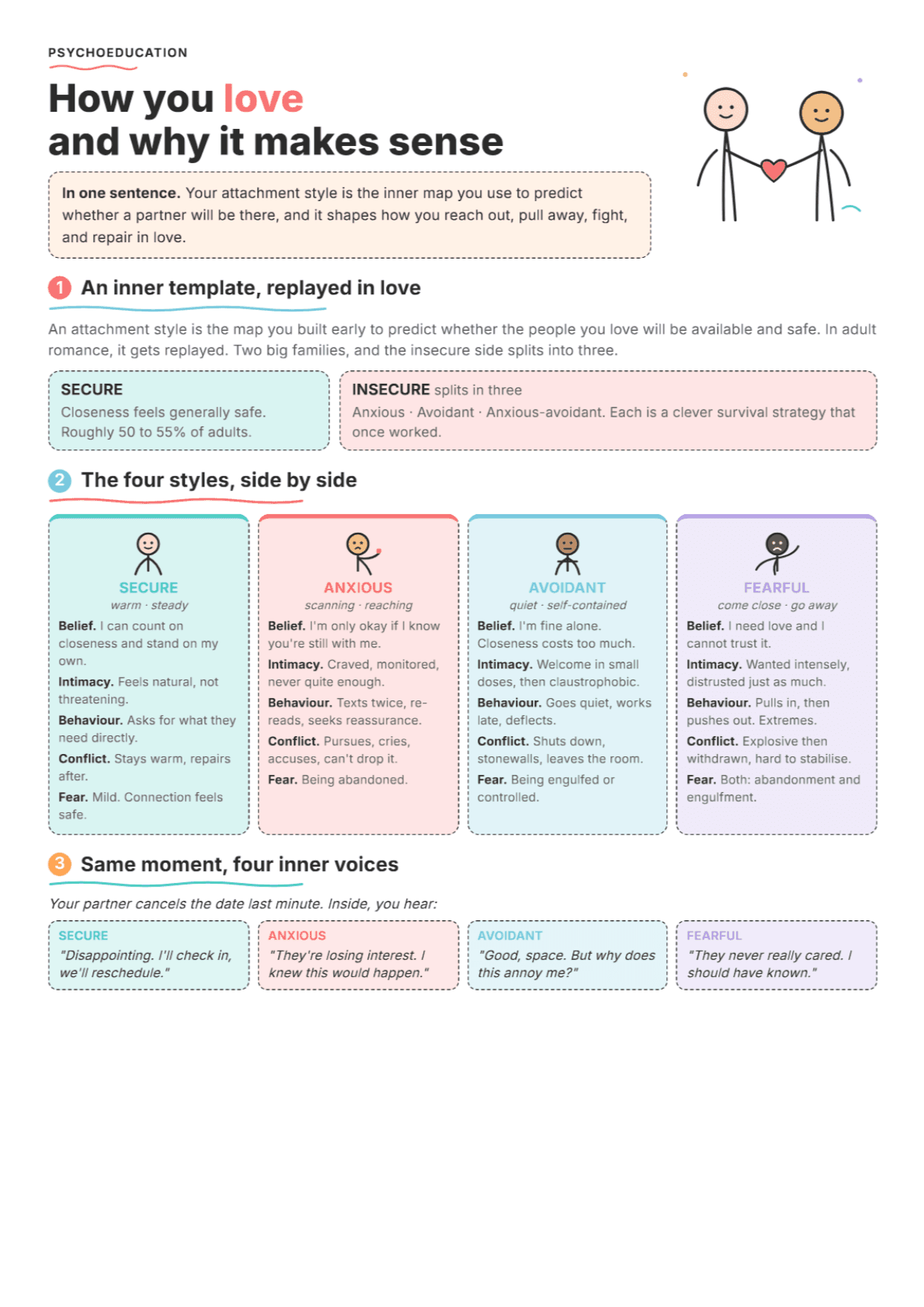
Tools such as Attachment Styles in Romantic Relationships: PDF Worksheet, Tools and Exercises can support this assessment phase by externalising the material: inviting the patient to map their relational patterns on paper often surfaces material that does not emerge easily in verbal exchange alone. The written format also creates a document the clinician and patient can revisit as treatment progresses, tracking shifts in the patient's relational representations.
Comorbidities, Differential Diagnosis, and the Question of Depth
When Psychodynamic Work Is Primary
Psychodynamic therapy has the strongest evidence base for personality disorders (particularly Cluster B and Cluster C), dysthymia and chronic depression, somatic symptom presentations, eating disorders in adults, and complex PTSD. In these presentations, surface symptom reduction without structural change tends to be fragile; relapse is common when underlying relational and defensive patterns remain unaddressed.
The clinician must also consider the patient's ego strength and capacity for mentalisation before committing to an uncovering approach. Psychodynamic work in the absence of adequate affect regulation capacity can be destabilising. In such cases, the initial phase of treatment may prioritise stabilisation and alliance-building before deeper interpretive work begins.
Differential Considerations and Adjunctive Models
Active psychotic episodes, severe dissociative disorder requiring phase-based trauma treatment, and acute suicidal crises require modification or temporary suspension of exploratory work. Psychodynamic formulation remains useful even in these presentations, but the technical stance shifts toward support rather than uncovering.
Comorbid ADHD, autism spectrum conditions, and neuropsychological vulnerabilities also modify technique. The psychodynamic formulation does not disappear, but pacing, the use of structured exercises, and explicit psychoeducation become more central to maintaining the patient's capacity to engage.
Using Psychodynamic Resources in Session: Structure and Stance
The Role of Written and Structured Exercises
A common misconception is that the psychodynamic frame excludes structured tools. In practice, written exercises and structured worksheets are entirely compatible with psychodynamic work when they are introduced with the right technical stance: not as cognitive tasks to be completed correctly, but as projective surfaces and elaboration prompts. The clinician's interest is less in what the patient writes than in the associations, resistances, and affective responses the writing evokes.
This is especially true of exercises that target the relational origins of belief and self-experience. The exercise Mapping the Relational Origins of Core Beliefs in Therapy exemplifies this logic: by tracing the developmental trajectory of a core belief back through significant relationships, the patient begins to perceive their current suffering as historically intelligible rather than fixed or constitutional. This reframing is itself a psychodynamic intervention, regardless of whether the clinician uses the language of object relations or schema.
Processing the Exercise in Session
The productive use of any worksheet within a psychodynamic frame depends heavily on how the material is processed in session. The clinician receives the completed exercise not as data to be verified but as clinical material: What was difficult to write? What was avoided? What emerged that surprised the patient? The countertransference the exercise evokes in the therapist is itself informative.
A brief example illustrates this:
> A patient returns with the Mapping the Relational Origins of Core Beliefs in Therapy exercise partially completed, stopping at the section concerning her father. She reports "not knowing what to write." Rather than prompting her to complete it, the clinician uses the blank as the entry point: the gap in the narrative becomes the site of interpretive work. What cannot be said in writing often surfaces, tentatively, when the therapist holds the silence with curiosity rather than urgency.
Integration into the Psychodynamic Care Plan
Phasing the Use of Resources
Within a longer-term psychodynamic treatment, structured resources are most useful at specific junctures, not as a continuous backdrop. The following sequencing reflects common clinical practice:
- Assessment and alliance-building phase: attachment-focused tools help the patient develop a language for relational experience and signal that the therapist is interested in their history, not just their symptoms.
- Working-through phase: exercises that trace relational patterns and their origins consolidate interpretive work done in session, extending the therapeutic process into the patient's week.
- Termination and consolidation phase: reviewing earlier completed worksheets can make structural change visible, supporting the patient's ownership of their progress and preparing them for the loss of the therapeutic relationship.
Attachment Work as a Psychodynamic Foundation
Attachment theory, initially proposed by Bowlby as a revision of classical drive theory, has become one of the most generative bridges between empirical developmental research and psychodynamic clinical practice. It offers a clinician-friendly framework for conceptualising early relational experience without requiring the patient to engage with metapsychological abstractions.
A resource such as Attachment Styles in Romantic Relationships: PDF Worksheet, Tools and Exercises serves multiple functions: it provides psychoeducation, it anchors affectively charged material in a semi-structured format, and it often prompts the patient to make links between their current relational difficulties and their developmental history, links the clinician can then deepen through interpretation.
Points of Vigilance and Clinical Limits
Risks of Misapplication
The primary clinical risk in psychodynamic practice is iatrogenic destabilisation through premature or poorly titrated depth work. Uncovering interpretations offered before the alliance is secure, or before the patient has sufficient affect regulation capacity, can increase symptom severity and precipitate dropout. The clinician working from this orientation must maintain ongoing appraisal of the patient's window of tolerance.
Written tools carry their own risks. A worksheet that asks the patient to trace painful relational origins can, in a vulnerable patient, activate trauma-related material outside the containing frame of the session. Clear instructions about how to manage distress, and explicit discussion of the exercise in the following session, are non-negotiable safeguards.
Limits of the Resources on This Page
The worksheets and exercises grouped in this category are adjunctive clinical supports, not substitutes for clinical formulation or the therapeutic relationship. Their utility depends entirely on the quality of the clinical context in which they are deployed. No resource can substitute for the clinician's capacity to hold the transference, tolerate uncertainty, and maintain an analytic attitude.
Practitioners are also reminded that these materials are designed for use with adult patients who have adequate literacy and a reasonably stable therapeutic alliance. Adaptation will be necessary for patients with significant cognitive limitations, active psychosis, or acute crisis presentations.
Tools in this category
Handout
Attachment Styles in Romantic Relationships: PDF Worksheet, Tools and Exercises
A printable PDF fiche, clinical tools, and concrete exercises to help patients understand their attachment style and the relational patterns it drives.
RelationshipsSelf & identity
Handout
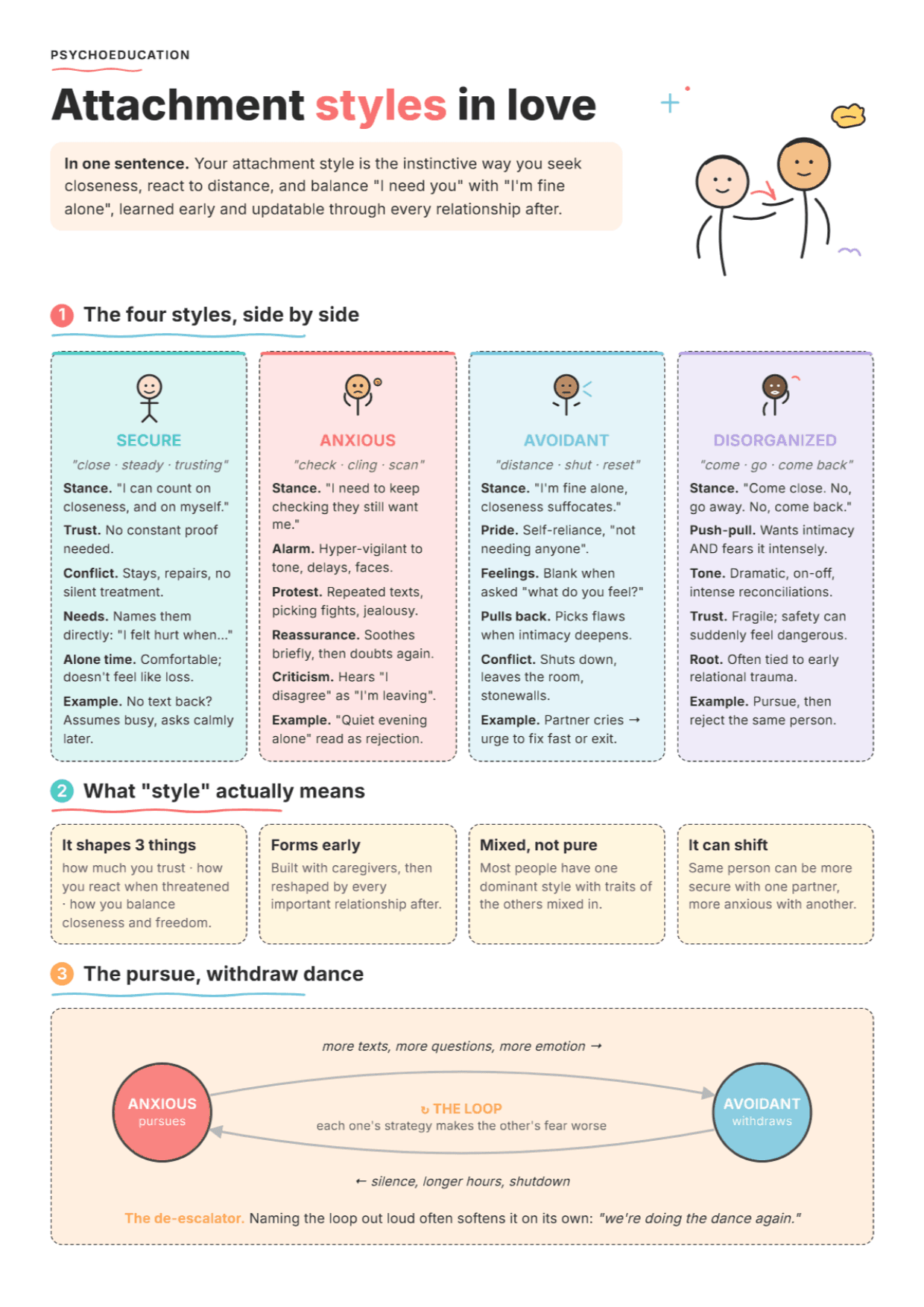
Four Attachment Styles in Relationships: PDF Worksheet, Tools and Exercises
A visual psychoeducation sheet clinicians can use in session to map attachment patterns, name the pursue-withdraw loop, and move toward earned security.
Relationships
Handout
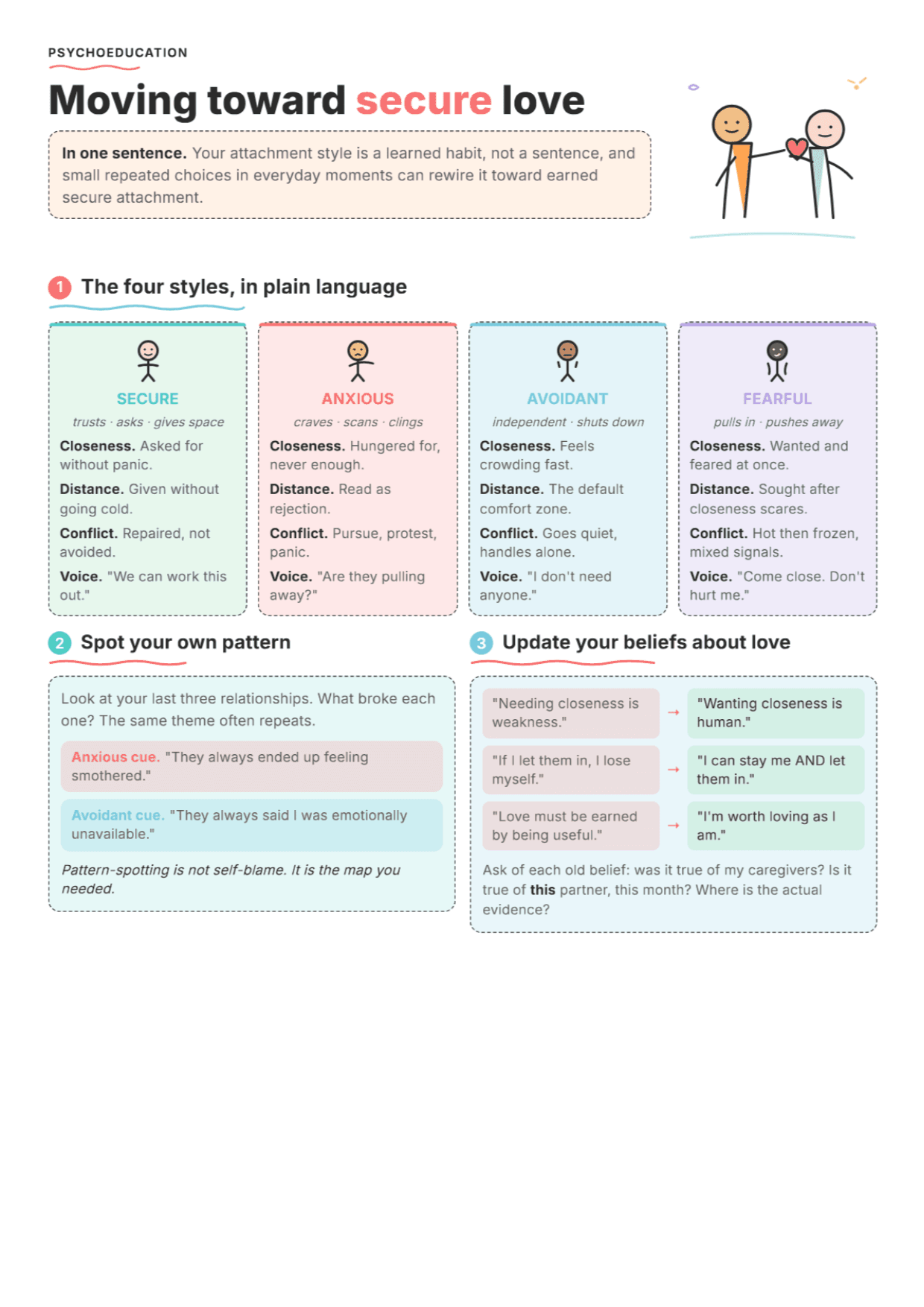
Secure Attachment: PDF Worksheet, Tools and Exercises for Clinical Practice
A printable PDF worksheet with tools and exercises to explain attachment styles, challenge core beliefs about love, and support earned secure attachment in clinical practice.
RelationshipsSelf & identity
Handout
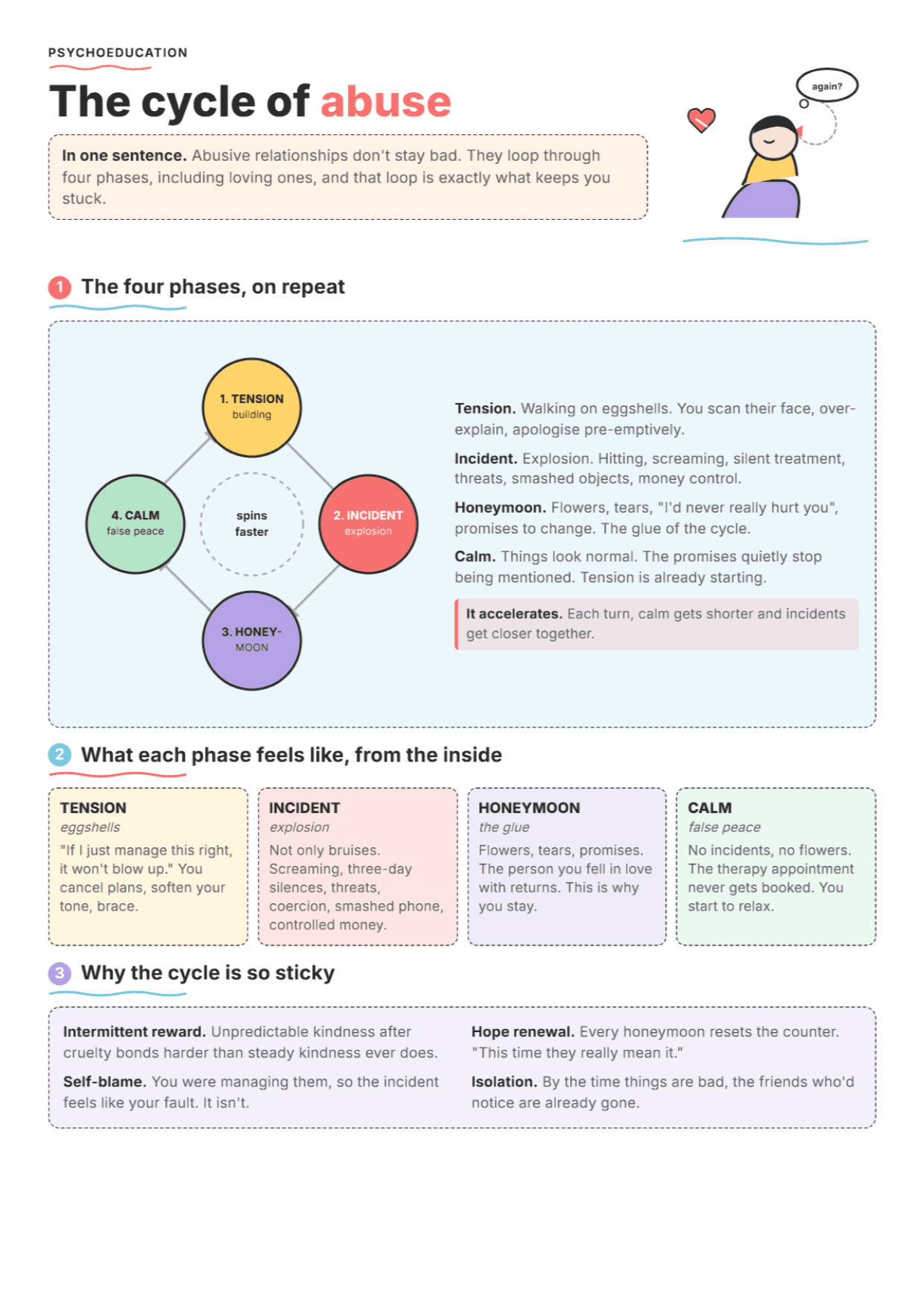
The Cycle of Abuse: PDF Worksheet, Tools and Exercises for Clinical Practice
A visual PDF worksheet with clinical tools and exercises to explain the four-phase abuse cycle in session, name intermittent reinforcement, and support patients in recognising what keeps them stuck.
RelationshipsTrauma & PTSD
Handout
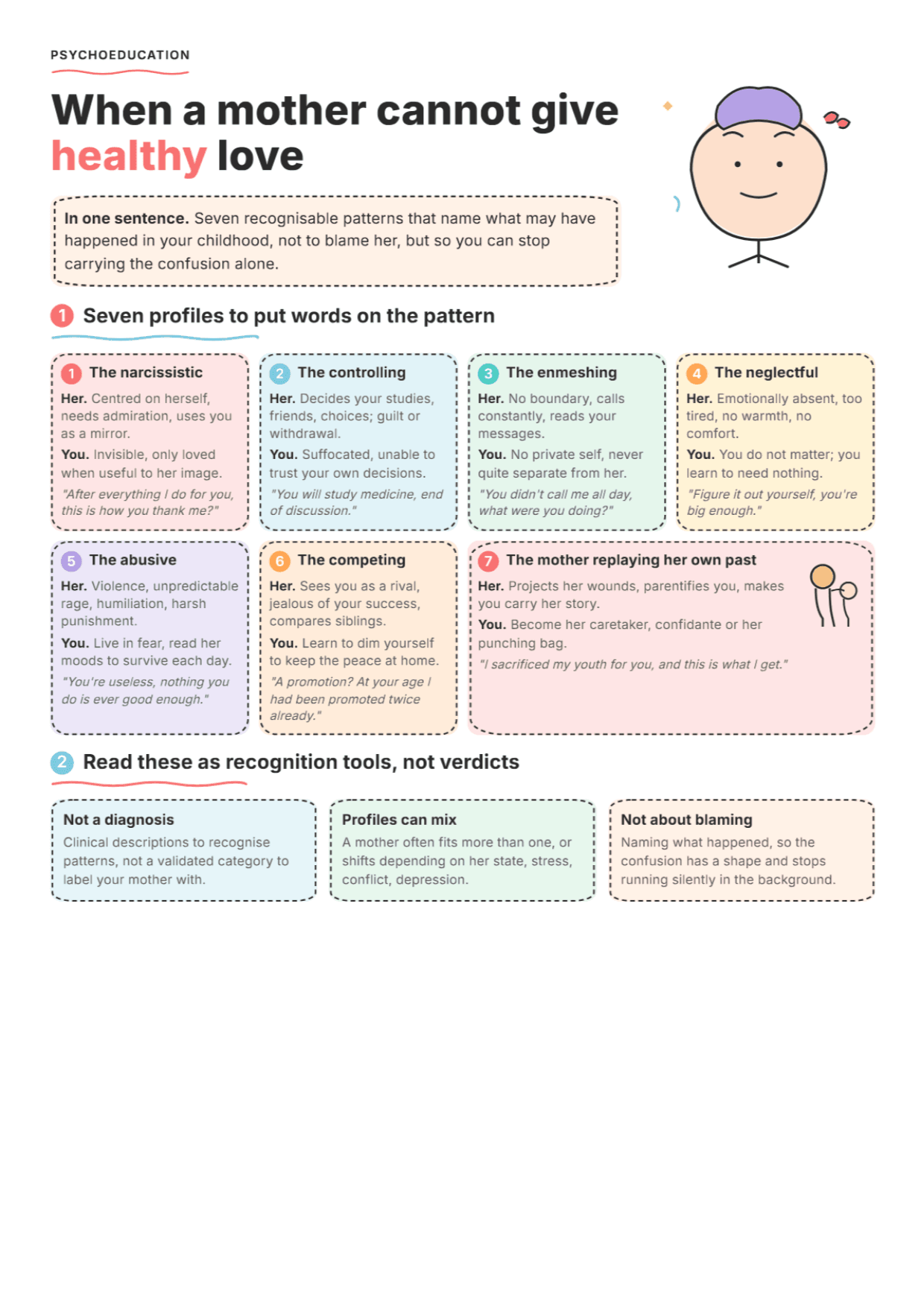
Toxic Mother Profiles: PDF Worksheet, Tools and Exercises for Clinical Practice
A visual psychoeducation tool helping clinicians name relational patterns from a difficult childhood, reduce patient confusion, and open structured clinical work on sequelae.
Self & identityRelationships
Handout
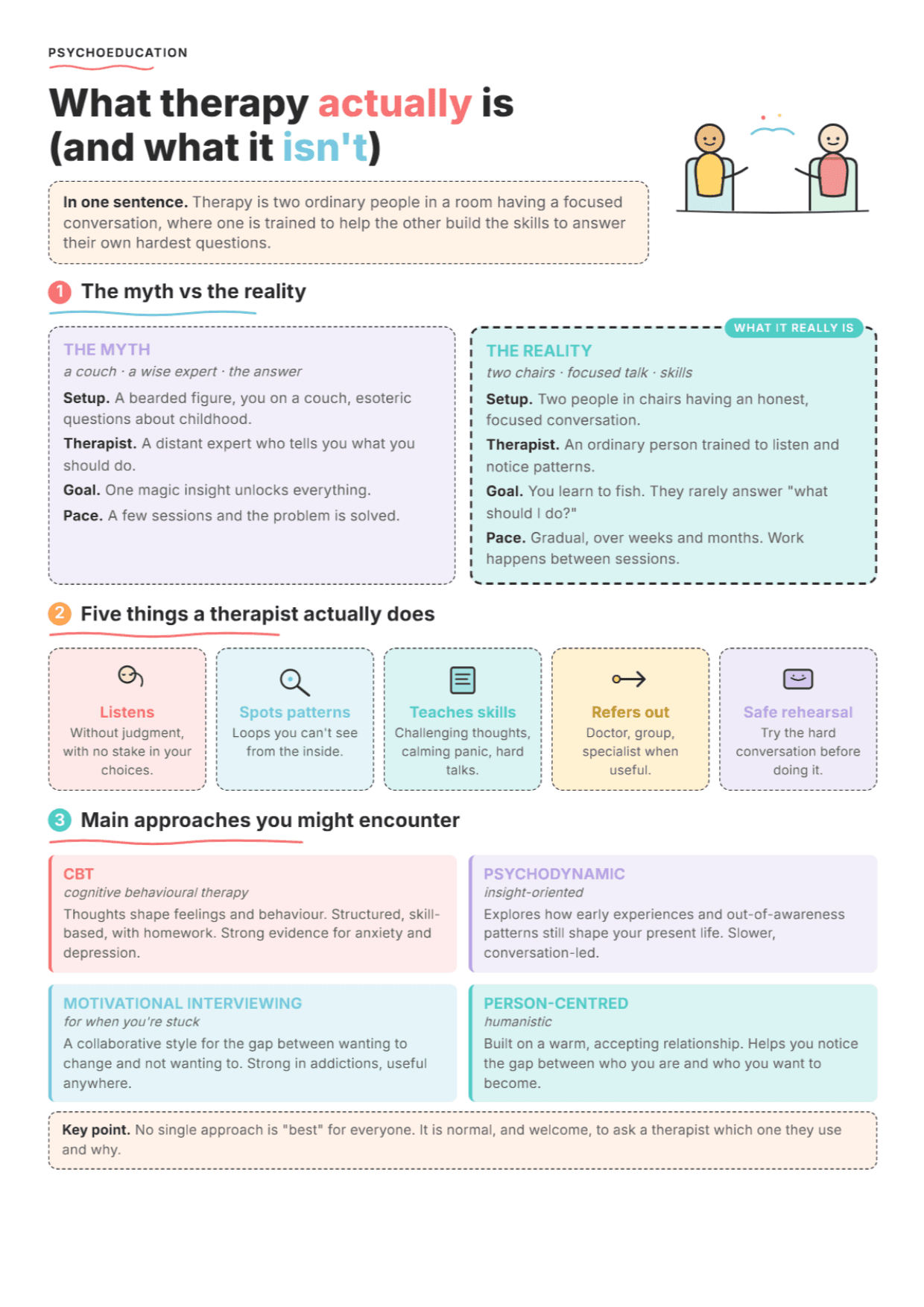
What Is Psychotherapy? PDF Worksheet, Tools and Exercises for Clinical Practice
A visual psychoeducation PDF worksheet with tools and exercises to orient patients to the therapeutic frame from the first session.