
Clinical picture. M., a 38-year-old woman presenting with persistent low mood and irritability, described feeling solely responsible for anticipating every household and parenting task while her partner remained largely unaware of the scope of that work. Her therapist introduced the written exercise as structured preparation for a couple discussion she had been avoiding for months. Working through the questions at home, M. identified two specific domains she was willing to transfer to her partner, and articulated where her own standards were higher than strictly necessary. She arrived at the next session with a clearer sense of what she wanted to say and, notably, a reduced sense of injustice once she had named it on paper.
ExerciseRelationshipsEmotions & stressBuild awarenessRepair & sootheBuild skillsSystemic & narrativeSolution-focused
Mental Load Imbalance in Couples: A Guided Clinical Exercise
A structured homework exercise helping patients name the mental load gap, examine differing standards, and prepare a real conversation with their partner.
Clinical vignettes
Naming the Gap Before the Conversation
Examining Standards, Not Only Tasks
Clinical picture. T., a 44-year-old man in couple-focused individual therapy, initially framed the problem as his wife's perfectionism blocking any real redistribution of domestic responsibilities. The clinician offered the exercise as a way to slow down and examine his own position before attributing the imbalance entirely to his partner. Question three prompted him to notice that several tasks he had labelled as poorly done by his wife met an adequate standard he had not consciously acknowledged. By question four, he was able to list two areas where he could accept a different approach, which gave the subsequent couple conversation a more negotiable starting point.
The Clinical Challenge: Why Mental Load Is So Hard to Talk Through
Mental load sits at a peculiar intersection: it is real, chronic, and invisible. Patients feel it acutely but often struggle to articulate it without sliding into global accusation or guilt-laden self-questioning. When you raise the topic verbally in the consultation room, the concept tends to either land as an abstract sociological label or collapse immediately into a heated grievance. Neither is therapeutically useful.
What makes it genuinely difficult is the layered structure underneath. Mental load is not just a question of who does what. It involves differing standards, an asymmetry in anticipation and planning, and often an unexamined assumption that the person who holds the load is also the person with the "right" standards. Untangling those three levels through oral exchange alone is slow work. Patients need a structure that holds the question still long enough for them to examine it honestly, including the parts that implicate their own rigidity.
This exercise meets that need by guiding patients through exactly that layered reflection, at their own pace, away from the heat of a live disagreement.
Use this resource with your patients
Handout, exercises and materials ready to use, right inside SessionFuel.
What the Tool Contains: Five Questions, One Coherent Arc
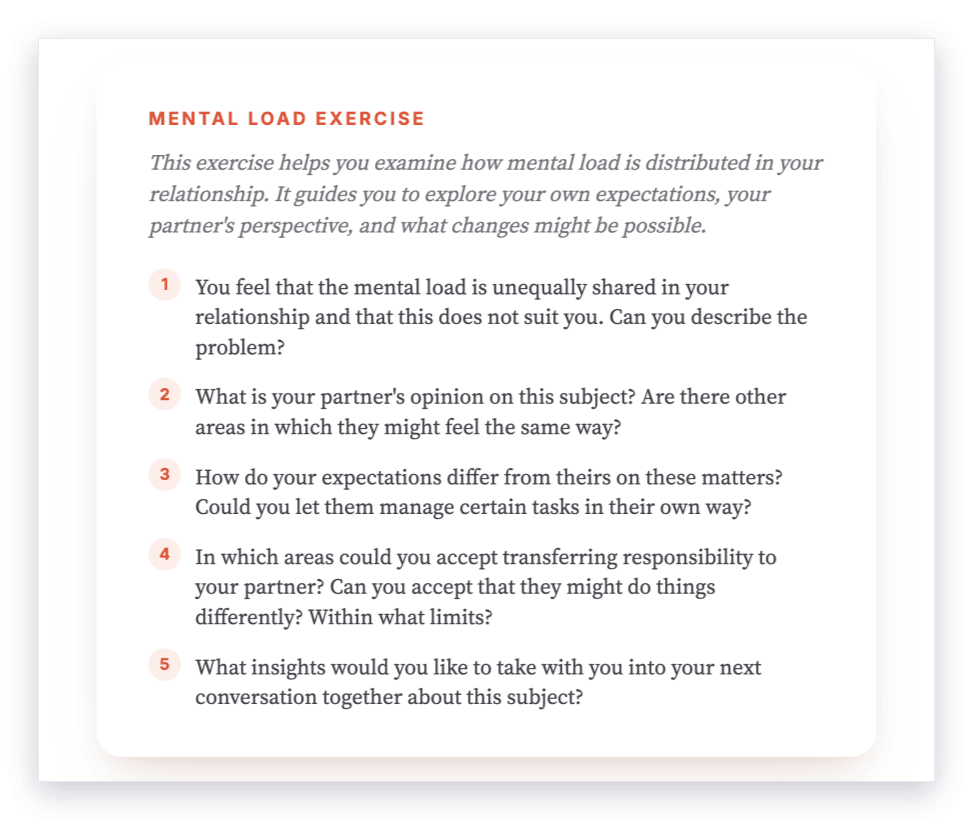
The exercise moves through five structured questions that build on each other deliberately.
The first question asks the patient to describe the problem in their own words: the imbalance as they perceive it, and why it does not work for them. This grounds the work in lived experience rather than theory.
The second opens perspective-taking: what is the partner's point of view, and are there domains where the partner might feel a similar imbalance going the other way? This question interrupts the unilateral framing that keeps many couples stuck.
The third is clinically the most demanding. It asks patients to examine how their own standards differ from their partner's on these topics, and whether they could tolerate the partner managing certain tasks in a different way. This is where perfectionism, the Self-Sacrifice Schema, and demanding standards often surface quietly.
The fourth question moves toward concrete negotiation territory: which domains could the patient genuinely transfer, under what conditions, and with what limits? This is the exercise's practical pivot, linking reflection to a real relational move.
The fifth invites the patient to identify the insights they want to bring into the next conversation with their partner, turning private reflection into preparation for dialogue.
The image above lists these five questions with a brief introductory framing. Note that this is a static preview of the questions only: the full guided experience, including patient-facing instructions and writing space, is delivered to the patient inside the app, not in this image.
This exercise is available to patients through the mobile application that is the dedicated patient-side interface of SessionFuel: you assign it directly from your clinician account, and your patient completes it autonomously on their phone between two appointments, at a time and pace that suits them.
Key clinical insight: The third question is where the real work lives. A patient who cannot imagine letting their partner "do it differently" has not yet identified where their load ends and their control begins. That distinction shapes the entire therapeutic direction.
Clinical library
750+ clinical tools
A library built with and for clinicians, ready to use in session and extend between appointments.
Access all the toolsSeveral resource types
Psychoeducation handouts
Understand at a glance
Interactive exercises
To do and fill in
Interactive programs
A structured path
Audios
Meditation and relaxation
Psychometric tests
Automatic scoring
Use it with your patients
Share this tool in the mobile app and follow the work between sessions.
How to Integrate It as Between-Session Homework
This exercise suits a range of profiles: patients in couples therapy processing a stuck pattern, individuals in individual therapy who raise relational exhaustion, and patients whose self-sacrifice schema or difficulty setting boundaries contributes to the load they carry.
Introduce it after a session in which the topic of mental load has surfaced organically. A simple framing works: "Before we continue this conversation, I'd like you to take some time on your own to think through a few questions. Not to prepare arguments, but to understand your own position more clearly." This positions the exercise as self-clarification, not ammunition gathering.
When the patient returns, the richest clinical material is usually in questions three and four. Where does the patient draw the limit of acceptable difference? What standards turn out to be non-negotiable, and why? This opens natural connections to nonviolent communication frameworks, to assertive expression of needs, or to the fair fighting rules the couple might need before the conversation the patient has prepared in question five.
For patients carrying a heavier cognitive load due to perfectionist patterns, pairing this exercise with the perfectionism guided self-reflection exercise in a subsequent homework cycle can deepen the work. For couples where communication has broken down more broadly, the Detecting Couple Misalignment exercise or the Weekly Couples Relationship Check-In can provide useful parallel structure.
The patient's written answers also give you something concrete to read together: specific sentences that reveal where perception diverges from reality, where empathy is present or absent, and where the patient is genuinely ready to negotiate versus still defending a position. That is clinical material that oral exchange rarely produces with the same precision.
Patient mobile app
Your session continues in your patients' pocket
Use with a patientYour resources, available everywhere
The handouts, exercises, programs and audios above: you choose which ones to make available to your patients, in the mobile app dedicated to them.
Psychoeducation handoutsInteractive exercisesInteractive programsAudiosPsychometric tests
And far more than a library
The app goes well beyond resources, to support your patients every day:
Standardized tests
Therapy journal
Gamification
Wellbeing challenges
Introspection prompts
Therapist homework
Related categories
Explore other clinical resources by category.

Emotions
Clinical resources on emotion regulation: worksheets, coping tools, CBT, REBT, and ACT exercises for therapists working across diagnoses and age groups.

Relationships
Clinical worksheets and tools on relational functioning: attachment, schemas, assertiveness, and communication skills for therapists. Printable PDF resources.

Build awareness
Clinical worksheets and tools to build awareness in therapy: cognitive distortions, schemas, emotions, ACT and CBT resources for practitioners.

Build skills
Skill-building resources for clinicians: printable worksheets and exercises for coping, assertiveness, and communication skills training in therapy.

Repair & soothe
Clinical resources for the repair and soothe therapeutic aim: worksheets, exercises and tools to build self-compassion, reduce shame and restore emotional safety.

Solution-focused
Clinical hub for Solution Focused Therapy resources: worksheets, exercises and programs for goal-oriented, strengths-based practice across individual and couple work.