
Clinical picture. A., a woman in her early forties, presented with persistent fatigue and low-grade irritability that she attributed to a demanding job and two adolescent children at home. She reported no difficulty saying yes to requests but struggled to articulate any personal needs without immediately qualifying them as selfish. In session, the clinician introduced the self-sacrifice schema psychoeducation sheet and walked through the six-step loop with her; A. paused at the resentment node and said, quietly, "That is exactly what happens, and then I feel terrible for feeling it." The clinician normalised the guilt-resentment cycle as a structural feature of the schema rather than a character flaw, which A. found more useful than previous reframes she had received. She left with the sheet and a single between-session task: to notice, without changing anything, the moment the guilt spike occurred.
Self-Sacrifice Schema: PDF Worksheet, Tools and Exercises
A visual PDF worksheet with clinical tools and exercises to identify, explain, and begin shifting the self-sacrifice schema in individual therapy.
Clinical vignettes
Naming the Loop Before Changing It
Avoidance Coping in a Caregiver
Clinical picture. T., a man in his mid-fifties, had been the primary carer for an ageing parent for three years and described his main coping strategy as "just not thinking about it." He reported increased alcohol use in the evenings, which he framed as unwinding rather than avoidance. When the clinician presented the three maintenance modes from the self-sacrifice schema sheet, T. recognised himself in the avoidance column rather than the surrender column, which surprised him; he had assumed only people who "gave too much" had this schema. The clinician used that recognition to open a discussion about how numbing behaviours kept his own needs invisible rather than resolving them, and T. agreed to monitor his urge to scroll or drink specifically in relation to moments when he had just finished doing something for his parent.
Patients carrying a self-sacrifice schema rarely arrive describing it as such. They present with exhaustion, simmering resentment toward people they love, and a guilt response so automatic that even naming it in session can trigger a defensive spiral. Explaining the schema verbally tends to produce intellectual agreement without experiential recognition. This fiche PDF gives you a visual structure that makes the pattern unmistakable.
Use this resource with your patients
Handout, exercises and materials ready to use, right inside SessionFuel.
Why the Self-Sacrifice Schema Is Hard to Explain at the Oral Level
The core difficulty is phenomenological: patients experience giving as freely chosen. The compulsive quality is invisible to them until the bill arrives (in the form of depletion, headaches, or quiet rage), and by then the guilt about resting has already reframed it as their own weakness. Verbal psychoeducation runs straight into this blind spot.
The second difficulty is the guilt spike itself. The moment you begin naming the schema, guilt activates as a moral signal rather than a conditioned reflex. Patients hear "you give too much" as "you are selfish." Without a visual framework showing the loop mechanistically, the concept does not land cleanly.
This is compounded when the schema co-occurs with approval-seeking patterns or emotional deprivation: the patient needs the giving to regulate attachment anxiety, so challenging it feels existentially threatening. A shared diagram externalises the mechanism, which reduces the threat enough for genuine exploration to begin.
What the Fiche Contains: A Visual Scaffold for Session Work
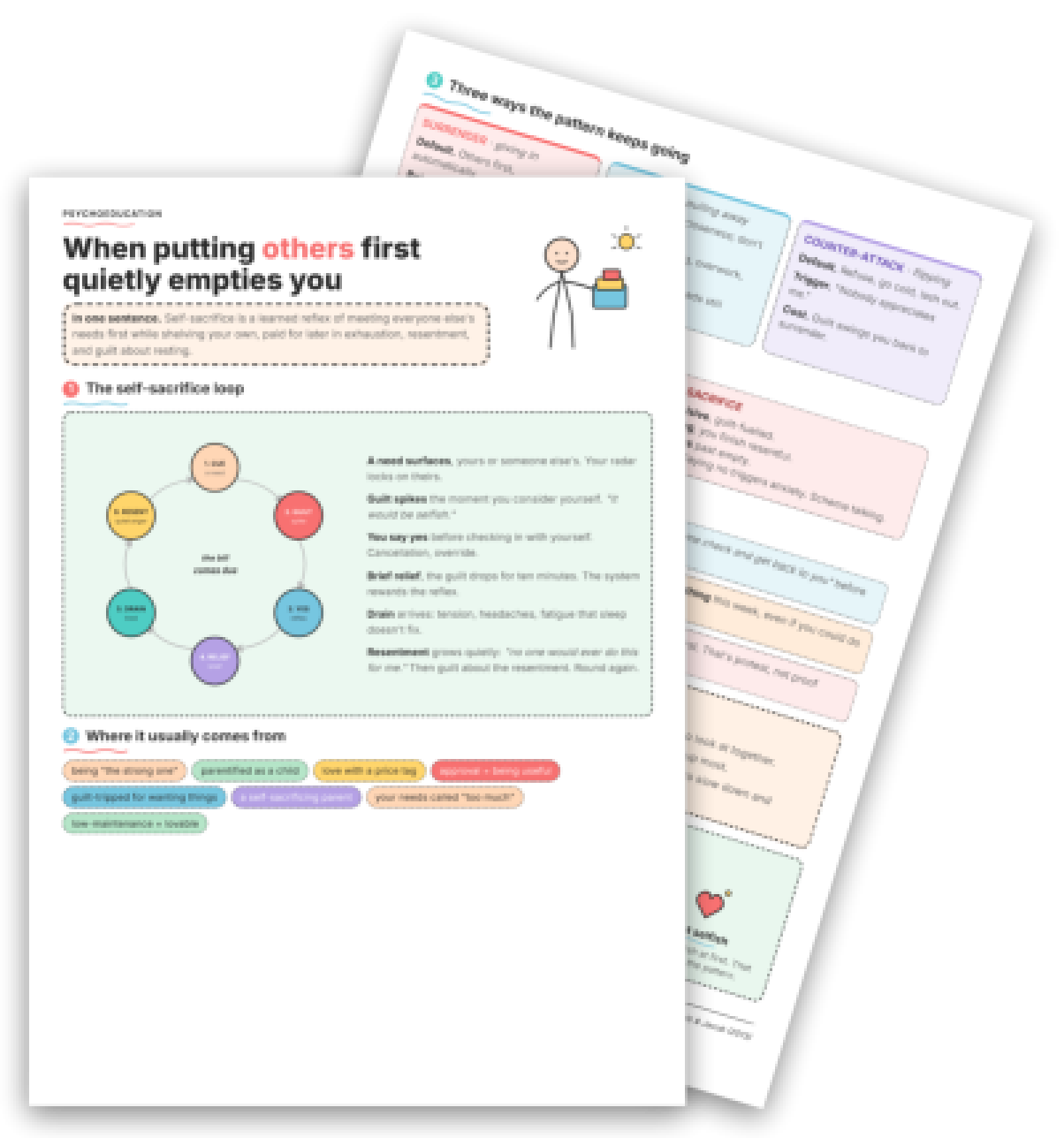
The fiche PDF is organised across five panels, each targeting a distinct psychoeducation objective. The visual layout does work that a spoken explanation cannot.
The first panel maps the self-sacrifice loop across six steps: CUE, GUILT spike, YES reflex, brief RELIEF, DRAIN, and RESENT, before the cycle resets. Presented as a circular diagram, it makes the automaticity of the sequence concrete. Patients can point to where they are in the loop right now, which anchors the session to lived experience rather than abstraction.
The second panel lists common developmental origins (parentification, conditional love, having needs labelled "too much"), giving patients a relational-historical frame drawn directly from the work of Young, Bach and Bernstein, and Arntz and Jacob. This is particularly useful when you are building a schema-focused case formulation alongside the broader early maladaptive schema overview.
The third panel maps the three coping modes: surrender (automatic compliance), avoidance (numbing, withdrawal), and counter-attack (lashing out, then guilt-swinging back into surrender). This maps cleanly onto the vocabulary of schema coping styles and helps patients recognise their own dominant mode without feeling pathologised.
The fourth panel offers a direct comparison between healthy giving and self-sacrifice, built around a concrete no-test: "Saying no triggers anxiety. Schema talking." That one line reliably produces recognition in the room.
The fifth panel provides brief shift strategies and three session prompts the patient takes home, structured around guilt as a signal rather than a verdict.
> Key point: The fiche is a visual support that facilitates the explanation in session, not an autonomous questionnaire. The clinician uses it alongside the patient to name the loop, locate the coping mode, and establish a shared vocabulary before any behavioural work begins.
750+ clinical tools
A library built with and for clinicians, ready to use in session and extend between appointments.
Access all the toolsWhen and How to Introduce It
This fiche works best in the psychoeducation phase, once the presenting picture is clear and the alliance is established (typically sessions two to four in schema-focused work, or after initial formulation). It is particularly indicated when the patient reports burnout with relational causes, chronic guilt about rest, or resentment that they immediately minimise.
You can introduce it without labelling the patient directly: "I want to show you a pattern I see come up a lot for people who tend to put others first. Tell me whether any of this resonates." That framing invites curiosity rather than defensiveness.
Debrief by asking which step of the loop they recognise most, which coping mode fits best, and whether the developmental origins section maps onto anything they know about their own history. From there, assertiveness exercises graded in low-stakes contexts and structured reflection on guilt and responsibility are natural next steps.
For patients with significant abandonment fears or a punitiveness schema, move more slowly through the loop diagram; the relief of recognition can be followed quickly by a shame spike. The fiche gives you a stable reference point to return to across sessions, which itself models the idea that needs deserve a place in the room.
Use it with your patients
Share this tool in the mobile app and follow the work between sessions.
Sources
- Young, J. E., Klosko, J. S., Weishaar, M. E. (2003). Schema Therapy: A Practitioner's Guide. Guilford Press.
- Young, J. E., Klosko, J. S. (1993). Reinventing Your Life: The Breakthrough Program to End Negative Behavior and Feel Great Again. Dutton Adult.
- Farrell, J. M., Reiss, N., Shaw, I. A. (2014). The Schema Therapy Clinician's Guide: A Complete Resource for Building and Developing Individual, Group and Integrated Schema Mode Treatment Programs. John Wiley and Sons.
Your session continues in your patients' pocket
Use with a patientYour resources, available everywhere
The handouts, exercises, programs and audios above: you choose which ones to make available to your patients, in the mobile app dedicated to them.
And far more than a library
The app goes well beyond resources, to support your patients every day:
Related categories
Explore other clinical resources by category.

Mood
Evidence-based worksheets and clinical tools for mood disorders: CBT, ACT, and positive psychology resources for psychologists and therapists.

Identity
Clinical resources for self-identity work in therapy: CBT, ACT, schema tools for clinicians addressing self-concept, core beliefs, and identity disruption.

Relationships
Clinical worksheets and tools on relational functioning: attachment, schemas, assertiveness, and communication skills for therapists. Printable PDF resources.

Understand
Clinical hub for the therapeutic aim 'Understand': worksheets and tools to build patient insight across CBT, ACT, schema therapy and more.

Build awareness
Clinical worksheets and tools to build awareness in therapy: cognitive distortions, schemas, emotions, ACT and CBT resources for practitioners.

Schema therapy
Schema therapy clinical resources for practitioners: worksheets, exercises, and programs targeting early maladaptive schemas, core beliefs, and schema modes.