
Clinical picture. M., a father in his late thirties, presented with irritability and a sense of helplessness centred on his seven-year-old son's daily whining episodes, particularly around mealtimes and homework. The clinician introduced the psychoeducation program and assigned Lesson 1 before the next appointment. Working through the reflective prompts independently, M. identified that his son's complaints clustered around transitions and fatigue, and that his own pattern of eventually giving in was reinforcing the behavior. At the follow-up appointment, M. reported that naming the trigger pattern had reduced his reactive frustration somewhat, though he acknowledged needing more strategies before feeling genuinely confident.
Children's Crying and Complaining: A Parent Psychoeducation Program
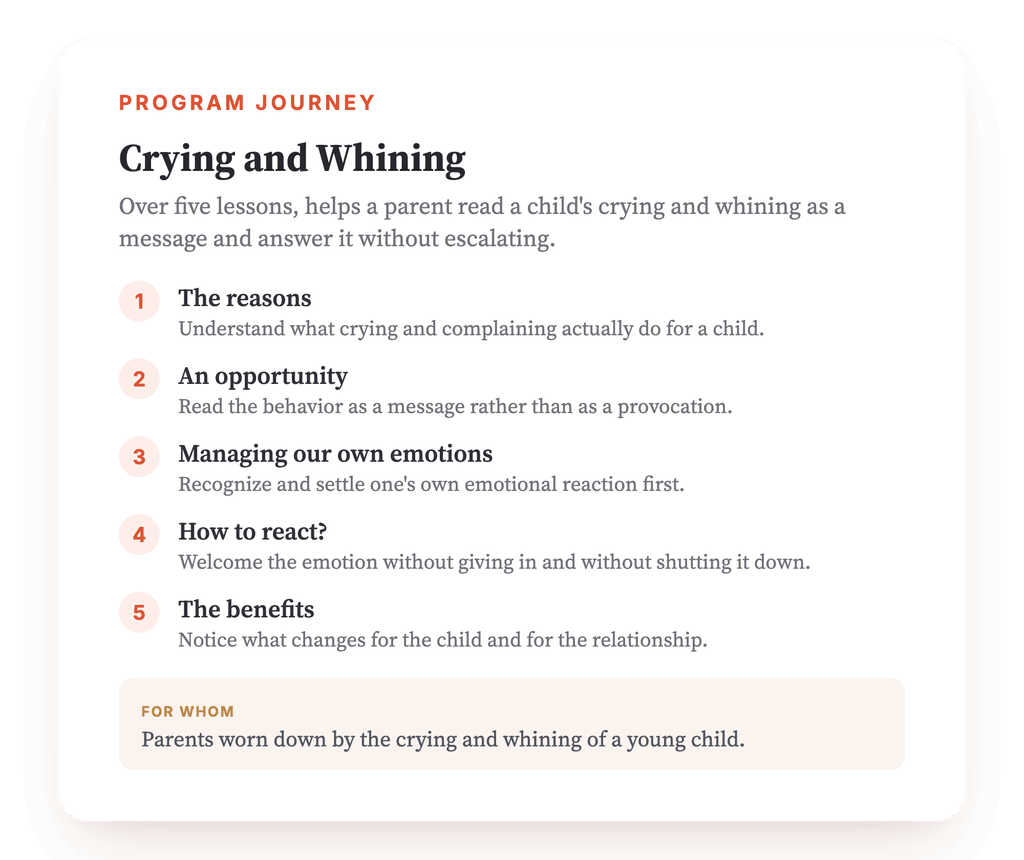
A structured 5-lesson program helping parents decode triggers, manage their own emotional reactions, and respond more effectively to their child's distress.
Clinical vignettes
Mapping Triggers in a Fatigued Parent
Reframing Complaints as Emotional Signals
Clinical picture. T., a mother in her early forties, described her nine-year-old daughter's persistent complaining as manipulative, and felt guilt immediately after losing patience. After completing Lessons 1 and 2 of the program between sessions, she engaged with the prompts on emotional maturity and the communicative function of crying. She returned to the session able to articulate that her daughter's complaints often followed overstimulating afternoons, and that the behavior might signal emotional dysregulation rather than deliberate manipulation. This reframe did not resolve the management difficulty, but it shifted T.'s starting point from frustration toward structured curiosity, which opened more productive discussion in session.
Use this resource with your patients
Handout, exercises and materials ready to use, right inside SessionFuel.
What Makes This So Hard to Address Clinically
Parents who come to you exhausted by their child's crying and complaining rarely lack love or commitment. What they lack is a working model of what is actually happening, and why their instinctive responses keep making things worse. Crying and complaining press emotional buttons in adults faster than almost any other child behaviour, which means the parent's own dysregulation becomes part of the problem before they have time to think.
Explaining the underlying dynamics verbally is only partially effective. The parent nods in session, then faces a meltdown at 7pm and finds the words have dissolved. What is needed is structured, repeated contact with the concepts, combined with guided self-observation between consultations. That is the clinical gap this program fills.
It also pairs well with adjacent work: the Behavior, Emotion, Underlying Need worksheet, the Children's Fundamental Needs by Age fiche, or the broader Parenting Fundamentals curriculum can all be woven into the same treatment arc.
Clinical library
750+ clinical tools
A library built with and for clinicians, ready to use in session and extend between appointments.
Access all the toolsSeveral resource types
Psychoeducation handouts
Understand at a glance
Interactive exercises
To do and fill in
Interactive programs
A structured path
Audios
Meditation and relaxation
Psychometric tests
Automatic scoring
What the Program Contains
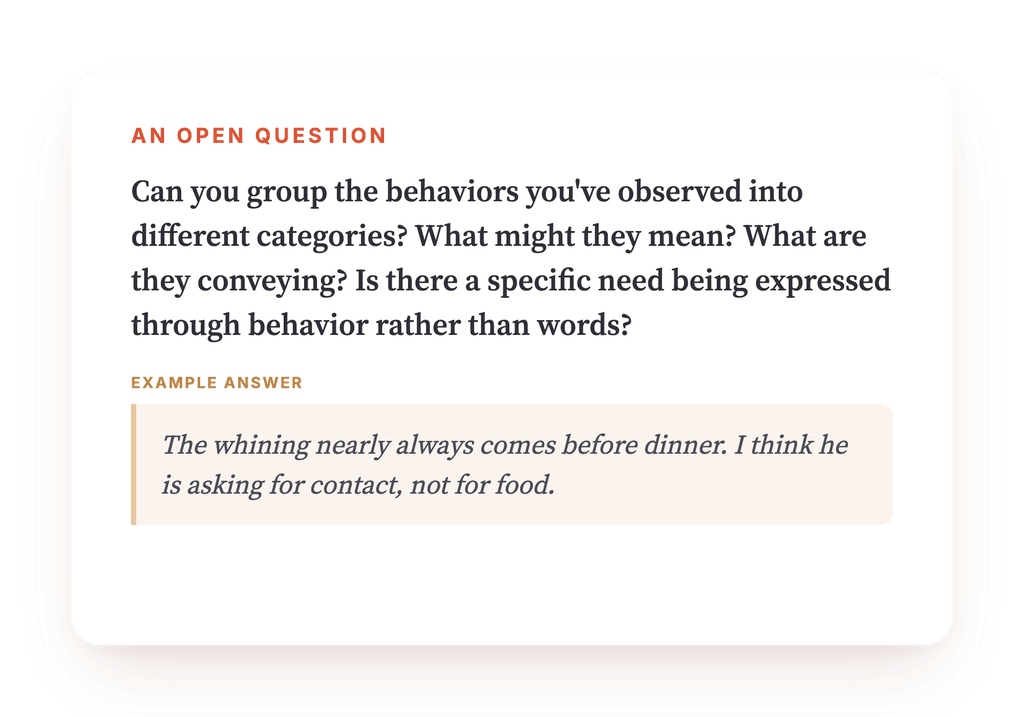
The five lessons build progressively. Lesson 1 asks the parent to identify specific triggers, situational patterns, and what function the behaviour may serve for the child, including whether past capitulations have inadvertently reinforced it. Lesson 2 reframes crying and complaining as informational signals: the parent learns to read accompanying body language and map unmet needs across a hierarchy (physiological, safety, belonging, esteem, self-actualisation), and to reflect on what each category felt like when their own needs went unmet.
Lesson 3 turns the lens on the parent's internal world: recognising which emotions get activated, where they are felt somatically, and practising a personalised calming anchor for moments of escalation. Lesson 4 introduces four concrete response strategies (non-judgmental stance, pause-listen-reframe, attention redirection, strategic non-intervention) and asks the parent to rehearse each against real recent situations. Lesson 5 addresses long-term stakes: the link between unmanaged negative affect in childhood and later mental health difficulties, and the importance of the parent's own emotional wellbeing as a prerequisite for sustained co-regulation.
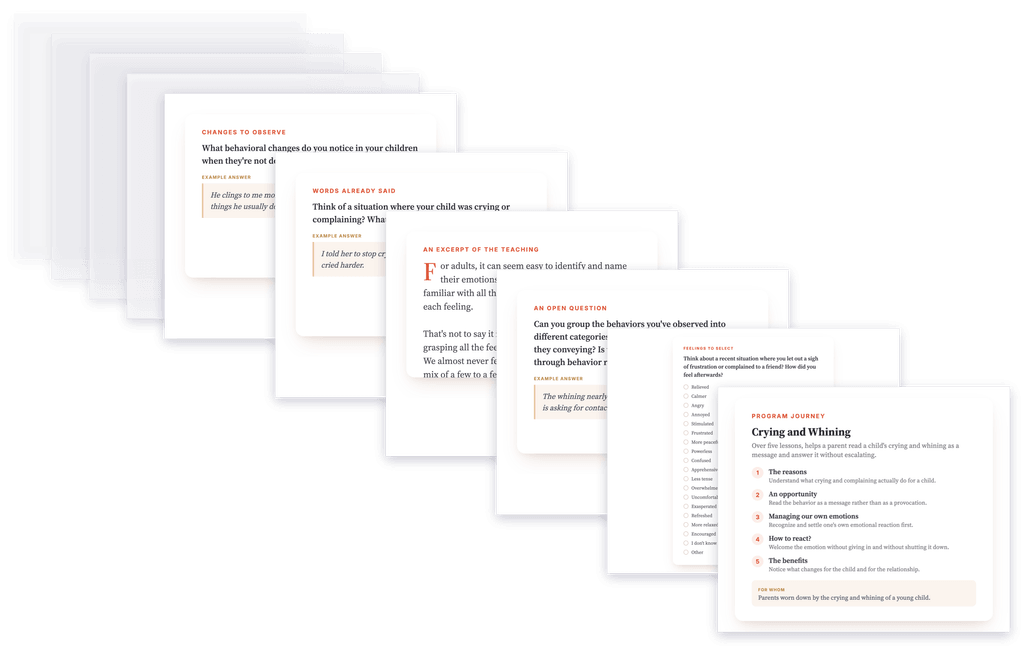
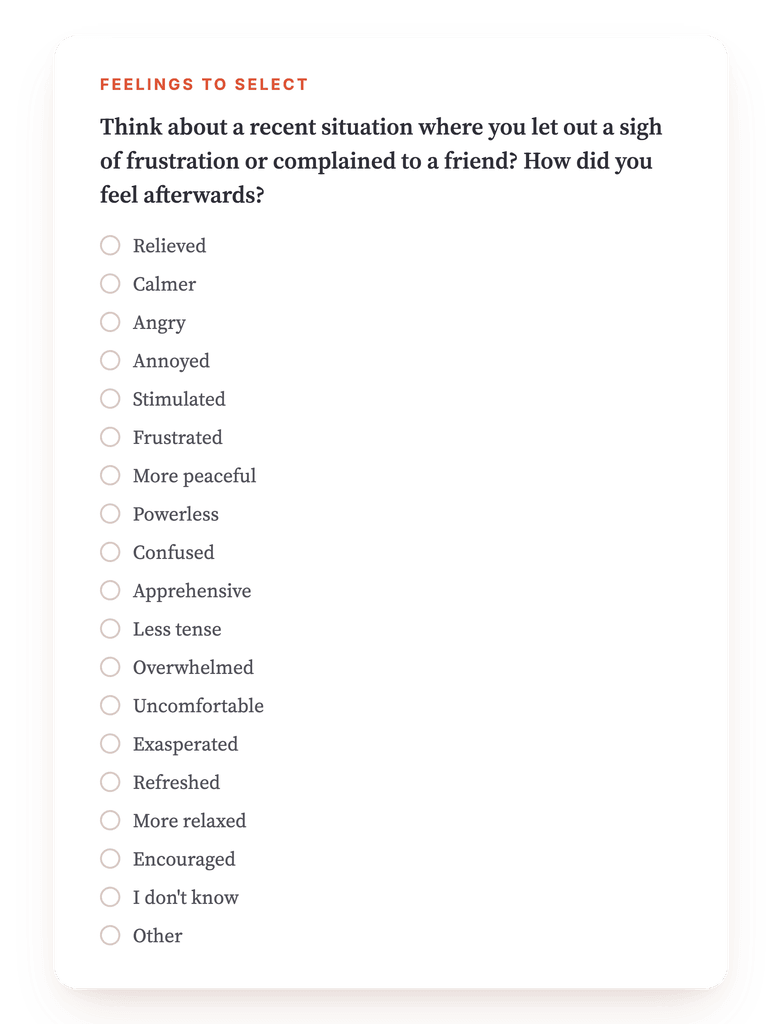
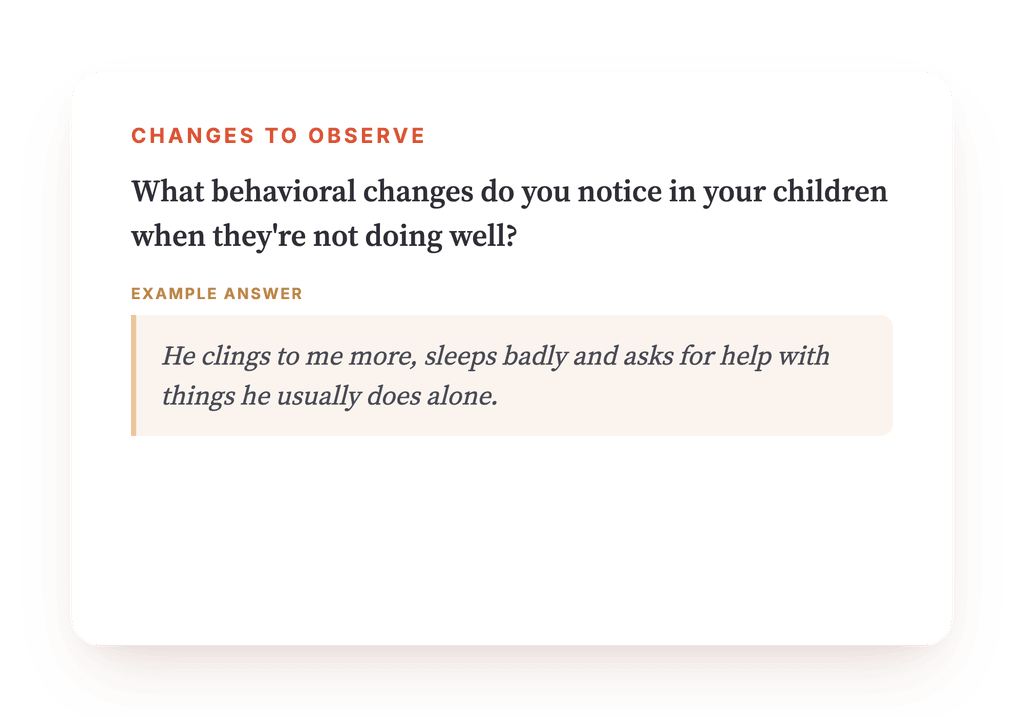
The preview images embedded here show only a small fraction of the program. The complete curriculum is far richer, with many more steps, guided prompts, psychoeducation texts, and multiple-choice emotion inventories than what these excerpts can convey.
This program is available to patients through the mobile application that is the dedicated patient-side interface of SessionFuel: you assign it directly from your SessionFuel account, and your patient then works through each lesson autonomously on their phone, at their own pace, between appointments.
Use it with your patients
Share this tool in the mobile app and follow the work between sessions.
How to Integrate It as Between-Session Homework
This program suits parents of children aged roughly 3 to 12 who present with parenting stress, emotional exhaustion, or conflict around child behaviour, whether or not a formal diagnosis is in the picture. It works particularly well alongside Expressing Appreciation to Children, the Strong-Willed Children program, or the Anxiety in Children and Adolescents curriculum, depending on what is driving the presentation.
Introduce it by naming the gap directly: "I want to give you something concrete to work through on your own between now and our next meeting, so that what we talk about here can become practice rather than theory." Assign one or two lessons at a time as homework between consultations, asking the parent to complete the written prompts as honestly as they can.
When the parent returns, the material they have produced is your clinical raw data: the triggers they identified, the emotion words they chose, the somatic descriptions from Lesson 3, the specific situations they mapped in Lesson 4. This feeds directly into your work on Identifying Emotional Triggers, Nonviolent Communication, or Using Praise Effectively, without requiring you to build that baseline from scratch in consultation.
Key insight: The parent's written responses across the five lessons give you a window into real home dynamics that no single consultation can replicate, and they arrive at the next appointment already having reflected, which shifts the depth of the conversation from the first minute.
The Family Mindfulness Schedule and the Token Reward System fiche make natural complements once the parent has completed the later lessons, extending the work from insight into structured daily practice.
Patient mobile app
Your session continues in your patients' pocket
Use with a patientYour resources, available everywhere
The handouts, exercises, programs and audios above: you choose which ones to make available to your patients, in the mobile app dedicated to them.
Psychoeducation handoutsInteractive exercisesInteractive programsAudiosPsychometric tests
And far more than a library
The app goes well beyond resources, to support your patients every day:
Standardized tests
Therapy journal
Gamification
Wellbeing challenges
Introspection prompts
Therapist homework
Related categories
Explore other clinical resources by category.

Emotions
Clinical resources on emotion regulation: worksheets, coping tools, CBT, REBT, and ACT exercises for therapists working across diagnoses and age groups.

Behaviours
Clinical hub for behaviors in therapy: worksheets and tools for coping, eating disorders, CBT formulation, and maladaptive behavioral patterns.

Relationships
Clinical worksheets and tools on relational functioning: attachment, schemas, assertiveness, and communication skills for therapists. Printable PDF resources.

Integrative
Integrative therapy clinical resources: worksheets, psychoeducation programs, and exercises for eclectic, multimodal practice across orientations.

Anxiety
Clinical hub for anxiety disorders: CBT and ACT worksheets, psychoeducation sheets, and exercises for assessment and treatment across the anxiety spectrum.
Trauma
Clinical hub on trauma and PTSD: assessment, differential diagnosis, treatment phases, and printable resources for practitioners. 155 chars.