
Clinical picture. T., a man in his late thirties, presented with recurrent tension headaches and reported feeling "stressed" without being able to say more. He described clenching his jaw most of the day at work and arriving home and snapping at his partner over minor things. In session, the clinician introduced the Emotions Reference Sheet and walked T. through the backwards method: starting from the tight jaw and raised voice, they traced a path to the anger family. T. paused, then identified "frustrated" as fitting better than the generic "stressed" he had been using, and the session shifted toward what specifically felt blocked at work. He left with the sheet to practise between appointments, noting body signals as they arose.
Emotions Reference Sheet: PDF Worksheet, Tools and Exercises for Clinical Practice
A visual psychoeducation tool helping patients name emotions from body signals and behaviour, with seven feeling families, worked examples, and a daily tracking habit.
Clinical vignettes
Naming Anger Behind Somatic Complaints
Differentiating Guilt from Sadness
Clinical picture. M., a woman in her mid-forties seen following a bereavement, described a persistent heaviness and poor sleep but also kept returning to a conversation she wished she had handled differently with the deceased. The clinician used the Emotions Reference Sheet to help her distinguish between the two clusters she appeared to be moving between: the sadness column matched her fatigue and withdrawal, while the guilt variant matched her replaying of events and urge to somehow repair things. Seeing the two descriptions side by side allowed M. to say, with some relief, "I think they are both there, but the guilt is louder right now." The sheet gave the work a concrete anchor without collapsing a layered grief into a single label.
Patients routinely arrive with broad, unhelpful labels: "stressed", "not great", "I just feel bad". Verbal psychoeducation on emotional granularity is easy to deliver and easy to forget. This fiche PDF gives you a structured visual support to move the work from vague affect to precise emotional language, in session, together, without rebuilding the rationale every time.
Use this resource with your patients
Handout, exercises and materials ready to use, right inside SessionFuel.
Why emotion labeling stalls in verbal explanation
When patients lack a differentiated emotional vocabulary, the problem is rarely lack of motivation. Without precise labels, the regulatory system has less to work with, a point Barrett's constructionist model makes explicit. Yet explaining emotional granularity verbally creates a specific bottleneck: you are asking a patient to introspect and label simultaneously, using words they may have never applied to internal states.
The fiche sidesteps this by anchoring the search in the body first. Most patients can describe a physical sensation (tight jaw, heavy chest) or a behaviour (snapping, withdrawing) before they can name a feeling. That entry point is far more accessible than asking "what do you feel?" directly. It pairs naturally with work on interoceptive awareness and the autonomic nervous system or with basic emotion recognition tools, and sits comfortably within a CBT cognitive model framework.
A recurring clinical friction point: patients presenting with emotional inhibition schemas or depression often collapse distinct internal states into "tired" or "fine". Alongside resources like Emotions in Depression or the Emotions: A Hierarchical Map, this fiche gives those patients a concrete starting point rather than an open-ended introspective request.
What the fiche contains: a visual structure for in-session psychoeducation
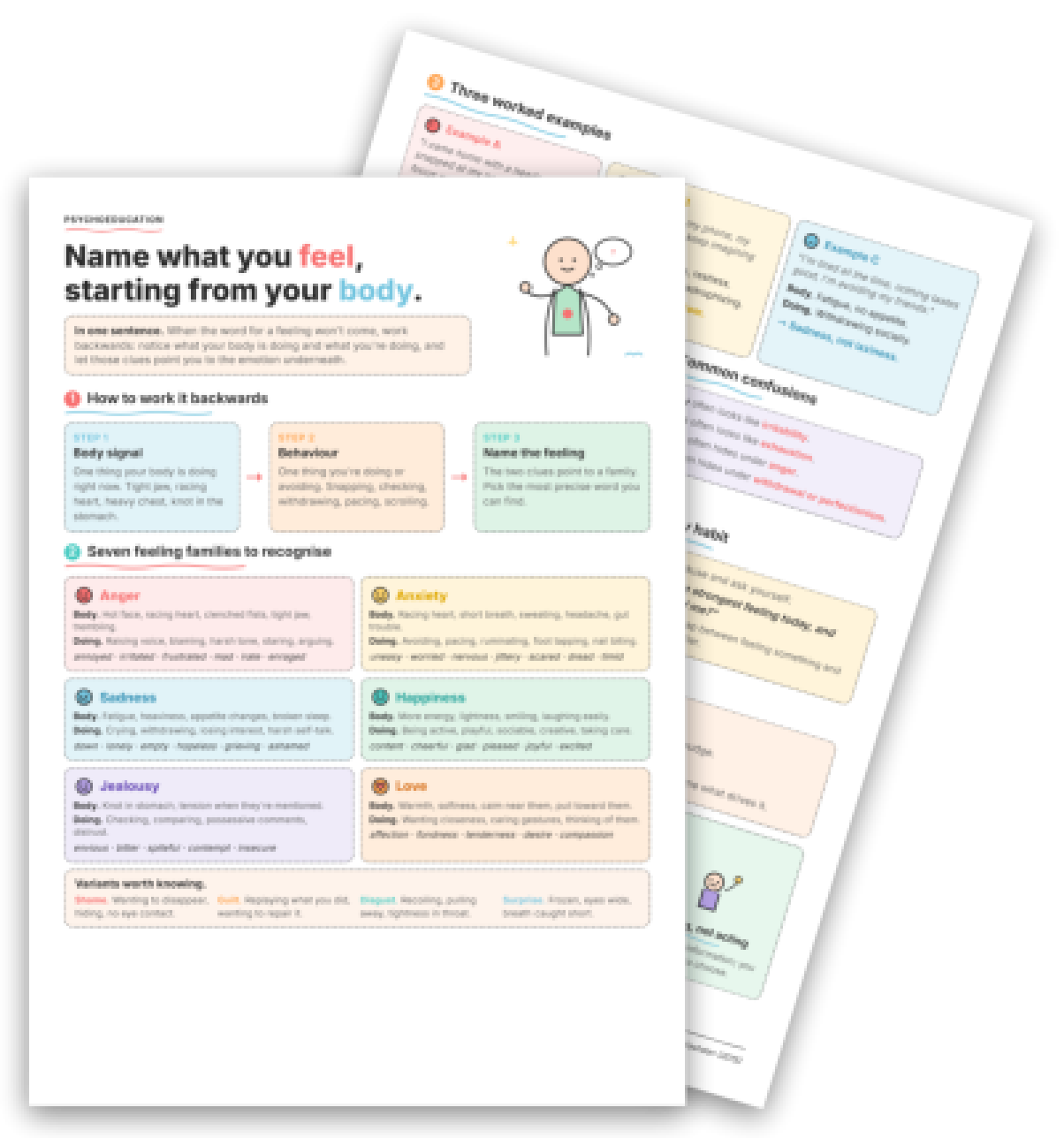
The sheet opens with one orienting sentence: "Name what you feel, starting from your body." That framing alone is worth reading aloud with the patient before anything else.
The core visual structure is a three-step backwards method: body signal first (tight jaw, racing heart, knot in the stomach), then behaviour (snapping, checking, withdrawing), then the emotional label. This sequence runs counter to most patients' habitual and repeatedly failed approach of searching for the word directly.
The fiche then maps seven feeling families (Anger, Anxiety, Sadness, Happiness, Jealousy, Love, plus four variants: Shame, Guilt, Disgust, Surprise), each with its specific body signals, behavioural markers, and a graduated vocabulary ladder. Seeing that "angry" can sharpen into humiliated, resentful, let down, or betrayed*, each pointing to a different clinical next step, is far more compelling on a visual grid than stated aloud. This complements the Emotion Wheel (114 Emotions) for patients ready for finer differentiation.
Three worked examples (A, B, C) demonstrate the backwards method in context: a patient snapping at home after work lands on anger; a patient checking their phone with a tight stomach lands on anxiety, not boredom; a patient withdrawing and losing appetite lands on sadness, not laziness. These illustrations make the distinction between an emotion and its behavioural mask concrete and discussable. They connect naturally to The Anger Iceberg and the Behavior, Emotion, Underlying Need framework.
A short "Common confusions" panel flags four frequent clinical overlaps: anxiety presenting as irritability, sadness as exhaustion, jealousy hiding under anger, and shame under withdrawal or perfectionism. That section alone can reframe a formulation mid-session. It runs parallel to dedicated resources like Shame in Therapy when one of those confusions becomes the therapeutic focus.
The sheet closes with a personalisation prompt ("For you, anger might show up as cleaning the kitchen at midnight") and a daily tracking habit. This gives the patient a between-session anchor without turning the sheet into a questionnaire they feel obliged to complete correctly.
> Key takeaway: this fiche is a visual support that facilitates the explanation of emotional labeling in session. It externalizes the backwards method onto a shared page, builds a common vocabulary between patient and clinician, and leaves a concrete reference the patient can return to between appointments, not a form to fill in alone.
Clinical library
750+ clinical tools
A library built with and for clinicians, ready to use in session and extend between appointments.
Access all the toolsSeveral resource types
Psychoeducation handouts
Understand at a glance
Interactive exercises
To do and fill in
Interactive programs
A structured path
Audios
Meditation and relaxation
Psychometric tests
Automatic scoring
When and how to introduce the fiche
This resource fits well from the second or third session, once the anamnesis is complete and you have a working sense of the patient's capacity for introspective language. It is particularly indicated for:
- Alexithymia or limited affective vocabulary: the body-first entry point bypasses the verbal bottleneck directly
- Somatic presentations without clear psychological attribution: the body signals column names exactly what these patients report
- Behavioural referrals lacking emotional insight (anger management, burnout, relational conflict): Cognitive Triangle work becomes easier once emotions are named, and DBT emotion regulation skills have a clearer target
A low-pressure introduction: "I'd like us to look at something together that might help put words to what you're describing. We start with what you notice in your body, not with the word for the feeling." That framing removes the pressure of introspective performance.
In session, walk through one worked example before pointing the patient to their own experience. The "Common confusions" panel is especially productive to debrief after a patient has used a broad label, opening a joint re-examination without imposing a reframe.
One limit worth noting: for patients with active dissociation or severe derealisation, the body-first method requires basic interoceptive contact that may not yet be available. Consolidate somatic grounding work first before introducing the sheet.
The fiche gives the patient vocabulary and a method, not instructions to follow correctly. That distinction keeps the tool clinically usable and keeps patients returning to it.
Use it with your patients
Share this tool in the mobile app and follow the work between sessions.
Sources
- Price, C. J., Hooven, C. (2018). Interoceptive Awareness Skills for Emotion Regulation: Theory and Approach of Mindful Awareness in Body-Oriented Therapy (MABT). Frontiers in Psychology.
- Burklund, L. J., Creswell, J. D., Irwin, M. R., Lieberman, M. D. (2014). The Common and Distinct Neural Bases of Affect Labeling and Reappraisal in Healthy Adults. Frontiers in Psychology.
- Barrett, L. F. (2017). How Emotions Are Made: The Secret Life of the Brain. Houghton Mifflin Harcourt.
Patient mobile app
Your session continues in your patients' pocket
Use with a patientYour resources, available everywhere
The handouts, exercises, programs and audios above: you choose which ones to make available to your patients, in the mobile app dedicated to them.
Psychoeducation handoutsInteractive exercisesInteractive programsAudiosPsychometric tests
And far more than a library
The app goes well beyond resources, to support your patients every day:
Standardized tests
Therapy journal
Gamification
Wellbeing challenges
Introspection prompts
Therapist homework
Related categories
Explore other clinical resources by category.

Identity
Clinical resources for self-identity work in therapy: CBT, ACT, schema tools for clinicians addressing self-concept, core beliefs, and identity disruption.

Emotions
Clinical resources on emotion regulation: worksheets, coping tools, CBT, REBT, and ACT exercises for therapists working across diagnoses and age groups.

Understand
Clinical hub for the therapeutic aim 'Understand': worksheets and tools to build patient insight across CBT, ACT, schema therapy and more.

Build awareness
Clinical worksheets and tools to build awareness in therapy: cognitive distortions, schemas, emotions, ACT and CBT resources for practitioners.

CBT
CBT worksheets, cognitive restructuring exercises & behavioral tools for clinicians. Evidence-based resources for every phase of cognitive behavioral therapy.

Integrative
Integrative therapy clinical resources: worksheets, psychoeducation programs, and exercises for eclectic, multimodal practice across orientations.