
Clinical picture. A., a 34-year-old school teacher, presented with recurrent panic attacks triggered by perceived cardiac sensations, leading to near-daily pulse-checking and repeated GP consultations over six months. The clinician introduced the informational sheet on what keeps panic going, focusing on petal 2: the therapist drew the tiger metaphor explicitly, noting that continuous body-scanning reliably produces the very sensations A. feared. A. recognized her habit of monitoring her heartbeat throughout lessons and identified this as her dominant entry point into the cycle. Over the following two weeks she tracked scanning episodes without attempting to suppress them, and reported a modest but noticeable reduction in the frequency of full panic episodes.
What Keeps Panic Going: PDF Worksheet, Tools and Exercises
A visual PDF worksheet clinicians can use in session to explain the three-petal maintenance cycle of panic disorder and make safety behaviour work concrete.
Clinical vignettes
Hypervigilance Maintaining Panic Cycle
Safety Behaviours Sustaining Catastrophic Beliefs
Clinical picture. M., a 27-year-old graduate student, described panic attacks on public transport that he managed by always sitting near exits, travelling with a companion, and carrying an unused anxiolytic as a precaution. During the session, the clinician used the three-petal worksheet to map M.'s safety moves as petal 3, explaining that each precaution prevented him from learning that the sensations would have passed regardless. M. acknowledged that the tablet in his pocket had never been taken yet felt indispensable, which opened a discussion about what belief the tablet was actually protecting. He agreed to one short solo journey the following week, without the tablet, as a first behavioural test of the false-alarm model.
Explaining what sustains panic to a patient mid-session is genuinely difficult. Saying "your avoidance keeps the fear alive" rarely lands; the logic feels circular, and patients leave with the words but not the mechanism. This PDF worksheet gives clinicians a visual support to make the full maintenance cycle concrete, shared, and discussable in the room, in a single glance.
Use this resource with your patients
Handout, exercises and materials ready to use, right inside SessionFuel.
Why the maintenance cycle of panic resists verbal explanation
Patients with panic disorder typically arrive with a theory of their own: a cardiac concern, a fear of losing control, or a conviction that something neurological is wrong. The CBT maintenance model, rooted in Clark's 1986 cognitive model, asks them to accept three counterintuitive ideas at once: that catastrophic interpretation creates the very sensations they fear, that hypervigilance amplifies rather than protects, and that every safety behaviour prevents disconfirmation. Presented verbally, all three together tend to produce polite nodding rather than genuine insight.
The specific sticking point is the loop structure. Patients can grasp each process in isolation; they almost never see, without visual scaffolding, how the three elements reinforce each other and feed back into panic. A diagram resolves this immediately, and that is exactly what this worksheet provides.
What the fiche contains: a visual map of the three-petal cycle
The worksheet is structured across four numbered panels, each building directly on the last.
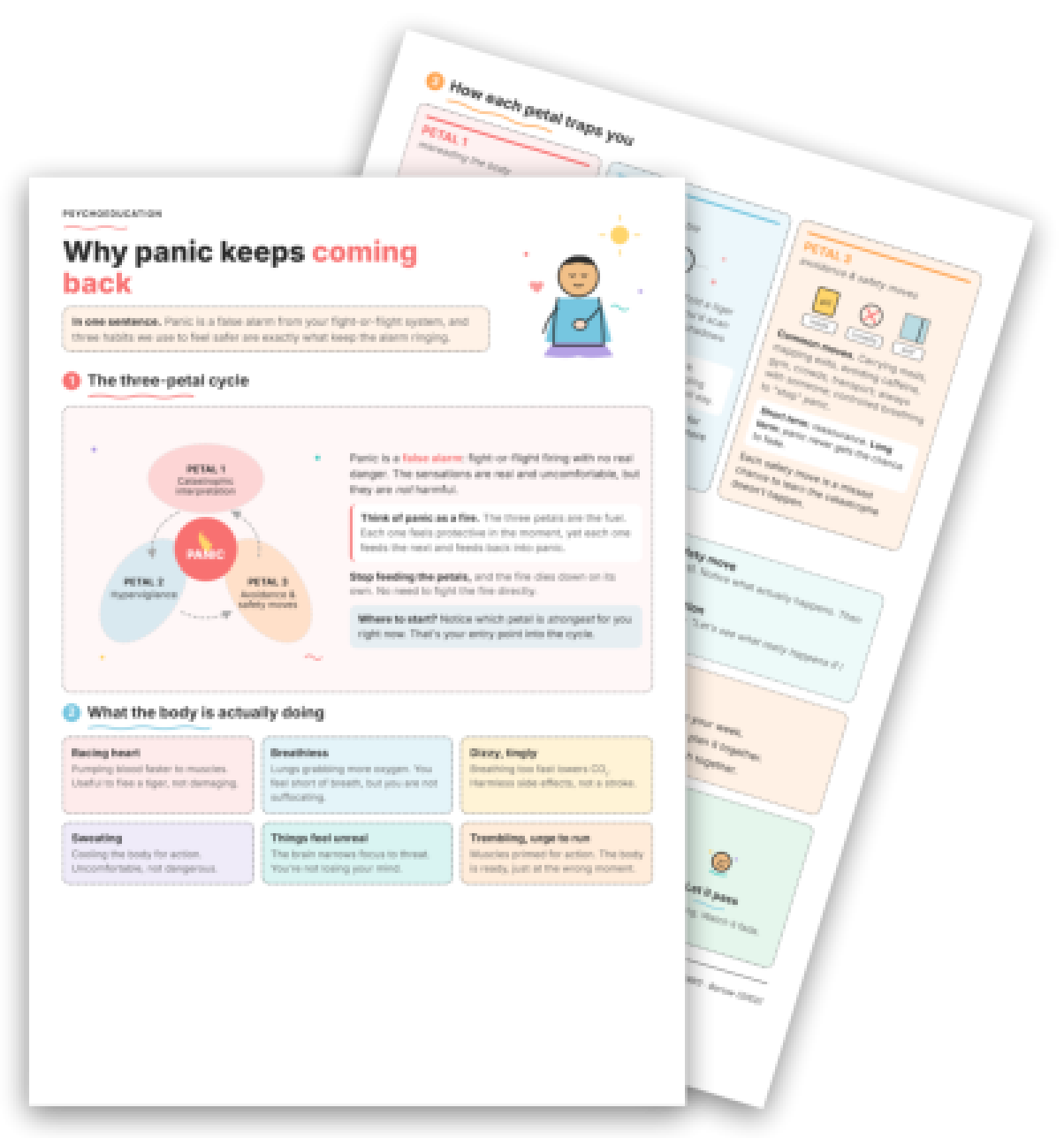
Panel 1 introduces the three-petal cycle diagram: catastrophic interpretation, hypervigilance, and avoidance and safety moves arranged around a central panic node. The orienting sentence frames the whole resource: "Panic is a false alarm: fight-or-flight firing with no real danger."
Panel 2 maps panic physiology item by item: racing heart, breathlessness, dizziness and tingling, sweating, derealisation, trembling. Each sensation is paired with its actual biological function and a brief demystifying note ("Breathing too fast lowers CO₂. Harmless side effects, not a stroke."). This panel directly challenges catastrophic appraisal without requiring the clinician to improvise anatomy from scratch. Pair it with the panic attack physiology resource for patients who need more depth on the somatic side.
Panel 3 unpacks each petal in clinical detail. For petal 1, it names the cognitive trap and lists the most common catastrophic cognitions. For petal 2, the tiger metaphor (scanning every bush after hearing a tiger has escaped nearby) makes hypervigilance immediately recognisable without lecturing. For petal 3, the worksheet states the core behavioural point plainly: "Each safety move is a missed chance to learn the catastrophe doesn't happen." The safety behaviours reference sheet and the dedicated cycle of avoidance resource can extend this section for patients who need more scaffolding before they are willing to drop a behaviour.
Panel 4 offers four concrete steps for breaking the cycle, and ends with three "To discuss in session" prompts the patient can use as a bridge to the next appointment.
> Key point: This fiche is a visual support that facilitates explanation in session, not a self-completion form. The three-petal diagram shows in one glance what a verbal account of the maintenance cycle takes five minutes to approximate; the physiology table removes the need to improvise body science under time pressure.
750+ clinical tools
A library built with and for clinicians, ready to use in session and extend between appointments.
Access all the toolsWhen and how to introduce the worksheet
This resource fits best in sessions 2 to 4, once a working formulation is in place and the patient has experienced at least one panic episode you can reference together. It is particularly useful for patients stuck at the psychoeducation stage because their safety behaviours feel non-negotiable, or for those already beginning graded exposure work who need a shared vocabulary for what they are targeting.
A workable introduction: "I'd like to show you a diagram of exactly what keeps the alarm ringing, so we can look at it together and spot where you're most caught in the loop." This positions the fiche as a clinical map you examine jointly, not a leaflet handed over to read alone.
After walking through the three petals, use the "To discuss in session" prompts on panel 4 as a standing homework bridge. Ask the patient to notice which petal felt most recognisable across the week, and to flag one safety behaviour they might consider dropping. The interoceptive exposure exercises and the broader therapy blueprint for panic are the natural next steps once this psychoeducation is consolidated.
One caution: with patients who are highly somatically hypervigilant, move through panel 2 at a measured pace. The physiology list can temporarily spike body scanning if introduced too quickly; a brief normalisation before each item keeps the session productive. For those patients, habituation principles are worth revisiting explicitly before panel 4. The worksheet does not replace the therapeutic framework; it makes the entry point into that work clearer and more collaborative from the first telling.
Use it with your patients
Share this tool in the mobile app and follow the work between sessions.
Sources
- Salkovskis, P. M. (1991). The importance of behaviour in the maintenance of anxiety and panic: A cognitive account. Behavioural and Cognitive Psychotherapy, 19(1), 6-19.
- Barlow, D. H. (2002). Anxiety and Its Disorders: The Nature and Treatment of Anxiety and Panic (2nd ed.). Guilford Press.
- Craske, M. G., Barlow, D. H. (2006). Mastery of Your Anxiety and Panic: Therapist Guide (4th ed.). Oxford University Press.
Your session continues in your patients' pocket
Use with a patientYour resources, available everywhere
The handouts, exercises, programs and audios above: you choose which ones to make available to your patients, in the mobile app dedicated to them.
And far more than a library
The app goes well beyond resources, to support your patients every day:
Related categories
Explore other clinical resources by category.

Anxiety
Clinical hub for anxiety disorders: CBT and ACT worksheets, psychoeducation sheets, and exercises for assessment and treatment across the anxiety spectrum.

Understand
Clinical hub for the therapeutic aim 'Understand': worksheets and tools to build patient insight across CBT, ACT, schema therapy and more.

CBT
CBT worksheets, cognitive restructuring exercises & behavioral tools for clinicians. Evidence-based resources for every phase of cognitive behavioral therapy.

Trauma
Clinical hub on trauma and PTSD: assessment, differential diagnosis, treatment phases, and printable resources for practitioners. 155 chars.

Mood
Evidence-based worksheets and clinical tools for mood disorders: CBT, ACT, and positive psychology resources for psychologists and therapists.

Identity
Clinical resources for self-identity work in therapy: CBT, ACT, schema tools for clinicians addressing self-concept, core beliefs, and identity disruption.