
Clinical picture. M., a 38-year-old manager, presented with burnout and persistent sleep difficulties. He attributed his career success entirely to his high standards and was initially reluctant to examine perfectionism, describing it as "the one thing that works for me." The clinician introduced the distinction between perfectionism and excellence using the psychoeducation sheet, asking M. to track time spent on low-stakes tasks across one week. The log revealed that roughly 40% of his working hours were absorbed by revisions that colleagues never requested and that produced no measurable gain. This concrete data shifted his framing: the standards had delivered results, but the perfectionism had quietly attached itself to the credit.
Perfectionism: PDF Worksheet, Tools and Exercises for Clinical Practice
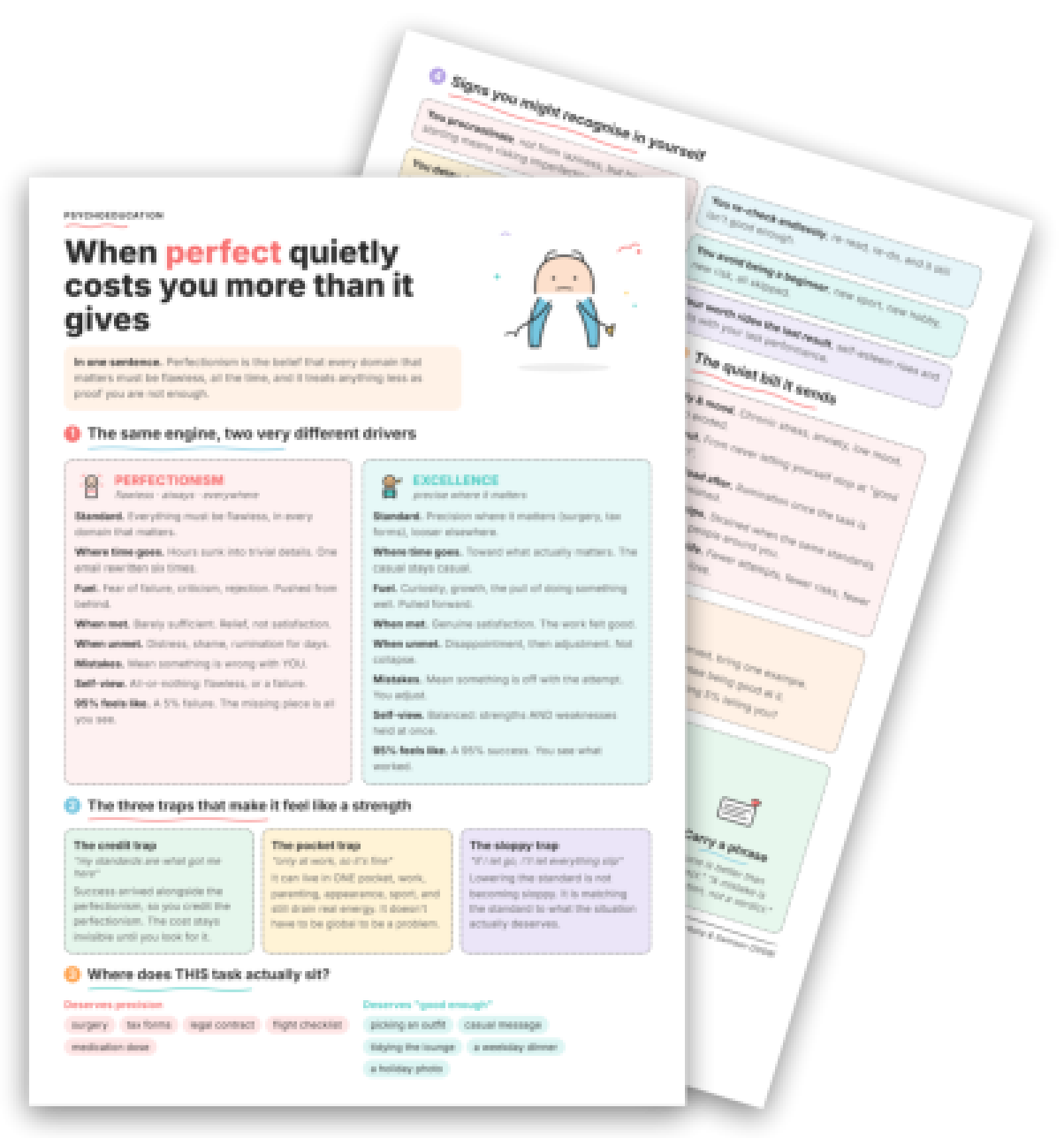
A printable PDF fiche clinicians can use as a visual psychoeducation support to explain perfectionism in session, distinguish it from healthy striving, and map its real costs.
Clinical vignettes
The Credit Trap in a High-Achieving Client
Perfectionism Contained to One Domain
Clinical picture. A., a 45-year-old primary school teacher, sought help for anxiety she described as confined to her professional life, noting she felt relaxed at home and saw no reason to question her overall functioning. During psychoeducation, the clinician used the "pocket trap" section of the sheet to explore whether a domain-specific pattern could still carry a significant cost. A. recognised that lesson preparation regularly extended past midnight and that any critical comment from a parent triggered several days of rumination. She had not connected this to perfectionism precisely because it did not feel global. Naming the pocket trap gave her a more accurate framework and opened a conversation about proportionate investment across different areas of her work.
Explaining perfectionism verbally in session tends to hit a wall: patients with high standards rarely recognise themselves in the word, because the word itself sounds like a flaw they do not believe they have. This fiche PDF gives you a visual structure to do the conceptual work more efficiently, placing the comparison right in front of the patient rather than inside a monologue.
Use this resource with your patients
Handout, exercises and materials ready to use, right inside SessionFuel.
Why Perfectionism Resists the Oral Explanation
The central clinical difficulty is that perfectionism genuinely looks like a strength from the inside. Patients credit their standards for real achievements, resist any suggestion that loosening them means "becoming sloppy," and experience their checking and re-doing as conscientious professionalism, not pathology. The fiche names this directly: it identifies three distinct cognitive traps, the credit trap, the pocket trap, and the sloppy trap, that explain why the pattern persists even when its costs are visible.
A second sticking point is all-or-nothing thinking. The fiche captures it with a single line most patients find arresting: "95% feels like a 5% failure. The missing piece is all you see." Saying that in words is rarely enough. Seeing it laid out next to a contrasting column tends to land differently. For patients already working on all-or-nothing cognitive distortions or on the Unrelenting Standards schema, the visual anchors the work they are already doing.
What the Fiche Contains
The printable is organised into six numbered sections, each short enough to scan in session without breaking conversational flow.
- Section 1 presents a side-by-side comparison of perfectionism and excellence across seven dimensions: the standard itself, where time goes, what fuels the behaviour, how meeting or missing the standard feels, how mistakes are interpreted, and how the self is evaluated. The contrast makes visible what oral psychoeducation often cannot: that the mechanism, not the ambition, is the problem.
- Section 2 names the three traps that make perfectionism feel adaptive.
- Section 3 offers a concrete task-sorting exercise: two columns of real-life examples sorted by whether they deserve precision (surgery, tax forms, legal contracts) or deserve "good enough" (picking an outfit, a weekday dinner, a casual message). This is the practical anchor for evaluating demanding standards in behavioural experiments.
- Sections 4 and 5 list behavioural signs, including procrastination rooted in fear of imperfection, avoidance of beginner experiences, and decision paralysis, alongside what a normal week actually looks like under the pattern.
- Section 6 maps the cumulative costs: chronic stress, burnout risk, post-task rumination, relational strain, and a progressively shrinking life. This links naturally to work you may already be doing with burnout presentations or low self-esteem.
- A closing "To discuss in session" block gives the patient three specific prompts to bring back next appointment.
> Key point: the fiche is a visual psychoeducation support you use with the patient in session, not a self-report questionnaire they complete alone. Its value is in making the perfectionism-versus-excellence distinction legible at a glance and leaving the patient a concrete reference between appointments.
Clinical library
750+ clinical tools
A library built with and for clinicians, ready to use in session and extend between appointments.
Access all the toolsSeveral resource types
Psychoeducation handouts
Understand at a glance
Interactive exercises
To do and fill in
Interactive programs
A structured path
Audios
Meditation and relaxation
Psychometric tests
Automatic scoring
When and How to Introduce It
The fiche fits naturally from the second or third session onward, once the formulation is taking shape. It is particularly well-suited to patients who present with high-functioning exhaustion, perfectionistic procrastination, or the kind of imposter syndrome that rests on an unacknowledged fear of being exposed as less than flawless.
A low-threshold introduction: "I'd like to show you something that might reflect what you've been describing. Tell me what stands out." That framing invites the patient to identify with specific cells in the comparison table rather than accepting a diagnostic label.
For the debrief, the three-trap section is a productive entry point: ask which trap feels most familiar, and whether the sloppy trap has been an active obstacle to reducing standards in lower-stakes situations. If the patient is already in CBT for clinical perfectionism or working through the Cognitive Behavioral Model of Perfectionism, the fiche consolidates the psychoeducational groundwork before you move into behavioural experiments. For those earlier in treatment, pair it with the Perfectionism Self-Reflection exercise to extend the work between sessions.
One contraindication worth noting: patients in an acute shame or self-critical state may read Section 6's cost list as further evidence of personal failure. In those cases, consider delaying the fiche until a degree of self-compassion scaffolding is in place, or introduce it selectively, starting with Sections 1 and 3 only.
The fiche does not replace the formulation or the exposure work; it makes the concept precise enough for the patient to start applying it to their own week.
Use it with your patients
Share this tool in the mobile app and follow the work between sessions.
Sources
- Frost, R. O., Marten, P., Lahart, C., & Rosenblate, R. (1990). The dimensions of perfectionism. Cognitive Therapy and Research.
- Shafran, R., Egan, S., & Wade, T. (2010). Overcoming Perfectionism: A self-help guide using cognitive-behavioural techniques. Robinson.
- Brown, B. (2010). The Gifts of Imperfection: Let Go of Who You Think You're Supposed to Be and Embrace Who You Are. Hazelden.
Patient mobile app
Your session continues in your patients' pocket
Use with a patientYour resources, available everywhere
The handouts, exercises, programs and audios above: you choose which ones to make available to your patients, in the mobile app dedicated to them.
Psychoeducation handoutsInteractive exercisesInteractive programsAudiosPsychometric tests
And far more than a library
The app goes well beyond resources, to support your patients every day:
Standardized tests
Therapy journal
Gamification
Wellbeing challenges
Introspection prompts
Therapist homework
Related categories
Explore other clinical resources by category.

Identity
Clinical resources for self-identity work in therapy: CBT, ACT, schema tools for clinicians addressing self-concept, core beliefs, and identity disruption.

Behaviours
Clinical hub for behaviors in therapy: worksheets and tools for coping, eating disorders, CBT formulation, and maladaptive behavioral patterns.

Cognition
Printable cognitive therapy worksheets and clinical tools for therapists: CBT, ACT, schema work, defusion, distortions, and belief restructuring.

Understand
Clinical hub for the therapeutic aim 'Understand': worksheets and tools to build patient insight across CBT, ACT, schema therapy and more.

Build awareness
Clinical worksheets and tools to build awareness in therapy: cognitive distortions, schemas, emotions, ACT and CBT resources for practitioners.

CBT
CBT worksheets, cognitive restructuring exercises & behavioral tools for clinicians. Evidence-based resources for every phase of cognitive behavioral therapy.