
Clinical picture. T., a man in his early 40s, presented with a moderate depressive episode and marked behavioral withdrawal; he had not exercised in over a year and described several failed attempts to restart a daily walk. The clinician introduced the Habit Breakdown worksheet, and together they identified that his self-assigned step one, "walk 30 minutes after dinner," was already step five on the ladder. They renegotiated his daily target to a single visible action: changing into his trainers after the evening meal, nothing more. Over the following two weeks T. reported completing this seed step reliably on most evenings, and on roughly half of those occasions he continued out the door for a short walk without it being required. When the seed felt automatic, they collaboratively moved the target to one block, leaving the 30-minute goal explicitly labeled as a future endpoint rather than a current obligation.
Habit Breakdown: PDF Worksheet, Tools and Exercises for Clinical Practice
A printable PDF built around a five-step ladder and the two-minute rule, giving clinicians a concrete visual tool to explain behavioral habit formation in session.
Clinical vignettes
Rebuilding Movement After Depression
Sleep Routine in Chronic Anxiety
Clinical picture. A., a woman in her late 20s with generalized anxiety disorder, reported persistent sleep-onset difficulties and a habitual pattern of screen use until midnight or later. Previous psychoeducation about sleep hygiene had not translated into behavior change; she described the full recommended routine as "overwhelming to even think about on a bad day." Using the Habit Breakdown worksheet, the clinician helped her place "be home and settled by 10 PM" as the seed, anchored to her existing habit of finishing a podcast episode on the commute. No further steps were assigned as daily targets. After three weeks A. noted the anchor was holding consistently, and she chose on her own to add toothbrushing and a brief shower as a next step, which she framed as finally feeling possible rather than pressured.
When patients describe failed habit attempts, the obstacle is almost never motivation. It's that step one was never small enough. Yet explaining this verbally, while the patient nods and then goes home to plan a 5 km morning run starting Monday, is a familiar frustration. This fiche PDF gives you a structured visual to make the argument stick in session rather than dissolve on the commute home.
Use this resource with your patients
Handout, exercises and materials ready to use, right inside SessionFuel.
Why Habit Formation Resists a Verbal Explanation
The core problem in consultation is that patients conflate ambition with a viable plan. When you explain graded commitment orally, the concept lands abstractly. They hear "start small" and translate it as "start slightly smaller than my original target." The cognitive error underneath this is well-documented: the all-or-nothing thinking pattern that frames a reduced step as failure before it has even begun.
Without a printed reference, three distinctions collapse during the week. Patients miss the difference between a daily target (step 1, and only step 1) and bonus behaviors (steps 2 to 5). They confuse a visible action with a motivational state as a starting point. And they fail to notice that raising the daily floor on a good day is a design error, not a sign of progress. A visual holds these distinctions in place between sessions in a way that no verbal summary reliably can.
750+ clinical tools
A library built with and for clinicians, ready to use in session and extend between appointments.
Access all the toolsInside the Fiche: a Five-Step Visual Scaffold
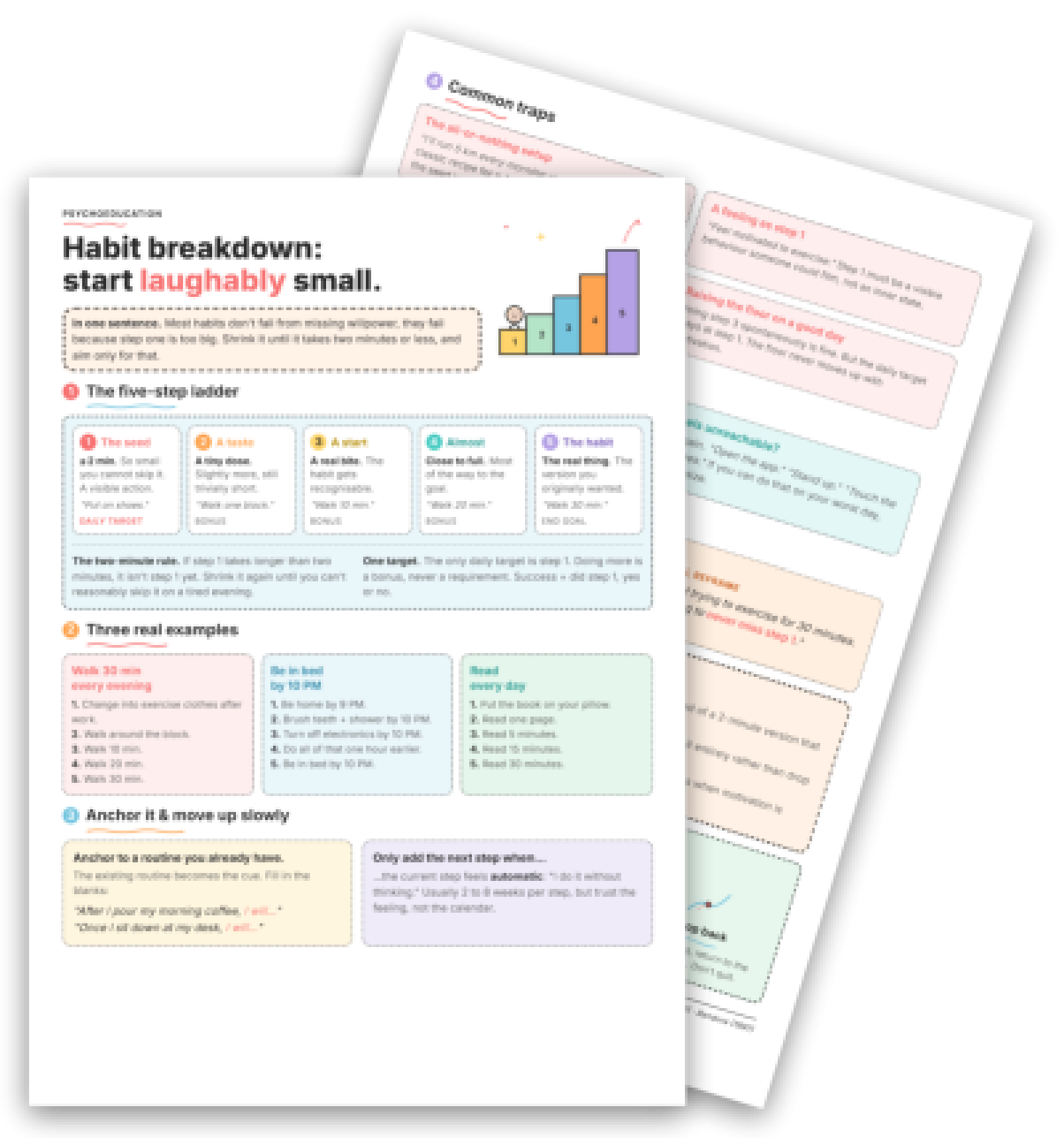
The fiche opens with a one-sentence psychoeducation frame: "Most habits don't fail from missing willpower, they fail because step one is too big." That reframe alone shifts the conversation from character to behavioral design, which changes what the patient feels responsible for fixing.
The visual centerpiece is the five-step ladder, moving from The seed (capped at 2 minutes, illustrated as "Put on shoes") through four intermediate rungs to The habit (the original goal). Each rung is labeled explicitly: DAILY TARGET for step 1 only, BONUS for steps 2 to 4, END GOAL for step 5. The hierarchy is impossible to miss on the page.
Three fully worked examples (a 30-minute evening walk, a 10 PM bedtime routine, and daily reading) show the complete ladder from first rung to final goal. Seeing "Change into exercise clothes after work" as step 1 of a 30-minute walking habit is more persuasive than any verbal description you can offer mid-session.
A dedicated anchoring panel prompts patients to hook the new behavior to an existing routine, with fill-in-the-blank cues: "After I pour my morning coffee, I will..." This operationalizes implementation intention logic without requiring the patient to engage with the research behind it.
The common traps section names four failure modes explicitly: the all-or-nothing setup, using a feeling rather than a visible behavior as step 1, skipping ahead because a rung feels too easy, and raising the daily floor after a successful run. Having these printed makes it easier to revisit them without reintroducing the concept from scratch in follow-up sessions. The "When it breaks down" and "To discuss in session" panels give you natural re-entry points across the care episode.
> To retain: the fiche is a visual support that facilitates the explanation of habit formation in session. It is not a self-monitoring diary the patient fills in alone, but a shared reference you use to make a complex behavioral concept tangible and to leave the patient a concrete anchor between appointments.
Use it with your patients
Share this tool in the mobile app and follow the work between sessions.
When and How to Propose It in Session
The fiche fits naturally at the transition from psychoeducation into behavioral work, whether you are operating within a CBT frame, running behavioral activation for depression, or addressing avoidance in the context of a procrastination-focused intervention. It pairs well with goal-setting and behavior change work and integrates smoothly after a current activity inventory.
Particularly suitable profiles include patients with prominent perfectionism (where the all-or-nothing trap is most active), those presenting with anhedonia in a weekly activity planning context, and patients rebuilding daily structure after burnout. For patients in acute destabilization, establishing baseline stability comes first: the ladder requires enough executive function to execute step 1 reliably.
To introduce it, you can say: "I want to show you a framework that explains why most habit attempts break down, and how to design one that holds even on a tired evening." Build step 1 together in session for the patient's specific target behavior, and encourage them to keep the fiche somewhere visible. A growth mindset frame can be a useful companion for patients who struggle to value a two-minute daily win as genuine progress.
At the next appointment, the debrief is short: Was step 1 done? Was it genuinely two minutes or less? Did the patient raise the floor after a good day? The fiche's shared vocabulary ("seed," "floor," "bonus") tightens that check-in considerably. The fiche does not replace the therapeutic frame; it makes one well-established behavioral principle clear enough to actually use.
Your session continues in your patients' pocket
Use with a patientYour resources, available everywhere
The handouts, exercises, programs and audios above: you choose which ones to make available to your patients, in the mobile app dedicated to them.
And far more than a library
The app goes well beyond resources, to support your patients every day:
Related categories
Explore other clinical resources by category.

Emotions
Clinical resources on emotion regulation: worksheets, coping tools, CBT, REBT, and ACT exercises for therapists working across diagnoses and age groups.

Behaviours
Clinical hub for behaviors in therapy: worksheets and tools for coping, eating disorders, CBT formulation, and maladaptive behavioral patterns.

Build skills
Skill-building resources for clinicians: printable worksheets and exercises for coping, assertiveness, and communication skills training in therapy.

Engage & motivate
Clinical hub: printable worksheets and exercises to build therapeutic engagement and motivation across ACT, CBT, and integrative practice. For clinicians.

CBT
CBT worksheets, cognitive restructuring exercises & behavioral tools for clinicians. Evidence-based resources for every phase of cognitive behavioral therapy.

Anxiety
Clinical hub for anxiety disorders: CBT and ACT worksheets, psychoeducation sheets, and exercises for assessment and treatment across the anxiety spectrum.