
Clinical picture. M., a 28-year-old referred after a third crisis presentation, arrived at the initial DBT orientation session visibly guarded, stating she had "tried therapy before and it never helped." The clinician introduced the core dialectic using the worksheet, framing her longstanding pattern of self-injury not as a character deficit but as a survival strategy that had outlived its function. M. paused at the phrase "you are doing the best you can AND you need to do better," and said it was the first time a therapeutic model had not felt like an accusation. By the end of the session she agreed to attend the skills group for a four-week trial, which represented her first sustained engagement with outpatient treatment in two years.
Dialectical Behavior Therapy (DBT): PDF Worksheet, Tools and Exercises
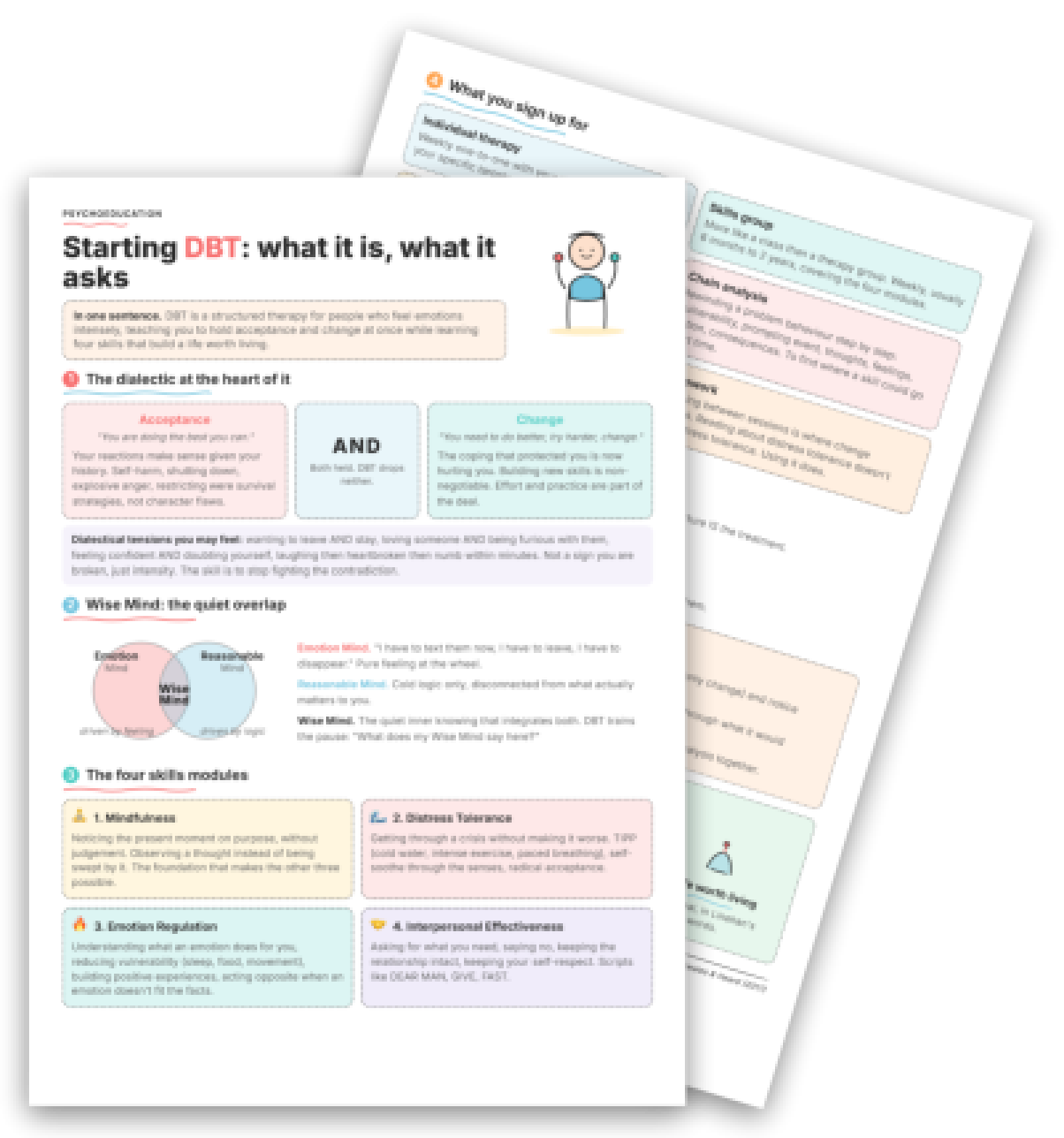
A printable psychoeducation fiche presenting DBT's acceptance-change dialectic, Wise Mind, and four skills modules as a visual in-session explanation tool for clinicians.
Clinical vignettes
Introducing the Dialectic to a Skeptical Patient
Using Wise Mind to Anchor a Skills Introduction
Clinical picture. T., a 34-year-old with a longstanding pattern of intense emotional dysregulation and repeated relationship ruptures, had difficulty engaging with skills-based work, describing it as "too mechanical." The clinician used the informational sheet to map Emotion Mind and Reasonable Mind as two familiar states T. could readily identify from recent examples, then introduced Wise Mind as the integration point rather than a compromise. T. recognized Wise Mind as something he had occasionally accessed when calm, which reframed the skill as cultivating an existing capacity rather than acquiring something foreign. Subsequent sessions showed improved willingness to attempt distress tolerance techniques, with T. explicitly referencing Wise Mind as a check before acting on urges.
Introducing Dialectical Behavior Therapy verbally, in the opening sessions, rarely produces the clarity the patient needs before committing to the program. The scope is wide, the dialectic is philosophically counterintuitive, and the structural demands (skills group, diary card, phone coaching, homework) can read as a wall of obligations without an organizing frame. This fiche PDF gives clinicians a single visual anchor to explain what DBT is and what it will actually ask of the patient, before the skills work begins.
Use this resource with your patients
Handout, exercises and materials ready to use, right inside SessionFuel.
Why DBT Resists a Simple Verbal Introduction
The core difficulty is structural. DBT is not one thing: it combines a theoretical framework, four distinct skills modules, and a multimodal delivery format. Trying to explain all of that verbally, while simultaneously building the therapeutic alliance, typically produces the same outcome. The patient hears "acceptance AND change" without genuinely holding the tension, and leaves unclear about what the coming months will require.
The acceptance-change dialectic is, in Linehan's formulation, not a compromise between two poles. It is a simultaneous holding of two opposing truths. Patients with marked emotional dysregulation tend to gravitate hard toward one side, either seeking validation to the exclusion of behavioral work, or collapsing into willpower-based change and dismissing their own emotional reality. Naming that pull verbally is one thing. Showing both sides in print, with neither subordinated to the other, changes how the patient processes the concept.
The Wise Mind construct creates a similar sticking point. Without a diagram placing Emotion Mind and Reasonable Mind as genuinely overlapping rather than simply balanced, patients frequently collapse Wise Mind into "calm, rational thinking," which misses the integrative logic entirely.
What the Fiche Contains, and What the Visual Layout Actually Shows
The fiche PDF is organized into five numbered panels, each targeting a different entry point into the model.
Panel 1 presents the dialectic as a visible AND structure: acceptance ("You are doing the best you can") placed alongside change ("You need to do better, try harder, change"), with both held explicitly rather than resolved. The layout makes it much harder for patients to flatten the tension into one side, since they can see the two poles sitting side by side on the page.
Panel 2 shows Wise Mind spatially, as the overlap between Emotion Mind and Reasonable Mind. Panel 3 maps the four skills modules with a brief functional description of each: DBT Mindfulness What & How Skills, Distress Tolerance, Emotion Regulation, and Interpersonal Effectiveness including scripts like DEAR MAN.
Panel 4 covers the structural components of full DBT: individual therapy, skills group, diary card, chain analysis, phone coaching, and between-session homework. Panel 5 addresses common patient worries directly, including "What if I miss a skill or fail the diary card?", which proactively addresses dropout-related anxiety before it surfaces. The fiche closes with a four-term summary: AND, Wise Mind, four skills, and Linehan's phrase "a life worth living," giving patients a compact reference to consult between sessions.
> Key takeaway: This fiche PDF is a visual support that facilitates the explanation of DBT in session. It is not an intake questionnaire the patient completes independently; it is a psychoeducation tool the clinician works through together with the patient, building a shared vocabulary before the first skills module opens.
Clinical library
750+ clinical tools
A library built with and for clinicians, ready to use in session and extend between appointments.
Access all the toolsSeveral resource types
Psychoeducation handouts
Understand at a glance
Interactive exercises
To do and fill in
Interactive programs
A structured path
Audios
Meditation and relaxation
Psychometric tests
Automatic scoring
When and How to Propose It
The fiche fits best at the start of DBT engagement, after initial assessment and before the patient commits to the full program structure. It answers the question most patients are already carrying: what exactly am I signing up for?
A natural introduction might be: "Before we get into the skills work, I'd like to walk through this sheet with you so we're using the same language from the start." That positions the fiche as collaborative orientation, not assigned reading.
For patients presenting with borderline personality disorder, recurrent self-harm, or severe emotional dysregulation (see Personality Disorders DSM-5 criteria), the fiche also clarifies why radical acceptance and behavioral change coexist rather than contradict. For patients with prior exposure to CBT or ACT, it shows where DBT shares ground and where it diverges, reducing conceptual confusion early.
Debrief by asking which side of the dialectic the patient found easier to accept, and where resistance showed up. That response almost always maps directly onto the patient's primary maintaining pattern. As specific skills are introduced, the dedicated fiches for TIPP skills and ACCEPTS distress tolerance extend the work naturally.
The fiche does not replace the therapeutic frame; it makes the entry point into DBT concrete and leaves the patient with a visual reference they can actually use between sessions.
Use it with your patients
Share this tool in the mobile app and follow the work between sessions.
Sources
- Linehan, M. M. (1993). Cognitive-Behavioral Treatment of Borderline Personality Disorder. Guilford Press.
- Linehan, M. M. (2015). DBT Skills Training Manual, Second Edition. Guilford Press.
- National Institute for Health and Care Excellence (NICE) (2009). Borderline Personality Disorder: Recognition and Management (CG78) - Recommendations.
Patient mobile app
Your session continues in your patients' pocket
Use with a patientYour resources, available everywhere
The handouts, exercises, programs and audios above: you choose which ones to make available to your patients, in the mobile app dedicated to them.
Psychoeducation handoutsInteractive exercisesInteractive programsAudiosPsychometric tests
And far more than a library
The app goes well beyond resources, to support your patients every day:
Standardized tests
Therapy journal
Gamification
Wellbeing challenges
Introspection prompts
Therapist homework
Related categories
Explore other clinical resources by category.

Emotions
Clinical resources on emotion regulation: worksheets, coping tools, CBT, REBT, and ACT exercises for therapists working across diagnoses and age groups.

Behaviours
Clinical hub for behaviors in therapy: worksheets and tools for coping, eating disorders, CBT formulation, and maladaptive behavioral patterns.

Understand
Clinical hub for the therapeutic aim 'Understand': worksheets and tools to build patient insight across CBT, ACT, schema therapy and more.

CBT
CBT worksheets, cognitive restructuring exercises & behavioral tools for clinicians. Evidence-based resources for every phase of cognitive behavioral therapy.

DBT
DBT worksheets and exercises for clinicians: distress tolerance, emotion regulation, and interpersonal skills tools for dialectical behavior therapy practice.

Mindfulness (MBSR/MBCT)
Clinical hub for MBSR and MBCT resources: guided audios, body scans, psychoeducation programmes, and mindfulness exercises for practitioner use in session.