
Clinical picture. A., a 34-year-old administrative worker, presented with longstanding anxiety that had progressively narrowed her daily routines; she had declined two work events in the preceding month and attributed this to fatigue rather than fear. The clinician introduced the first lesson of the Fighting Anxiety program and asked her to complete it before the next appointment, paying particular attention to the self-assessment steps on avoidance behaviors. At the following session, A. reported that naming her avoidance patterns in the guided prompts had been clarifying: she had not previously connected her social withdrawal to anxiety, and had instead framed it as a personality trait. This reframe opened a productive discussion about the maintaining role of avoidance, which became the focus of subsequent work.
Combating Anxiety: A Structured Psychoeducation Program
A 4-lesson autonomous program helping patients understand anxiety's origins, avoidance loops, and recovery principles, step by step.
Clinical vignettes
Psychoeducation Reframes Avoidance Pattern
Symptom Checklist Reduces Self-Blame
Clinical picture. M., a 51-year-old teacher, had consulted repeatedly for chest tightness and gastrointestinal discomfort; prior medical workup was unremarkable, and he carried a degree of shame about what he called his "weakness." The clinician assigned the first lesson of the program as structured reading between sessions, drawing M.'s attention to the steps explaining the physiological basis of anxiety symptoms. M. returned having ticked several items on the symptom checklist and, notably, appeared less self-critical: learning that palpitations and abdominal pain are consistent features of the fear response, rather than signs of personal failing, reduced his avoidance of discussing the problem. The clinician used this shift in self-attribution as a foundation for introducing the subsequent lessons.
Use this resource with your patients
Handout, exercises and materials ready to use, right inside SessionFuel.
What makes anxiety so hard to explain in words alone
Anxiety is one of the most prevalent presentations in clinical practice, yet it consistently resists the kind of understanding that changes behavior. You can explain the fight-flight-freeze response clearly, map the cycle of avoidance on a whiteboard, describe how safety behaviors maintain fear, and still, your patient leaves the consultation without the embodied sense that any of this applies to them. What is missing is not information, but personal recognition: the moment a patient connects the clinical model to their own symptoms, their own childhood, their own shrinking world.
This is precisely the gap a structured, self-paced psychoeducation program can fill. When patients work through material on their own, answer questions about their specific avoidances, and reflect on what they are willing to change, the concepts stop being abstract. They become personal clinical data your patient brings back to the next session.

750+ clinical tools
A library built with and for clinicians, ready to use in session and extend between appointments.
Access all the toolsWhat this program contains
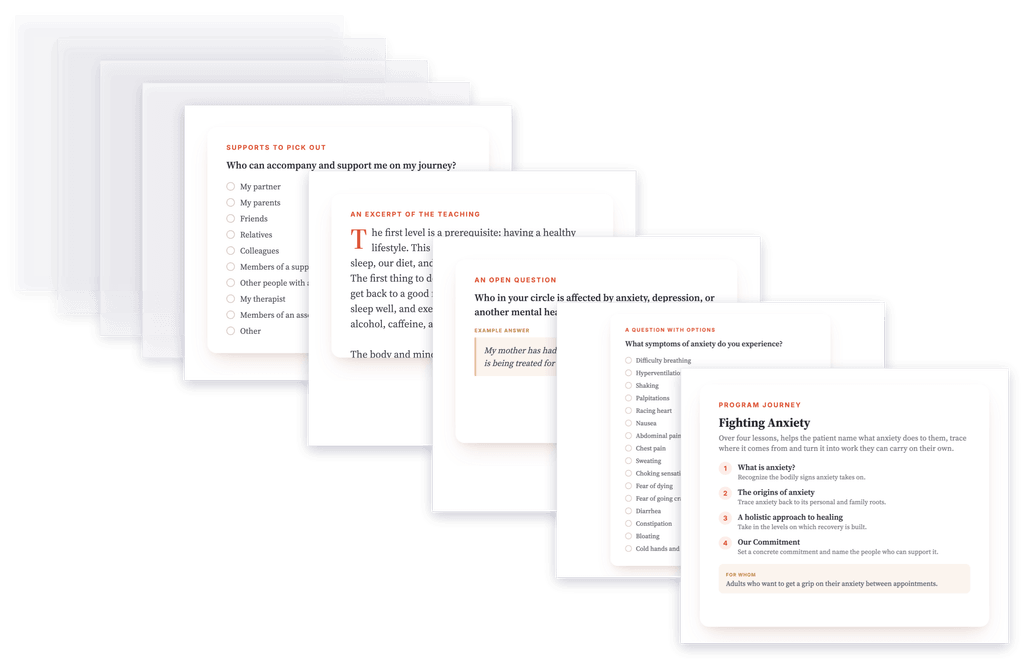
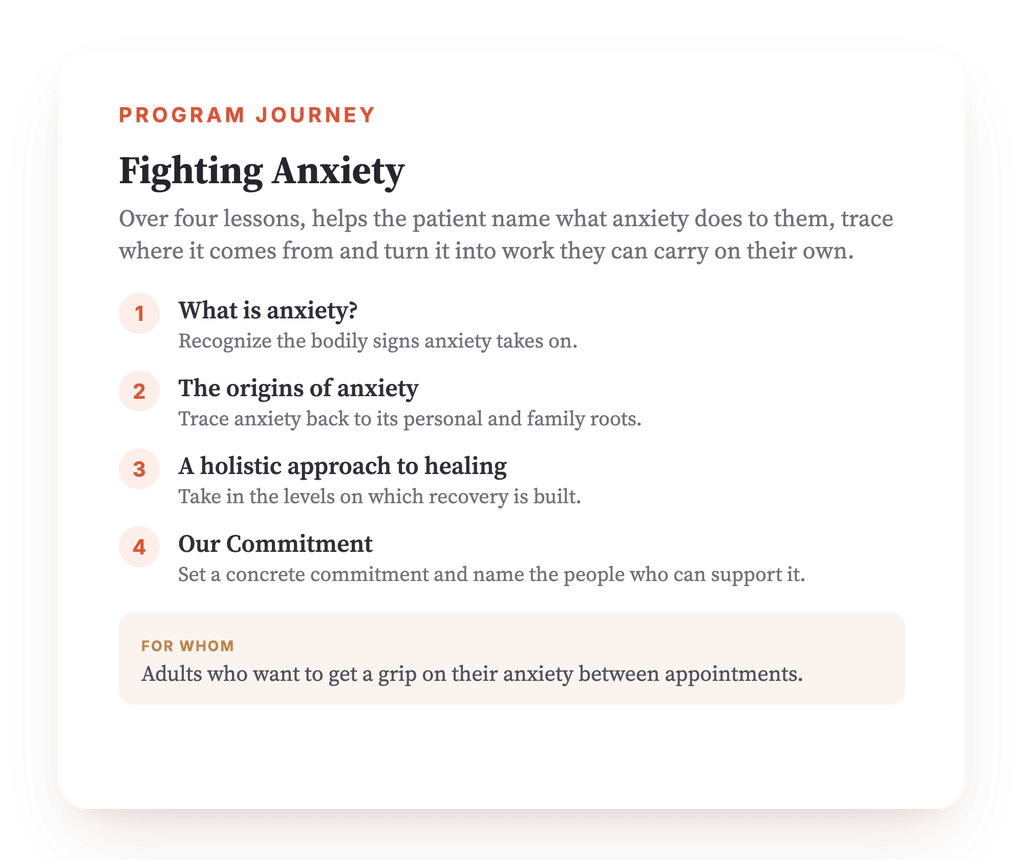
Fighting Anxiety is a 4-lesson psychoeducation curriculum that walks patients through a complete arc of understanding and commitment, step by step.
Lesson 1 opens by distinguishing anxiety from ordinary fear, covering the physiological symptom picture, the avoidance mechanism, and the social isolation that follows, with multiple-choice prompts that ask patients to identify their own symptoms, their own avoided situations, and the impact on their social life.
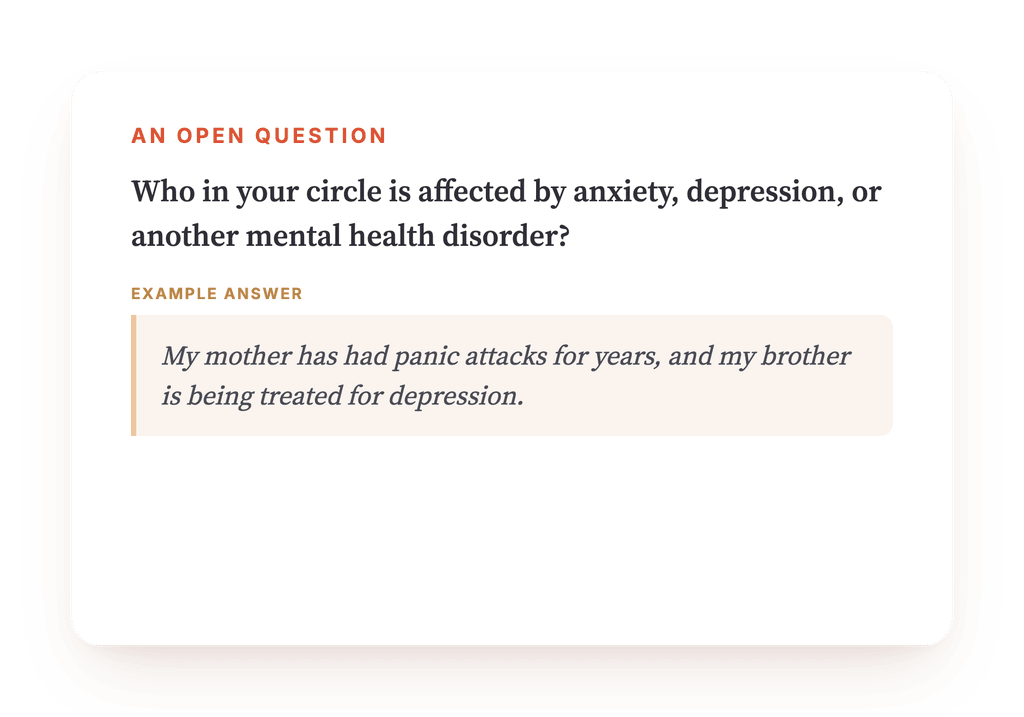
Lesson 2 turns to origins: hereditary predisposition, the role of early environment (growing up in a climate of perceived danger, under criticism, with suppressed emotional expression), and life events that can tip a vulnerable person into a full anxiety disorder. Open prompts ask patients to reflect on family history and on the link they perceive between their childhood and their current state. This material naturally prepares deeper work on how the past affects the present and on core beliefs that sustain fear.
Lesson 3 introduces a holistic recovery model: sleep, nutrition, and physical activity as a necessary foundation; emotional awareness and the cost of suppression; the role of cognitive distortions and maladaptive beliefs in feeding anxiety; and, crucially, the first steps toward confronting rather than avoiding feared situations. This lesson lays the conceptual groundwork for later exposure work and connects naturally to the comfort, stretch, and panic zones framework.
Lesson 4 addresses the psychology of commitment: relinquishing blame without relinquishing responsibility, identifying sources of social support, setting a first small win, and making a concrete personal engagement with recovery. It prepares patients for the non-linear path ahead, which pairs well with a stages of change conversation in session.
This program is available to patients through the mobile application that is the dedicated patient-side interface of SessionFuel: once you assign it in your SessionFuel account, your patient receives it directly on their phone and works through each lesson independently, at their own pace.
The preview images included here, an overview map and a few sample cards, show only a small fraction of the program. The complete curriculum contains many more lesson steps, multiple-choice questions, open reflective prompts, and psychoeducation texts than what these excerpts can convey.
Key insight: The program's value is not simply informational, it is the patient's own answers across the four lessons that become clinical material: what they avoid, what they believe about their past, and what they are willing to risk.
Use it with your patients
Share this tool in the mobile app and follow the work between sessions.
How to assign it and use what comes back
This program is designed as autonomous between-session homework. You assign it after an initial psychoeducation conversation, ideally once the patient understands the basic anxiety model, perhaps with support from a fiche like Understanding Anxiety or the generalized anxiety disorder worksheet.
It suits a broad range of profiles: patients presenting with GAD, social anxiety, specific phobias, panic disorder, or a more diffuse anxious picture that has not yet been formally labeled. It is particularly useful with patients who intellectualize well in session but struggle to connect theory to their daily experience, and with those who find it easier to reflect in writing than to speak spontaneously.
Introduce it simply: "Between now and our next appointment, I'd like you to work through the first two lessons at your own pace. There are no right answers, I'm more interested in what comes up for you." At the next session, open with their responses: which symptoms they checked, which childhood influences they recognized, which avoidances surprised them. This material directly feeds the collaborative case conceptualization, whether you are building an exposure hierarchy, exploring intolerance of uncertainty, or working with the inner dialogue that sustains anxious anticipation. The program can also serve as a bridge toward more targeted work, for example, the Anxiety and Limiting Beliefs curriculum or Automatic Behaviors for patients whose avoidance and control loops have become entrenched.

Your session continues in your patients' pocket
Use with a patientYour resources, available everywhere
The handouts, exercises, programs and audios above: you choose which ones to make available to your patients, in the mobile app dedicated to them.
And far more than a library
The app goes well beyond resources, to support your patients every day:
Related categories
Explore other clinical resources by category.

Anxiety
Clinical hub for anxiety disorders: CBT and ACT worksheets, psychoeducation sheets, and exercises for assessment and treatment across the anxiety spectrum.

Cognition
Printable cognitive therapy worksheets and clinical tools for therapists: CBT, ACT, schema work, defusion, distortions, and belief restructuring.

Integrative
Integrative therapy clinical resources: worksheets, psychoeducation programs, and exercises for eclectic, multimodal practice across orientations.

Trauma
Clinical hub on trauma and PTSD: assessment, differential diagnosis, treatment phases, and printable resources for practitioners. 155 chars.

Mood
Evidence-based worksheets and clinical tools for mood disorders: CBT, ACT, and positive psychology resources for psychologists and therapists.

Identity
Clinical resources for self-identity work in therapy: CBT, ACT, schema tools for clinicians addressing self-concept, core beliefs, and identity disruption.