
CBT: Printable Clinical Resources for Cognitive Behavioral Practice
Cognitive behavioral therapy (CBT), the most empirically validated short-term psychotherapeutic approach in contemporary clinical psychology, encompasses a broad family of techniques targeting the reciprocal relationships among cognitions, emotions, and behaviors. This page is designed for clinicians who apply CBT principles across individual, couples, or group formats and are looking for ready-to-use worksheets, structured exercises, and psychoeducation tools. The resources gathered here span the full arc of a CBT care plan: from initial psychoeducation and cognitive restructuring to behavioral activation, schema work, and relapse prevention. Each tool has been developed with session integration in mind, meaning it is meant to be used with the client, not simply handed out.

The Cognitive Model at the Core of CBT
The central premise of cognitive behavioral therapy is that psychological distress is maintained, if not generated, by systematic errors in information processing. Aaron Beck's cognitive model postulates three levels of cognition: automatic thoughts, intermediate beliefs (rules, assumptions, attitudes), and core beliefs (global, rigid schemas about the self, others, and the world). CBT interventions target all three levels, typically moving from the surface toward the deeper schema layer as therapy progresses.
Rational Emotive Behavior Therapy (REBT), Albert Ellis's variant, introduces the ABC model as a pedagogical and clinical lever: the Activating event, the Belief, and the emotional-behavioral Consequence. This framework is particularly useful early in treatment to help clients recognize that events do not directly cause distress; beliefs do. The ABC Model (REBT): PDF Worksheet, Tools and Exercises for Clinical Practice operationalizes this distinction in a format that transfers directly to homework assignments.
Cognitive Distortions as Therapeutic Targets
Cognitive distortions are the specific, identifiable thinking errors that sustain emotional dysfunction. Cataloguing them with the client builds metacognitive awareness and creates a shared clinical language. Several distortions warrant dedicated intervention time:
- All-or-nothing thinking (dichotomous thinking): the tendency to evaluate experiences in absolute, binary categories. The All-or-Nothing Thinking: PDF Worksheet, Tools and Exercises for Clinical Practice supports structured Socratic questioning around this pattern.
- Catastrophizing: amplifying the probability or severity of negative outcomes. Work on this distortion is supported by the Decatastrophizing: PDF Worksheet, Tools and Exercises for Clinical Practice and the Fortune-Telling Bias: Challenge Catastrophic Predictions.
- Mind reading: inferring negative intentions or judgments without evidence. The Mind Reading: PDF Worksheet, Tools and Exercises for Clinical Practice isolates this distortion for targeted disputation.
- Overgeneralization: drawing sweeping conclusions from isolated events, often expressed as "always" or "never" statements. The Overgeneralization in CBT: Challenging Always and Never Thinking provides a structured reappraisal sequence.
- Global judgments: wholesale negative evaluations of self or others that fuel shame and rage. The Dismantling Global Judgments That Drive Emotional Distress targets this pattern directly.
Cognitive Restructuring: Techniques and Session Tools
From Identification to Disputation
Cognitive restructuring is the cornerstone technique of CBT: the clinician guides the client to identify automatic thoughts, evaluate the evidence for and against them, and construct more balanced, functional alternatives. The process is iterative and requires repeated practice both in session and between sessions. A useful entry point is the Cognitive Restructuring: A Guided Exercise for Negative Thoughts, which walks through the standard thought record protocol in a clinician-facilitated format.
For clients caught in rumination cycles, simple restructuring may be insufficient; the loop itself needs interrupting before content can be examined. The Rumination Guided Exercise: Interrupting Negative Thought Loops addresses the process dimension of ruminative thinking, helping clients develop meta-level strategies to disengage.
Working With Core Beliefs and Schemas
Once surface cognitions are addressed with some stability, schema-level work becomes the focus of mid-to-late phase CBT. Core beliefs are typically absolute, global, and highly resistant to change because they are confirmed by cognitive bias rather than tested against reality. The Exploring Core Beliefs About Self, Others, and the World provides a structured map for identifying the dominant schemas operating across life domains.
The clinical sequence for schema modification generally runs:
- Identify and name the core belief with the client.
- Trace its developmental origins and current maintaining factors.
- Evaluate the evidence using the Clarifying Core Beliefs: A Structured Clinical Exercise.
- Construct an alternative, more adaptive belief.
- Support the transition with the Replacing a Negative Belief: A Structured Clinical Exercise.
- Consolidate the new belief over subsequent weeks using the Reinforcing a New Core Belief: A Guided Clinical Exercise.
This sequenced approach reduces the risk of premature belief change attempts that collapse under emotional pressure.
Behavioral Activation and Activity Scheduling
Targeting Avoidance and Withdrawal
Behavioral activation (BA) is an empirically supported component of CBT for depression, proceeding from the observation that withdrawal and avoidance maintain and deepen low mood by severing the client from sources of positive reinforcement. The first step is establishing a behavioral baseline. The My Current Inventory: A Clinical Time-Use Baseline Tool maps the client's current activity patterns before any scheduling intervention is introduced.
Avoidance is not merely a symptom; it is a maintaining mechanism. The Avoidance in Depression: A Guided Exercise for Clinicians helps the clinician and client identify specific avoidance patterns and their short- versus long-term function. Once avoidance is mapped, structured scheduling can begin with the Weekly Activity Planning Exercise for Depression in Session.
Monitoring Progress and Reinforcing Change
Tracking behavioral change over time serves both a motivational and a clinical assessment function. The Weekly Self-Review Exercise for Behavioral Activation provides a structured self-monitoring format that can anchor the opening of each session during the BA phase. When progress is slow or the client undervalues gains, the Celebrating Progress in Depression: A Guided Exercise redirects attention toward incremental change, counteracting the negative attentional bias characteristic of depressive episodes.
> Clinical vignette: A 38-year-old client with recurrent major depression reported that nothing had changed after three weeks of activity scheduling. Reviewing her completed Weekly Self-Review Exercise for Behavioral Activation in session revealed a consistent increase in time spent outside the home and two instances of spontaneous social contact she had not mentioned verbally. Using the progress-review exercise shifted her attributional framing from "therapy isn't working" to "I am doing this, and it is affecting my behavior even when I don't feel it yet."
Emotion Regulation Within a CBT Framework
Differentiating Healthy From Unhealthy Emotional Responses
CBT does not aim to eliminate negative affect; it targets unhealthy emotional responses that are disproportionate, sustained by distorted appraisals, and associated with dysfunctional behavior. The clinical distinction between healthy and unhealthy versions of the same emotion (concern vs. anxiety, sadness vs. depression, irritation vs. rage) is central to REBT-informed work and informs the Mapping Unhealthy Emotions Toward Healthy Behavioral Change.
Emotion-specific work is supported by a range of targeted resources:
- Anger: the The Anger Iceberg: PDF Worksheet, Tools and Exercises for Clinical Practice externalizes the secondary nature of anger over vulnerability emotions; the Anger Warning Signs: PDF Worksheet, Tools and Exercises for Clinical Practice builds early somatic awareness; Working With Anger in Session: A Guided Reflection Exercise deepens in-session processing.
- Sadness: the Working Through Sadness: A Structured Clinical Exercise applies restructuring specifically to grief-adjacent cognitions.
- Fear: the Fear in Session: A Structured Four-Question Clinical Exercise uses a Socratic sequence to examine the appraisals maintaining fear.
- Shame: the Shame in Therapy: A Guided Exercise to Break the Silence creates a structured, safe route into what is often the most avoided affect in the consulting room.
Frustration Tolerance and Perceived Injustice
Low frustration tolerance (LFT) is a core REBT construct that appears across diagnoses: it maintains procrastination, substance use, and interpersonal conflict. The Frustration Tolerance: A Guided Exercise for Clinicians targets the "I can't stand it" cognitions that underlie LFT. A related and frequently underaddressed schema is perceived injustice, particularly relevant in anger disorders and adjustment presentations. The Working With Perceived Injustice: A Structured Exercise provides a reappraisal pathway that does not dismiss the client's legitimate grievance while dismantling the maintaining distortion.
CBT Applied to Specific Clinical Presentations
Eating Disorders and Body Image
CBT has a strong evidence base for eating disorders, particularly bulimia nervosa and binge eating disorder. The CBT Model of Bulimia Nervosa: PDF Worksheet, Tools and Exercises provides a psychoeducational map of the maintaining cognitive-behavioral cycle, useful as a shared formulation tool early in treatment. For anorexia nervosa, where motivational ambivalence is a defining clinical challenge, the Anorexia: PDF Worksheet, Tools and Exercises for Clinical Practice supports structured assessment and psychoeducation within a CBT-compatible frame.
OCD, Assertiveness, and Social Functioning
Obsessive-compulsive disorder is best understood within a cognitive model emphasizing the misappraisal of intrusive thoughts and the maintaining role of neutralization behaviors. The OCD Explained in Session: PDF Worksheet, Tools and Exercises orients clients to this model before exposure-based work begins.
Assertiveness deficits are transdiagnostic and appear in depression, social anxiety, and dependent personality presentations. The CBT approach to assertiveness training is scaffolded across several tools: Assertive Rights: PDF Worksheet, Tools and Exercises for Clinical Practice establishes the normative foundation; the Assertiveness Ladder: PDF Worksheet, Tools and Exercises for Clinical Practice structures graduated behavioral rehearsal; and Assertiveness: PDF Worksheet, Tools and Exercises for Clinical Practice addresses the specific skill of limit-setting.
Coping, Positive Cognition, and Future-Oriented Techniques
Coping Repertoire Development
Coping strategy work within CBT distinguishes between adaptive coping (problem-focused, emotion-focused, and meaning-focused strategies that reduce distress without generating secondary problems) and maladaptive coping (avoidance, substance use, rumination, and similar patterns that provide short-term relief at long-term cost). The Adaptive vs Maladaptive Coping: PDF Worksheet, Tools and Exercises makes this distinction explicit and clinically actionable. For work with younger populations, the 50 Coping Strategies for Children and Adolescents: PDF Worksheet, Tools and Exercises offers a developmentally calibrated repertoire.
Positive Cognitive Techniques and Motivational Work
Third-wave and positive-psychology-informed CBT integrates forward-looking, strength-based techniques alongside the traditional deficit-reduction focus. The Best Possible Self: PDF Worksheet, Tools and Exercises for Clinical Practice is an evidence-supported positive imagery exercise that enhances optimism and treatment motivation, particularly useful in the mid-phase of therapy when initial symptom relief has been achieved but engagement begins to plateau. Similarly, the Adopting a Growth Mindset: PDF Worksheet, Tools and Exercises for Clinical Practice targets the fixed-mindset beliefs that prevent clients from attempting behavioral experiments.
Clinical Vigilance: Limits and Contraindications in CBT
CBT is not a uniform treatment; its effectiveness depends heavily on the clinician's capacity to individualize the formulation and calibrate the pace of intervention. Premature cognitive restructuring before the therapeutic alliance is established often produces intellectualization rather than change. Schema work with clients presenting personality disorder features requires significant modifications in pacing and relational stance.
Several points of vigilance deserve attention:
- Homework non-completion is clinical data, not non-compliance: explore the cognitions and practical barriers before problem-solving.
- Pure technique delivery without formulation-driven rationale reduces CBT to a series of disconnected exercises.
- Clients with significant trauma histories may find standard thought records destabilizing; trauma-informed adaptations are required before cognitive work proceeds.
- The motivational and psychoeducational tools in this category (notably the Reflections: A Communication Skill, PDF Worksheet, Tools and Exercises and the interpersonal exercises) are adjuncts to, not substitutes for, competency in the CBT model itself.
Used within a coherent formulation and a solid therapeutic relationship, the resources in this category constitute a versatile, evidence-grounded toolkit for the full range of CBT-oriented clinical work.
Tools in this category

Handout
Unrelenting Standards Schema: PDF Handout, Tools and Exercises
A visual psychoeducation handout to help clinicians explain the unrelenting standards schema in session, name its origins, and open the first work toward flexibility.
Self & identityThoughts & cognition
Handout
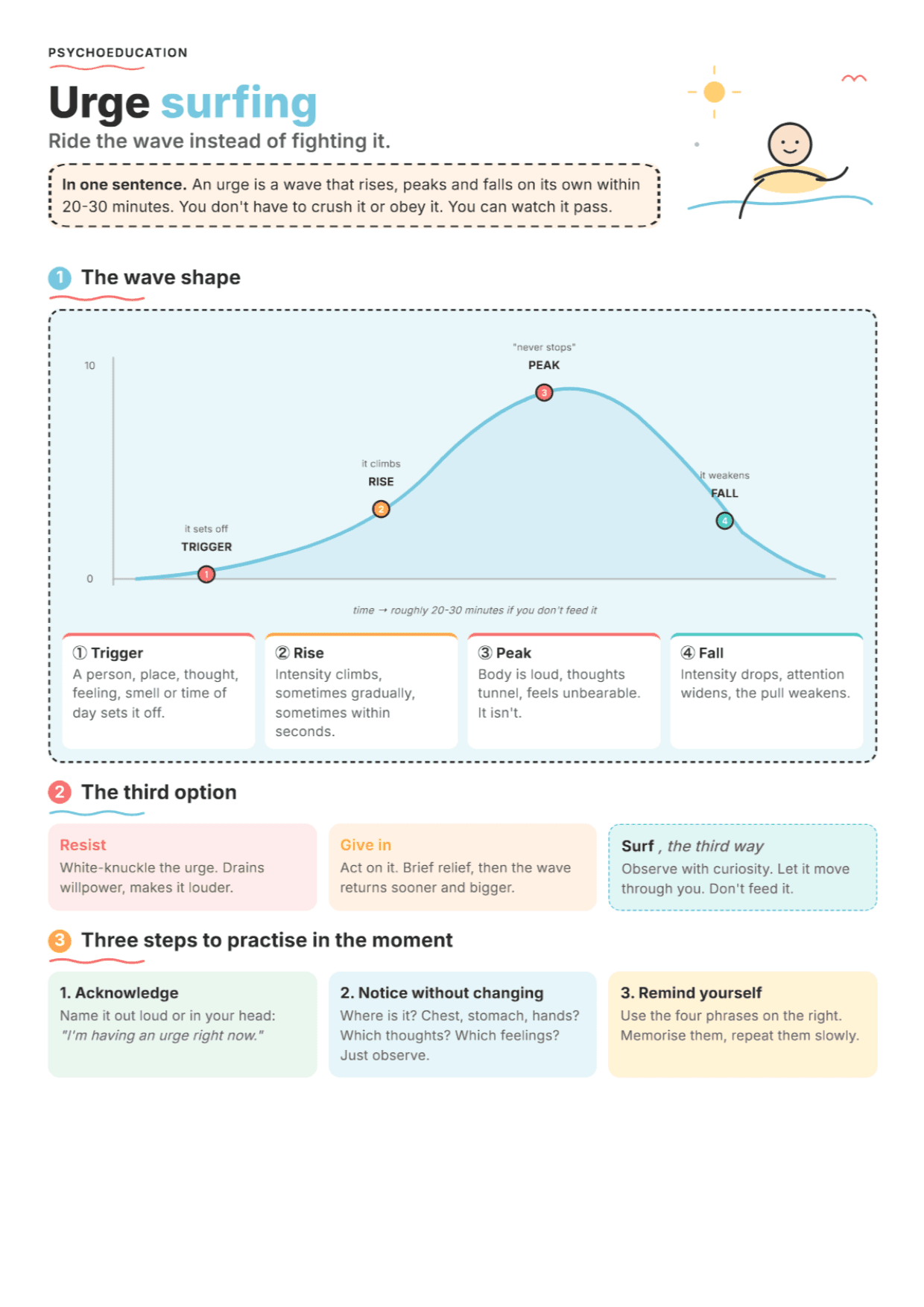
Urge Surfing: PDF Worksheet, Tools and Exercises for Distress Tolerance
A printable PDF worksheet presenting the wave model, trigger mapping, and ready-to-use phrases to teach urge surfing visually in session.
Emotions & stressBehaviours & addictions
Handout
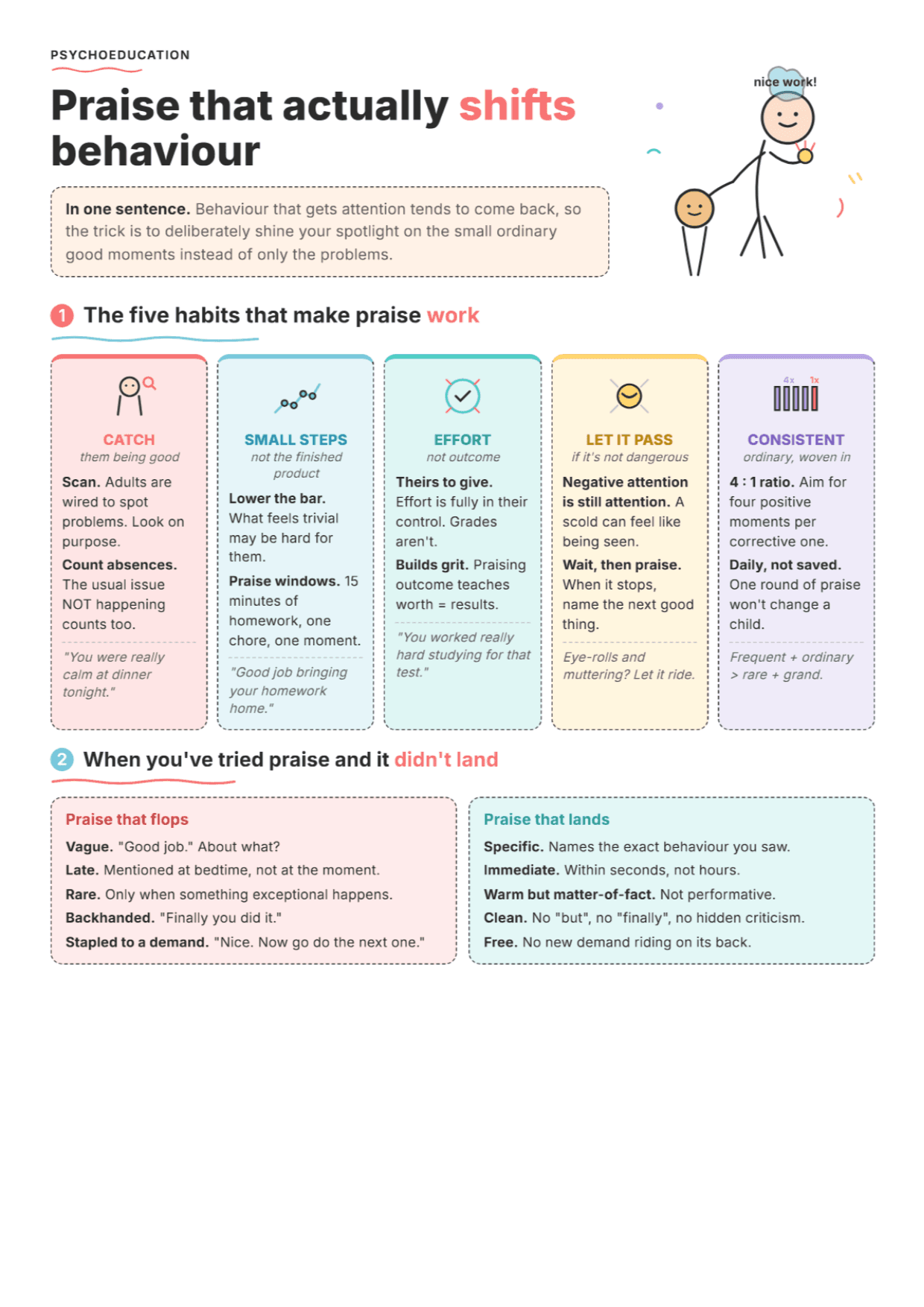
Using Praise Effectively: PDF Worksheet, Tools and Exercises for Clinical Practice
A printable PDF worksheet with structured tools and exercises to help clinicians teach parents how to use praise as a deliberate behaviour-change lever in their family.
RelationshipsBehaviours & addictions
Handout
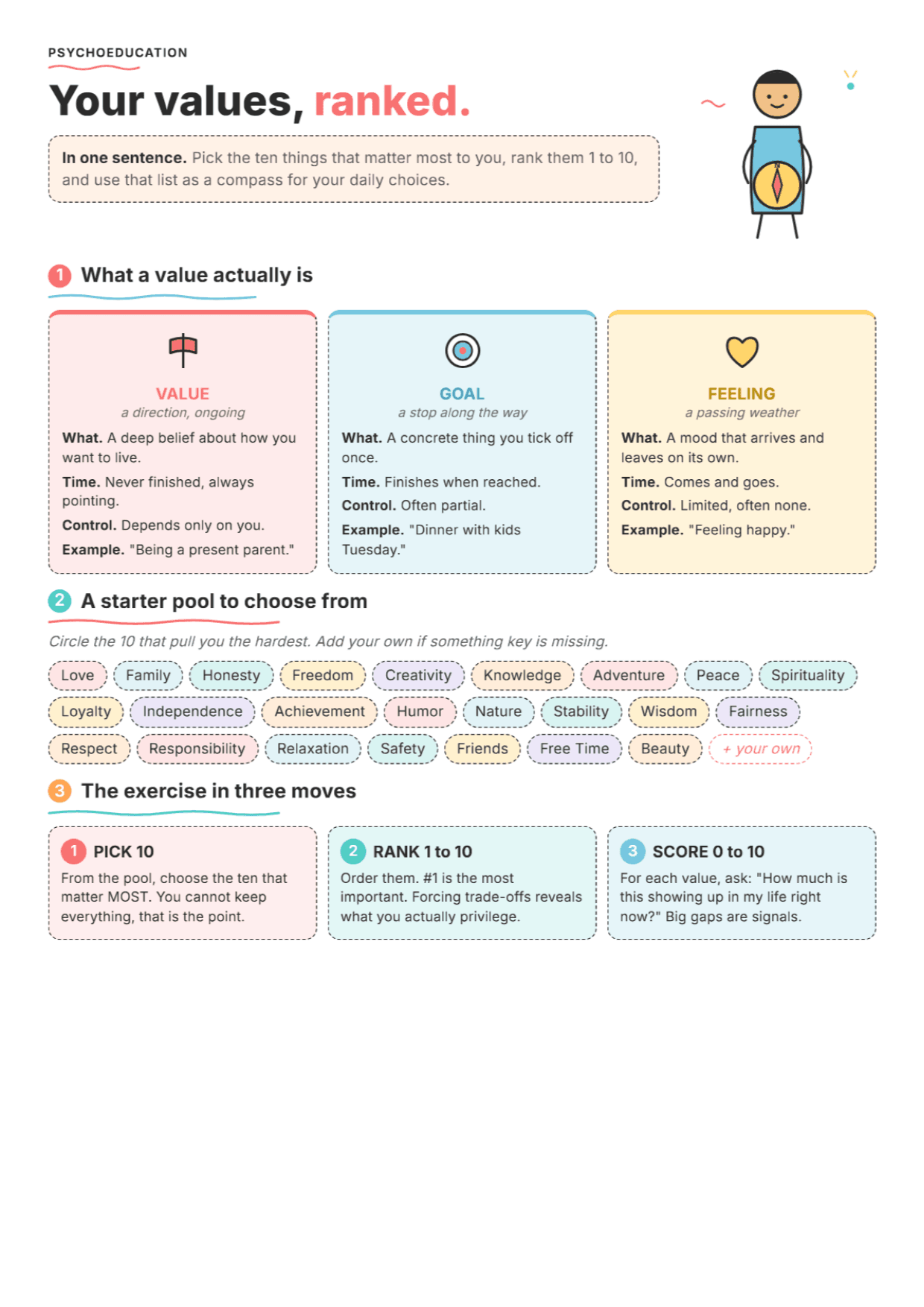
Values Clarification: PDF Worksheet, Tools and Exercises
A structured PDF worksheet with visual panels to help clinicians guide patients through values ranking, gap analysis, and committed action in ACT-informed practice.
Self & identityLife transitions
Handout
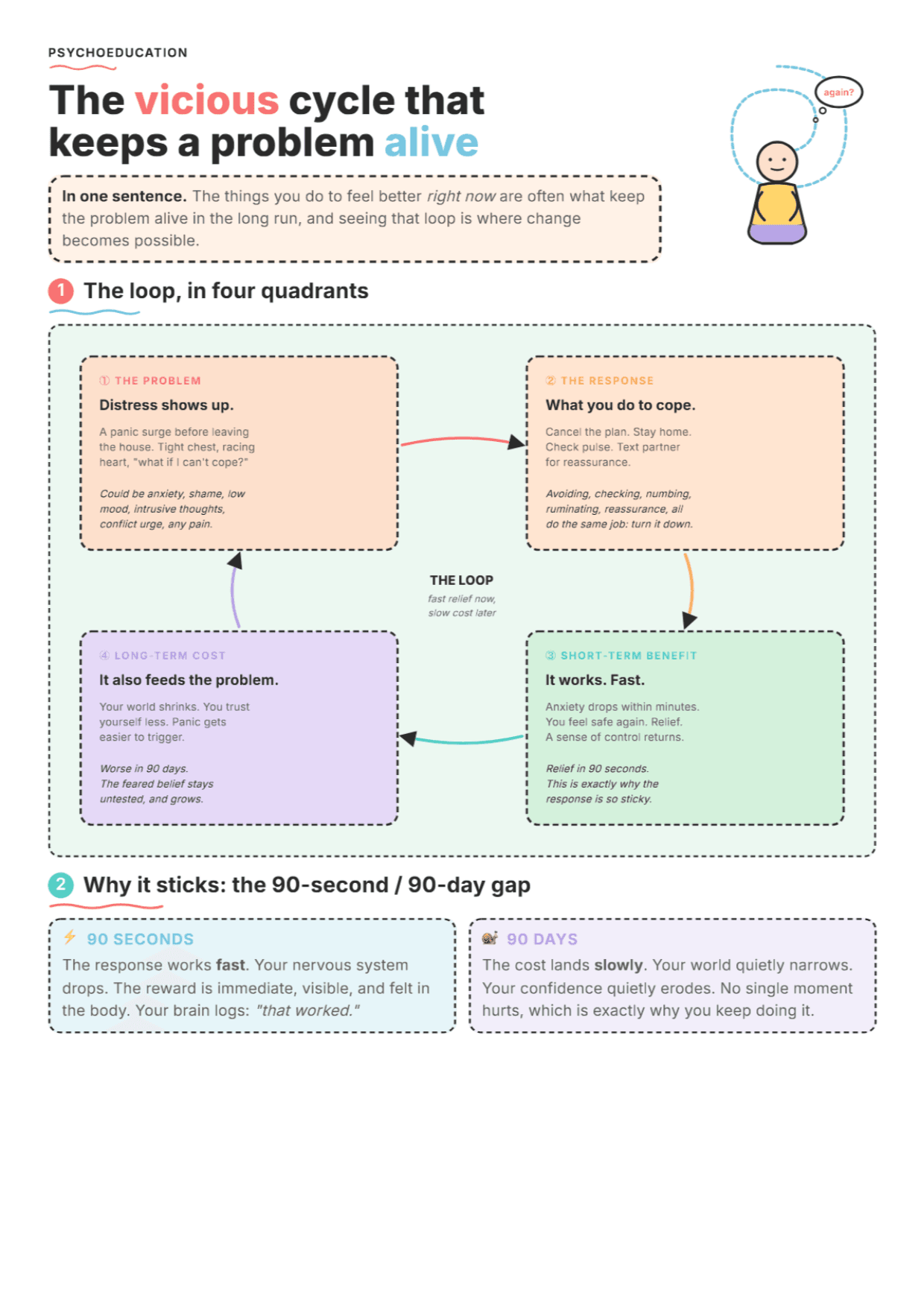
Vicious Cycle: Costs and Benefits: PDF Worksheet, Tools and Exercises
A visual psychoeducation tool helping clinicians map the short-term relief and long-term cost loop that keeps any presenting problem alive in session.
AnxietyMood & depression

Handout
Vicious Cycle: Responses and Consequences, PDF Worksheet, Tools and Exercises
A visual psychoeducation tool to map the three-node maintenance loop in session and help patients see exactly where to cut it.
AnxietyMood & depression
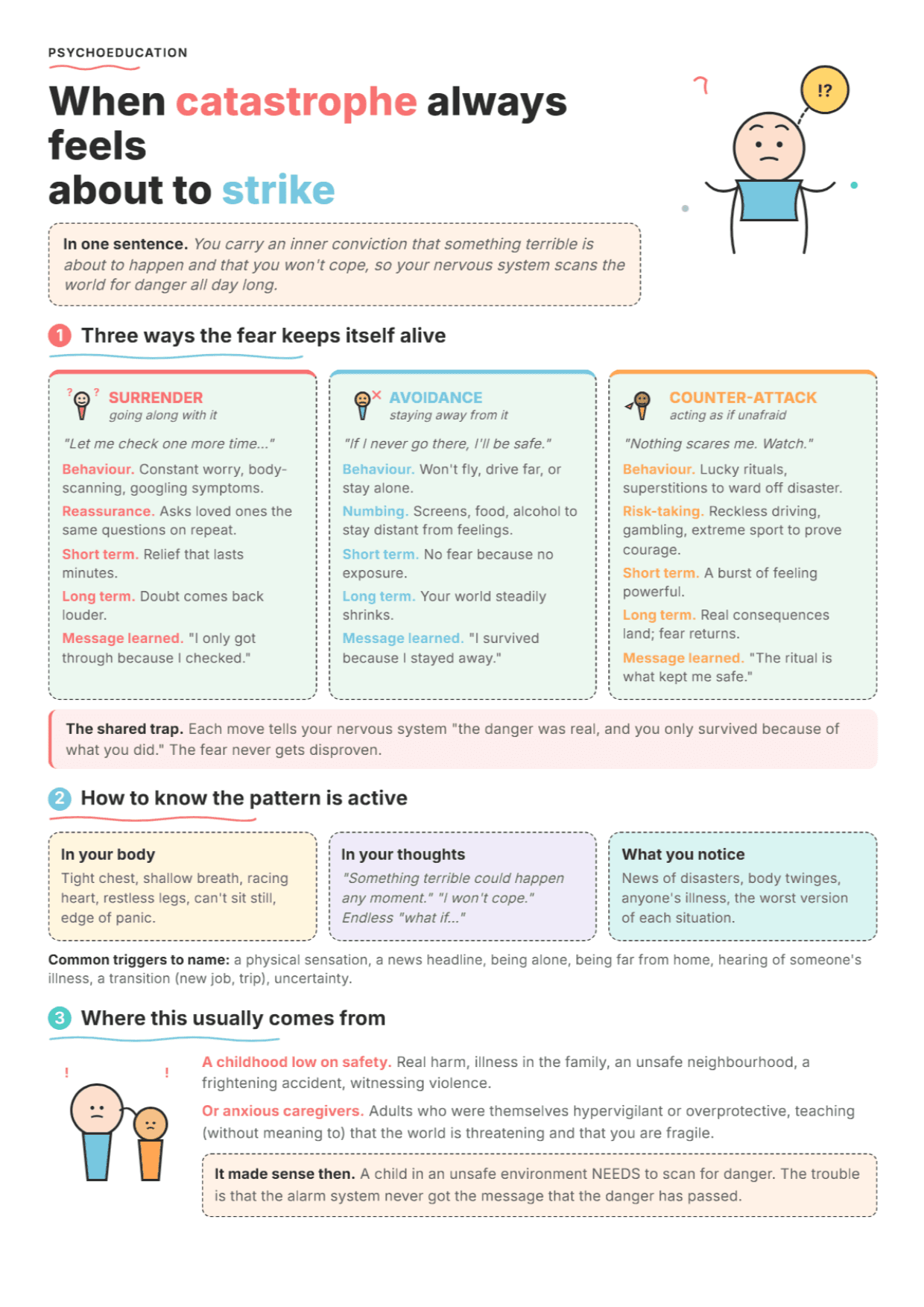
Handout
Vulnerability to Harm Schema: PDF Worksheet, Tools and Exercises for Clinical Practice
A visual psychoeducation tool helping clinicians explain the Vulnerability to Harm schema in session, its three coping modes, body signals, developmental roots, and pathways to change.
AnxietySelf & identity

Handout
Waking Up Refreshed: PDF Worksheet, Tools and Exercises for Clinical Practice
A visual psychoeducation sheet clinicians can use in session to reframe sleep inertia, dismantle the snooze habit, and co-build a morning routine that actually holds.
Body & healthMood & depression
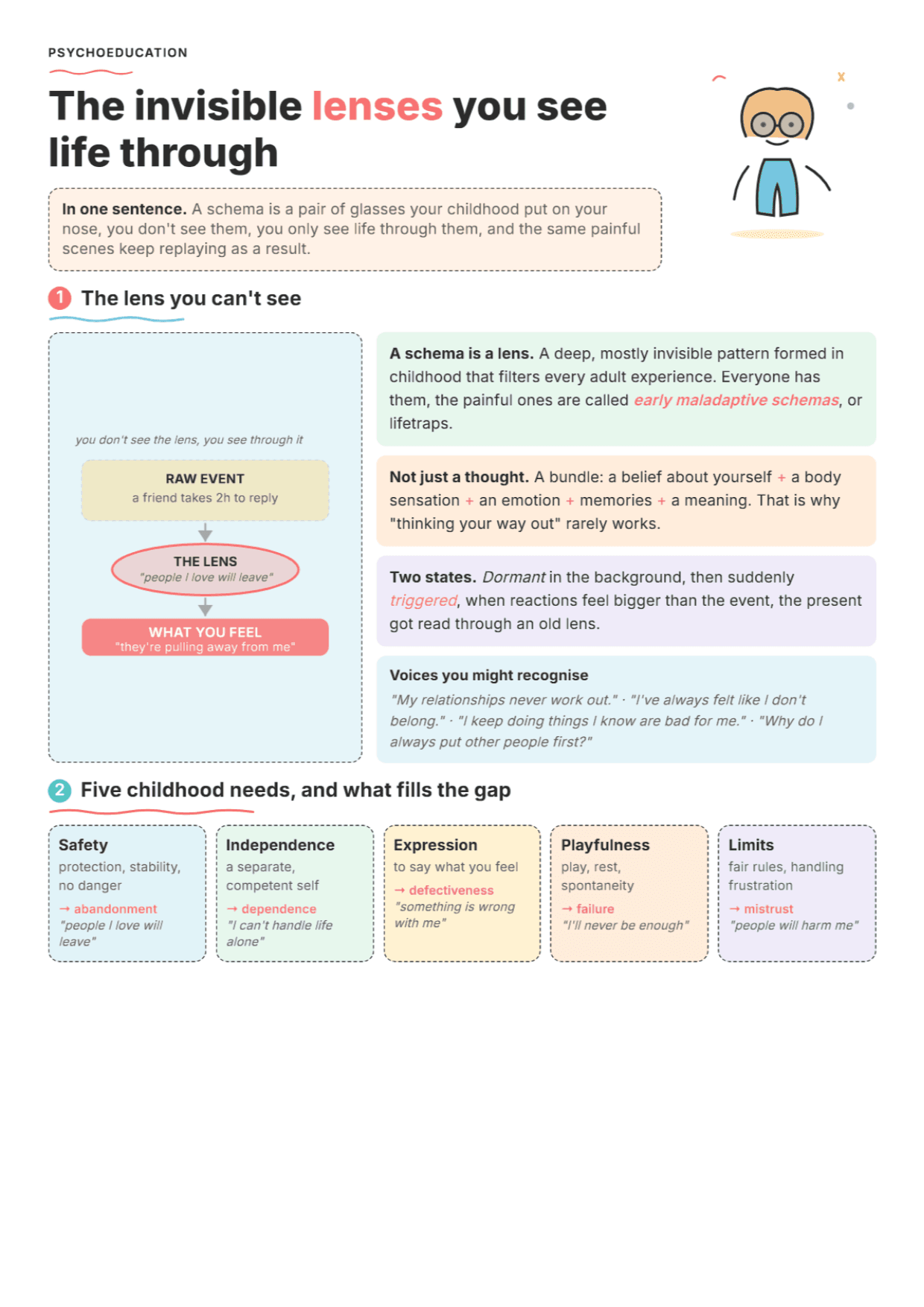
Handout
What Are Schemas? PDF Worksheet, Tools and Exercises
A printable psychoeducation fiche, clinical tools and exercises to help patients grasp early maladaptive schemas during session.
Self & identityPersonality