
Clinical picture. A, a woman in her mid-forties, was referred for recurrent health anxiety following three separate cardiology work-ups that returned normal results. She described checking her pulse several times an hour and keeping a detailed symptom log she reviewed each morning. In session, the clinician introduced the informational sheet on the Vulnerability to Harm schema, walking through the self-confirming loop to map how each Google search produced brief relief and then a faster return of alarm. A recognized, with some surprise, that her mother had narrated childhood illness in nearly identical terms to those listed under early origins. She agreed to track one full loop per day between sessions, noting trigger, action, and the duration of relief, as a first step toward recognizing the pattern rather than interrupting it prematurely.
Vulnerability to Harm Schema: PDF Worksheet, Tools and Exercises
A visual PDF worksheet to explain the vulnerability to harm and illness schema in session, with tools and exercises for schema therapy and CBT practice.
Clinical vignettes
Reassurance Loop in Health Anxiety
Safety Props Following a Family Loss
Clinical picture. M, a man in his early thirties, presented with persistent generalized worry and difficulty travelling more than thirty minutes from home without mapping hospital locations in advance. He linked the onset to his father's sudden cardiac death five years earlier, after which he had begun carrying antacids daily for symptoms his GP had attributed to anxiety. The clinician used the fiche's section on safety props to introduce the concept in non-pathologizing terms, framing M's behavior as a learned protective strategy that had outlived its original context. M identified three props he relied on and rated how much each actually reduced distress over time; he noted that relief rarely lasted beyond the drive home. The session ended with a shared formulation rather than a behavioral prescription, giving M a working vocabulary for the pattern before any exposure work was proposed.
In schema therapy practice, few early maladaptive schemas generate as persistent a credibility gap as the Vulnerability to Harm schema. Patients acknowledge, intellectually, that a chest twinge is probably muscular. The somatic alarm has already fired. By the time they have googled symptoms and called the doctor, relief has arrived, and the very belief you are working to loosen has been confirmed once more. This PDF worksheet gives you a visual anchor for that psychoeducation conversation, one that shows the maintenance loop rather than merely describing it.
Use this resource with your patients
Handout, exercises and materials ready to use, right inside SessionFuel.
Why the Vulnerability to Harm Schema Resists Verbal Explanation
The standard difficulty is that patients hear "your worry is excessive" and stiffen defensively. The schema is not irrational; it is the predictable output of a specific learning history. The fiche names those origins concisely: a parent whose vigilance became the ambient air, cautionary phrases repeated across childhood ("Be careful," "Cover up"), overprotection from normal developmental risks, or a genuine illness or loss in the family. When you articulate that history aloud, the conversation shifts from confronting irrationality to tracing causality.
What patients consistently miss when the explanation stays verbal is the self-reinforcing architecture of the loop. They experience each reassurance-seeking episode as a one-off response to a genuine threat, not as a link in a chain that tightens with each repetition. The schema also extends well beyond health fears: it drives avoidance of conflict, safety behaviors woven into every departure and every night's sleep, and the overprotective parenting that transmits the pattern across a generation. Placing a circular diagram on the table makes that architecture visible before you say another word.
The Vulnerability to Harm schema overlaps clinically with health anxiety, strong intolerance of uncertainty, and the cycle of avoidance that quietly shrinks the patient's navigable world.
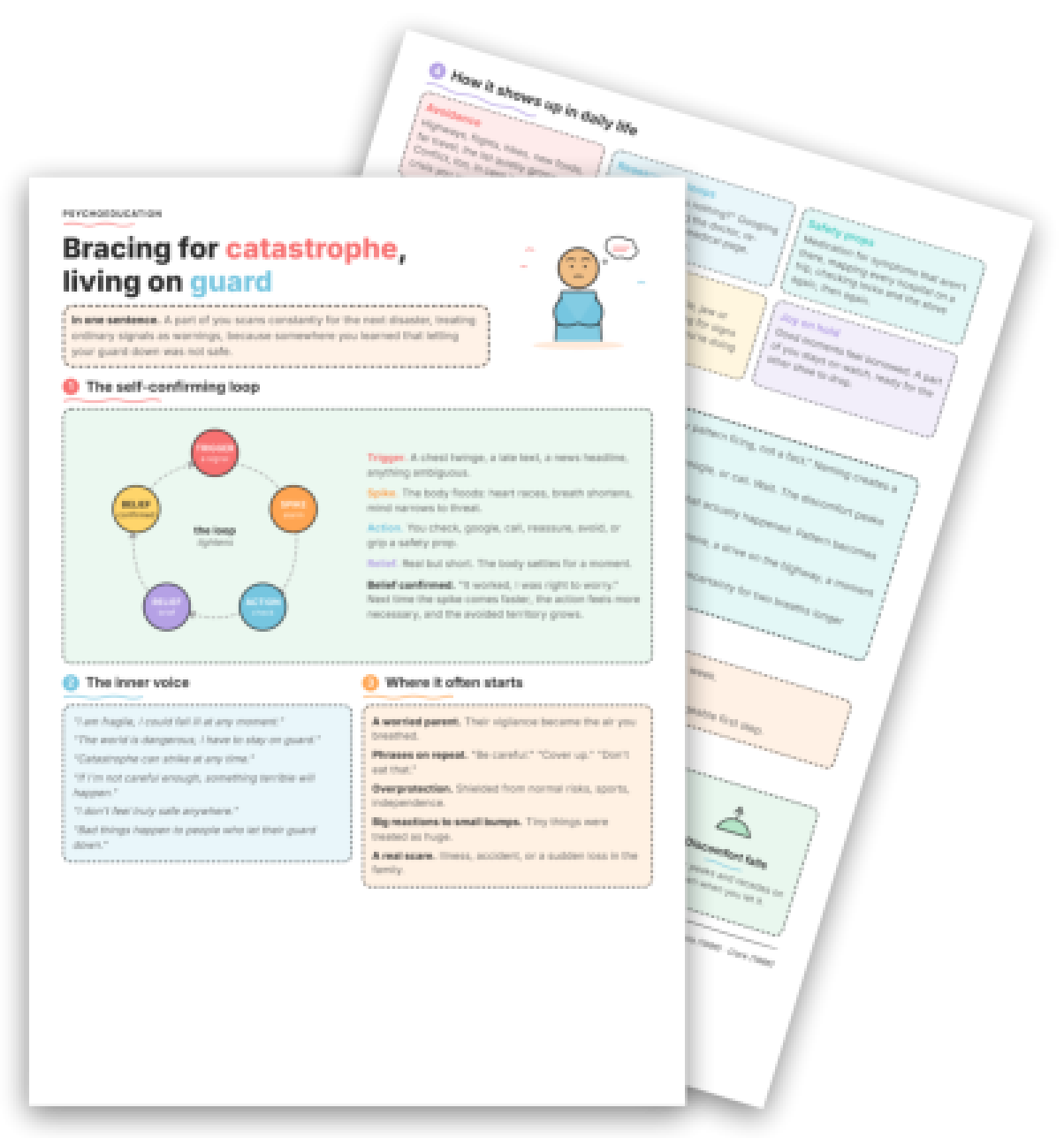
What the Fiche Contains: A Visual Support for In-Session Psychoeducation
The worksheet opens with a single orienting sentence: "A part of you scans constantly for the next disaster, treating ordinary signals as warnings, because somewhere you learned that letting your guard down was not safe." Read aloud, it tends to land with a recognition that a clinical definition does not.
Five numbered sections follow, each serving a distinct clinical function:
- The self-confirming loop: a circular diagram tracing Trigger → Spike → Action → Relief → Belief confirmed → Trigger. Patients who have heard the schema maintenance vicious cycle described verbally often see their own pattern for the first time when this diagram is in front of them.
- The inner voice: six belief statements to scan and recognise, including "I am fragile, I could fall ill at any moment" and "Bad things happen to people who let their guard down." Having pre-written statements removes the cognitive load of generating them spontaneously.
- Where it often starts: developmental origins listed without jargon: worried parent, phrases on repeat, overprotection, outsized reactions to small bumps, a real scare. This section often surfaces material that would otherwise take most of a session to excavate.
- How it shows up in daily life: six behavioral expressions (Avoidance, Reassurance loops, Safety props, Overprotecting others, Body on alert, Joy on hold). Each is described concisely and maps directly onto presenting complaints.
- First moves out of the loop: five concrete starting-point behaviors, including delaying the safety behavior by 10 minutes, one-week self-monitoring of the trigger-thought-action sequence, and approaching one avoided situation without the safety prop. These frame the next collaborative steps; they are not a self-help checklist the patient completes alone.
A closing panel, labeled "To discuss in session," offers three debriefing prompts for the following appointment. A "Remember" block restates four core messages: not a flaw, once useful, name it, discomfort falls.
> Key point: The fiche is a visual support that facilitates the explanation in session, not a take-home questionnaire. The loop diagram and belief list do the heavy lifting so the patient leaves with a concrete map of their own pattern rather than a verbal summary they may only half recall.
750+ clinical tools
A library built with and for clinicians, ready to use in session and extend between appointments.
Access all the toolsWhen and How to Introduce This Worksheet
Good timing is the second or third session, once you hold a preliminary schema formulation and can point to two or three of the patient's own examples: a reassurance call, an avoided route, an evening spent mapping nearby hospitals. Introduce it without diagnostic labeling: "I'd like to show you a diagram that clarifies something I think we're seeing in your situation. Tell me what fits and what doesn't."
The fiche suits a wide range of presentations: health anxiety, generalized worry with prominent somatic vigilance, patients with a dense early maladaptive schema profile, and parents whose overprotective behavior is driven by their own unaddressed schema. It pairs well with graded exposure targeting illness fears, work on reassurance-seeking patterns, and habituation-based rationales for dropping psychological safety crutches.
Walk through the loop diagram first. Most patients interrupt within seconds with a specific recent episode. Move to the inner voice panel next: ask which of the six statements resonate, without prompting them to endorse the full list. The developmental origins section often generates the richest schema-mode material and can carry a session on its own.
One limit worth tracking: with patients who are already highly interoceptively focused and prone to rumination, introduce the loop and the belief statements first, and hold the "Body on alert" passage for a later session once the maintenance cycle is well understood.
The worksheet does not replace the therapeutic relationship or the exposure hierarchy work that follows. It creates a shared vocabulary earlier in treatment, saves substantial explanation time, and leaves the patient something tangible to consult when the alarm fires between sessions.
Use it with your patients
Share this tool in the mobile app and follow the work between sessions.
Sources
- Young, J. E., Klosko, J. S., & Weishaar, M. E. (2003). Schema Therapy: A Practitioner's Guide. Guilford Press.
- Young, J. E., & Klosko, J. S. (1994). Reinventing Your Life. Plume.
Your session continues in your patients' pocket
Use with a patientYour resources, available everywhere
The handouts, exercises, programs and audios above: you choose which ones to make available to your patients, in the mobile app dedicated to them.
And far more than a library
The app goes well beyond resources, to support your patients every day:
Related categories
Explore other clinical resources by category.

Anxiety
Clinical hub for anxiety disorders: CBT and ACT worksheets, psychoeducation sheets, and exercises for assessment and treatment across the anxiety spectrum.

Identity
Clinical resources for self-identity work in therapy: CBT, ACT, schema tools for clinicians addressing self-concept, core beliefs, and identity disruption.

Cognition
Printable cognitive therapy worksheets and clinical tools for therapists: CBT, ACT, schema work, defusion, distortions, and belief restructuring.

Understand
Clinical hub for the therapeutic aim 'Understand': worksheets and tools to build patient insight across CBT, ACT, schema therapy and more.

Build awareness
Clinical worksheets and tools to build awareness in therapy: cognitive distortions, schemas, emotions, ACT and CBT resources for practitioners.

Schema therapy
Schema therapy clinical resources for practitioners: worksheets, exercises, and programs targeting early maladaptive schemas, core beliefs, and schema modes.