
Clinical picture. A, a woman in her late twenties, presented with recurrent depersonalization episodes triggered by fluorescent lighting in her workplace, describing a sensation of watching herself type from a slight distance and feeling her hands were not her own. She had developed a habit of repeatedly glancing at her palms and pinching her forearm throughout the day to confirm bodily reality, a pattern she described as automatic and almost constant. Using an informational worksheet on maintenance cycles, the clinician walked her through the four-petal model, and A was able to identify that her checking behavior was functioning as the primary loop driver: each scan confirmed something felt off, which then amplified the alarm. Over the following two weeks she agreed to reduce mirror checks and hand inspection to one designated moment per hour; she reported that individual episodes, while still present, resolved more quickly and felt less catastrophic.
Depersonalization-Derealization: PDF Worksheet, Tools and Exercises for Clinical Practice
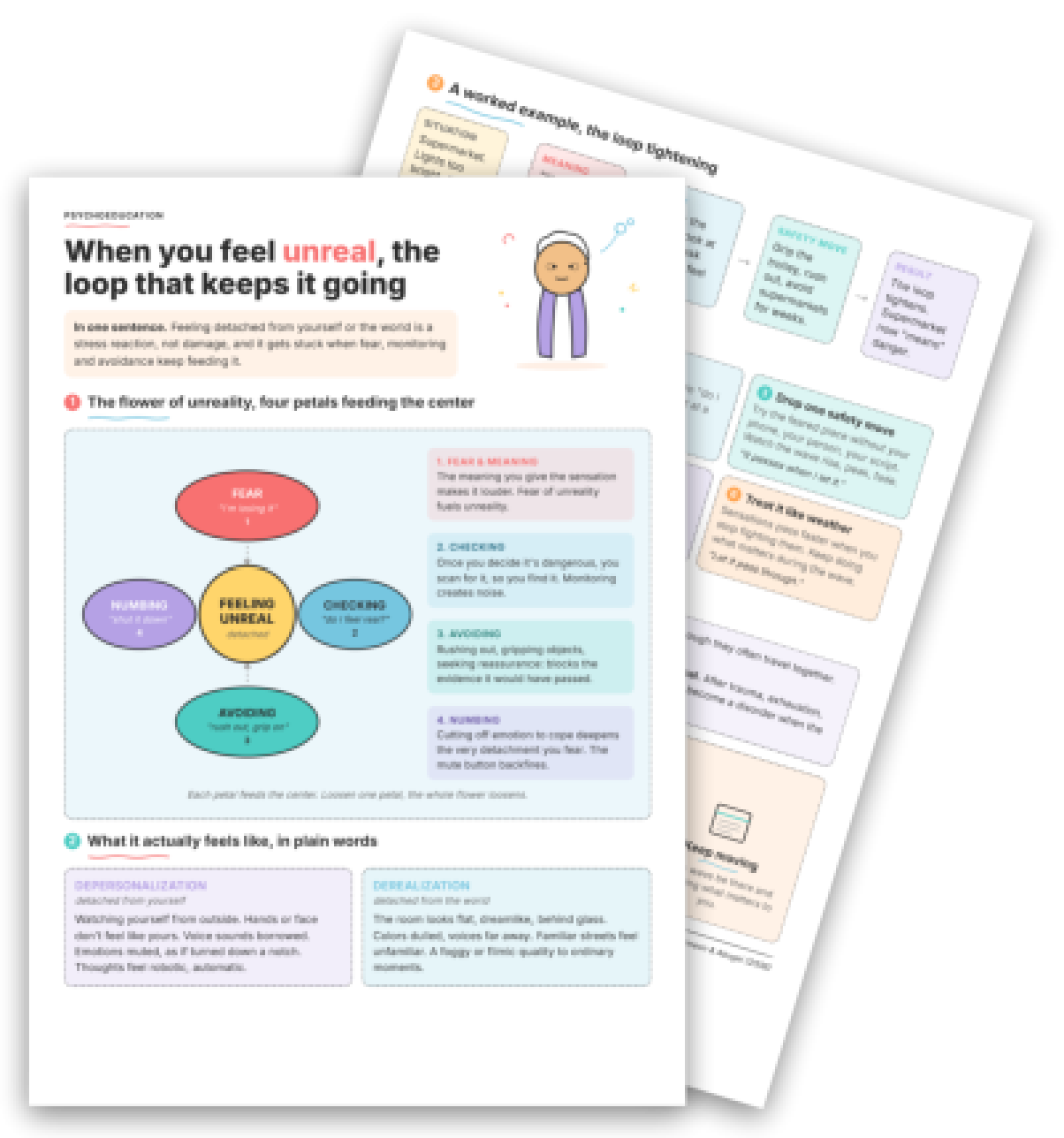
A visual psychoeducation tool explaining the maintenance loop of depersonalization-derealization, fear, checking, avoidance, and numbing, to use directly in session.
Clinical vignettes
Checking Behavior Sustaining Dissociation
Avoidance Narrowing a Patient's World
Clinical picture. M, a man in his early forties with a history of generalized anxiety, began experiencing derealization in busy public spaces, describing the environment as flat and filmed rather than real. His initial response had been to leave triggering environments immediately and to reorganize his week to avoid supermarkets, crowded transport, and open-plan offices, reasoning that escape prevented the sensation from worsening. During a psychoeducation session the clinician introduced the maintenance framework and highlighted how each successful exit deprived M of evidence that the wave would have passed without action, reinforcing the belief that avoidance was what kept him safe. M identified avoidance as the petal he was most willing to address first, and the clinician collaboratively planned brief, planned exposures to one previously avoided setting per week, with no safety behaviors. At the four-week review M reported that his avoidance list had shortened substantially, and his interpretation of the sensation had shifted from one of impending breakdown toward something closer to a transient stress response.
Explaining depersonalization-derealization to a patient in words alone rarely lands cleanly. The sensation of unreality is already hard to articulate, and when you layer the maintenance loop on top, fear, hypervigilance, reassurance-seeking, évitement expérientiel, the patient often leaves with a vague sense of having been told something useful but without a clear map. This PDF worksheet gives you that map: a visual support you use directly in session to make the loop visible, interruptible, and less catastrophic.
Use this resource with your patients
Handout, exercises and materials ready to use, right inside SessionFuel.
Why depersonalization is so difficult to explain orally
The core clinical difficulty is double-layered: the patient struggles to name the experience, and then catastrophises the name they do find. Most patients arrive having Googled "depersonalization" and concluded they are either dissociating into psychosis or that something is neurologically broken. Disconfirming that belief verbally, while they are already hypervigilant, is slow work.
What keeps depersonalization going is not the initial trigger, it is the meaning-driven loop: the patient notices a sensation of unreality, appraises it as dangerous, scans for more evidence, finds it (because attentional monitoring manufactures signal), and then deploys safety behaviours that block disconfirmation. Numbing compounds the problem; cutting off emotion to cope deepens the very detachment the patient fears. The oral explanation of this cycle easily collapses into a circular paragraph. A visual layout cuts the circularity.
What the worksheet contains, and what the visual does
The fiche is organised across five panels. The anchor is "The Flower of Unreality": a diagram with four labelled petals (Fear, Checking, Avoiding, Numbing) feeding a central node of detachment. Each petal carries a prototypical internal monologue ("I'm losing it", "do I feel real?", "rush out, grip on") and a single-sentence clinical commentary, for example, "Monitoring creates noise" under Checking, and "The mute button backfires" under Numbing. Placed on a shared surface between you and the patient, this image does what speech cannot: it shows simultaneity. All four petals operate at once, reinforcing each other. The single most clarifying sentence in the fiche is "Loosen one petal, the whole flower loosens." That reframe, printed visually, changes the treatment logic for the patient.
The second panel separates depersonalization (detachment from self: hands that feel borrowed, robotic thoughts, muted emotion) from derealization (detachment from environment: rooms behind glass, voices too far away, familiar streets gone strange). Naming both explicitly matters in session, many patients have only one form, and confirming that their specific experience fits the map reduces the catastrophic appraisal considerably.
A worked example, a supermarket situation that tightens into a conditioned danger signal over weeks, makes the cognitive-behavioural formulation concrete without the clinician having to construct a bespoke example on the spot. The fifth panel lists six entry points (naming it neutrally, dropping one checking behaviour, dropping one safety move, anchoring attention outward with 5-4-3-2-1, testing the prediction, treating the sensation like weather). These can seed the session's intervention plan directly.
A brief "Common Confusions" panel addresses the differential: the worksheet states plainly that this is not psychosis, not a panic attack, and not depression, a comparison to psychosis symptoms that clinicians often need to make explicit before therapeutic work can progress.
> Key takeaway: the worksheet is a visual support that facilitates the explanation of the maintenance loop in session, not a self-help questionnaire to hand out. It lets you and the patient look at the same map together, name the petals, and identify one entry point to work on first.
750+ clinical tools
A library built with and for clinicians, ready to use in session and extend between appointments.
Access all the toolsWhen and how to introduce the worksheet
The natural moment is after an initial anamnesis has confirmed depersonalization-derealization as a primary feature, and once you have begun building the alliance thérapeutique. Introducing it too early, before the patient trusts the normalisation frame, risks the diagram being read as confirmation of damage rather than clarification of mechanism.
A workable introduction: "I want to show you something that might explain why this feeling keeps coming back even though you want it to stop." Then place the flower diagram in view and ask the patient which petal they recognise most. That question alone generates valuable formulation material and anchors the patient's engagement with the CBT maintenance model.
For patients who overlap with panic, the Checking and Avoiding petals resonate immediately. For those carrying dissociative features post-trauma, introduce the normalisation panel first to manage the catastrophic appraisal before mapping the loop. The six intervention entry points double as a session agenda: choose one with the patient, link it to a graded exposure or dropping safety behaviours, and return to the worksheet at the next session to track which petal has loosened.
The worksheet does not replace the case formulation, it makes one dimension of it visible. Leave it with the patient as a concrete reference between sessions, not as homework to fill in, but as a map they can return to when the next wave arrives.
Use it with your patients
Share this tool in the mobile app and follow the work between sessions.
Sources
- Hunter, E. C. M., Wong, C. L. M., Gafoor, R., Lewis, G., & David, A. S. (2023). Cognitive Behaviour Therapy (CBT) for Depersonalization Derealization Disorder (DDD): a self-controlled cross-over study of waiting list vs. active treatment. Cognitive Behaviour Therapy.
- Baker, D., Hunter, E., Lawrence, E., & David, A. (2018). Overcoming Depersonalisation and Feelings of Unreality: A self-help guide using cognitive behavioural techniques (2nd ed.). Robinson.
Your session continues in your patients' pocket
Use with a patientYour resources, available everywhere
The handouts, exercises, programs and audios above: you choose which ones to make available to your patients, in the mobile app dedicated to them.
And far more than a library
The app goes well beyond resources, to support your patients every day:
Related categories
Explore other clinical resources by category.

Trauma
Clinical hub on trauma and PTSD: assessment, differential diagnosis, treatment phases, and printable resources for practitioners. 155 chars.

Understand
Clinical hub for the therapeutic aim 'Understand': worksheets and tools to build patient insight across CBT, ACT, schema therapy and more.

Build awareness
Clinical worksheets and tools to build awareness in therapy: cognitive distortions, schemas, emotions, ACT and CBT resources for practitioners.

CBT
CBT worksheets, cognitive restructuring exercises & behavioral tools for clinicians. Evidence-based resources for every phase of cognitive behavioral therapy.

Anxiety
Clinical hub for anxiety disorders: CBT and ACT worksheets, psychoeducation sheets, and exercises for assessment and treatment across the anxiety spectrum.

Mood
Evidence-based worksheets and clinical tools for mood disorders: CBT, ACT, and positive psychology resources for psychologists and therapists.