
Clinical picture. M., a woman in her late thirties, presents with a trauma history and reports feeling "checked out" for stretches of her workday, sometimes arriving home with no clear memory of the commute. She has avoided naming these experiences, fearing they signal something "seriously wrong" with her mind. The clinician introduces the dissociation continuum from the psychoeducation sheet, walking through the range from highway hypnosis and absorbed reading to peri-traumatic shutdown. M. immediately places herself at the milder end for most episodes and, for the first time, identifies two events she now recognises as belonging further along the continuum. The normalising frame reduces her shame sufficiently that she agrees to begin tracking episodes between sessions using a brief log.
Types of Dissociation: PDF Worksheet, Tools and Exercises
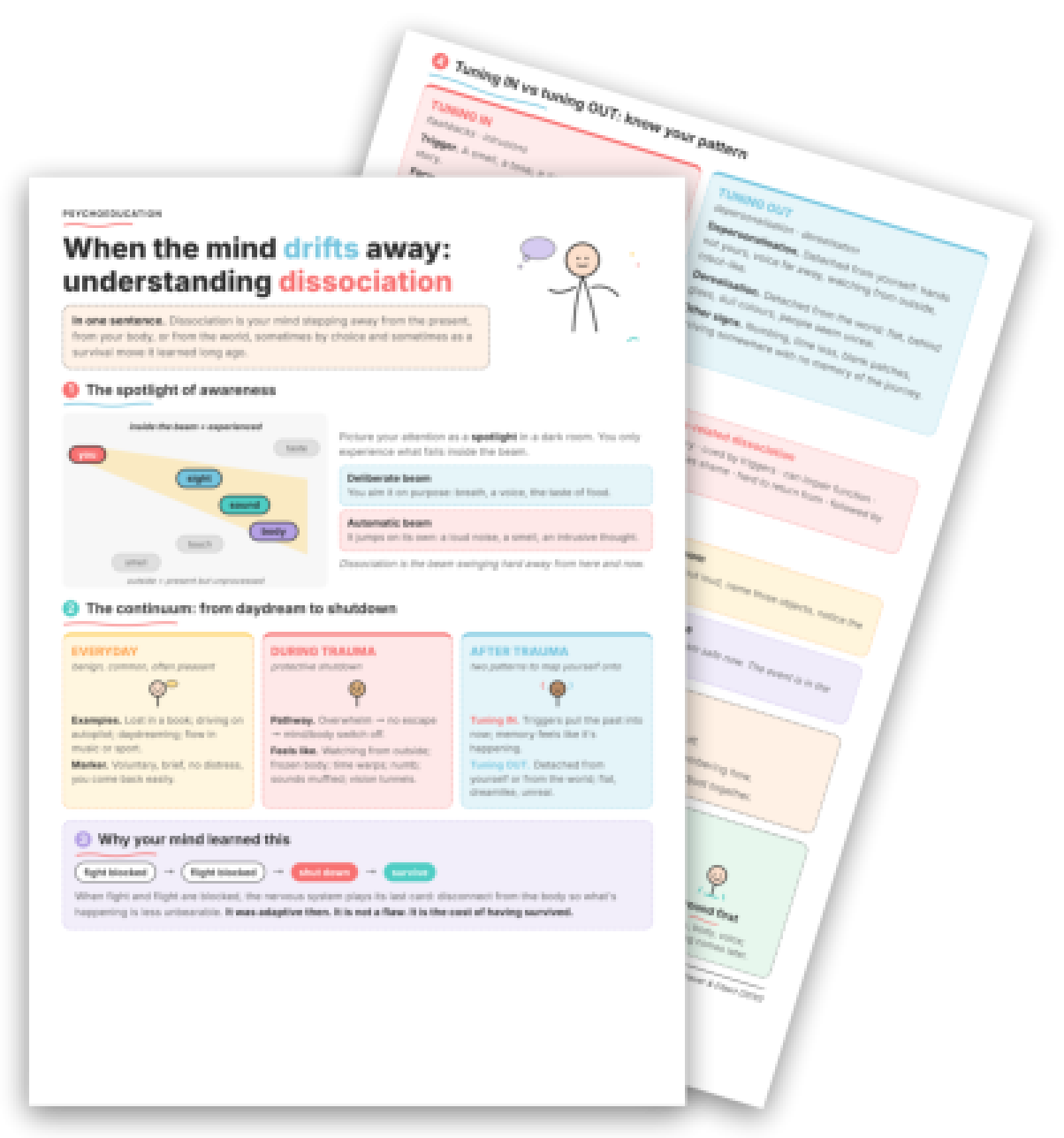
A printable PDF fiche giving clinicians a visual scaffold to explain the dissociation continuum, the tuning-in/tuning-out distinction, and grounding tools in a single session.
Clinical vignettes
Mapping the Continuum in Session
Distinguishing Tuning In from Tuning Out
Clinical picture. R., a man in his mid-forties with a diagnosis of PTSD following an industrial accident, describes two distinct states that he had been grouping under the single label "going blank." During the psychoeducation review, the clinician uses the tuning-in versus tuning-out distinction from the sheet to help R. separate intrusive re-experiencing, in which a particular sound pulls the past into the present moment, from a detached, dreamlike flatness that descends after those episodes and can last several hours. R. recognises that he has been trying to manage both states with the same avoidance strategy, which has been ineffective for the intrusive pattern. This distinction gives the clinician a clearer basis for sequencing subsequent work, addressing stabilisation of the tuning-out state before approaching memory processing.
Explaining dissociation verbally rarely lands on the first attempt. Patients either minimise what they experience ("I just zone out sometimes") or catastrophise it ("Am I going mad?"), and the gap between those two poles is genuinely hard to bridge with words alone. This fiche PDF provides a visual scaffold that lets you walk through the concept systematically, name what the patient is already experiencing, and leave them with a concrete reference they can return to between sessions.
Use this resource with your patients
Handout, exercises and materials ready to use, right inside SessionFuel.
Why Dissociation Is So Hard to Explain Without a Visual Support
The core difficulty is threefold. First, dissociation is a continuum, and patients tend to anchor to one extreme: either the benign daydream they recognise in themselves, or the florid depersonalisation they fear. Without a visual map of that spectrum, the middle ground stays murky. Second, patients rarely have the vocabulary to distinguish what the literature calls tuning in (intrusion-type dissociation: flashbacks, body-sense intrusions, the past flooding the present) from tuning out (detachment-type: derealisation, depersonalisation, emotional numbing). These feel phenomenologically opposite and are maintained differently, yet patients often describe both with the same vague language: "I wasn't really there." Third, shame and confusion compound each other. When a patient cannot name what is happening, they tend to assume something is fundamentally wrong with them. A printed, coherent framework disrupts that loop before it consolidates.
The fight-flight-freeze response and autonomic nervous system fiches give useful context here, but neither addresses the phenomenology of dissociation specifically. This is where this resource fills a gap.
750+ clinical tools
A library built with and for clinicians, ready to use in session and extend between appointments.
Access all the toolsWhat the Fiche Contains: A Visual Map of the Dissociation Continuum
The fiche PDF is structured in six numbered panels, each carrying a distinct clinical function.
- Panel 1: the spotlight metaphor. Attention is represented as a spotlight in a dark room. Dissociation is framed as "the beam swinging hard away from here and now," distinguishing voluntary focus from automatic capture. This single image tends to produce the fastest recognition in patients.
- Panel 2: the continuum. Three zones run from everyday dissociation (flow states, highway hypnosis, absorption in music) through acute trauma response, to two post-trauma patterns: tuning in and tuning out. Seeing these on a single axis normalises the benign end and contextualises the pathological end without conflating them.
- Panel 3: the survival logic. The shutdown pathway is shown as a sequence: fight blocked, flight blocked, disconnect. The fiche names this explicitly as adaptive survival, not weakness. That framing alone shifts the therapeutic alliance in patients who carry significant shame about their symptoms.
- Panel 4: detailed comparison of tuning in vs tuning out. Flashbacks, intrusions, sensory fragments, and the quality of "it feels like NOW" are described on one side. Depersonalisation, derealisation, time loss, and arriving somewhere with no memory of the journey appear on the other. The visual side-by-side is something a purely verbal explanation struggles to replicate.
- Panel 5: a practical differentiator between everyday and trauma-related dissociation, across voluntariness, cue-dependence, functional impact, and recovery time.
- Panel 6: grounding tools. The 5-4-3-2-1 senses exercise, body anchoring, and a scripted self-statement ("This is a flashback. I am safe now. The event is in the past.") are presented alongside a short list of prompts marked "To discuss in session."
> Key point: the fiche is a visual support that facilitates the explanation in session; it is not a self-administered questionnaire. You use it alongside the patient to build shared vocabulary, then send it home as a reference, not a task.
Use it with your patients
Share this tool in the mobile app and follow the work between sessions.
When and How to Propose It
This fiche is well placed from the second or third session onwards, once a working alliance is established and an initial trauma or dissociative history has been mentioned. For patients presenting with PTSD, complex PTSD, or significant emotional numbing in the context of a personality disorder, it can anchor the psychoeducation phase before any processing work begins.
A natural introduction: "A lot of people who experience what you're describing find it hard to place, because it can look quite different depending on the day. I have a diagram that maps out the different forms, which often makes it easier to see where your own experience fits."
During the debrief, the "To discuss in session" prompts built into the fiche do useful work: whether the patient tends to tune in or tune out, what triggers seem to set it off, and crucially, when grounding helps versus when it appears to worsen symptoms. That last point matters clinically: the grounding techniques menu and the 5-4-3-2-1 sensory grounding exercise are strong follow-on tools, but they are contraindicated or need adaptation for patients in whom body-focused attention intensifies intrusive material rather than settling it.
For adolescent patients, the trauma reactions and symptoms fiche can serve as a precursor, and for clinicians working within an EMDR framework, combining this psychoeducation with the EMDR negative and positive cognitions fiche consolidates the conceptual preparation phase. The Ehlers and Clark PTSD model pairs well for patients where cognitive maintaining processes need mapping alongside the dissociative picture.
The fiche does not replace a thorough dissociative assessment or a structured trauma formulation; it makes the conversation that precedes both of those considerably more efficient.
Your session continues in your patients' pocket
Use with a patientYour resources, available everywhere
The handouts, exercises, programs and audios above: you choose which ones to make available to your patients, in the mobile app dedicated to them.
And far more than a library
The app goes well beyond resources, to support your patients every day:
Related categories
Explore other clinical resources by category.
Trauma
Clinical hub on trauma and PTSD: assessment, differential diagnosis, treatment phases, and printable resources for practitioners. 155 chars.

Understand
Clinical hub for the therapeutic aim 'Understand': worksheets and tools to build patient insight across CBT, ACT, schema therapy and more.

CBT
CBT worksheets, cognitive restructuring exercises & behavioral tools for clinicians. Evidence-based resources for every phase of cognitive behavioral therapy.
Anxiety
Clinical hub for anxiety disorders: CBT and ACT worksheets, psychoeducation sheets, and exercises for assessment and treatment across the anxiety spectrum.
Mood
Evidence-based worksheets and clinical tools for mood disorders: CBT, ACT, and positive psychology resources for psychologists and therapists.

Identity
Clinical resources for self-identity work in therapy: CBT, ACT, schema tools for clinicians addressing self-concept, core beliefs, and identity disruption.