
Clinical picture. M., a woman in her late thirties, presented with chronic low-grade resentment toward her partner and recurring cycles of emotional withdrawal followed by guilt. She described a recent episode: her partner had missed her work presentation, and rather than naming her hurt she spent the evening giving one-word answers and refusing to explain why. In session, the clinician introduced the worksheet's two-route comparison and invited M. to identify which thoughts had driven her silence, specifically "they should figure out what they did" and "saying it directly would be too much." M. recognised the self-reinforcing loop: her partner had sensed tension but could not locate its source, leaving her feeling less seen than before. Over the following two sessions she began practising a brief assertive disclosure with the clinician before attempting it at home, with modest but tangible gains in her sense of being heard.
Passive-Aggressive Communication: PDF Worksheet, Tools and Exercises
A printable PDF worksheet, clinical tools, and structured exercises to explain passive-aggressive communication patterns and move patients toward assertive expression in session.
Clinical vignettes
Silent Treatment After a Missed Event
Deliberate Forgetting at Work
Clinical picture. P., a man in his mid-forties referred for workplace interpersonal difficulties, described a pattern of "forgetting" to pass on information to a colleague he felt had taken credit for his work. He had not raised the issue with his manager and framed his omissions as simple memory lapses. Using the worksheet's four-corner framework, the clinician and P. mapped the underlying feelings, powerlessness and a quiet sense of being owed something, alongside the hidden goal of punishing without being seen to punish. P. was initially resistant to labelling the behaviour as communicative, but he acknowledged that the colleague's confusion and frustration produced a brief, private satisfaction. The clinician did not frame assertiveness as an easy alternative; instead, they explored what made direct disclosure feel unsafe in this specific professional context, which became the focus of the next phase of work.
Explaining passive-aggressive communication in session is one of those moments where the verbal explanation routinely falls flat. Patients either over-identify ("yes, that's everyone around me") or defensively under-recognise the pattern in themselves. This fiche PDF gives you a structured visual anchor to hold that conversation steady and make the mechanism legible from the inside out.
Use this resource with your patients
The handout, exercises and materials, ready to use right inside SessionFuel.
Why Passive-Aggressive Behaviour Is Hard to Name in Session
The core clinical difficulty is that passive-aggressive communication is ego-syntonic by design. The patient is not consciously deceiving anyone; they genuinely believe they are keeping the peace. What they experience as restraint, the partner or colleague reads as hostility. That gap between intent and impact is exactly what resists purely oral explanation.
A second layer: the function of the behaviour (express anger you can plausibly deny, punish without appearing to punish) tends to produce shame once it is named directly. Patients presented with a blunt label often retreat or intellectualise. A visual support that maps the mechanism without accusation lets you introduce the concept as a pattern to observe, not a character flaw to confess.
The pattern is also deeply self-reinforcing. The indirectness guarantees the message won't land, which raises the emotional stakes, which makes direct expression feel even riskier next time. Without a schematic to show that loop clearly, patients often focus on the other person's failure to "just understand" rather than on their own role in the cycle.
What the Fiche Contains: a Visual Map of the Full Pattern
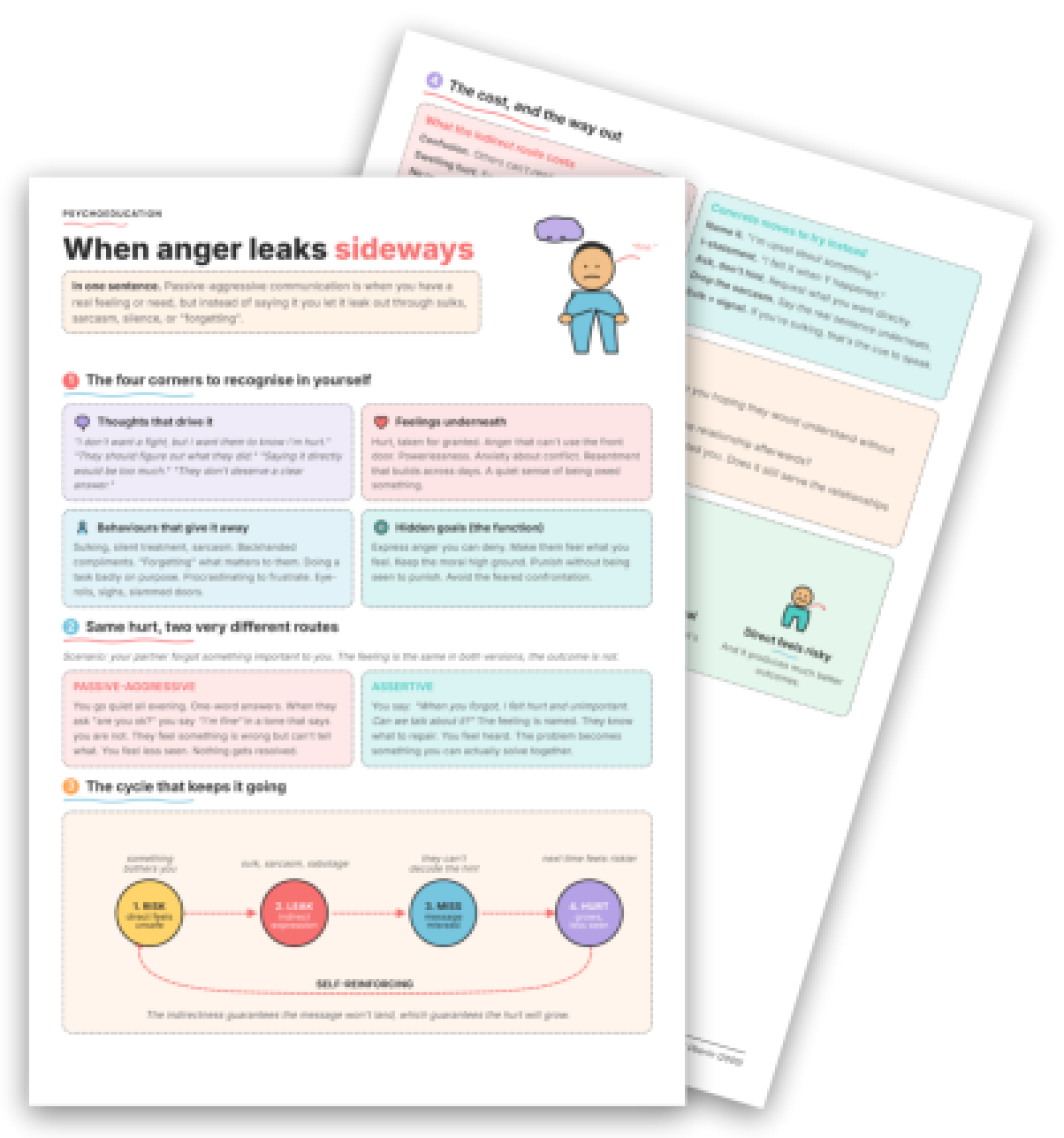
The worksheet opens with a single-sentence anchor: "Passive-aggressive communication is when you have a real feeling or need, but instead of saying it you let it leak out through sulks, sarcasm, silence, or 'forgetting'." That sentence alone tends to land differently when a patient reads it than when they hear it.
The fiche then unfolds across four structured panels:
- The four corners: thoughts driving the behaviour ("They should figure out what they did"), feelings underneath (hurt, powerlessness, resentment), observable behaviours (sulking, backhanded compliments, deliberate procrastination), and hidden goals (preserve the moral high ground, punish without visibility).
- Side-by-side route comparison: the same scenario (a partner forgets something important) played out through a passive-aggressive response versus an assertive communication response. The contrast makes concrete what stays stuck versus what becomes repairable.
- The self-reinforcing cycle: a four-step loop (risk, leak, miss, hurt) showing how indirectness guarantees the message will be misread, and how each failed hint raises the perceived risk of direct expression.
- Cost and concrete moves: five specific behavioural alternatives (naming the feeling, using I-messages, dropping the sarcasm and saying the real sentence underneath) alongside three structured reflection questions for the patient to revisit between sessions.
The visual layout does work that oral formulation cannot: a patient can hold the cycle diagram and trace their own recent episode around it in real time, which activates self-observation rather than defensiveness. The side-by-side comparison is particularly useful with couples, where each partner can see the same scenario from two distinct communication trajectories.
Key clinical point: this fiche is not a self-report questionnaire. It is a visual psychoeducation support designed for the clinician to walk through in session, building a shared vocabulary around a pattern the patient has rarely seen mapped so explicitly.
750+ clinical tools
A library built with and for clinicians, ready to use in session and to keep the work going between appointments.
Get access to every toolHow and When to Introduce It in Session
The fiche fits naturally in the mid-formulation phase of treatment, once the therapeutic alliance is established and you have observed indirect communication in the clinical material, in how the patient describes a relational conflict, or in the session itself.
You can introduce it without labelling the patient: "I want to show you a pattern I think might be relevant to what you described last week. Have a look at this and tell me if any of it resonates." That framing invites curiosity rather than triggering shame. Pair it with work on the anger iceberg if the primary presentation involves unexpressed anger, or with communication styles if you are mapping the full spectrum from passive through to aggressive communication.
For patients with relational conflict at the centre of their presentation, the fiche integrates cleanly with assertiveness tools, vulnerability expression exercises, or the fair fighting rules worksheet. In couples work, it complements nonviolent communication frameworks and resources on beliefs that damage relationships.
The three reflection questions at the bottom of the fiche ("What were you hoping they would understand without you saying it?") can be assigned as structured homework. Debrief them in the following session by asking what the patient noticed, not what they concluded: the observational stance is the first step out of the cycle.
One limit worth noting: for patients with significant social anxiety or trauma-based conflict avoidance, the "direct feels risky" section of the fiche needs to be met with validation before any behavioural prescription. Name the developmental logic explicitly. The fiche itself prompts this: "If direct expression wasn't safe growing up, this style once protected you." Use that line as a door into schema-level work rather than skipping straight to the concrete moves.
The fiche does not replace the case formulation. It makes one part of it visible enough to work with.
Use it with your patients
Share this tool through the patient app and follow their work between sessions.
Sources
- Schanz, C. G., Equit, M., Schäfer, S. K., Käfer, M., Mattheus, H. K., & Michael, T. (2021). Development and Psychometric Properties of the Test of Passive Aggression. Frontiers in Psychology, 12, 579183.
- Wetzler, S. (1992). Living with the Passive-Aggressive Man. Simon & Schuster.
- Rohner, J., & Schutz, A. (2024). Psychology of Communication. Springer.
Your sessions carry on in your patients' pockets
Use it with a patientYour resources, wherever your patients are
From handouts to tests, you choose which resources your patients can access, right in their own mobile app.
And much more than a library
The app goes well beyond resources to support your patients every day:
Related categories
Explore other clinical resources by category.

Identity
Clinical resources for self-identity work in therapy: CBT, ACT, schema tools for clinicians addressing self-concept, core beliefs, and identity disruption.

Emotions
Clinical resources on emotion regulation: worksheets, coping tools, CBT, REBT, and ACT exercises for therapists working across diagnoses and age groups.

Relationships
Clinical worksheets and tools on relational functioning: attachment, schemas, assertiveness, and communication skills for therapists. Printable PDF resources.

Understand
Clinical hub for the therapeutic aim 'Understand': worksheets and tools to build patient insight across CBT, ACT, schema therapy and more.

Build awareness
Clinical worksheets and tools to build awareness in therapy: cognitive distortions, schemas, emotions, ACT and CBT resources for practitioners.

CBT
CBT worksheets, cognitive restructuring exercises & behavioral tools for clinicians. Evidence-based resources for every phase of cognitive behavioral therapy.