
Clinical picture. T., a 13-year-old referred for low mood and school refusal, arrived at session three with a completed first page of the worksheet, having filled in "I am useless" without prompting. The clinician used the Sam and Logan vignettes on the sheet as a stepping stone, asking T. to explain how those fictional peers had arrived at their conclusions before turning the same question back to his own life. T. identified being kept down a year and his father's repeated comparisons to an older brother as the events behind his sentence. By the end of the session he could articulate, in his own words, that the sentence described what had happened to him rather than what he was. No global shift in self-concept occurred, but he agreed to return the following week to map the timeline of experiences more fully.
What Do People Think About Themselves? PDF Worksheet, Tools and Exercises
A printable visual support to help clinicians explain how negative self-beliefs form, persist, and change, designed for work with children and young people.
Clinical vignettes
Externalising the 'I Am' Sentence
Tracking a Core Belief to Its Source
Clinical picture. R., a 15-year-old presenting with persistent anxiety and social withdrawal, struggled in early sessions to name any negative self-belief, describing her difficulties only as "just feeling wrong around people." The clinician introduced the worksheet and read the Sally scenario aloud, inviting R. to speculate on what sentence Sally might carry. R. immediately said "she'd think she's never going to be enough," then paused and added quietly, "that's mine too." Exploration over the next two sessions linked the belief to years of unfavourable comparisons made by a parent and a peer group that had excluded her in primary school. The worksheet gave R. a shared vocabulary for distinguishing the originating events from the meaning she had constructed, which eased subsequent cognitive work without overstating the speed of change.
Explaining negative core beliefs to a young person in words alone rarely produces the epistemic shift you are looking for. They nod, or they push back, but the idea that "I am stupid" is a learned conclusion rather than a fact tends not to land without a concrete visual to anchor it. This fiche PDF is built exactly for that moment, giving you a two-page psychoeducation scaffold to work through with the patient in session.
Use this resource with your patients
Handout, exercises and materials ready to use, right inside SessionFuel.
Why "I Am ___" Beliefs Resist Oral Explanation
The clinical difficulty is not conceptual, the mechanism of belief formation is well established, from Beck's work on early experience to the early maladaptive schemas framework Young developed. The difficulty is phenomenological. For a young patient, "I am a problem" does not feel like a hypothesis; it feels like evidence. Asking them directly to examine their deepest self-beliefs activates the very maintaining processes the belief runs on: the filter that notices only confirming data, the avoidance that prevents disconfirmation, and the globalizing label that turns one bad moment into a personality verdict.
Direct verbal questioning can inadvertently reinforce rather than loosen the belief. The fiche solves this by approaching the first-person question through a third-person detour.
750+ clinical tools
A library built with and for clinicians, ready to use in session and extend between appointments.
Access all the toolsWhat the Fiche Contains: A Visual Scaffold for Belief Work
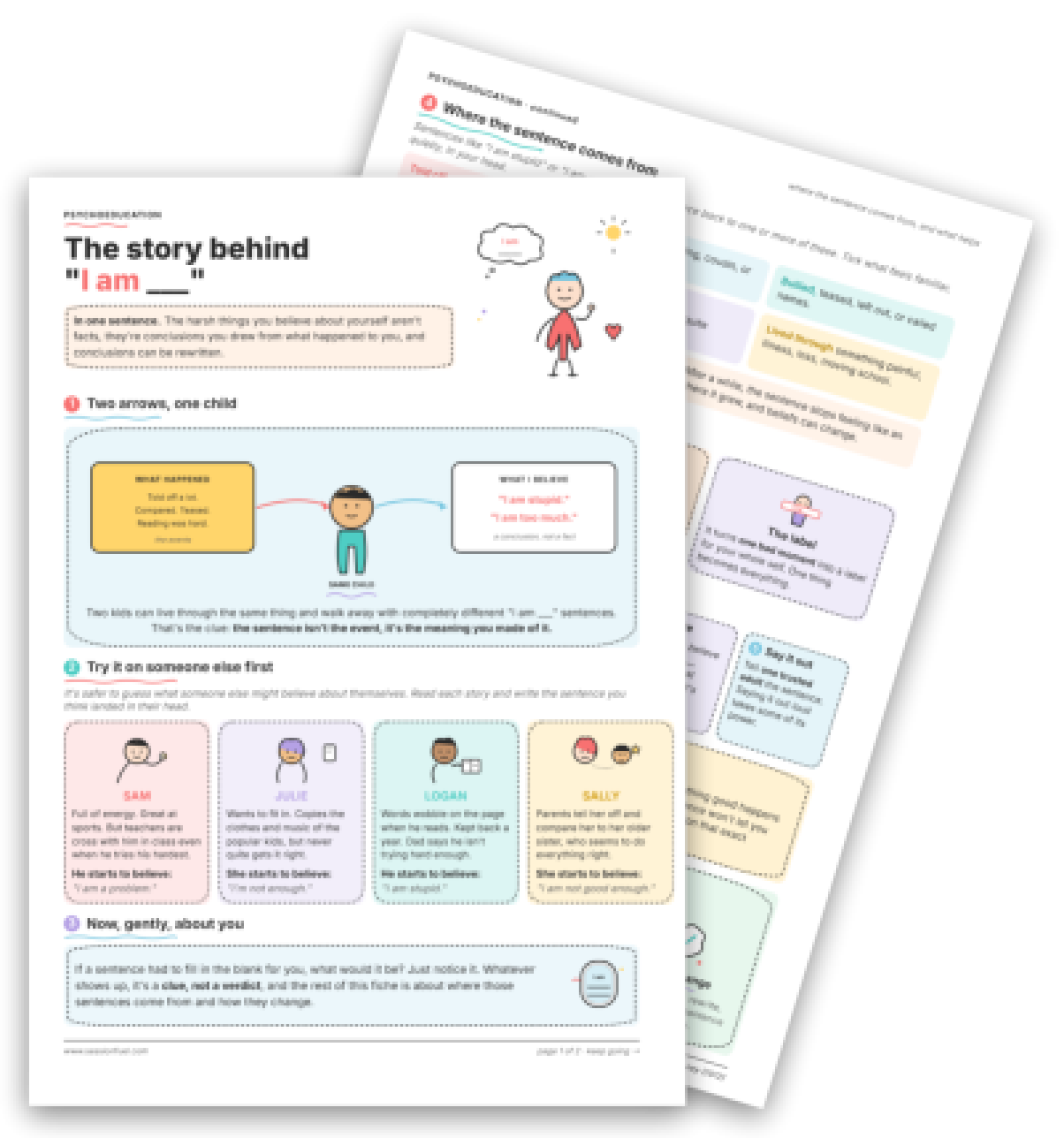
The resource spans two pages and six sequenced panels, moving deliberately from observer to subject.
Panel 1, "Two arrows, one child," uses a split diagram showing that the same cluster of events, being told off, struggling to read, being compared to a sibling, produces a belief in one arrow and the bare events in the other. The phrase printed beneath the example is precise: "a conclusion, not a fact." That phrase is worth borrowing verbatim in session; patients often return to it.
Panel 2, "Try it on someone else first," is the fiche's central clinical device. Four brief vignettes, Sam, Julie, Logan, Sally, each describe a relatable experience, with a blank sentence for the patient to complete: "He starts to believe: ___." Working with fictional characters first externalizes the mechanism. Patients who would deflect a direct question often engage readily with what Logan or Julie "starts to believe." This is the same scaffolding principle used in resources like CBT for Kids: Thoughts, Feelings & Actions, and it works for the same reason: third-person distance reduces shame activation.
Panel 3 pivots: "If a sentence had to fill in the blank for you, what would it be?" The shift is gradual enough that many patients complete it without full defensive withdrawal.
Panels 4 and 5 map, in visual columns, where the sentence comes from (a ticked checklist covering teasing, comparison, parental disappointment, loss, academic struggle) and why it persists through three named mechanisms: the filter, the avoid, the label. This is schema maintenance territory, covering ground similar to dedicated resources on schema maintenance vicious cycles and Fennell's CBT model of low self-esteem, but rendered in language accessible to a twelve-year-old.
Panel 6, "Five things that help," closes with concrete micro-strategies: catching the sentence, the friend test, building a counter-list, a rewrite template ("I learned to believe ___ because ___ happened. That doesn't mean it's true about me"), and naming it to a trusted adult.
> To remember: This fiche is a visual support that facilitates the explanation of "I am ___" beliefs in session. It is not a questionnaire for the patient to complete at home alone. It is a psychoeducation scaffold the clinician works through with the patient, making the formation, maintenance, and modifiability of self-beliefs visible on paper at the same time as they are discussed aloud.
Use it with your patients
Share this tool in the mobile app and follow the work between sessions.
When and How to Introduce It
The fiche fits naturally once the therapeutic alliance is established and the presenting picture has been mapped, typically sessions 2 to 4 in a CBT-informed youth protocol. For patients already working with core beliefs about self, others, and world, it extends that groundwork into concrete formative history. For those earlier in therapy, it pairs well with a belief-o-meter for children to calibrate conviction levels before and after.
A simple framing when introducing it: "I want to show you something about how kids end up thinking certain things about themselves, not because of who they are, but because of what happened to them. We'll look at it together." Positioning it as a shared reading task, not a self-assessment, reduces avoidance.
Work through Panel 2 collaboratively first. The quality of the pause when Panel 3 lands, its length, any deflection, is often more clinically informative than what the patient eventually writes. From there, Panel 4's checklist becomes a formulation tool: connecting the patient's own sentence to specific experiences makes the belief's origins concrete, not abstract.
This material feeds directly into later cognitive restructuring work, including restructuring a negative core belief and the formal downward arrow technique. The exercise on tracing the origin of core beliefs and the clarifying a core belief homework task sit naturally downstream. Monitoring belief strength over time can be tracked with scaling beliefs about yourself.
For patients with significant shame activation or a presentation consistent with a defectiveness/shame schema, slow Panel 2 down and do not press Panel 3 in the same session. Splitting the two pages across consecutive appointments is a legitimate clinical choice. The fiche leaves the patient with a vocabulary they can carry back between sessions: "the filter," "the avoid," "the label." When those terms reappear in their own language, that is the formulation taking hold.
Your session continues in your patients' pocket
Use with a patientYour resources, available everywhere
The handouts, exercises, programs and audios above: you choose which ones to make available to your patients, in the mobile app dedicated to them.
And far more than a library
The app goes well beyond resources, to support your patients every day:
Related categories
Explore other clinical resources by category.
Trauma
Clinical hub on trauma and PTSD: assessment, differential diagnosis, treatment phases, and printable resources for practitioners. 155 chars.

Identity
Clinical resources for self-identity work in therapy: CBT, ACT, schema tools for clinicians addressing self-concept, core beliefs, and identity disruption.

Understand
Clinical hub for the therapeutic aim 'Understand': worksheets and tools to build patient insight across CBT, ACT, schema therapy and more.
Build awareness
Clinical worksheets and tools to build awareness in therapy: cognitive distortions, schemas, emotions, ACT and CBT resources for practitioners.
CBT
CBT worksheets, cognitive restructuring exercises & behavioral tools for clinicians. Evidence-based resources for every phase of cognitive behavioral therapy.
Compassion-focused
CFT clinical tools for practioners: exercises, programs and guided audio on shame, self-criticism, guilt and self-compassion. Ready to use in session.