
Positive Psychology: Clinical Resources for Evidence-Based Practice
Positive psychology, the scientific study of well-being, strengths, and human flourishing, has moved well beyond its early popularisation to become a recognised therapeutic orientation with a robust empirical base. This page is addressed to clinicians who integrate positive psychology interventions (PPIs) into individual therapy, couples work, or group programmes and are looking for structured, ready-to-use tools. The resources gathered here span worksheets, guided exercises, and multi-session psychoeducation programmes that translate core constructs, such as gratitude, goal-setting, resilience, and growth mindset, into concrete clinical moments. Each tool has been designed to complement, not replace, your formulation and to be adapted to the specificities of each case.

From Deficit Models to a Strengths-Based Framework
The historical dominance of pathology-focused models in clinical psychology left a systematic gap: suffering was described with precision, but conditions for thriving were largely underspecified. Positive psychology, formalised by Seligman and Csikszentmihalyi at the turn of the millennium, proposed a complementary axis, one concerned with identifying and cultivating the psychological resources that buffer against disorder and promote sustainable well-being. The PERMA model (Positive emotions, Engagement, Relationships, Meaning, Accomplishment) remains a useful clinical organiser, even for practitioners who do not adhere to it dogmatically.
In practice, a strengths-based frame does not imply minimising distress. Rather, it adds a second dimension to the formulation: alongside vulnerability factors and maintaining mechanisms, the clinician maps character strengths, functional coping assets, and domains of vitality. This dual focus is particularly productive in chronic presentations where pathology-centred work alone risks reinforcing an identity organised around deficit.
Empirical Status of Positive Psychology Interventions
Meta-analyses (Bolier et al., 2013; Sin & Lyubomirsky, 2009) document moderate effect sizes for PPIs on well-being outcomes and small-to-moderate effects on depressive symptoms in non-clinical and subclinical samples. Effects are larger when interventions are therapist-guided rather than self-administered, when they are tailored to individual strengths profiles, and when they are embedded in a broader treatment plan. The clinical implication is clear: structured tools matter more when the clinician actively frames them, debriefs them, and links findings to the formulation.
Identifying the Right Entry Points in Session
Clinical Indicators for a Positive Psychology Lens
No presenting problem is in itself a contraindication for positive psychology work; the question is one of timing and dosage. Strengths-based interventions tend to be particularly indicated when the patient presents with a pervasive negative self-narrative, persistent anhedonia without acute crisis, motivational flatness, or a history in which previous gains were not consolidated. In couples work, the ratio of positive-to-negative interactions (Gottman's concept) often flags the need to explicitly rebuild positive registers before conflict work can proceed.
Clinically relevant signals include the patient's difficulty generating any recent memory of competence or pleasure, or an automatic attribution style that externalises successes and internalises failures. These patterns call for structured work on self-efficacy beliefs and on broadening attentional scope toward positive experience, both of which are operationalised in the resources below.
Differential Considerations and Comorbidity
Positive psychology tools are not a treatment for acute major depressive episode with melancholic features, active psychosis, or acute trauma. Attempting gratitude exercises with a patient in acute grief or severe anhedonia without careful framing can be iatrogenic, producing shame or a sense of failure. The clinician must assess hedonic capacity before prescribing any exercise centred on positive affect generation.
With dysthymia, mild-to-moderate depressive episodes, and chronic low self-esteem, however, the incremental introduction of PPIs alongside evidence-based protocols (CBT, ACT, interpersonal therapy) is well-supported. In these presentations, resources such as Celebrating Progress in Depression: A Guided Exercise and My Fight Against Depression: A Guided Exercise for Clinicians help reorient attentional bias without bypassing the patient's pain.
Core Constructs and the Resources That Operationalise Them
Gratitude and Positive Emotion Broadening
Gratitude interventions are among the most replicated PPIs, with evidence for effects on positive affect, relationship satisfaction, and reduced envy. The mechanism, consistent with Fredrickson's broaden-and-build theory, is that repeated intentional attention to positive events expands the cognitive-attentional repertoire and builds social capital. In individual therapy, Cultivating Positivity: A Daily Gratitude Exercise for Therapy structures this practice in a format designed for debriefing in session.
In couples therapy, gratitude work addresses a specific relational dynamic: the habituation effect that erodes perceived partner value over time. Cultivating Gratitude and Appreciation in Couples Therapy targets exactly this mechanism, asking each partner to actively reconstruct the positive relational register. This exercise pairs naturally with Keeping the Flame Alive: A Guided Exercise for Couples when the presenting concern involves relational flatness or loss of intimacy.
Self-Concept, Strengths, and Future Orientation
Future-self visualisation, particularly the Best Possible Self (BPS) technique, produces reliable short-term increases in optimism and positive affect. Its mechanism involves prospective mental simulation, which activates approach motivational systems without the cognitive restructuring load of traditional CBT techniques. Best Possible Self: PDF Worksheet, Tools and Exercises for Clinical Practice gives this exercise a structured clinical format, including debriefing prompts.
For patients whose self-concept is rigidly negative or who hold fixed beliefs about their own capacity, Adopting a Growth Mindset: PDF Worksheet, Tools and Exercises for Clinical Practice introduces Dweck's growth-versus-fixed mindset framework in a therapeutically usable form. This is particularly productive in adolescents, in patients with academic or professional performance anxiety, and following setbacks. The exercise on Holistic Self-Concept: A Guided Uniqueness Exercise works on a complementary axis, broadening the patient's self-definition beyond symptomatic or role-based identity.
Acknowledging gains without minimising them is a persistent clinical challenge in low self-esteem presentations. Celebrating Successes: A Guided Self-Esteem Exercise structures this work and helps counteract the discounting of positives that characterises many depressive and anxious presentations. For patients reporting pervasive uselessness, Feeling Useless: A Guided Exercise for Clinical Practice provides a targeted entry point into this theme.
Goal-Setting and Motivational Work
Values-Aligned Goal Construction
Goal-setting sits at the intersection of positive psychology and motivational science. Self-determination theory (Deci & Ryan) specifies that goals anchored in intrinsic motivation and aligned with personal values produce greater sustained effort and well-being than externally imposed targets. In clinical work, this means the goal-setting process itself has therapeutic value: it clarifies values, reveals avoidance patterns, and surfaces ambivalence.
For near-term horizon work, Setting 6 and 12-Month Goals: A Guided Clinical Exercise structures achievable, values-consistent goal-setting with scaffolding for obstacle anticipation. For longer-horizon exploration, 10-Year Goal Projection: A Clinical Exercise for Values Work opens a different cognitive register, one less constrained by current symptoms and better suited to identity and meaning work. These two tools are sequenced naturally: short-horizon goals build confidence and momentum; long-horizon projection aligns action with the patient's deepest values.
Motivational Dips and Work-Life Domains
Losses of motivation are among the most common reasons a therapy episode stalls or a patient disengages. Motivational Dips in Practice: A Guided Clinical Exercise helps the clinician and patient jointly analyse the specific structure of the motivational failure, distinguishing between hedonic flatness, value misalignment, overload, and fear of failure, each of which calls for a different clinical response.
In the professional and occupational domain, two complementary resources address the work-life interface: Work-Life Balance: A Structured Self-Assessment Exercise offers a broad mapping of investment and satisfaction across life domains, while Work Wellbeing Weekly Check-In: A Guided Clinical Exercise provides an ongoing monitoring format suited to patients in high-stress professional contexts. Professional Life Assessment: A Guided Clinical Exercise extends this work to a fuller career and meaning-at-work appraisal.
Multi-Session Programmes: Building Capacity Over Time
Resilience and Structured Psychoeducation
Positive psychology is perhaps most clinically potent when delivered as a structured programme rather than as isolated exercises. The Resilience Program: A Structured Tool for Your Clinical Work operationalises resilience across multiple sessions, addressing cognitive flexibility, emotional regulation, and social support mobilisation. It is designed for individual use but adapts readily to group formats.
For parents, two programmes address both the relational and skills dimensions of parenting through a positive psychology lens: Parenting Beliefs and Skills: A Psychoeducation Program works on parental self-efficacy and attributional style, while Communicating With Children: A Psychoeducation Program for Parents targets the interactional patterns that either reinforce or undermine a child's developing strengths.
Couples and Sexual Well-Being Programmes
In couples work, a positive psychology frame rebalances the clinical tendency to focus exclusively on conflict and repair. The Long-Term Relationship Program: A Clinical Psychoeducation Tool addresses relational well-being over the full arc of a couple's life, including the positive maintenance behaviours that are routinely neglected under chronic stress.
Sexual well-being, often approached primarily through dysfunction, also benefits from a positive orientation. The Sexual Life: A Four-Session Psychoeducation Program for Couples and the Sexual Desire Check-In: A Guided Weekly Reflection Tool introduce structured attention to desire, pleasure, and relational closeness as positive targets in their own right, not merely the absence of difficulty.
Integrating Positive Psychology Resources into the Care Plan
Sequencing and Dosing in Individual Therapy
A cardinal principle: PPIs are not homework fillers. Each tool should be introduced with a clear clinical rationale tied to the formulation, completed between sessions with a defined observational task, and debriefed in the subsequent session. The following sequencing logic often applies:
- Assessment phase: Use broad self-assessment tools (work-life balance, professional life, self-concept exercises) to map the patient's current well-being landscape and identify strengths.
- Skill-building phase: Introduce daily practices (gratitude, growth mindset, progress tracking) with short feedback loops to build evidence of capacity.
- Projection phase: Move to longer-horizon exercises (Best Possible Self, 6/12-month goals, 10-year projection) once the patient has accumulated some experiential evidence of their own agency.
- Consolidation phase: Use celebrating-successes and resilience programme materials to anchor gains and prepare for ending.
Points of Vigilance and Limits
Several failure modes deserve explicit clinical attention. First, toxic positivity: framing that inadvertently communicates that negative affect is unacceptable. PPIs should always be presented as expanding the patient's repertoire, not as injunctions to feel better. Second, cultural variation in the construal of individual flourishing is significant: goal-setting and self-concept exercises carry assumptions about autonomy and individual agency that may not map onto the patient's cultural context. Adaptation is the clinician's responsibility, not the tool's.
Finally, positive psychology resources work best when embedded in a coherent formulation and a trustworthy therapeutic alliance. A gratitude exercise introduced too early in a relationship characterised by mistrust, or prescribed without sensitivity to the patient's current capacity, will be experienced as minimising. The tools in this category are clinically productive in the right hands, at the right moment, with the right patient.
Tools in this category

Handout
Social Support: PDF Worksheet, Tools and Exercises for Clinical Practice
A structured visual PDF worksheet to help clinicians explain the four types of social support, dismantle help-seeking barriers, and build a workable network with patients in session.
RelationshipsEmotions & stress

Handout
Sources of Workplace Stress: PDF Worksheet, Tools and Exercises
A visual PDF worksheet and practical tools to help clinicians name the five sources of occupational stress in session, shift self-blame, and map concrete actions with patients.
Emotions & stressLife transitions
Handout
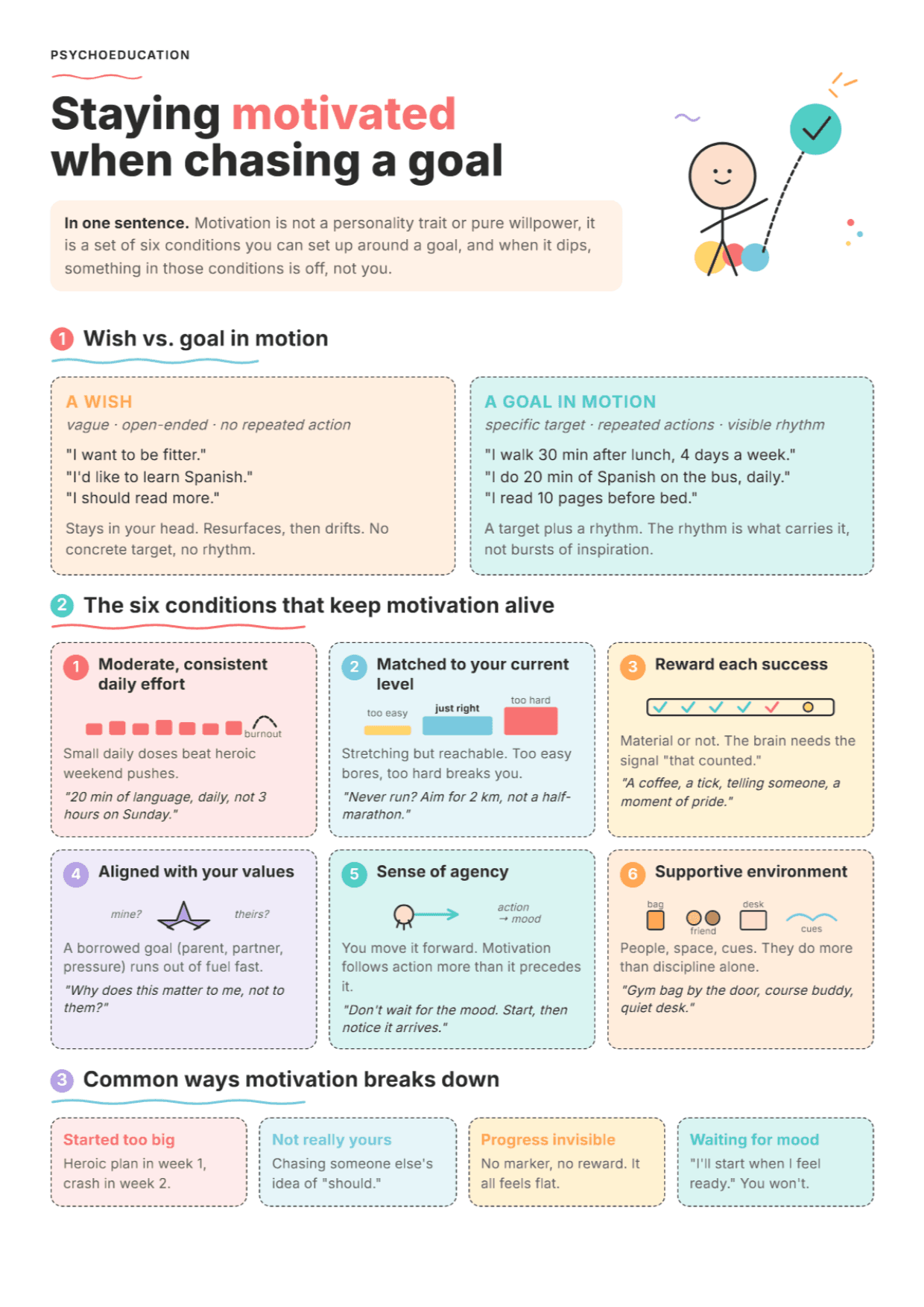
Staying Motivated: PDF Worksheet, Tools and Exercises for Clinical Practice
A structured PDF worksheet with tools and exercises to explain the six conditions of sustainable motivation, identify what has broken down, and give patients a concrete lever to adjust this week.
Self & identityLife transitions
Handout
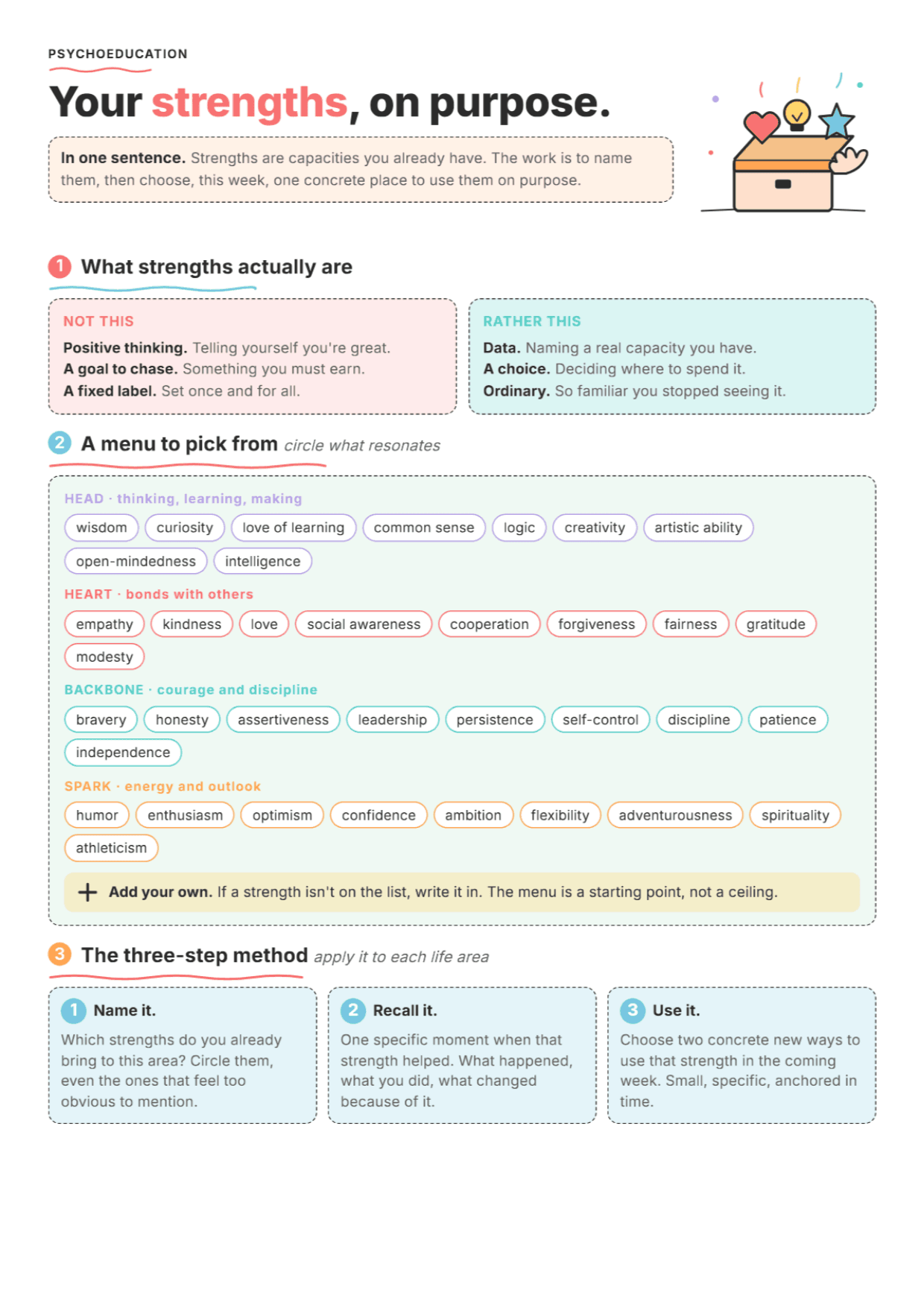
Strengths Exploration: PDF Worksheet, Tools and Exercises for Clinical Practice
A printable PDF worksheet with concrete tools and exercises helping clinicians guide patients through naming, recalling, and deliberately applying their personal strengths.
Self & identityLife transitions
Handout
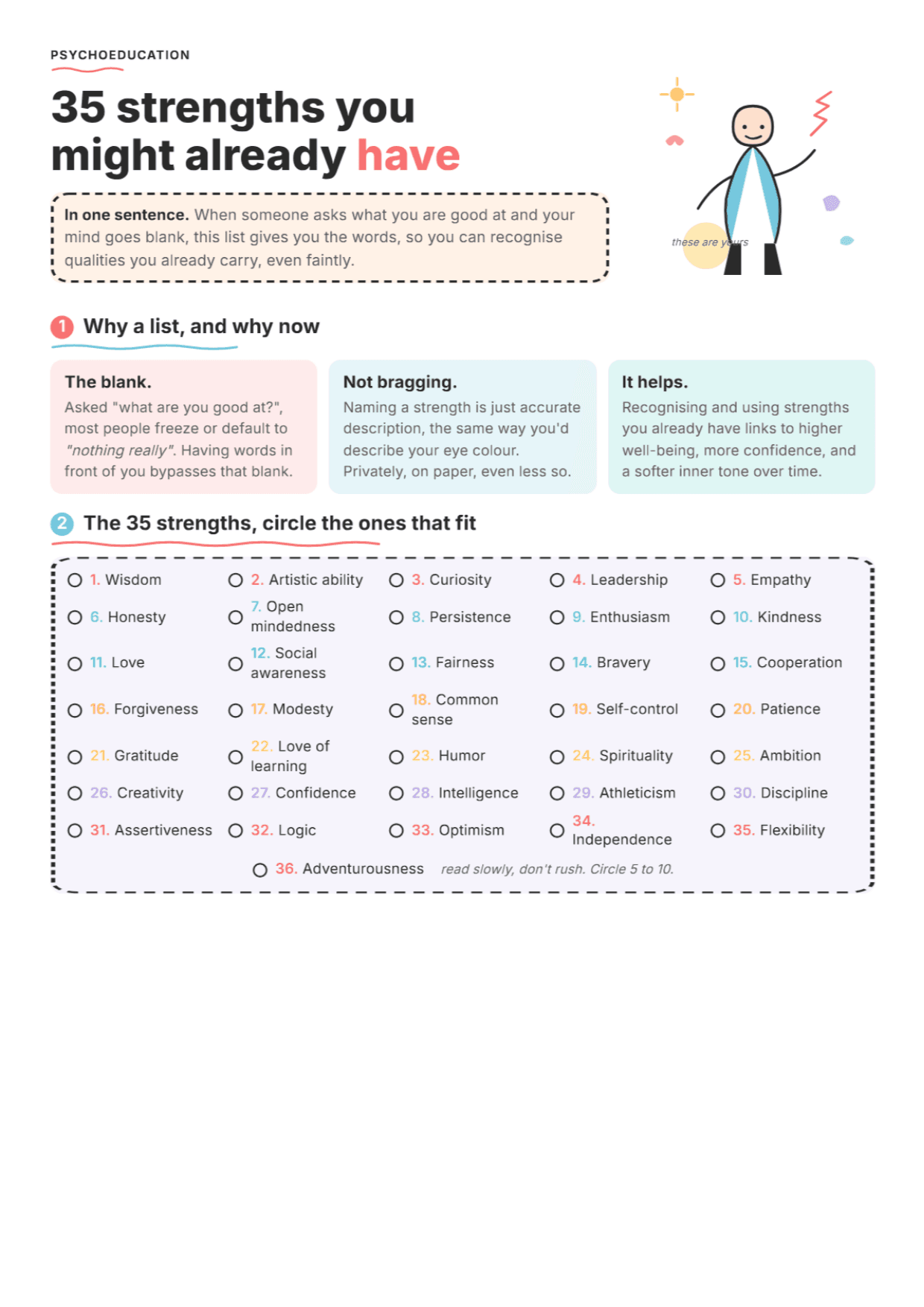
Strengths List: PDF Worksheet, Tools and Exercises for Clinical Practice
A printable PDF worksheet clinicians can use in session to break through the 'blank' patients hit when asked what they are good at, with 35 named strengths and a six-step anchoring process.
Self & identityMood & depression

Handout
Stress Management: PDF Worksheet, Tools and Exercises for Clinicians
A printable PDF fiche, practical tools, and concrete exercises to help clinicians explain everyday stress management clearly in session.
Emotions & stress
Handout
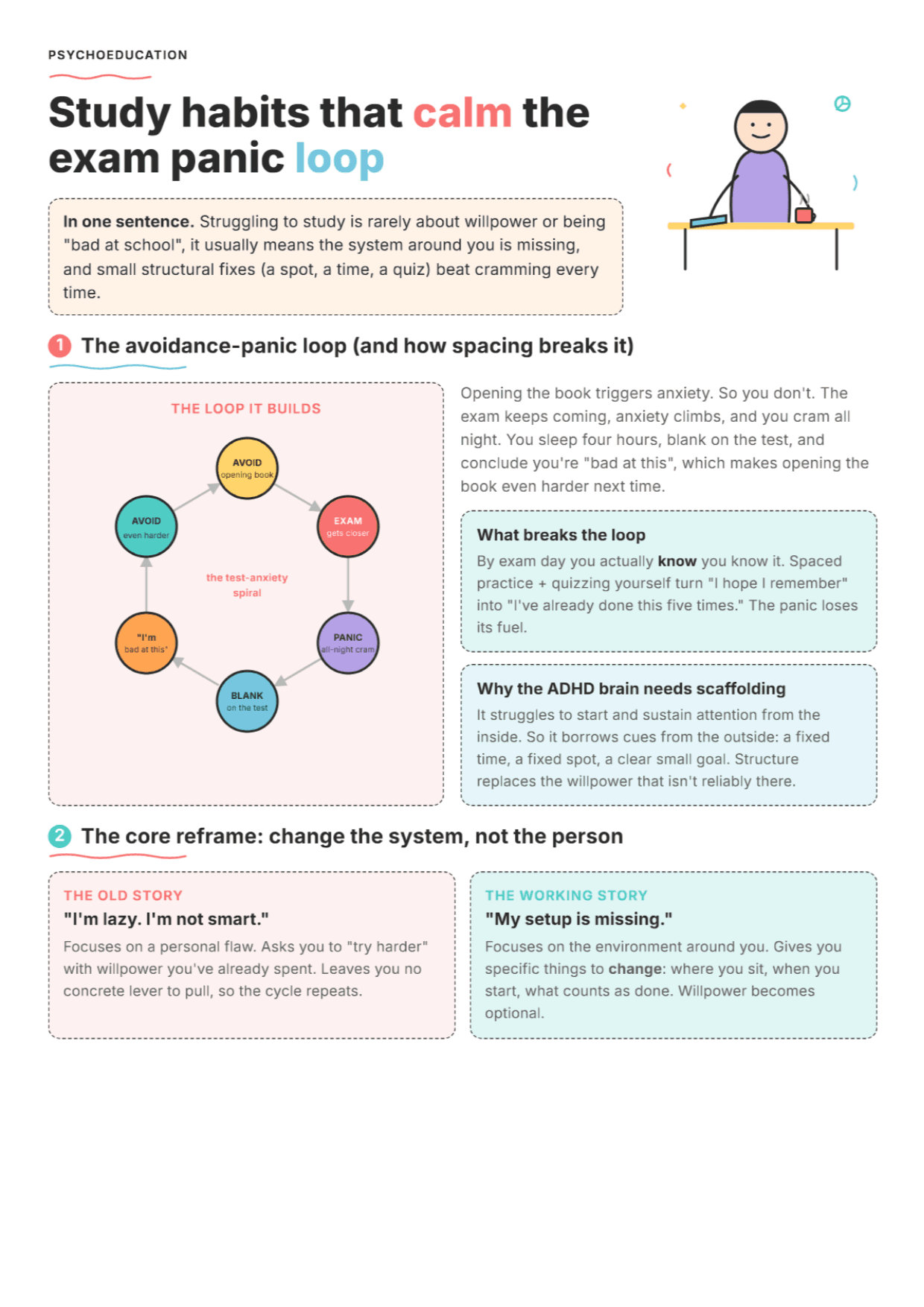
Study Tips for ADHD and Test Anxiety: PDF Worksheet, Tools and Exercises
A printable psychoeducation fiche clinicians can use in session to break the avoidance-panic loop, reframe the 'lazy' narrative, and give ADHD and test-anxious patients concrete structural anchors.
NeurodevelopmentAnxiety
Handout
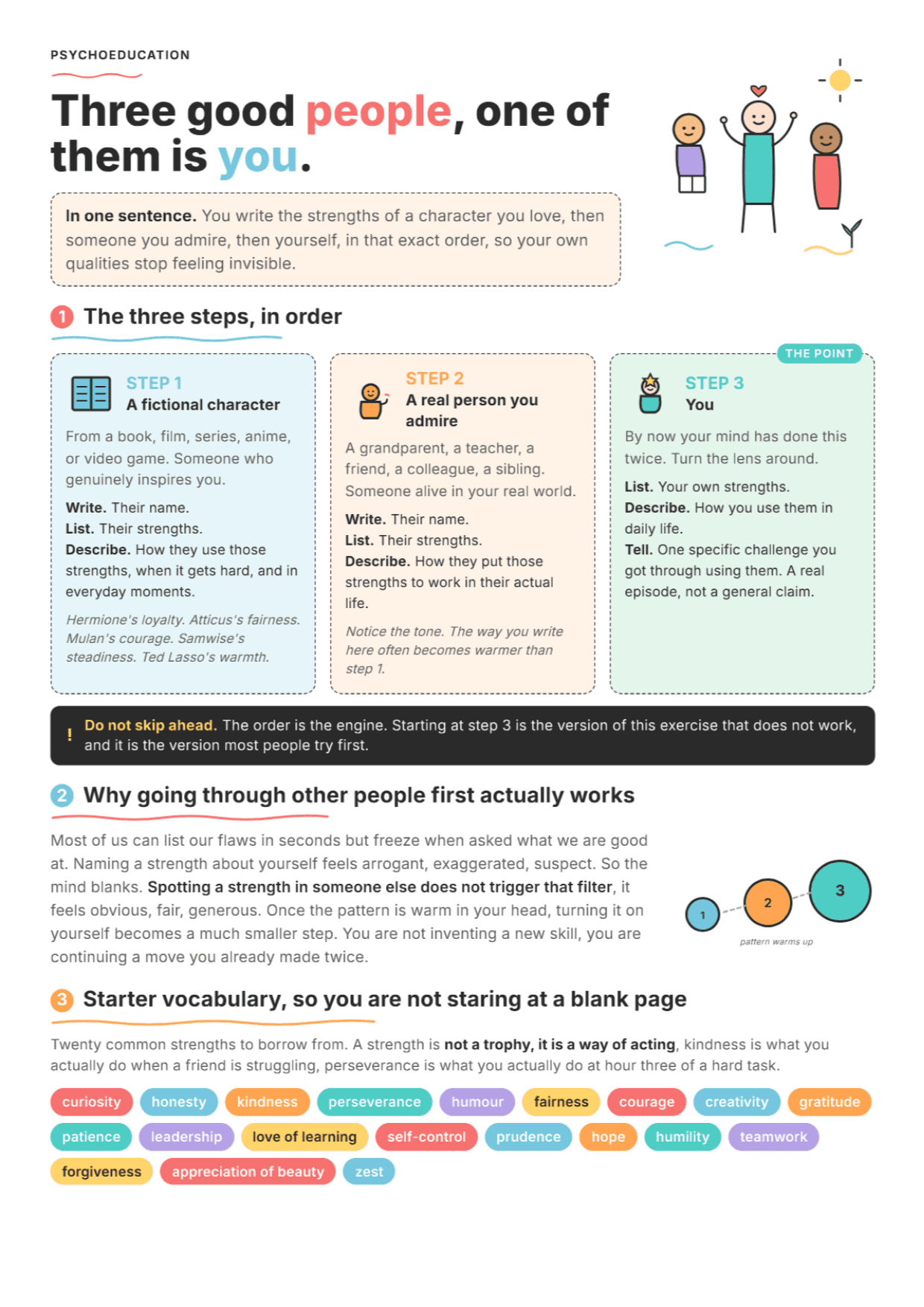
Three Good People: PDF Worksheet, Tools and Exercises for Strengths Spotting
A printable strengths-spotting fiche that uses fictional characters and real-life figures as a warm-up, so patients can finally identify their own qualities in session.
Self & identity

Handout
Three Pillars of Self-Confidence: PDF Worksheet, Tools and Exercises
A visual psychoeducation tool helping clinicians explain self-esteem, self-efficacy, and assertiveness as three distinct, trainable pillars in a single session.
Self & identity