
Clinical picture. A, a woman in her late thirties, presented with persistent low mood and difficulty returning to work after a period of sick leave. She described feeling stuck and doubted that anything had changed. The clinician introduced a scaling question, asking her to rate her functioning over the past week on a zero-to-ten scale; A placed herself at a four, then spontaneously noted she had managed three morning walks. Rather than analysing the underlying mood, the session focused on what had made those walks possible and what a half-point improvement might look like in practical terms. By the end of the session A had identified one specific, observable action for the following week, which she rated as realistic.
Solution-Focused Brief Therapy: PDF Worksheet, Tools and Exercises
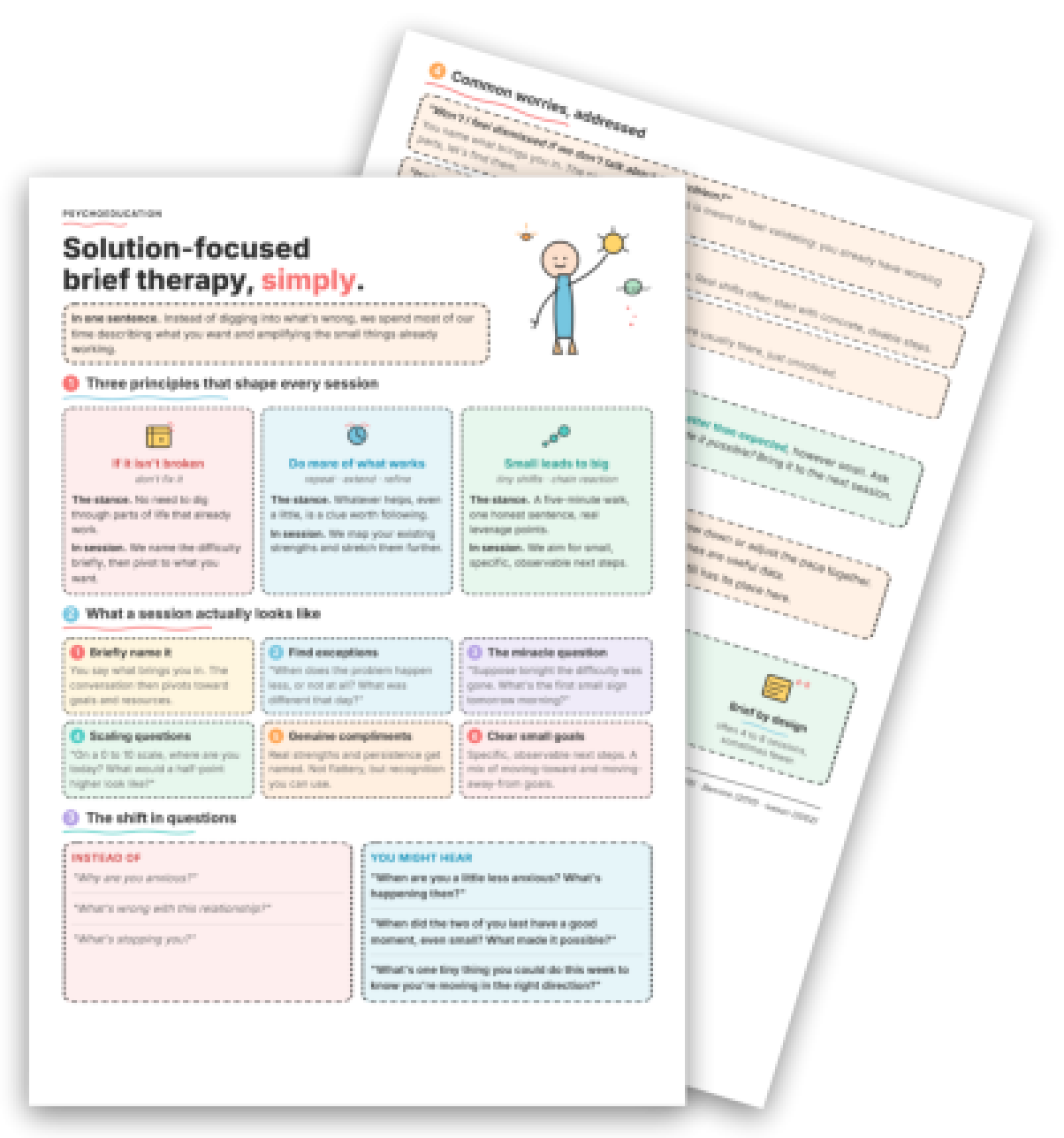
A printable psychoeducation fiche to explain SFBT's core logic visually in session, establish a shared vocabulary, and orient patients toward exceptions and forward-looking goals.
Clinical vignettes
Scaling Questions in Low Mood
Exception-Finding in a Relationship Concern
Clinical picture. B, a man in his mid-forties, sought help for recurring conflict with his adult son, reporting that most interactions ended in arguments. The clinician acknowledged the difficulty briefly, then asked B to describe a recent occasion when the conversation had gone slightly better, even if only marginally. B recalled a shared lunch two weeks prior and began to notice, with some surprise, that he had listened without interrupting. The session mapped what had been different that day and explored whether that behaviour was something B could choose again. No dramatic resolution was reached, but B left with a concrete and modest intention rather than a general resolve to communicate better.
When you introduce solution-focused brief therapy to a patient accustomed to problem-centered work, the phrase "we focus on what's working" often lands as dismissal rather than reorientation. This SFBT PDF fiche gives you a concrete visual support to explain the model's logic in session, before the skepticism takes root.
Use this resource with your patients
Handout, exercises and materials ready to use, right inside SessionFuel.
Why SFBT Is Hard to Explain Without a Visual Anchor
The resistance is predictable. Patients arrive with a problem narrative they have rehearsed, sometimes for years. When you announce that the conversation will pivot toward goals and existing strengths, two things tend to happen: they either agree too quickly without grasping the shift, or they immediately worry their pain isn't being taken seriously. Explaining the miracle question or scaling questions verbally, without any visual frame, is particularly risky. The concepts sound abstract, even gimmicky, to a patient whose attentional bias is entirely problem-focused.
A second difficulty is pacing. SFBT's three core principles, if it isn't broken, don't fix it; do more of what works; small leads to big, form a coherent logic that takes three to four minutes to articulate out loud, but that a patient can absorb at a glance when laid out visually side by side. Without that scaffold, you spend the early sessions re-explaining your own stance rather than building the alliance thérapeutique and gathering exception data.
What the Fiche Contains and What the Visual Layout Adds
The fiche is structured across seven panels, all grounded in de Shazer and Berg's original framework. It opens with a one-sentence summary of the model's stance, then presents the three guiding principles in a column layout, each pairing a clinical stance ("No need to dig through parts of life that already work") with its in-session translation ("We name the difficulty briefly, then pivot to what you want"). This two-row structure is doing real work: it distinguishes philosophy from technique, a confusion that often derails psychoeducation when the explanation stays oral.
Panel 2 maps the six steps of a session in sequence: briefly naming the presenting difficulty, identifying exceptions, the miracle question, scaling questions, genuine compliments, and defining small observable goals. Having this sequence printed gives you something to point to when a patient asks "where are we going?", which is far more reassuring than a verbal overview.
Panel 3 is arguably the most clinically useful: "The shift in questions." It presents three direct contrasts, for example, "Why are you anxious?" versus "When are you a little less anxious? What's happening then?", that make the SFBT questioning stance concrete and non-threatening. Reading the contrast columns together shows patients exactly what different from the questions they expect. No verbal explanation achieves that as efficiently.
Panel 4 addresses the three most common patient worries (dismissal, superficiality, no exceptions to find) with brief, grounded answers. Panel 5 introduces a simple between-session practice: each evening, notice one moment that went slightly better than expected and ask what made it possible. Panel 6 gives the patient explicit permission to slow things down if the forward-facing questions feel strange, a disclosure prompt that protects the working alliance. The fiche closes with four "Remember" anchors, including "Brief by design: often 4 to 8 sessions, sometimes fewer," which manages expectations from the outset.
> Key takeaway: This fiche is a visual support that facilitates the explanation of SFBT in session. It is not a self-administered questionnaire. You use it alongside the patient to build shared vocabulary and reduce the early resistance that sinks the model before it starts.
Clinical library
750+ clinical tools
A library built with and for clinicians, ready to use in session and extend between appointments.
Access all the toolsSeveral resource types
Psychoeducation handouts
Understand at a glance
Interactive exercises
To do and fill in
Interactive programs
A structured path
Audios
Meditation and relaxation
Psychometric tests
Automatic scoring
When and How to Introduce It in Session
The fiche fits best at the end of session one or the opening of session two, once you have completed a brief anamnèse and signaled the approach you are proposing. A natural framing: "I'd like to show you how we'll work together, this sheet maps what a session typically looks like and addresses a few questions you might already have."
It works across a wide range of presentations: adjustment difficulties, mild to moderate depression where behavioral activation strategies have stalled, anxiety disorders where avoidance cycles are entrenched, and brief interventions in primary care settings. It is especially well-suited to patients in the contemplation or preparation stage, where motivational interviewing tools have already opened the door to change. For more complex presentations with high chronicité or significant schema involvement, use it as a complement to a fuller case formulation rather than a standalone frame.
Patients who report having no exceptions at all deserve particular attention during the debrief. The fiche itself names this as normal ("Exceptions are usually there, just unnoticed"), which you can use to normalize the impasse without abandoning the model. Pairing the session work with strengths exploration or a best-possible-self exercise can surface the exception data the patient couldn't access directly. For goal-setting work that follows naturally from SFBT's forward-facing stance, SMART goals tools and life goals across eight domains both extend what the fiche initiates.
The fiche does not replace the therapeutic frame. It makes the first explanation clearer and leaves the patient with a concrete reference between sessions.
Use it with your patients
Share this tool in the mobile app and follow the work between sessions.
Sources
- de Shazer, S. (1985). Keys to Solution in Brief Therapy. W. W. Norton.
- De Jong, P., & Berg, I. K. (2013). Interviewing for Solutions (4th ed.). Brooks/Cole, Cengage Learning.
- Franklin, C., Ding, X., Kim, J., Zhang, A., Hai, A. H., Jones, K., Nachbaur, M., & O'Connor, A. (2024). Solution-Focused Brief Therapy in Community-Based Services: A Meta-Analysis of Randomized Controlled Studies. Research on Social Work Practice, 34(3).
- De Jong, P. (2019). A Brief, Informal History of SFBT as Told by Steve de Shazer and Insoo Kim Berg. Journal of Solution Focused Practices, 3(1), Article 5.
Patient mobile app
Your session continues in your patients' pocket
Use with a patientYour resources, available everywhere
The handouts, exercises, programs and audios above: you choose which ones to make available to your patients, in the mobile app dedicated to them.
Psychoeducation handoutsInteractive exercisesInteractive programsAudiosPsychometric tests
And far more than a library
The app goes well beyond resources, to support your patients every day:
Standardized tests
Therapy journal
Gamification
Wellbeing challenges
Introspection prompts
Therapist homework
Related categories
Explore other clinical resources by category.

Transitions
Clinical hub for life transitions: tools, worksheets and exercises to support psychosocial adjustment, role change and identity work in practice.

Understand
Clinical hub for the therapeutic aim 'Understand': worksheets and tools to build patient insight across CBT, ACT, schema therapy and more.

Engage & motivate
Clinical hub: printable worksheets and exercises to build therapeutic engagement and motivation across ACT, CBT, and integrative practice. For clinicians.

Solution-focused
Clinical hub for Solution Focused Therapy resources: worksheets, exercises and programs for goal-oriented, strengths-based practice across individual and couple work.

Anxiety
Clinical hub for anxiety disorders: CBT and ACT worksheets, psychoeducation sheets, and exercises for assessment and treatment across the anxiety spectrum.

Trauma
Clinical hub on trauma and PTSD: assessment, differential diagnosis, treatment phases, and printable resources for practitioners. 155 chars.