
Cognition in Clinical Practice: Worksheets and Tools for Therapists
Cognition, broadly defined as the set of mental processes governing how patients perceive, interpret, and respond to experience, sits at the core of most evidence-based psychotherapies, whether you are working within cognitive-behavioural therapy, acceptance and commitment therapy, or schema-focused approaches. This page is designed for clinicians seeking structured, printable resources to support cognitive work across a wide range of presentations: anxiety disorders, mood disorders, eating disorders, relational difficulties, and beyond. The worksheets, psychoeducation sheets, and clinical exercises gathered here cover the full arc of cognitive intervention, from initial identification of dysfunctional thought patterns through to advanced defusion and flexibility work.

Why Cognition Remains Central to Psychotherapy
Cognitive processes, including automatic thoughts, core beliefs, schemas, and metacognitive appraisals, are not merely symptoms to be reduced. They are active mechanisms that maintain psychological distress across diagnostic categories. When a patient catastrophises before a medical appointment, interprets ambiguous social cues as rejection, or fuses with a rigid self-narrative, these are tractable targets: observable, measurable, and modifiable through structured intervention.
The clinical utility of working at the cognitive level rests on a well-replicated principle: changing the relationship a patient has with their thoughts, whether through direct restructuring or through defusion and acceptance, produces downstream shifts in affect and behaviour. This bidirectional relationship between cognition and emotion is what makes cognitive-level work so versatile across modalities.
From Beck to Hayes: a Continuum of Approaches
Classical cognitive restructuring (Beck, Ellis) targets the content of thoughts, seeking to evaluate and modify distorted appraisals. Third-wave approaches such as ACT shift the focus from content to function: the goal is not to eliminate unhelpful thoughts but to reduce the degree to which they govern behaviour. In practice, many clinicians move fluidly between these positions depending on the patient's presentation, stage of therapy, and capacity for metacognitive reflection.
The resources on this page reflect that breadth. Some are firmly rooted in CBT logic; others are drawn from ACT or schema therapy. All share the assumption that making cognitive processes explicit, naming them, externalising them on paper, is itself a therapeutic act.
Identifying Cognitive Distortions in Session
Common Presentations and Clinical Markers
Cognitive distortions rarely announce themselves. They emerge embedded in a patient's narrative: in the absolutism of "I always fail", in the assumed certainty of "she thinks I'm incompetent", or in the collapsed middle ground of "either I do it perfectly or I don't do it at all". Your first clinical task is to slow down that narrative long enough to isolate the underlying inferential error.
In the consultation, markers worth attending to include unprompted generalisations, rapid emotional escalation when a belief is questioned, and a notable absence of doubt about interpersonal inferences. When a patient reports with apparent certainty what another person was thinking or feeling, Mind Reading: PDF Worksheet, Tools and Exercises for Clinical Practice provides a structured framework to make this distortion explicit and testable.
All-or-Nothing Thinking as a Transdiagnostic Marker
Dichotomous thinking, also called black-and-white or polarised thinking, appears across depression, eating disorders, perfectionism, and personality pathology. It is one of the most clinically significant distortions because it forecloses the nuanced appraisal that recovery often requires. All-or-Nothing Thinking: PDF Worksheet, Tools and Exercises for Clinical Practice gives patients a concrete tool for recognising where they are collapsing a continuum into a binary, and for generating intermediate positions.
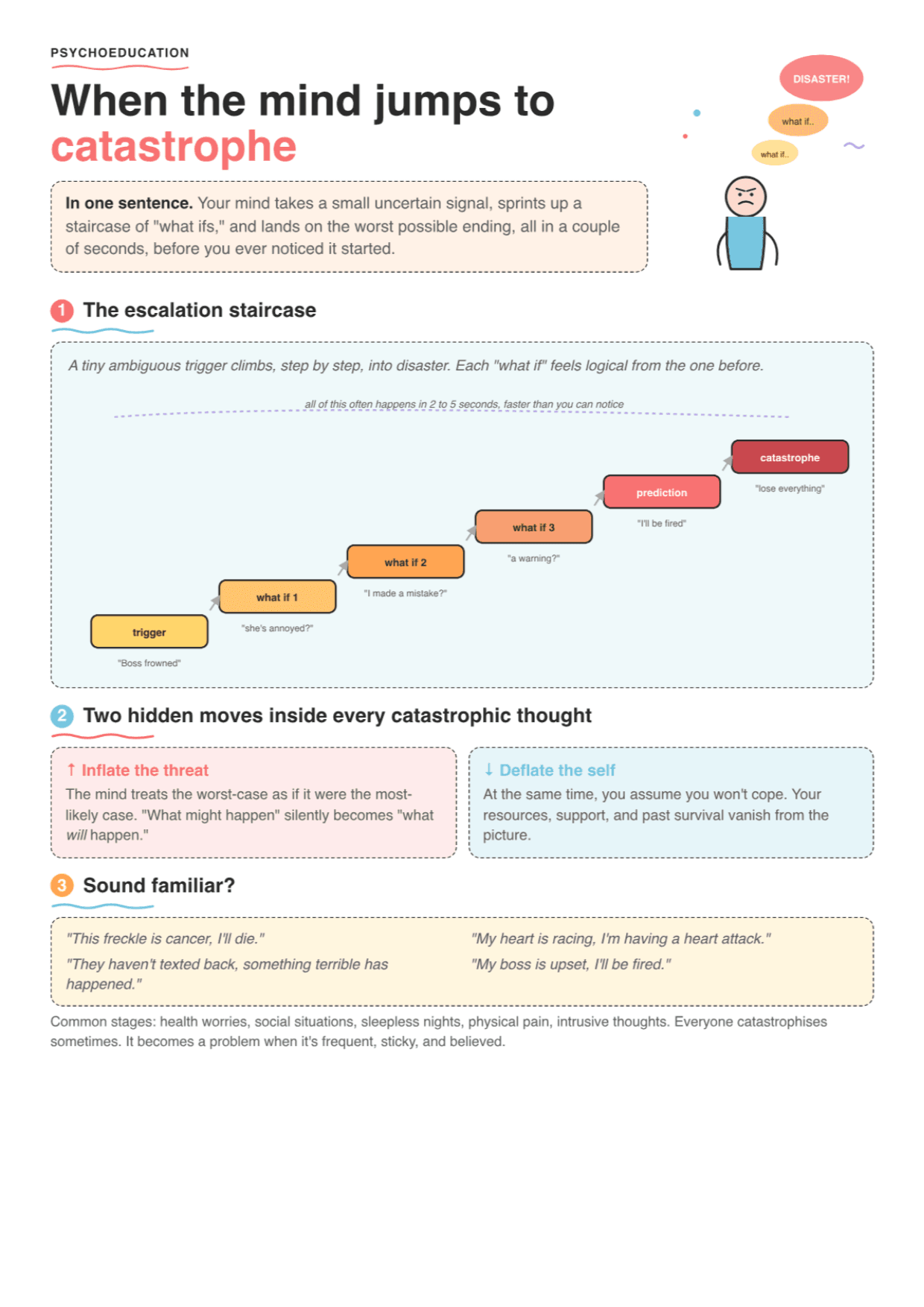
Paired with work on catastrophising, which tends to co-occur in anxious presentations, Decatastrophizing: PDF Worksheet, Tools and Exercises for Clinical Practice supports patients in re-evaluating worst-case scenarios through a stepped, evidence-based appraisal. Together, these two resources address the two most common distortion clusters seen in outpatient anxiety and depression work.
Structuring Cognitive Work: the ABC and CBT Frameworks
The ABC Model as a Clinical Entry Point
For patients new to cognitive work, the ABC model offers an accessible entry point that does not require prior familiarity with psychological concepts. By distinguishing the activating event (A), the belief (B), and the emotional and behavioural consequence (C), it makes visible a causal chain that most patients have never articulated. ABC Model (REBT): PDF Worksheet, Tools and Exercises for Clinical Practice translates Ellis's rational emotive framework into a printable, session-ready format that can anchor psychoeducation in the first few sessions.
The ABC model also serves as a scaffold for more complex case conceptualisation later in therapy. Once a patient can reliably locate their beliefs in the B column, you can begin exploring where those beliefs originate, which opens the door to schema work.
Disorder-Specific Cognitive Models
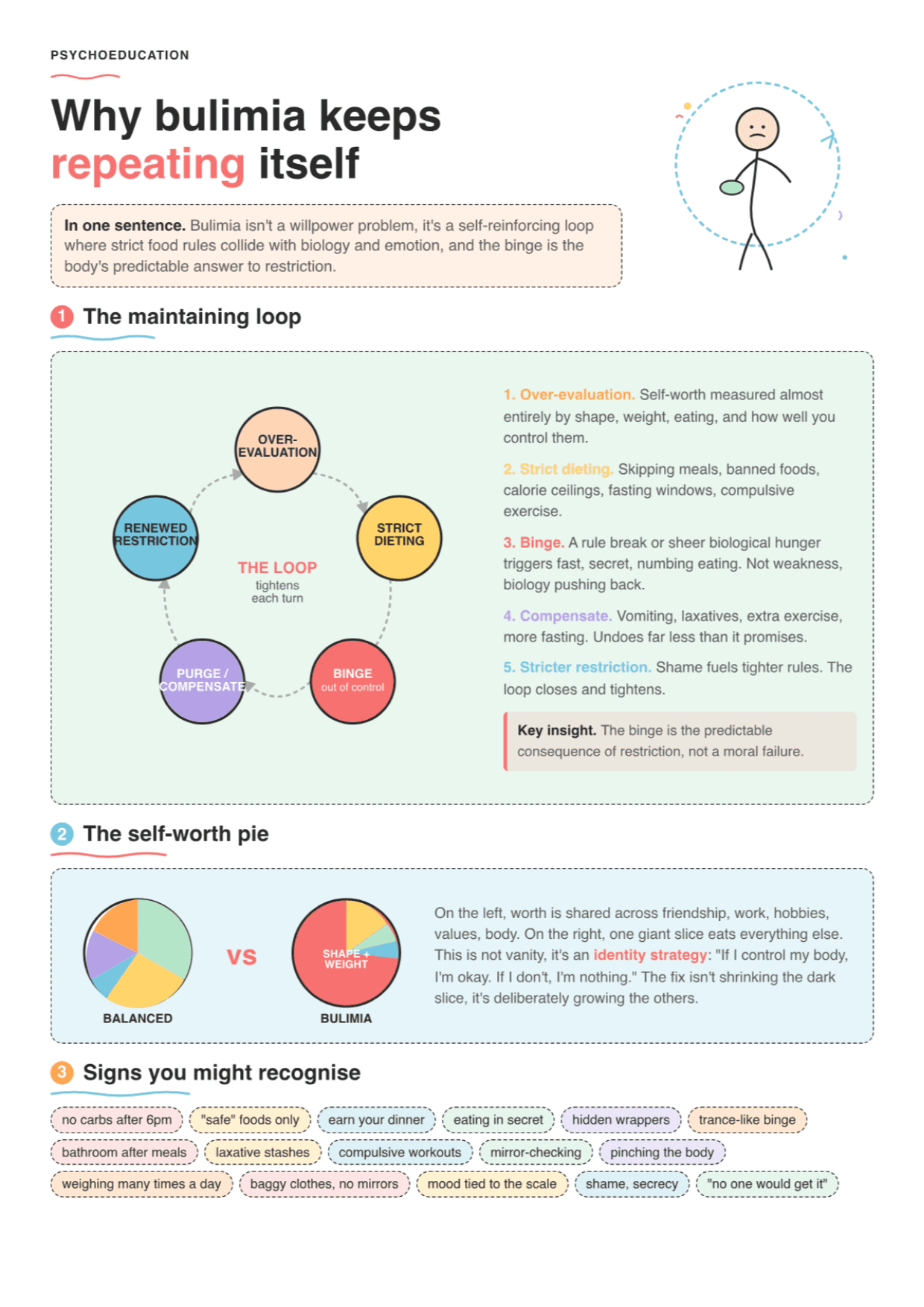
Not all cognitive work is transdiagnostic. In eating disorder presentations, the specific cognitive model of bulimia nervosa, which implicates dietary restraint, shape and weight overvaluation, and binge-purge cycles, warrants dedicated psychoeducation. CBT Model of Bulimia Nervosa: PDF Worksheet, Tools and Exercises provides a visual and explanatory resource that supports the patient's understanding of maintenance mechanisms, which is itself a precondition for change.
Belief Systems, Schemas, and Relational Cognition
Core Beliefs and Their Relational Manifestations
Core beliefs and early maladaptive schemas are the deeper, more stable cognitive structures that generate surface-level distortions. They typically concern the self ("I am fundamentally flawed"), others ("people will leave"), or the world ("the environment is dangerous"), and they often become most visible in relational contexts.
12 Beliefs That Damage Relationships: PDF Worksheet, Tools and Exercises is particularly useful for patients presenting with repetitive relational difficulties, where the same interpersonal pattern recurs across different partners, friendships, or professional contexts. Naming the underlying belief system removes some of its implicit power.
The Abandonment Schema in Clinical Practice
The abandonment schema, one of the most frequently encountered in outpatient work, drives hypervigilance to relational cues, pushes patients towards preoccupied attachment, and is often a significant factor in non-adherence or rupture in the therapeutic relationship itself. The Abandonment Schema: PDF Worksheet, Tools and Exercises for Clinical Practice offers clinicians a structured tool for psychoeducation and for helping the patient trace the schema's developmental origins.
Used within a schema therapy or CBT framework, this resource can support mode work by helping patients distinguish between the vulnerable child mode's perception and the adult mode's appraisal of the same relational event.
> Clinical vignette. A 34-year-old patient in individual therapy for recurrent depression consistently interpreted her therapist's three-day response delay to an email as evidence of abandonment. Rather than reassure her directly, the clinician used The Abandonment Schema: PDF Worksheet, Tools and Exercises for Clinical Practice in the following session to name the schema explicitly. The patient recognised the pattern from childhood, which reduced its immediate emotional charge and opened a productive conversation about schema triggers in adult relationships.
ACT-Based Cognitive Approaches: Defusion and Flexibility
Cognitive Defusion as an Alternative to Restructuring
Cognitive defusion, the ACT process of altering the function of a thought rather than its content, is indicated when direct restructuring has failed, when the patient fuses strongly with a rigid self-narrative, or when the clinical presentation involves values-based avoidance rather than simple distortion. ACT Cognitive Defusion: PDF Worksheet, Tools and Exercises for Clinical Practice provides a range of experiential exercises that clinicians can adapt to individual patients, from labelling thoughts as thoughts to externalisation techniques.
Defusion exercises work best when the patient has already developed some capacity to observe their own cognitive processes. If that metacognitive capacity is limited, a preparatory session using the ABC Model (REBT): PDF Worksheet, Tools and Exercises for Clinical Practice may be needed first.
The ACT Hexaflex and Psychological Flexibility
The ACT hexaflex is the conceptual map that situates defusion within a broader model of psychological health: acceptance, present-moment awareness, values, committed action, self-as-context, and defusion together constitute psychological flexibility. For clinicians new to ACT, or for those who want a shared formulation tool to use with patients, The ACT Hexaflex: PDF Worksheet, Tools and Exercises for Clinical Practice makes this framework visible and discussable.
Psychological Flexibility: PDF Worksheet, Tools and Exercises for ACT Practice extends this work into practical exercises targeting the flexibility process most relevant to the patient's presenting difficulties. 12 ACT Schemas and Modes of Thinking: PDF Worksheet, Tools and Exercises bridges ACT and schema therapy vocabularies, which is particularly useful in settings where the therapist is integrating both approaches.
Decision-Making and Values Clarification
Cognitive rigidity frequently shows up at decision points: the patient who cannot choose between two options, who avoids commitment, or who makes decisions driven by experiential avoidance rather than values. The Choice Point: PDF Worksheet, Tools and Exercises for ACT Practice provides a visual decision-mapping tool that externalises the choice between towards-moves and away-moves, making implicit cognitive and motivational processes explicit within the session.
Integrating Cognitive Resources into the Care Plan
Sequencing Worksheets Across the Phases of Therapy
Cognitive resources are not interchangeable: their clinical utility depends heavily on sequencing. A reasonable progression for most presentations follows these steps:
- Psychoeducation on the cognitive model (ABC model, hexaflex, or disorder-specific CBT framework) to establish shared language.
- Distortion identification using targeted worksheets (all-or-nothing thinking, mind reading, catastrophising) to build pattern recognition.
- Belief and schema work once surface distortions are identified and the patient is ready to explore deeper structures.
- Defusion and flexibility exercises when the patient shows fusion, values-avoidance, or when restructuring has reached a ceiling.
- Consolidation and generalisation, including work on Adopting a Growth Mindset: PDF Worksheet, Tools and Exercises for Clinical Practice to support the patient in applying a more adaptive cognitive stance beyond the therapy room.
Between-Session Use and Homework Rationale
Printable worksheets used as between-session assignments extend the therapeutic dose and support generalisation. The clinician's role is to frame the assignment clearly, review it at the following session, and use any non-completion as clinical data rather than a compliance failure. Resistance to cognitive exercises often reflects schema activation or experiential avoidance, which are themselves relevant clinical material.
Clinical Vigilance and Limits
When Cognitive Work Requires Adaptation
Cognitive approaches assume a minimum level of metacognitive capacity and capacity for abstraction. In presentations involving active psychosis, severe dissociation, acute trauma activation, or significant intellectual disability, standard cognitive worksheets may require substantial adaptation or temporary suspension. The clinician's formulation should drive the selection and timing of any resource.
For patients with personality disorder, particularly cluster B presentations, cognitive work at the belief level can activate intense affect and destabilise the session if not embedded within a secure therapeutic relationship. Schema and mode conceptualisation, as introduced in resources on the abandonment schema or ACT schemas, provides a containing framework, but the pace must be calibrated to relational safety.
Cultural and Contextual Factors in Cognitive Appraisal
What counts as a "distortion" is never culturally neutral. Appraisals that appear catastrophic from a Western individualist framework may reflect realistic assessments of genuine structural risk in other contexts. Clinicians are responsible for situating cognitive work within the patient's actual social, cultural, and material reality. The resources here are clinical scaffolds, not algorithms; clinical judgement remains the primary instrument.
Tools in this category
Feature
Box Breathing: A Guided Tool for Physiological Regulation
A four-phase animated breathing exercise that down-regulates sympathetic arousal and builds a portable self-regulation skill patients can practise autonomously.
AnxietyMood & depression
Feature
Cardiac Coherence: Paced Breathing for HRV Regulation
How to prescribe a daily six-breaths-per-minute practice to build lasting parasympathetic tone and support stress regulation between sessions.
AnxietyMood & depression
Handout
Catastrophizing: PDF Worksheet, Tools and Exercises for Clinical Practice
A printable PDF worksheet, clinical tools, and exercises to explain catastrophizing clearly in session and help patients interrupt the spiral.
AnxietyTrauma & PTSD
Handout
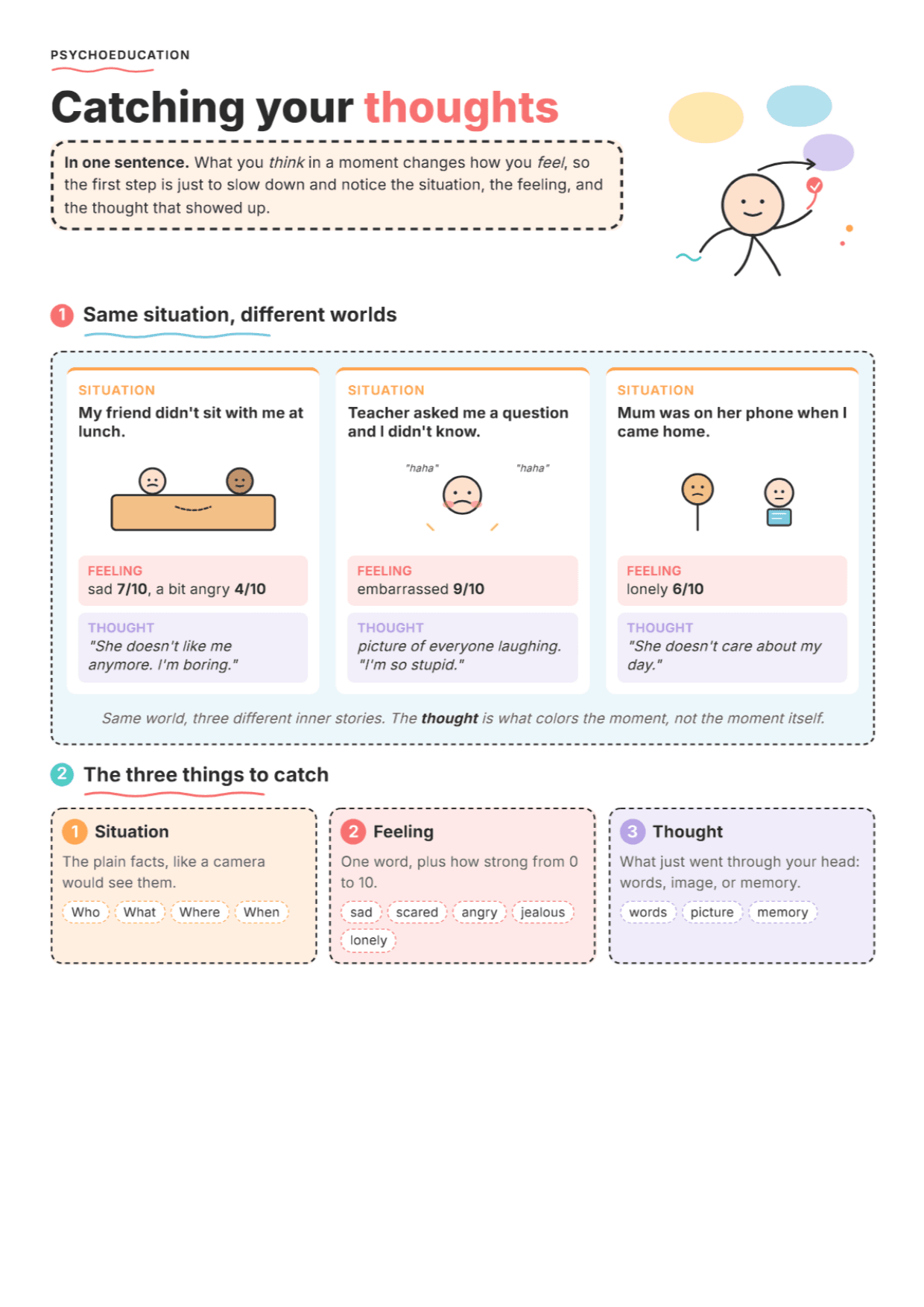
Catching Your Thoughts: PDF Worksheet, Tools and Exercises
A structured visual worksheet helping clinicians introduce thought monitoring to children and adolescents in CBT, with concrete tools, exercises, and a printable PDF to use in session.
AnxietyMood & depression
Handout
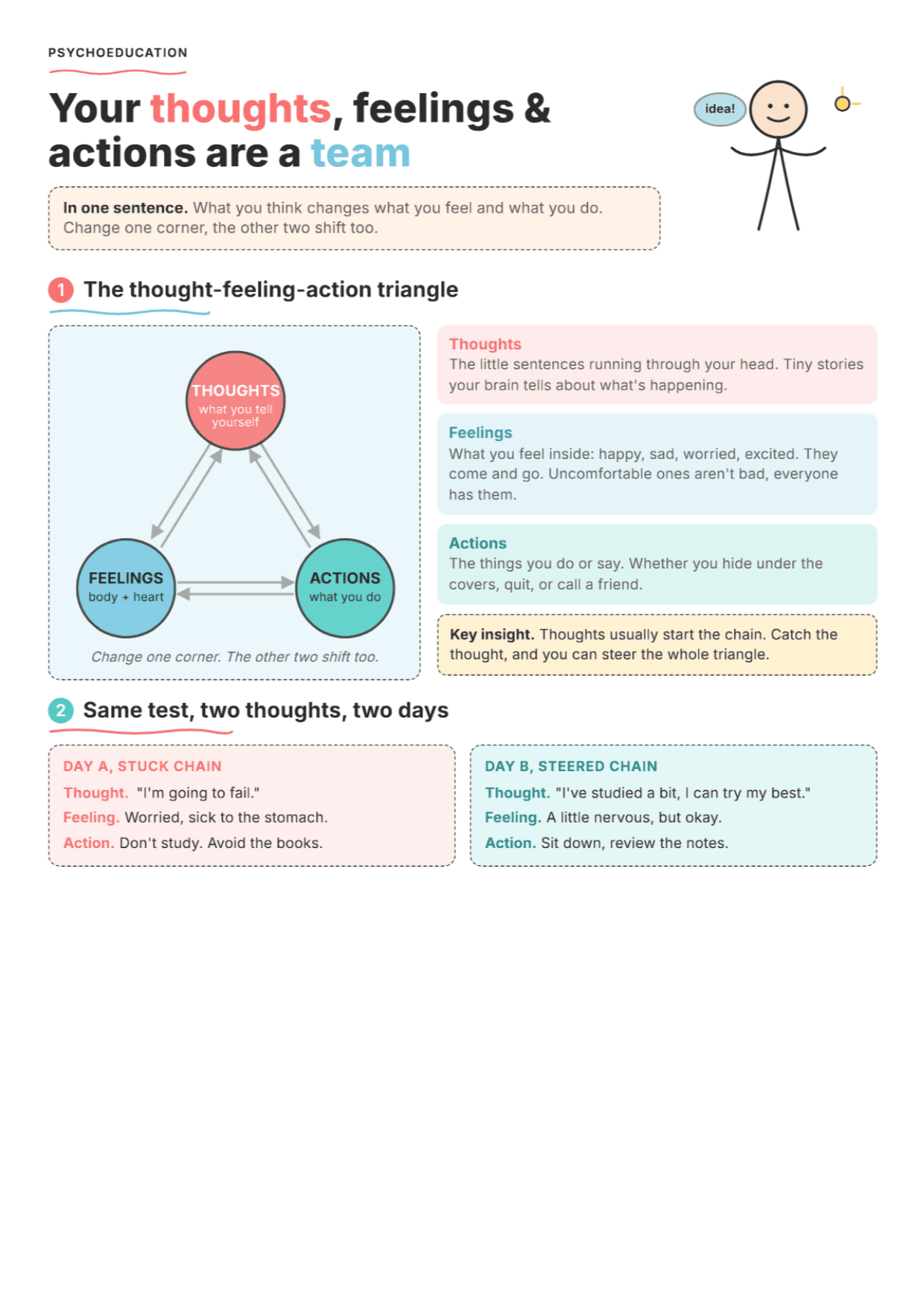
CBT for Kids: Thoughts, Feelings & Actions: PDF Worksheet, Tools and Exercises
A visual psychoeducation fiche PDF and set of clinical tools helping therapists explain the cognitive triangle to children through concrete exercises and guided discussion.
Thoughts & cognition
Handout
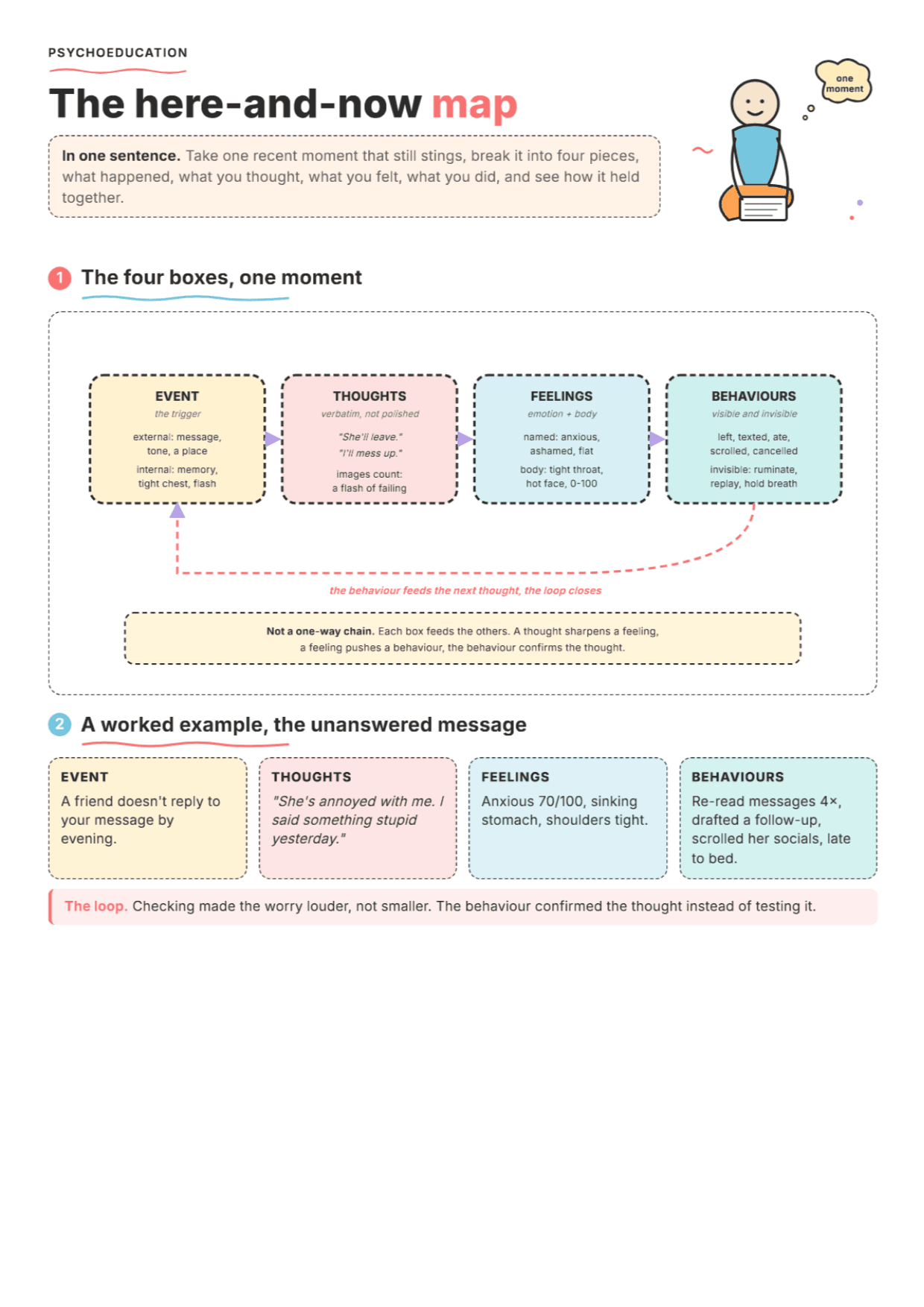
CBT Here-and-Now Model: PDF Worksheet, Tools and Exercises
A printable PDF worksheet and clinical tools to map thoughts, feelings, and behaviours in one specific moment, for use in CBT sessions.
AnxietyMood & depression
Handout
CBT Maintaining Processes: PDF Worksheet, Tools and Exercises
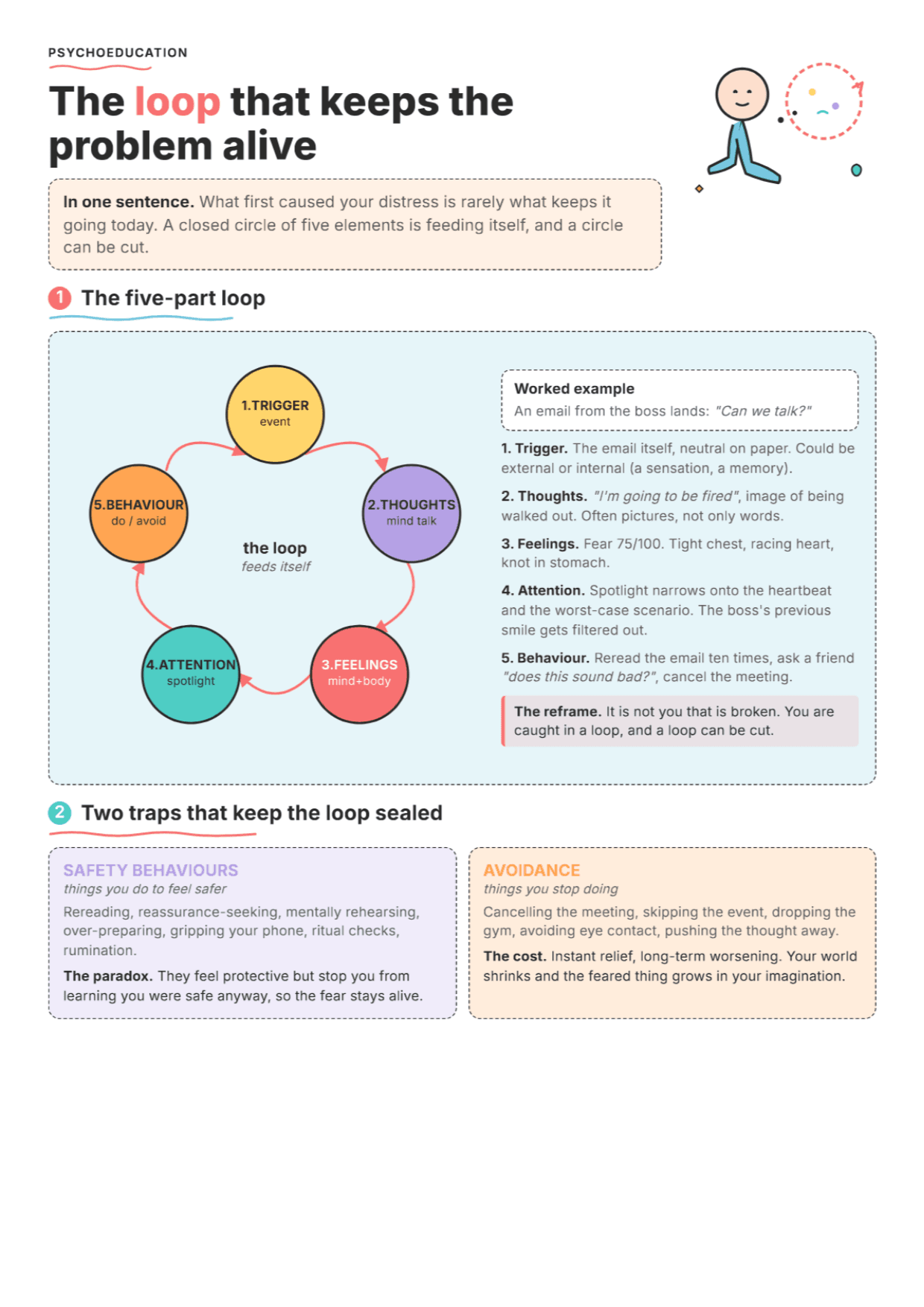
A visual PDF worksheet clinicians can use in session to map the five-part maintenance loop, distinguish safety behaviours from avoidance, and anchor psychoeducation in a concrete shared diagram.
AnxietyMood & depression
Handout
CBT Maintaining Processes: PDF Worksheet, Tools and Exercises
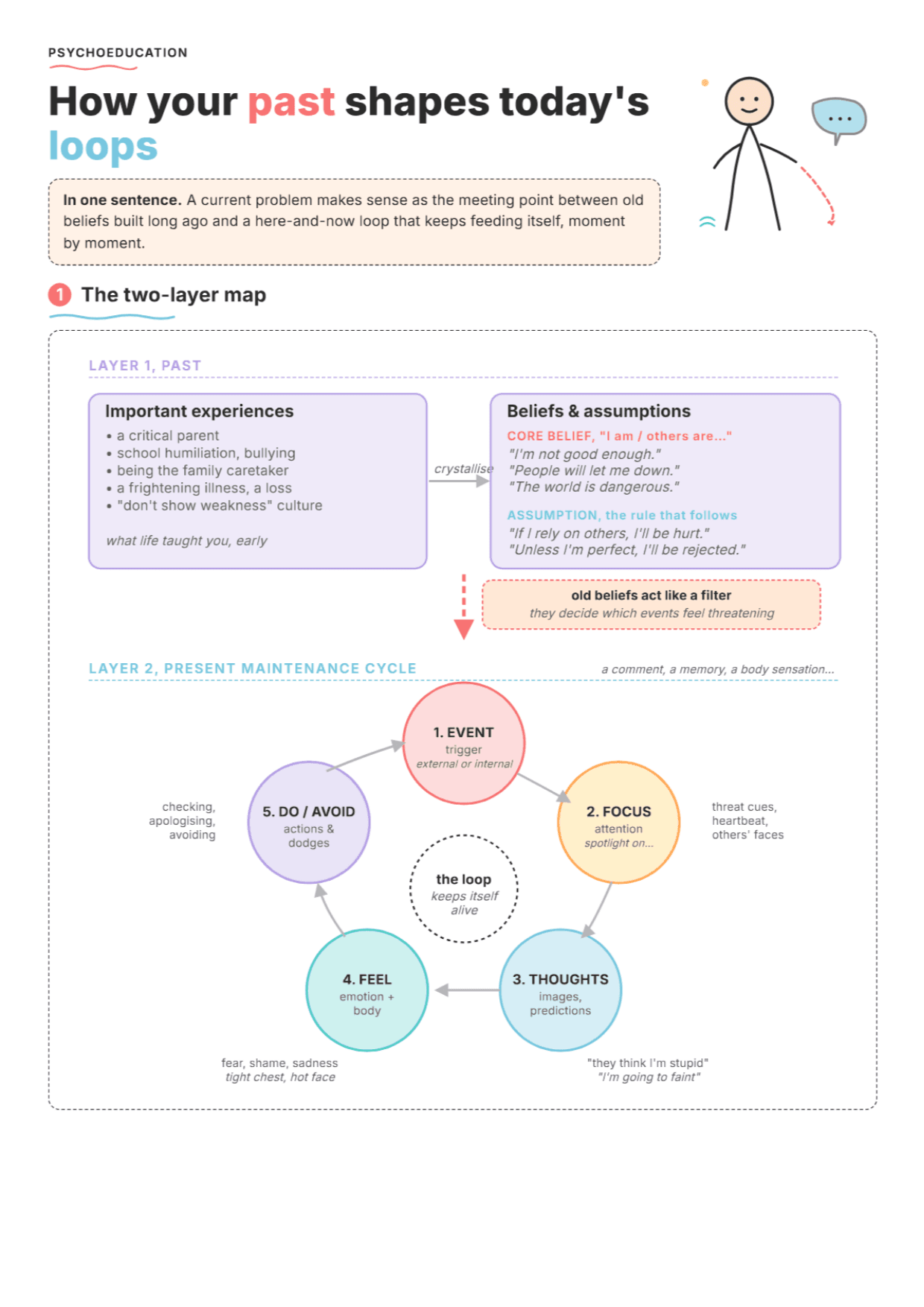
A printable visual aid helping clinicians explain, in session, how past beliefs and present maintenance cycles keep psychological difficulties alive.
AnxietyMood & depression
Handout
CBT Model of Bulimia Nervosa: PDF Worksheet, Tools and Exercises
A visual PDF worksheet grounded in Fairburn's CBT model to help clinicians explain the binge-purge cycle, self-worth over-evaluation, and maintaining factors in session.
Behaviours & addictionsSelf & identity